
PMP Career Opportunities by Industry: Where Project Managers Are Needed
Updated on 12 October 2026. What’s new: the PMP exam fee is now USD $425 for PMI members and USD $675 for non-members, and exams are delivered by Pearson VUE.
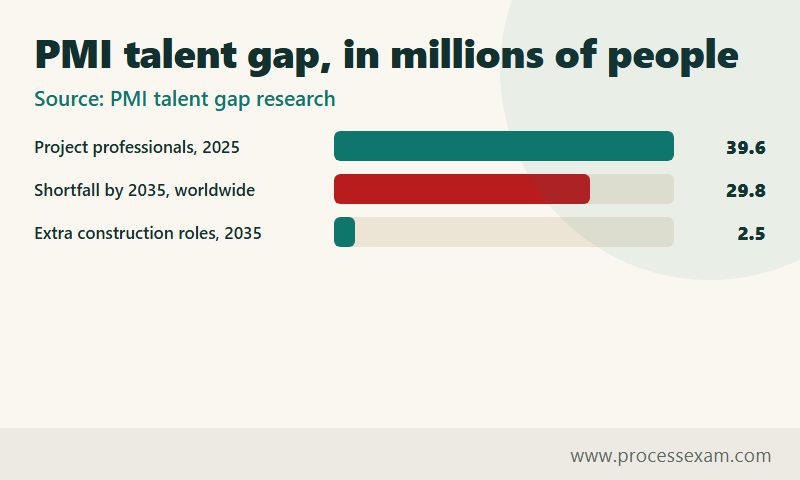
PMI's Global Project Management Talent Gap report (May 2025) counts 39.6 million project professionals worldwide and warns of a shortfall of up to 29.8 million by 2035. The shortage is not spread evenly. It bites hardest where projects are large, regulated and expensive to get wrong, which is why a PMP opens different doors in a hospital, a utility and a bank.

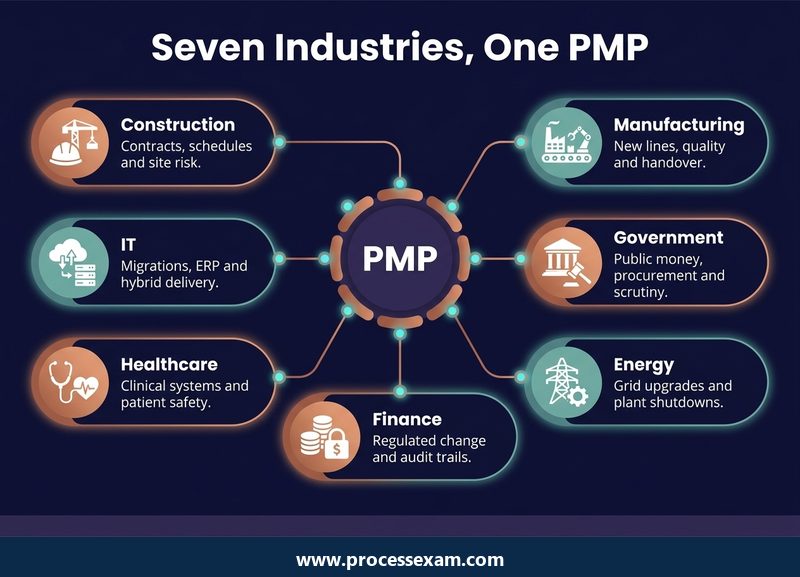
This article walks through seven sectors: construction, IT, healthcare, finance, energy, government and defence, and manufacturing. For each it says what a project manager actually does there, which domain knowledge employers expect on top of the credential, and how the PMP exam's own content lines up with that work. It also separates salary evidence you can check from the kind you cannot.
Is demand for project managers really rising, and in which sectors?
Yes, and PMI's own research is the best place to see it. The talent gap report models demand for project talent growing by 64% between 2025 and 2035, driven by capital investment and by industries rebuilding around new technology. PMI's announcement of the report names construction, manufacturing, IT services and healthcare among the sectors under the most pressure, and points to South Asia, Sub-Saharan Africa and China as the fastest-growing regions.
A second PMI study looks at one sector alone. Its construction talent gap analysis finds that the industry will need nearly 2.5 million additional construction project professionals by 2035, a 60% rise on 2025 levels. Two numbers from the same family of research, then: a global total that is enormous and a single sector that carries a large share of the pressure.
What does that mean for you? A project manager who can show both method and sector knowledge is scarcer than one who shows method alone. The PMP proves the method. Everything below is about the second half, the sector knowledge, and about choosing where to build it.
What a count of project professionals can and cannot tell you
The talent gap figures are forecasts built from job-title data and workforce modelling. They show where pressure is likely to build, not how many vacancies will carry the letters PMP in the advert. Treat them as direction, not as a promise of a job. A shortage of people who can run projects is real in most sectors; whether a particular employer asks for the credential varies by country, by company size and by how mature its project office is.
What does a PMP do differently in construction and infrastructure?
Construction is the sector where the credential and the daily work overlap most visibly. Schedules run in networks of dependent trades, cost is tracked against a signed contract, and a slip in one package ripples through the rest. The project manager is the person who keeps the baseline honest and tells the owner early when it will not hold.
The work
Typical responsibilities include building and updating the master schedule, managing change orders against the contract, coordinating design teams and subcontractors, running risk workshops on ground conditions and supply, and reporting cost and progress to an owner or lender. On infrastructure programmes, add land, permits and public consultation to the list.
The domain knowledge that matters
Contract forms and who carries which risk, safety and site regulation, procurement routes, quantity and cost control, and the basics of the trade packages you coordinate. A PMP who learns to read a drawing set and a bill of quantities is worth more on site than one who only knows the vocabulary of the process groups. PMI also offers a construction-specific credential, the PMI-CP, for people who want a sector route after the PMP.
Where the exam helps
The Process domain, at 41% of the exam, covers scheduling, cost, scope, quality, procurement and risk, which is the language of a construction baseline. The Business Environment domain, at 26%, adds compliance, governance and benefits, the concerns that dominate public works.
Picture a road-widening scheme in which a utility diversion turns out to be larger than the survey showed. A project manager who thinks in PMP terms logs the risk, quantifies the schedule and cost exposure, raises a change request with the owner, and re-baselines once it is approved, instead of quietly absorbing the delay. That habit of making problems visible and governed is what employers in construction pay for.
How does the PMP fit IT and software delivery?
IT is the sector where the PMP meets the most debate, because much of the work runs on Agile methods and some teams see a certified manager as a leftover of the waterfall era. The reality is a blend. Software teams deliver in short cycles, but the programme around them still has budgets, vendors, dependencies, security reviews and a sponsor who wants a date.
The work
An IT project manager might run a cloud migration, an ERP rollout, a data platform build or a security remediation programme. The job is to align delivery teams with the business case, manage third-party suppliers, control scope when requirements move, and keep stakeholders informed without drowning them in status reports.
The domain knowledge that matters
Enough technical literacy to challenge an estimate, working knowledge of Agile and hybrid delivery, an understanding of change management in live systems, and awareness of data protection and security obligations. Candidates from a delivery or service-management background often find the People domain, at 33%, the easiest to relate to, because it is about leading teams, resolving conflict and engaging stakeholders, which is what a good delivery lead already does.
The credential's value in IT is therefore a shared structure for planning and governing work that is not purely iterative. It helps most in large programmes, consultancies and outsourcing firms, and least in a small product team that never touches a steering committee.
Consider a retailer moving its stock system to the cloud while the shops keep trading. The project manager has to sequence cut-over weekends around peak trading, agree rollback criteria with the operations director, hold the vendor to its milestones and brief the board in plain language. None of that depends on a framework label, but all of it depends on the planning, risk and stakeholder skills the PMP examines.
What do project managers handle in healthcare and finance?
These two sectors look unlike each other, yet they share a defining feature: regulation shapes every project. A change that is trivial in a retail business needs sign-off, audit evidence and a rollback plan here.
Healthcare
Healthcare projects range from building a new ward to introducing an electronic patient record, consolidating laboratory systems or setting up a clinical trial site. The project manager coordinates clinicians who have little spare time, IT teams, estates, suppliers and regulators, and must keep patient safety above the schedule when the two collide.
Domain knowledge to build: clinical workflows and terminology, patient data protection rules in your country, procurement rules for public health bodies, and how a clinical safety case or validation step fits into a plan. Stakeholder engagement is the daily challenge. A system that clinicians will not use has not been delivered, however well the project ran.
Finance
Banks, insurers and asset managers run large change programmes: regulatory reporting, core platform replacements, payment system migrations, mergers and product launches. Here the project manager works with risk and compliance teams from day one, plans around audit and testing windows, and manages many internal and external dependencies at once.
Domain knowledge to build: the regulatory regime that applies to your institution, how controls and change approvals work, operational resilience expectations, and the economics of the business line you serve. In both sectors the Business Environment domain is the closest match, because it asks you to connect project work to compliance, organisational change and the value the project is meant to deliver.
Where do energy, government and defence, and manufacturing use the credential?
The last three sectors share a common thread of large capital, long timelines and heavy accountability.
Energy and utilities
Energy projects include power plants and grid upgrades, wind and solar developments, pipelines, refinery turnarounds and plant shutdowns. A shutdown is almost pure project management: a fixed window, thousands of tasks and a cost for every day it overruns. The energy transition has added projects that did not exist a generation ago, from battery storage to grid connections for renewable sites.
Domain knowledge to build: health, safety and environment practice, permitting and consent processes, capital project stage gates, vendor and contractor management, and the commercial model of the asset you are building.
Government and defence
Public bodies run digital services, infrastructure, benefit systems, defence equipment and shared services. Project managers here work under tight governance: business cases, spending controls, procurement law, scrutiny by auditors and elected officials, and often security clearance. Delivery is judged not only on cost and time but on whether public money was spent properly and openly.
Domain knowledge to build: procurement and contract rules, assurance and gate reviews, benefits realisation, and the political context in which sponsors make decisions. Some public bodies use their own methods, so check which framework your target employers name before you commit.
Manufacturing
Manufacturing projects cover new product introduction, plant expansion, automation, equipment installation and supply chain changes. The project manager balances engineering, quality, procurement and operations, and has to plan around production schedules that cannot stop for a project.
Domain knowledge to build: product and process engineering basics, quality systems, supply chain lead times, and how to commission a line and hand it over to operations.
The seven sectors side by side
| Sector | Typical project | Knowledge to add to the PMP |
|---|---|---|
| Construction | Building or infrastructure package | Contracts, site safety, cost control |
| IT | Cloud migration or ERP rollout | Agile and hybrid delivery, security |
| Healthcare | Patient record system or new ward | Clinical workflow, patient data rules |
| Finance | Regulatory or platform change | Controls, audit, resilience |
| Energy | Grid upgrade or plant shutdown | Health and safety, permitting, stage gates |
| Government and defence | Digital service or equipment programme | Procurement law, assurance reviews |
| Manufacturing | New product or line installation | Quality systems, supply chain, handover |
Which salary and demand figures can you trust?
Be careful with any table of "average PMP salary by industry". Salary figures depend on country, currency, year, seniority, company size and the survey's sample, and a chart with no source and no date cannot be checked. Use figures only when you can see who published them, which year they describe and which jobs they cover.
One figure you can check
The US Bureau of Labor Statistics publishes its Occupational Outlook Handbook entry for project management specialists. It reports a median annual wage of $102,320 in May 2025 and projects employment to grow 7% between 2025 and 2035, with about 76,500 openings a year, most of them to replace workers who leave the occupation. That is a government figure for one country and one occupation group; it does not isolate PMP holders, and it does not break pay down by sector.
How to read a salary survey
PMI publishes its own salary survey, and professional bodies and recruiters publish others. When you read one, check four things: the year of the data, the country and currency, whether the respondents are all certified or a mix, and whether the figure is a median or an average, since averages are pulled up by a few very high earners. If a survey does not say, assume the figure is not safe to quote.
How to check pay for your own sector
The most reliable evidence for your decision is local. Read ten live job adverts in the sector and city you want, note how many name the PMP and what pay band they give, and compare with ten in a neighbouring sector. That small sample tells you more about your market than any global chart.
Which sector should you aim at, and how do you make the case?
The PMP does not replace sector knowledge, so the best plan pairs the credential with a domain you can show. Work from where you already stand.
- You already work in a sector. Stay and earn the PMP there. Employers value a credentialed colleague who already knows the vocabulary, and you skip the hardest part, which is learning the domain.
- You are changing sector. Pick the one nearest to your existing skills: IT delivery people often move easily into finance or healthcare programmes, and engineers into energy, construction or manufacturing.
- You are starting out. Look at sectors where PMI sees the largest gaps, then build experience as a coordinator or assistant while you accumulate the project leadership months the exam asks for.
When you apply, describe projects in the sector's own terms: the contract value in construction, the clinical go-live date in healthcare, the audit finding you closed in finance. The credential gets your application read; the sector detail gets you shortlisted.
In interviews, expect the question to turn from the certificate to the sector within minutes. A hiring manager in healthcare will ask how you handled a clinician who refused to change a workflow; one in energy will ask how you planned around a safety stand-down. Prepare two or three stories per sector, each with the situation, the decision you made, the trade-off you accepted and the result.
Building sector depth while you study
You do not have to wait for the certificate to start. Read the trade press for your target sector, learn its regulator's name and its three biggest recurring risks, and ask to sit in on one steering committee or design review. Each of those gives you a concrete example for both the exam and the interview.
What does the PMP exam ask, and what does it cost?
PMI replaced its exam content outline in July 2026, and the exam now weights three domains. The table gives the facts, and PMI's PMP certification page carries the current rules.
| Exam detail | PMP |
|---|---|
| Full name | PMI Project Management Professional |
| Exam code | PMP |
| Vendor | PMI |
| Number of questions | 180 |
| Duration | 240 minutes |
| Exam fee | Member Price: USD $425 Full Price: USD $675 |
| Domains | People 33%, Process 41%, Business Environment 26% |
| Result reported as | Above Target / Target / Below Target / Needs Improvement |
| Delivery | Pearson VUE |
Eligibility is measured in months of experience leading projects, plus 35 hours of project management training, and the number of months depends on your education. PMI sets this out on its certification page, and the PMP exam syllabus page lists the content areas. Read both before you plan a date, because the experience routes changed with the new outline.
Connecting the exam to your sector
The scenario questions are set in generic organisations, so you do not need sector expertise to pass. You do need to answer as a project manager would on a well-run project: engage stakeholders, follow governance, manage risk early and choose the delivery approach that fits the work. Use your sector as a source of examples when you revise. If you build a risk register for a hospital ward refit or a bank migration while studying, the abstract technique sticks.
A sensible preparation path
Start with the Business Environment domain, since it is the newest weight and the one most candidates have studied least. Then work through Process and People, finishing with timed practice. Close the plan with the PMP practice exam, where the aim is simple: finish 180 questions inside the time limit with a few minutes left for review.
After you pass
The credential runs on a three-year cycle, kept alive by professional development units and a renewal fee. That obligation suits a sector career: choose courses in your industry's regulation, technology or commercial practice and you build the domain depth that sets you apart.
Frequently Asked Questions
Which industries hire the most PMP-certified project managers?
PMI's talent gap research names construction, manufacturing, IT services and healthcare as sectors under the most pressure. Finance, energy and government also run large regulated programmes. The mix varies by country, so read local job adverts to see which sector near you asks for the PMP.
Can I get a PMP job without working in a specific industry first?
Yes, but sector knowledge helps you get shortlisted. The PMP proves your method, and the exam does not test industry expertise. Many managers move sector by choosing one close to their current skills, building domain knowledge, and describing past projects in the new sector's language.
How much does the PMP exam cost?
The PMP exam fee is Member Price: USD $425 and Full Price: USD $675. PMI membership has its own annual fee, which varies by region, so compare the saving with the dues before you decide. Training hours and study materials are extra and depend on the provider.
How many questions are on the PMP exam, and how long is it?
The PMP exam has 180 questions and runs 240 minutes. Under PMI's July 2026 content outline the domains are weighted People 33%, Process 41% and Business Environment 26%. Plan practice sessions at full length so you can hold concentration for the whole sitting.
Is a PMP salary figure from a chart reliable?
Only if the chart names its publisher, year, country and job group. For example, the US Bureau of Labor Statistics reported a median wage of $102,320 for project management specialists in May 2025, but that figure covers the whole occupation, not only PMP holders, and not any single industry.
- PMP Certification |
- PMI Project Management Exam Questions |
- PMI Project Management Question Bank |
- PMI Project Management Questions |
- PMI Project Management Study Guide |
- PMI PMP Quiz |
- PMP Questions |
- PMP Practice Test |
- PMP Study Guide Material |
- PMP Sample Exam |
- Project Management Certification |
- PMI Project Management Book |
- Project Management Certification Cost |
- Project Management Certification Requirements |
- PMI Project Management Sample Questions |
- PMP Exam Questions Download |
- PMP Test Questions |
- Project Management PDF |
- PMI Project Management Professional


