
PMI-CPMAI Certification Cost, Prep Time and ROI Guide
Budget USD $699 for the PMI-CPMAI certification if you are a PMI member, or USD $899 at full price, based on PMI's published pricing. Most candidates who study around an hour a day need six to eight weeks to prepare for the 120-question, 160-minute exam. The return comes from passing on the first attempt, because every extra attempt means paying the exam fee again.

The PMI Certified Professional in Managing AI (PMI-CPMAI) is the Project Management Institute's credential for people who lead artificial intelligence projects. It is built on the Cognitive Project Management in AI (CPMAI) methodology, which PMI took over when it acquired Cognilytica in September 2024, and it tests whether you can run an AI initiative from the first business question through to a model running in production.
Before you commit, three questions matter: how much will it really cost, how much time will it take, and what will you get back? This guide answers all three using PMI's own published figures and nothing else. Where PMI does not publish a number, we say so rather than guess.
How much does the PMI-CPMAI certification cost?
PMI publishes two prices for the PMI-CPMAI, one for PMI members and one for everyone else:
- Member Price: USD $699
- Full Price: USD $899
Those are the only two fee figures this guide uses. They are the figures most people are searching for when they type "CPMAI certification cost" or "PMI-CPMAI member price", and they are the ones to budget around.
What the price is attached to
PMI-CPMAI is not an exam you can book on its own. PMI requires every candidate to complete the PMI-CPMAI Exam Prep Course before scheduling the exam, and the purchase in your myPMI account is for the "Exam Prep Course & Certification" together. PMI states that initial course and examination fees must be paid before you can take the course, and that scheduling opens once the course is complete. Because pricing rules can change, confirm exactly what your purchase includes on PMI's PMI-CPMAI certification page before you pay.
Member or non-member
PMI's Exam Content Outline is clear on three points about membership:
- Membership is not required to earn PMI-CPMAI.
- Fees follow regional and membership pricing rules, so the price you see depends on your membership status and where you are.
- If you join PMI after you have paid for the certification, PMI will not refund the difference.
The practical lesson is simple: decide on membership before you buy. If you plan to join PMI anyway, for its standards, its community or other certifications, do it first so you pay the member price. If you do not intend to join, the full price is the figure to plan for. Check PMI's current membership fee yourself when comparing the two routes, because it is not part of Master's exam data and varies by region.
Costs that are easy to overlook
The exam fee is the largest single item, but it is not the whole budget. Plan for these as well:
- Retake fees. PMI states that each further attempt requires paying an exam fee before you can schedule it. A failed first attempt is the most expensive outcome of all.
- Cancellation and no-show fees. Once an exam date is confirmed, PMI says you may be charged for cancelling or missing it.
- Maintenance. Keeping the credential active requires a renewal payment under regional and membership pricing rules, plus professional development units (covered later).
- Your time. The biggest hidden cost is the study hours themselves, especially if you are fitting them around a full-time job.
PMI accepts payment in USD, Euros, BRL and INR, by credit card or wire transfer, and offers third-party "buy now, pay later" options for eligible orders.
What is the PMI-CPMAI exam format?
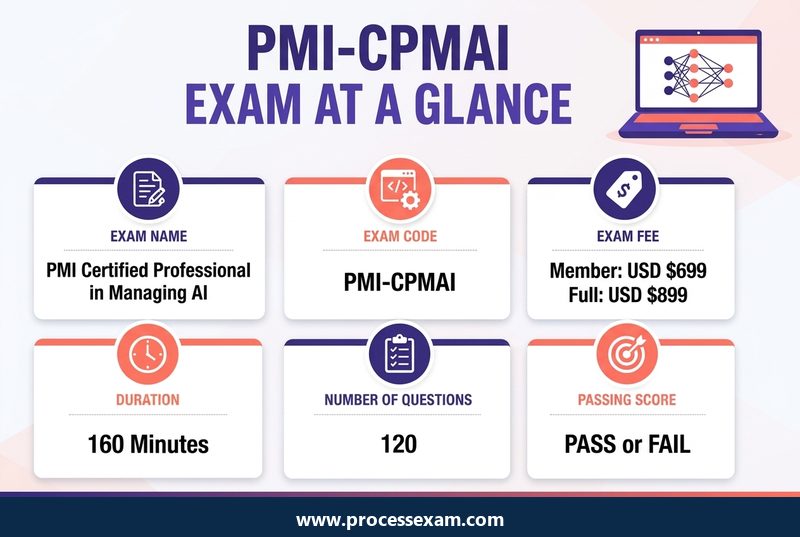
Knowing the format helps you judge the preparation time. Here are the exam facts in one place:
| Exam detail | PMI-CPMAI |
|---|---|
| Full name | PMI Certified Professional in Managing AI |
| Exam code | PMI-CPMAI |
| Vendor | PMI |
| Exam fee | Member Price: USD $699 Full Price: USD $899 |
| Duration | 160 minutes |
| Number of questions | 120 |
| Passing score | PASS or FAIL |
A few details from PMI's PMI-CPMAI Exam Content Outline shape how you should prepare:
- 100 of the 120 questions are scored. The other 20 are unscored pre-test questions placed at random, so you cannot tell which is which. Treat every question as if it counts.
- No scheduled breaks. 160 minutes is a long stretch; build stamina with full-length practice.
- Tutorial and survey time is extra. Up to 15 minutes for the tutorial and closing survey is not deducted from your testing time.
- Two delivery options. You can sit the exam at a Pearson VUE test centre, which PMI recommends, or online with a proctor. Test centre availability is listed on Pearson VUE's PMI page.
- One-year window. You have 12 months from purchase to earn the certification, and up to three attempts within a 365-day eligibility period.
- Result as Pass or Fail. PMI does not publish a numeric passing score.
The exam launched in English, and PMI announced Arabic, Brazilian Portuguese, French, German, Japanese, Korean, Simplified and Traditional Chinese, and Spanish versions from January 2026.
What does the PMI-CPMAI exam cover?
The exam content is split into five domains. The weights below come from PMI's September 2025 Exam Content Outline and tell you where most questions will come from. The full task list is in the PMI-CPMAI syllabus, which mirrors PMI's outline task by task.
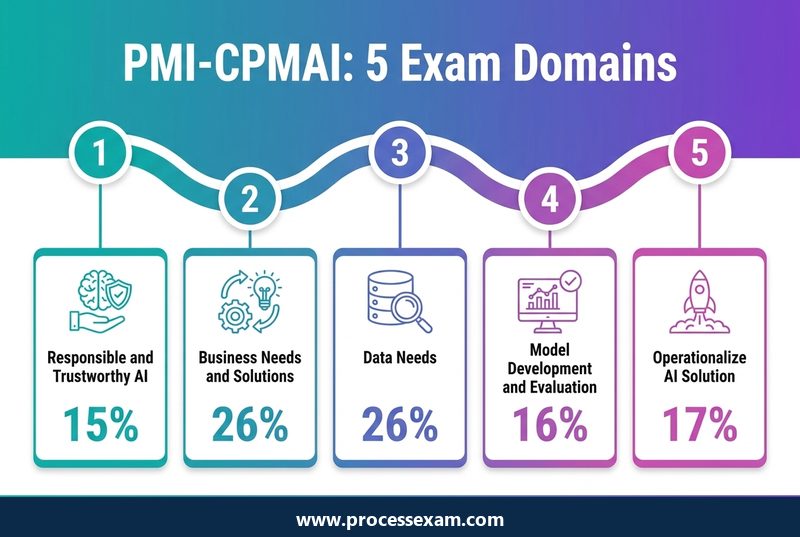
Domain I: Support Responsible and Trustworthy AI Efforts (15%)
This domain covers the governance that sits around every AI project: privacy and security plans, transparency about data and algorithm choices, bias checks on data, models and algorithms, regulatory and policy compliance, and a complete accountability and audit trail. Expect scenarios where a model works technically but raises a fairness, privacy or explainability issue, and you must choose the right governance response.
Domain II: Identify Business Needs and Solutions (26%)
The joint-largest domain is about starting the right project. It includes identifying the real problem and the users it affects, evaluating whether AI is feasible at all, running risk assessments, writing an AI project scope statement, determining ROI, planning for adoption and integration risk, drafting the solution, defining success criteria and identifying resources. A recurring theme is knowing when AI is not the answer and a conventional solution would do better.
Domain III: Identify Data Needs (26%)
Equal in weight to business needs, this domain reflects the CPMAI view that AI projects are data projects first. You need to know how to define the data a model requires, find the subject matter experts who understand it, locate data sources, set up the AI workspace, gather the data, check privacy, compliance and access rights, evaluate data quality and decide whether the data actually meets the need. The domain ends with conveying data understanding to leadership, so communication matters as much as analysis.
Domain IV: Manage AI Model Development and Evaluation (16%)
You are not expected to build models yourself, but you are expected to manage those who do. The tasks cover overseeing the choice of technique (supervised, unsupervised or reinforcement learning), model quality assurance and configuration management, training, data transformation and preparation, and two go/no-go decisions: one on data quality before preparation, and one on whether the model is ready for operationalisation.
Domain V: Operationalize AI Solution (17%)
The final domain deals with getting a model into production and keeping it healthy. It includes the deployment plan and the deployment itself, model governance and drift detection, solution metrics and KPIs, lessons learned, the transition to operational support and a contingency plan for AI system failures. Many candidates underestimate this domain because it looks like ordinary project close-out; the AI-specific parts, such as monitoring drift and planning retraining, are where the marks are.
How the CPMAI methodology ties the domains together
The CPMAI methodology runs in six iterative phases: Business Understanding, Data Understanding, Data Preparation, Model Development, Model Evaluation and Model Operationalization. The five domains map closely onto them, with responsible AI running across every phase. If you learn the phases in order and ask, for each one, "what decision does the project manager make here, and what could go wrong?", you will be able to place most scenario questions quickly.
How long does it take to prepare for the PMI-CPMAI exam?
PMI does not publish a recommended study time, so treat the plan below as guidance rather than a rule. For someone with some project management background who can study about an hour a day, six to eight weeks is a realistic window, including the required PMI-CPMAI Exam Prep Course. If AI concepts are new to you, allow the upper end; if you already manage data or AI work, you may need less.
Plan one full PMI-CPMAI mock exam in the last fortnight; with 120 questions it is the closest rehearsal you will get before the real appointment.
| Weeks | Focus | What to finish |
|---|---|---|
| 1–2 | Exam Prep Course and methodology | Complete PMI's required course; learn the six CPMAI phases and the five domains |
| 3 | Business needs | Problem definition, AI feasibility, scope, ROI, success criteria |
| 4 | Data needs | Data requirements, sources, quality, privacy and the data go/no-go decision |
| 5 | Models, operations and responsible AI | Model oversight, deployment, governance, drift, bias and compliance |
| 6–7 | Timed practice | Full-length practice tests, an error log, targeted review of weak domains |
| 8 | Final revision | A one-page summary per domain, rest, exam logistics |
Two points make this plan efficient. First, the two 26% domains together make up just over half of the exam, so they deserve the most study time. Second, practice testing starts before the end, not in the last few days, so you still have time to fix what it reveals.
A useful free starting point is PMI's Free Introduction: PMI Certified Professional in Managing AI (PMI-CPMAI) course, which PMI lists among its reference materials, along with the Leading and Managing AI Projects Digital Guide. PMI also notes that the exam is not written from any single text, so use these as a foundation rather than the only source.
How does a PMI-CPMAI practice exam lower the cost of certification?
The most expensive way to earn PMI-CPMAI is to fail the first attempt. You pay the exam fee again, PMI suggests around 30 days of further study before a retake, and the one-year eligibility window keeps running. A practice exam costs far less than a second attempt, and it attacks the three most common reasons candidates fail.
It exposes weak domains early
Scoring each practice test by domain shows you where marks are being lost. If you consistently miss questions on data readiness or model governance, you know where the next week of study should go. Without that feedback, most people keep revising the topics they already find comfortable.
It trains pace and stamina
120 questions in 160 minutes with no scheduled break is a test of concentration as much as knowledge. Full-length timed tests teach you how long you can spend per question, when to flag and move on, and how it feels to be at question 100 with 30 minutes left.
It teaches the scenario style
PMI-CPMAI questions describe a situation on an AI project and ask what the project professional should do next. Several options often sound reasonable. Practice shows you how PMI's methodology frames the "best" answer: follow the phase order, confirm the data before the model, involve the right stakeholders, and never skip governance.
ProcessExam's PMI-CPMAI practice exam follows the same 120-question, 160-minute format, so you can measure readiness under realistic timing. Take at least two full-length tests under exam conditions, review every question you got wrong or guessed, and look for a rising score on questions you have not seen before. That rising score is the clearest signal that you are ready to book.
Is the PMI-CPMAI certification worth it, and what is the ROI?
ROI has two halves: what you put in and what you get out. The input side is known: Member Price: USD $699 or Full Price: USD $899, plus your study time and, later, renewal. The output side depends on your role, and it is worth being honest about which parts are measurable.
Where the value comes from
- A recognised signal in a new field. Many organisations are moving AI work from pilots into core operations and need people who can manage it. PMI-CPMAI gives employers independent evidence that you know a structured, vendor-agnostic method for doing that.
- Fewer failed AI projects. The CPMAI methodology is built around catching problems early: checking that AI suits the problem, confirming the data before building, and setting go/no-go gates. That skill is valuable to any employer that has seen an AI project stall.
- A bridge between business and data teams. The exam's emphasis on stakeholders, business cases and communicating data findings to leadership prepares you for the translator role that AI programmes depend on.
- Portability. Because PMI requires no prior project management, technical or AI certification, the credential suits project managers, product managers, business analysts and data professionals alike.
What about PMI-CPMAI salary?
"CPMAI certification salary" is one of the most searched questions about this credential. No official salary figure exists for PMI-CPMAI holders specifically, and the credential is too new for reliable survey data, so we do not quote one. What can be said is that roles managing AI programmes, such as AI project manager, AI product manager and AI programme lead, sit in a fast-growing part of the market. Your own ROI is best judged by the roles you can apply for with the certification compared with those you can reach without it.
A simple way to judge your own ROI
Write down the full cost at your price (member or full), your realistic study hours, and the value of one outcome the certification makes more likely: a new role, a promotion, a client engagement or leading an AI project you would not otherwise be trusted with. If that one outcome is worth more than the cost and time, the certification pays for itself. If you are only collecting credentials, it probably does not.
Which mistakes make PMI-CPMAI more expensive than it needs to be?
Most of the avoidable cost comes from a handful of mistakes:
- Buying before deciding on membership. PMI does not refund the difference if you join after paying, so settle the membership question first.
- Leaving the Exam Prep Course too late. You cannot schedule the exam until it is complete, and your one-year window starts at purchase.
- Studying general AI instead of the methodology. The exam tests how to manage AI projects with the CPMAI phases, not how to write algorithms. Stick to PMI's outline.
- Underweighting data. Identify Data Needs carries 26% of the exam. Candidates from a project management background often skim it and lose marks.
- Treating responsible AI as a side topic. Bias, transparency and compliance appear in their own domain and inside scenarios from the other four.
- Booking the exam too early. Book when your practice scores are consistently strong, not on a date chosen before you started studying. A rushed first attempt risks paying the exam fee twice.
- Ignoring exam-day logistics. Online proctoring requires system checks and a thorough check-in; test centres need travel time. A missed or cancelled slot can bring a fee.
What does it cost to keep PMI-CPMAI active after you pass?
Earning the credential is not the end of the budget. PMI's Continuing Certification Requirements (CCR) programme asks every PMI-CPMAI holder to earn 30 professional development units (PDUs) every 3 years. Renewal also requires a payment under PMI's regional and membership pricing rules, so the membership decision affects this cost too.
PDUs can come from many kinds of learning, and much of it can be low-cost or free: webinars, reading, podcasts, and applying and sharing your expertise at work. PMI's reference list for the exam includes free resources, such as its AI in project management material and the AI Today podcast, that can double as ongoing learning once you are certified.
Planning for renewal from the start keeps your investment working. Log PDUs as you earn them rather than rushing to find 30 in the final months of the cycle.
A final checklist before you buy
- Confirm the current price, and what it includes, on PMI's page.
- Decide on PMI membership first.
- Block six to eight weeks in your calendar, starting with the Exam Prep Course.
- Plan at least two timed full-length practice tests before you book.
- Choose test centre or online delivery and check the requirements.
Follow that checklist and the PMI-CPMAI becomes a planned, one-time investment rather than an open-ended cost, with the best chance of passing on the first attempt.
Frequently Asked Questions
How much does the PMI-CPMAI certification cost?
PMI lists two prices for PMI-CPMAI: Member Price: USD $699 and Full Price: USD $899. Membership is not required, but PMI will not refund the difference if you join after paying, so decide on membership first and confirm what the purchase includes on PMI's certification page.
How many questions are on the PMI-CPMAI exam?
The PMI-CPMAI exam has 120 questions and a time limit of 160 minutes. According to PMI's Exam Content Outline, of the 120 questions, 100 count toward your score and 20 are unscored pre-test items placed at random, so every question should be answered as if it counts toward your result.
What is the passing score for PMI-CPMAI?
PMI reports PMI-CPMAI results as PASS or FAIL and does not publish a numeric passing score. The most reliable way to judge readiness is steady, strong performance on timed full-length practice tests, together with being able to explain why each wrong answer option is wrong.
How long does it take to prepare for PMI-CPMAI?
PMI does not set a study time, but six to eight weeks at about an hour a day suits most candidates with some project experience. That includes the required PMI-CPMAI Exam Prep Course, study of the five domains, and at least two weeks of timed practice and revision.
Is there a prerequisite for the PMI-CPMAI exam?
PMI requires no prior project management, technical or AI experience or certification. The one requirement is completing the PMI-CPMAI Exam Prep Course, after which you can schedule the exam with Pearson VUE at a test centre or online with a remote proctor.
How do you maintain the PMI-CPMAI certification?
PMI-CPMAI holders maintain the credential through PMI's Continuing Certification Requirements programme by earning 30 professional development units every three years. Renewal also involves a payment set by PMI's regional and membership pricing rules, so check the current renewal terms with PMI.
- Specialized |
- PMI Managing AI Professional Test Questions |
- PMI-CPMAI Question Bank |
- Managing AI Professional Simulator |
- Managing AI Professional Mock Exam |
- PMI Managing AI Professional Book |
- Managing AI Professional Certification Cost |
- Managing AI Professional Certification Requirements |
- PMI Managing AI Professional Sample Questions |
- PMI-CPMAI Exam Questions Download |
- PMI-CPMAI Test Questions |
- Managing AI Professional PDF


