
PHRi Certification: Meaning, Cost and How to Pass
The PHRi exam puts 115 questions in front of you, yet only 90 of them count towards your result. The other 25 are trial items that HRCI is testing for future exams, and nothing marks them out. You get 135 minutes plus 30 minutes of administration time, you pay $395 for the exam and $100 to apply, and you need a scaled score of 500 on a scale of 100-700.

Those numbers shape how you should prepare. Because the trial items are invisible, you cannot ignore any question, and because the pass line is a scaled score rather than a percentage, chasing a fixed share of correct answers misleads you. This guide sets out what the letters mean, who HRCI lets in, what the questions look like, how the seven functional areas are weighted, what the exam costs and what to do if it goes wrong, followed by an eight-week training plan. Every exam fact comes from HRCI or from our exam summary, checked in September 2026.
What does PHRi mean, and who is the exam for?
PHRi stands for Professional in Human Resources - International. It is a credential awarded by HRCI, the Human Resource Certification Institute, and it certifies that you can carry out the technical and operational side of HR: recruiting, pay and benefits, employee relations, learning, HR data and the day-to-day handling of people problems. HRCI classes it as a professional certification, one step above the knowledge-level aPHRi and one step below the strategic SPHRi.
The lowercase i is what separates it from the PHR. HRCI keeps two matching families of exams. The PHR line is written around United States practice. The PHRi line covers the same job without tying you to one country's statute book, so a question about hiring or leave asks what the applicable law requires rather than naming an American act. If you work in an HR team in the Gulf, South Asia, Africa, Europe or anywhere else outside the United States, the PHRi is the version that matches the rules you actually apply.
Who gains most from it
- HR officers and generalists who already handle recruitment, payroll liaison and employee cases and want a recognised credential for the work.
- HR business partners and specialists in a single function such as reward or talent acquisition who need to show breadth across the rest of the profession.
- Consultants and new managers stepping into people responsibility for a local team in a multinational.
If you are earlier in your career and have not yet done professional-level HR work, look at the aPHRi instead; if you lead the function and set policy, the SPHRi is the closer fit. The PHRi sits in the middle for people who deliver HR rather than design it.
HRCI's own page for the credential, its PHRi certification overview, is the source to check for fees and eligibility before you pay anything, because HRCI may change either.
Which of HRCI's three routes into the PHRi could you use?
The PHRi has an experience gate that is checked when you apply. HRCI accepts you if you meet any one of three combinations of education and professional-level HR experience:
- Postgraduate route: a master's degree, or the equivalent qualification from another country, with one year of work at professional level in HR.
- Graduate route: a bachelor's degree, or its equivalent abroad, with two years of that kind of work.
- Experience route: four years of professional-level HR work, and no degree at all.
Read the phrase professional-level carefully, because it is where applications go wrong. HRCI describes such a role as one where you use independent judgement, hold some authority over decisions, gather and interpret data, deal with people at several levels including decision-makers, and answer personally for results. Answering the phone for an HR desk or filing personnel records does not usually meet that description on its own. Drafting a job offer, running a disciplinary meeting, or benchmarking a pay band probably does.
Points that matter for international applicants
Two rules in HRCI's certification handbook are worth a line each. Your degree does not have to be in HR, and your experience does not have to be recent or continuous, so a career break or a job in another sector does not cancel earlier HR years. And the name on your application must be your full legal name in Latin characters, exactly as it appears on your government-issued photo ID, because the test-centre check compares the two. If your passport spells your name differently from your degree certificate, follow the passport.
HRCI also audits applications at random. If yours is picked you will be asked for evidence, so write job titles and dates as they really were rather than as you would like them to read.
What do the 115 PHRi exam questions look like on the day?
Here is the exam in one table, using the figures in our exam summary.
| Detail | PHRi |
|---|---|
| Exam name | HRCI Professional in Human Resources - International |
| Exam code | PHRi |
| Vendor | HRCI |
| Category | Professional Certification |
| Number of questions | 115 |
| Exam duration | 135 Minutes plus 30 minutes administration time |
| Exam fee | Exam Fee: $395 |
| Application fee | Application Fee: $100 |
| Passing score | 500 (on a scale of 100-700) |
Scored and trial questions
HRCI's page for the exam describes 90 scored questions plus 25 pretest questions. Pretest items are new questions that HRCI wants data on before they count in future versions. They are scattered through the paper and look like every other item, so the only sensible approach is to give each question the same care. With 115 questions in 135 minutes you have a little over a minute for each, which is comfortable for a fact question and tight for a long scenario.
The question types you will meet
HRCI's handbook lists five item formats, and knowing them removes surprises on the day.
| Format | What you do | Where candidates slip |
|---|---|---|
| Multiple choice | Pick the one correct answer from four | Choosing a true statement that does not answer the question asked |
| Multiple response | Pick every correct option; the item says how many | Stopping at one good answer when two are required |
| Fill in the blank | Type a numeral, word or phrase | Vague wording where a precise term is expected |
| Drag and drop | Move items into the correct positions | Guessing the order of a process you have never written out |
| Scenario | Answer several items about one HR situation | Missing a fact in the setup that changes the answer |
The handbook also says every question is tagged to one of three thinking levels: recalling facts such as definitions, applying familiar principles to a real problem, and combining elements to solve a complex problem. Expect a mix, weighted towards application, which is why memorised lists alone rarely carry a candidate over 500.
Where and how you sit it
The exam is computer-based. You can take it at a Pearson VUE test centre or, where HRCI offers it, online with a proctor watching through your webcam. Online delivery is not always available in every country, so confirm it before you plan around it. You show one unexpired government photo ID at check-in, and its name must match your application exactly.
How much of the PHRi exam does each functional area carry?
The exam is written from HRCI's PHRi exam content outline. The version in force took effect in 2024, and it was still the current one on HRCI's site in September 2026. It divides the exam into seven functional areas.
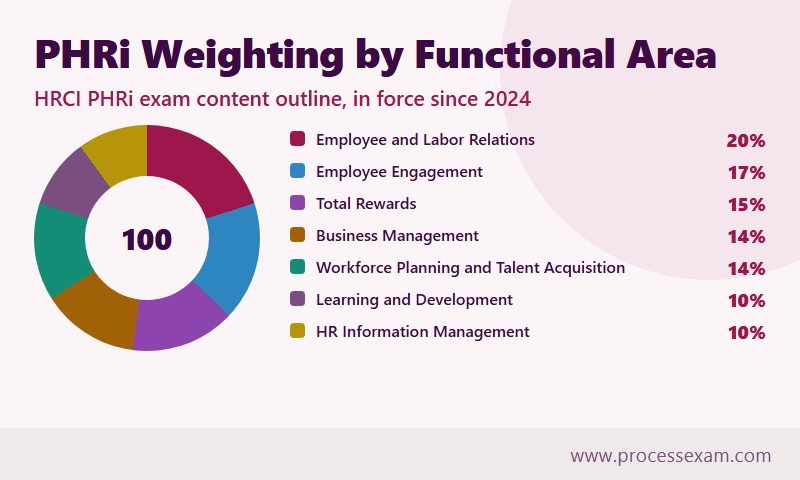
Two areas together, Employee and Labor Relations and Employee Engagement, make up 37 percent of the paper, more than the three smallest areas combined. That should decide where your hours go. Our PHRi syllabus breakdown lists the same areas as a topic checklist you can tick off as you study; what follows explains what each area means for the questions you will face.
Employee and Labor Relations - 20%
The heaviest area is about running legally compliant programmes and policies that shape the employee's experience. It covers diversity and inclusion programmes, health, safety, security and privacy support, interpreting and enforcing policies such as the handbook and attendance rules, handling complaints and conflicts through investigation and escalation, and the tools of positive employee relations in workplaces with and without a union. The outline names no statute. Instead you must reason from the principle to the law of the country in the scenario.
Employee Engagement - 17%
This area follows the whole employee lifecycle: measuring how well each stage works from hiring to exit, running surveys, focus groups, wellness activities and employee resource groups, supporting performance management, and handling the harder end of it, such as improvement plans, corrective action, redundancies and offboarding. Questions here reward candidates who have sat through a difficult conversation and know what a fair process looks like.
Total Rewards - 15%
Pay, recognition, incentives, non-monetary rewards such as flexible scheduling, benefits and leave, and keeping the whole package fair and sustainable through pay equity checks, benchmarking, salary bands and life-event changes. Expect scenario items that ask what to do when a rule and a manager's request collide.
Business Management - 14%
Understanding the organisation around HR: how the business environment and industry practice affect decisions, who the cross-functional stakeholders are, how to spot risk and recommend controls, how to read metrics such as attrition, time to hire and return on training, and how to reinforce culture, values and ethical expectations.
Workforce Planning and Talent Acquisition - 14%
Applying the labour rules that govern hiring, choosing sourcing methods from referrals to job boards to campus recruitment, and running the acquisition lifecycle from job description through interview, offer and background check to onboarding.
Learning and Development - 10%
Implementing and evaluating training and career-development programmes, contributing data to succession planning, and administering compliance, safety and systems training. It is the smallest tier, but its questions are usually quick marks for anyone who has organised a training programme.
HR Information Management - 10%
Working with HR databases and systems, turning their data into reports and trends, and protecting it through access permissions, accuracy checks and security practice. Candidates from small teams that keep records in spreadsheets often underestimate this area.
How do you work through a PHRi scenario question?
The exam rewards a repeatable method more than clever guessing. The six steps below suit every format, and they matter most on scenario items, where several questions hang off one set of facts and a single overlooked detail can spoil all of them.
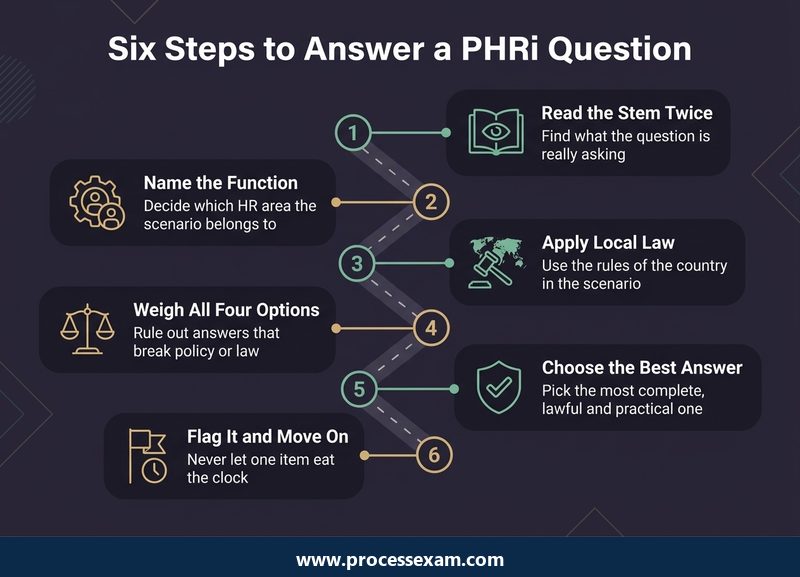
Start by reading the stem twice, the second time underlining in your mind the words that set the constraint: which country, whether a union is present, whether a policy already exists. Then name the functional area, which tells you which body of knowledge to draw on. Next apply the local law in the scenario, not the law you happen to work under, because the exam is deliberately jurisdiction-neutral and expects you to reason from what the scenario states.
When you reach the options, weigh all four before choosing. The wrong answers on a professional-level exam are rarely absurd. They are usually actions that are partly right but skip a step, break a policy, or leave a legal duty unmet. The best answer is normally the one that is lawful, documented and proportionate. Finally, do not let one stubborn item cost you five minutes. Flag it, move on, and return if time is left.
How much does the PHRi cost, and what happens if you fail?
Budget for two payments to HRCI and one optional extra. All amounts are in US dollars and can change, so confirm them on HRCI's page when you apply.
| Item | Amount | When it applies |
|---|---|---|
| Application fee | $100 | When you submit your application |
| Exam fee | $395 | With the application, before you book |
| Total | $495 | Both fees together |
| Second Chance Insurance | Set by HRCI | Optional; only at the moment you apply |
The clock after you are approved
Once HRCI approves your application, you have 180 days to book and sit the exam. Miss the window and you must apply again and pay again. HRCI will grant one extension of 60 days if you cannot test in time, but only once, and it requires a form and a fee. Changing an appointment costs a non-refundable Pearson VUE fee each time, and you lose all fees if you reschedule fewer than two business days before a test-centre appointment or less than an hour before an online session.
If you do not reach 500
HRCI reports your result as a scaled score and tells you how far you were from the pass mark. The results report also gives a performance level for each topic area. HRCI says this is not an official domain score, only a guide to what to revisit, and its guide to the results report explains how to read it. A candidate who fails must wait 90 days before scheduling a retake, and the retake must still fall inside the original 180 days. That is the reason some candidates buy Second Chance Insurance when they apply: it lets you retake a different form of the same exam without paying the fees again, but it is only sold with the application, is non-refundable, and lapses if you never use it.
What the published pass rate does and does not tell you
HRCI publishes pass rates for each credential on its pass rates page. At 31 December 2025 it showed 84 percent for the PHRi. Treat that as context, not a target: the candidates who sit the PHRi have already cleared an experience gate and are typically working in HR, and a pass rate is not the same thing as a pass mark. Your own score of 500 is the only figure that decides your result.
Why does a scaled score exist at all? HRCI maintains several forms of each exam and sets the cut score with the modified Angoff method, in which subject-matter experts judge how a minimally qualified candidate would perform on each question. Raw results are then converted so that a form with slightly harder questions does not make the pass harder. The scale stays fixed at 500 whichever form you get.
What does an eight-week PHRi training plan look like?
People searching for PHRi training usually want one of two things: a course or a plan. HRCI lists its own learning options on its learning and development page, and you can add any textbook or course that follows the outline. Whatever you choose, tie your hours to the weightings above. This plan assumes six to eight hours a week alongside a full-time job and starts from the professional who does most of an HR job already but has gaps.
| Weeks | Outline areas | Practice task at the end |
|---|---|---|
| 1 | Read the whole outline; gap-check yourself against every responsibility | Rate each of the 27 responsibility statements red, amber or green |
| 2-3 | Employee and Labor Relations | Write out a complaint investigation from intake to closure, then check it against a reference |
| 4 | Employee Engagement | List the steps of a fair improvement plan and an exit process |
| 5 | Total Rewards | Compare two benefit or leave scenarios and decide which rule applies |
| 6 | Business Management and Workforce Planning and Talent Acquisition | Calculate time to hire and attrition from a small data set |
| 7 | Learning and Development and HR Information Management | Draft a data-access rule for a small HR team |
| 8 | Full revision and timed practice | Sit two timed papers and log every miss by cause |
Practice under timed conditions early in the plan, not only at the end. A timed PHRi practice exam shows you whether your pace holds at a little over a minute per question, and the wrong answers tell you whether you missed the topic, misread the stem or ran short of time. Those three causes need three different fixes, and only the log reveals which one is yours.
Common mistakes to design out of the plan
- Studying US law because most English-language material does. The international exam expects you to apply the rules of the country in each scenario.
- Spending equal time on all areas. Twenty percent of the exam is Employee and Labor Relations, ten percent is Learning and Development.
- Leaving the trial items unanswered or rushing them. You cannot identify them, so every question needs a considered answer.
- Treating a practice-test percentage as a prediction. It shows weak areas, not your scaled score.
The last week and the morning of the exam
In the final week, stop learning new material. Re-read your error log, redo the questions you missed twice, and rehearse the six-step method on two scenarios a day. The day before, confirm your appointment, your ID and its name match, and how you will get there or set up your room. On the morning, plan the clock: a first pass at about a minute a question finishes in under two hours and leaves roughly 20 minutes to return to flagged items.
What does keeping the PHRi ask of you afterwards?
A PHRi is valid for three years. To keep it, HRCI asks for 60 HR recertification credits earned over that time, or you can retake the exam instead. Credits come from ordinary professional development such as courses, conferences and webinars, so keeping a running record from the day you pass is far easier than reconstructing three years at the end.
Is it worth the effort? The credential is accredited by the National Commission for Certifying Agencies, an independent body, which gives the letters weight with employers who look for third-party accreditation. It shows a recruiter that a stranger's HR experience has been tested against a defined outline, and it gives you a common vocabulary if you move between countries or into a multinational team. It cannot promise a raise or a promotion; what it does is remove doubt about whether you know the profession, so the conversation can move to what you have done with it.
If the PHRi describes your current job, the fastest way to decide is to read the outline, mark your gaps and book a date inside your 180 days. If it describes the job you want next, spend a month on the outline before you pay, so the fee buys you a real attempt.
Frequently Asked Questions
What does PHRi stand for?
PHRi stands for Professional in Human Resources - International, a professional-level credential from HRCI. It follows the same structure as the PHR but is written for HR practitioners working outside the United States, so its questions ask for the applicable law rather than naming American statutes.
How many questions are on the PHRi exam?
The PHRi exam has 115 questions and allows 135 minutes plus 30 minutes of administration time. HRCI states that 90 questions are scored and 25 are unscored pretest items. You cannot tell them apart, so answer every question with the same care.
What score do you need to pass the PHRi?
You need a scaled score of 500 on a scale of 100-700. HRCI converts raw results to that scale so that different exam forms are equally fair. The pass mark is therefore not a fixed percentage of correct answers, and a practice-test percentage cannot predict it exactly.
How much does the PHRi certification cost?
HRCI charges an exam fee of $395 and an application fee of $100, which makes $495 in total. Second Chance Insurance is optional and must be bought at the time of application. Fees can change, so check HRCI's PHRi page before you apply.
Who is eligible to take the PHRi exam?
You qualify with a master's degree plus one year of professional-level HR experience, a bachelor's degree plus two years, or four years of professional-level experience without a degree. Degrees may be the global equivalent, and the experience does not need to be recent or continuous.
- Professional Certification |
- HRCI HR Professional in Human Resources - International Test Questions |
- PHRi Question Bank |
- HRCI HR Professional in Human Resources - International Book |
- HR Professional in Human Resources - International Certification Cost |
- HR Professional in Human Resources - International Certification Requirements |
- HRCI HR Professional in Human Resources - International Sample Questions |
- PHRi Exam Questions Download |
- PHRi Test Questions |
- HR Professional in Human Resources - International PDF


