
PHRca Exam Guide: Your Path to California HR Certification
Updated on 22 September 2026. What’s new: passing score corrected to 500 on HRCI's 100-700 scale, and the exam to 115 questions (90 scored plus 25 unscored pretest items)
A common belief is that the PHRca is just the PHR with a California chapter added, and that you must hold the PHR and live in the state before you can sit it. Neither is true. The PHRca is a stand-alone HRCI credential that tests one thing: whether you can apply California employment law in everyday HR work. It has 115 questions, runs for 135 Minutes plus 30 minutes administration time, and is passed at 500 (on a scale of 100-700).

That narrow focus is the whole point of the credential. California layers its own wage orders, leave laws, safety rules and enforcement agencies on top of federal requirements, and an HR professional who applies federal rules alone can expose an employer to claims that would never arise in most other states. The PHRca exists so that an employer, a client or a hiring manager can see at a glance that you know the California layer as well as the federal one.
This guide explains who the credential really suits, how to qualify and apply, what happens on exam day, what each of the five functional areas in HRCI's current exam content outline expects from you, how to plan your study around laws that change every year, the errors that cost candidates marks, and what the letters do for your career once you have them.
Who is the PHRca really for, if not only people living in California?
HRCI describes the PHRca as a credential for HR professionals who work with California's employment rules. Look closely at the three eligibility routes on HRCI's PHRca certification page and you will notice what is missing: none of them mentions where you live, where your employer is registered, or whether you already hold another HRCI credential. The test is your professional-level HR experience and your degree, nothing else.
In practice the credential attracts five groups of people.
- HR generalists and managers at California employers. This is the core audience: people who handle pay, leave, discipline and terminations every week under California rules and want independent proof of that knowledge.
- HR staff at multi-state employers with California sites. A people team based in Texas, Arizona or New York that supports a California warehouse or office needs someone who can spot where a company-wide policy fails California requirements.
- Payroll and total rewards specialists. Compensation and wage-and-hour rules make up a fifth of the exam, and they are the rules that most often produce costly back-pay claims.
- Consultants, outsourced HR providers and PEO staff. Anyone who advises several California clients benefits from a credential that clients can check quickly.
- HR professionals who already hold the PHR or SPHR. Many add the PHRca as a second credential because their national certification does not show state-specific depth.
PHRca and PHR: separate exams, not a sequence
It helps to picture the two credentials side by side rather than one above the other. The PHR tests HR practice under United States federal law and is not tied to any single state. The PHRca tests HR practice under California law and assumes you will apply it inside a California workplace. HRCI does not require the PHR first, and holding the PHR does not shorten or exempt you from any part of the PHRca. Some people sit both, usually PHR first because it is broader, but plenty of California practitioners take the PHRca alone because it maps more closely to the questions they answer at work.
The exams also feel different. A PHR question might ask what a federal statute requires; a PHRca question is more likely to describe a California employee, a schedule, a leave request or a termination and ask what the employer must do under state rules. The skill being measured is not recall of a statute's name but correct application of it to a situation.
Do you qualify for the PHRca, and how does the application work?
HRCI accepts three combinations of experience and education, and you need to meet only one of them:
- a master's degree or higher, plus at least one year in a professional-level HR role;
- a bachelor's degree, plus at least two years in a professional-level HR role; or
- at least four years in a professional-level HR role, whether or not you hold a degree.
The wording that decides most applications is "professional-level". HRCI is interested in work where you applied independent judgement: interpreting policy, advising managers, running an investigation, owning a process. Purely clerical time, such as data entry or filing, is unlikely to count on its own. If your career began in an administrative role and moved into a professional one, count only the professional period and describe it honestly on the application.
From application to booked appointment
HRCI accepts PHRca applications year-round, so there is no annual deadline to chase. The sequence runs like this:
- Apply online and pay. The Application Fee of $100 and the Exam Fee of $395 are paid when you apply.
- Wait for the review. HRCI checks your stated experience and education. A share of applications is picked for audit at random, and an audited candidate must supply evidence, so keep job titles, dates and duties accurate.
- Receive your authorisation. Approval opens a 180-day eligibility period, and your exam must be both booked and taken before it closes.
- Book with Pearson VUE. You choose between a test centre and an online proctored session from home or the office.
The 180-day clock is the single most important logistic. If you let it lapse, you apply and pay again. That makes a simple rule worth following: begin serious study before you apply, and submit the application only when you can see a realistic exam date inside the next few months.
How many questions are on the PHRca exam, and how is it scored?
These are the figures to plan against, taken from our exam summary for the credential.
| Exam detail | PHRca |
|---|---|
| Exam name | HRCI Professional in Human Resources - California |
| Exam code | PHRca |
| Vendor | HRCI |
| Number of questions | 115 |
| Exam duration | 135 Minutes plus 30 minutes administration time |
| Exam fee | Exam Fee: $395 |
| Application fee | Application Fee: $100 |
| Passing score | 500 (on a scale of 100-700) |
Only 90 of the 115 questions count
HRCI's PHRca page breaks the 115 down as 90 scored questions, mostly multiple-choice, plus 25 pretest questions. The pretest items are being trialled for future versions of the exam and do not affect your result, but they are mixed in with the scored ones and look identical. There is no way to tell them apart, so treat every question as if it counts.
Why your result is a scaled score
HRCI reports results on a scale from 100 to 700, and the passing standard is 500 on that scale. A scaled score lets HRCI keep the standard constant across different versions of the exam, so a candidate who happens to receive a slightly harder set of questions is not penalised for it. The practical consequence for you is that a percentage from a practice test is not the same measure as a scaled score. Use practice results to find weak areas; do not read them as a forecast of your final number.
Timing on the day
You have 135 minutes of testing time for 115 questions, which works out at a little over a minute per question. The additional 30 minutes are for administration, not for answering questions. Scenario questions about leave interactions or termination risk take longer to read, so bank time on the shorter recall items and flag anything that stalls you for a second pass.
What does the PHRca exam content outline test in each functional area?
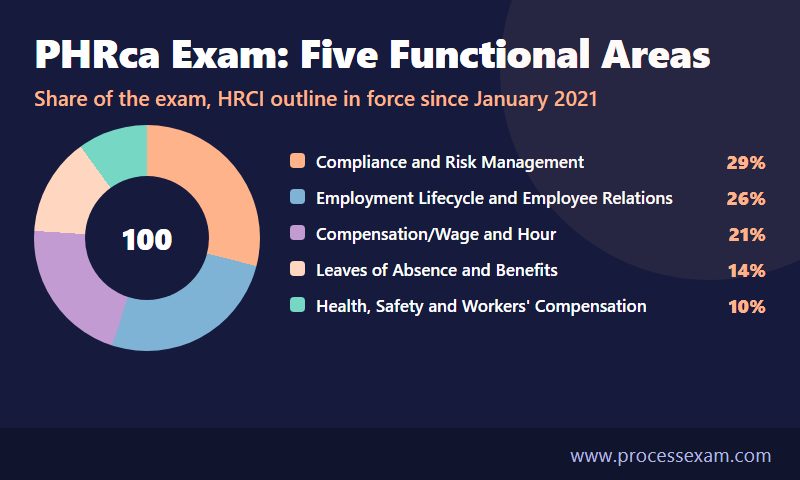
The exam is built from the PHRca Exam Content Outline, which HRCI produces through a practice analysis carried out with HR subject matter experts. The outline in force today took effect in January 2021, and when we checked HRCI's site in September 2026 it was still the current version, with the same five functional areas and weightings. HRCI publishes the full PHRca exam content outline as a free download.
One line in that document shapes how you should study: candidates are responsible for knowing the laws and regulations in effect in January of the calendar year in which they sit the exam. California passes new employment legislation most years, so a study resource that was accurate three years ago may now be wrong on a threshold, a notice or a deadline.
If you would like the responsibility statements laid out as a checklist, our PHRca topic list with area weightings reproduces all five areas so you can tick them off as you go.
Compliance and Risk Management (29%)
The largest area, and the one that ties the rest together. It asks you to work out which obligations apply to an employer based on its size and industry, such as mandatory and job-protected leaves, Cal-COBRA, disability accommodation and communication in multiple languages. It covers privacy and security protocols for personal data, monitoring, social media and trade secrets, and it expects you to weigh the penalties of getting things wrong, including Private Attorneys General Act (PAGA) claims and class actions.
It also includes the less glamorous tasks that generate real liability: posting and distributing required notices, keeping personnel records for the correct periods and giving employees access to their files, applying fair employment and equal pay practices, running the interactive process for reasonable accommodation, and responding to inquiries from state agencies such as the Division of Labor Standards Enforcement and the Employment Development Department.
Employment Lifecycle and Employee Relations (26%)
This area follows an employee from first contact to exit. Recruiting and pre-employment practice is tested in California terms: background and credit checks, drug testing and marijuana laws, ban-the-box, the ban on asking about wage history, and employment of minors. Onboarding covers required notices, mandatory training and new hire reporting. You are also expected to draft enforceable policies and agreements covering areas such as non-compete clauses, non-disclosure, arbitration, severance and whistleblowing.
Two responsibilities deserve extra time. Harassment prevention training is tested down to its content and who may deliver it, and workplace investigations are tested through FEHA protected characteristics, retaliation and bullying. The area closes with Cal-WARN obligations for layoffs and closures and with managing the risks of termination, including dismissals during a leave.
Compensation/Wage and Hour (21%)
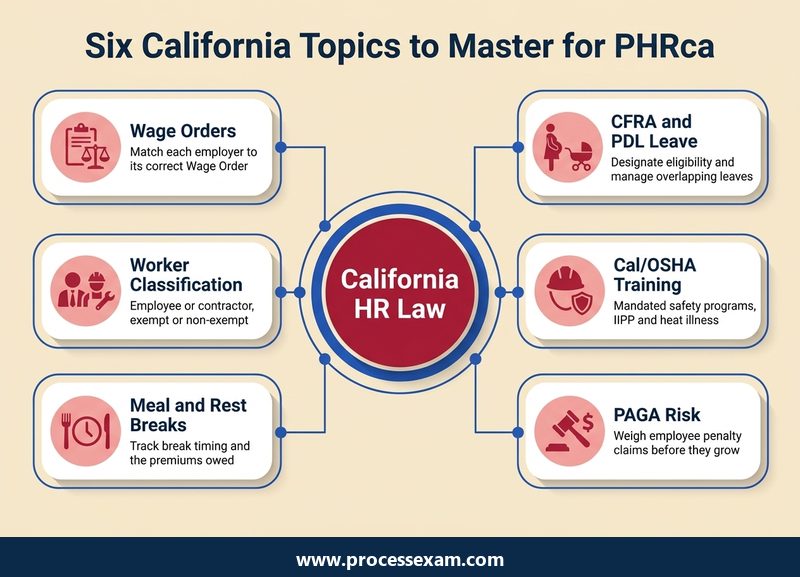
For many candidates this is the hardest area because the detail is unforgiving. It starts with identifying which Wage Order applies to an organisation, industry or profession. It then covers classification of workers as employees or independent contractors and as exempt or non-exempt, including minimum salary requirements. You need to know how pay is calculated, timed and documented: minimum wage, overtime, deductions, final pay, bonuses, wage statements, pay frequency and expense reimbursement.
Timekeeping gets its own responsibility, with split shifts, time between shifts, meal periods and rest breaks, consecutive workdays, premium calculations, piece-rate pay, reporting pay, makeup time and travel time all named in the outline. The last responsibility covers building compliant work schedules, including alternative workweek schedules.
Leaves of Absence and Benefits (14%)
Three responsibilities, but each hides a lot of interaction. You set up compliant leave and benefit policies, covering domestic partner coverage, vacation, paid time off and the Health Insurance Premium Payment program. You designate leave eligibility under the California Family Rights Act, Pregnancy Disability Leave, paid sick leave, school activities leave and kin care. Then you manage how those leaves overlap and how wage replacement is integrated, which is where most scenario questions in this area are aimed.
Health, Safety and Workers' Compensation (10%)
The smallest area covers running workers' compensation programmes, including claims administration, fraud, Medical Provider Networks and designation of a personal physician. It also covers safety policy, including agency notification, the Injury and Illness Prevention Program, heat illness, drug and alcohol use and ergonomics, plus Cal/OSHA mandated training and responding to agency claims, appeals and hearings before bodies such as the Workers' Compensation Appeals Board. Ten percent of 90 scored questions is roughly nine marks, which is too many to give away by skipping it.
How should you plan PHRca study around California's changing laws?
A ten-week plan at six to eight hours a week suits most people who already work in California HR. Stretch it if your role has kept you away from payroll or leave administration, because those are the areas where unfamiliar detail takes the longest to absorb.
| Week | Focus | Done when you can |
|---|---|---|
| 1 | Orientation | Read the outline end to end, rate yourself on each responsibility, and pick an exam date |
| 2-3 | Compliance and Risk Management | Explain which obligations switch on at which employer size, and what PAGA exposure looks like |
| 4-5 | Employment Lifecycle and Employee Relations | Walk a hire from job posting to separation without breaking a California rule |
| 6-7 | Compensation/Wage and Hour | Classify a role, choose its Wage Order and calculate overtime and break premiums by hand |
| 8 | Leaves of Absence and Benefits | Map how CFRA, PDL and paid sick leave overlap for one employee |
| 9 | Health, Safety and Workers' Compensation | Outline an IIPP and describe the path of a disputed workers' compensation claim |
| 10 | Full rehearsal | Sit a timed full-length attempt, log every miss by area, and revise the two weakest |
Anchor every topic to a primary source
Commercial summaries of California law age quickly. For each topic, read the plain-language guidance published by the California agency responsible for it, then compare it with your study notes and correct anything that has changed. Date your notes. When a note says what a rule was as of a given January, you will never confuse this year's requirement with last year's.
Practise application, not recall
PHRca questions describe a workplace and ask what the employer should do. A useful habit is to turn every responsibility in the outline into a mini-case from your own experience. What would you tell a manager who wants to convert an hourly supervisor to salary? How would you designate leave for an employee who is pregnant, already used part of CFRA, and also has sick leave banked? Writing two or three sentences of answer for each forces the reasoning the exam rewards.
Check your readiness under real time pressure
By the end of week three you will have covered the largest area, which makes it a good moment for a first timed diagnostic. A PHRca practice test taken then shows which of the remaining areas need more than their planned week, while there is still room in the schedule to move hours around. Repeat a full attempt in week ten, and compare your results area by area rather than by headline score.
Which PHRca mistakes cost candidates the most marks?
The same errors come up again and again among people who fall short, and most of them can be fixed during preparation rather than on the day.
- Answering with the federal rule. When California and federal law differ, the exam wants the California answer. Candidates with a strong PHR background are especially prone to picking the federal option out of habit.
- Studying from an outdated source. Because you are tested on the law in effect each January, a guide written before the most recent legislative changes can teach you a wrong answer with complete confidence.
- Learning acronyms without the process. Knowing that CFRA, PDL, Cal-WARN and PAGA exist is not enough; questions ask what triggers each one and what the employer must do next.
- Under-weighting Compliance and Risk Management. At 29 percent it is the largest area, yet candidates often treat it as general background rather than as a subject in its own right.
- Skimming wage and hour detail. Classification, breaks, premiums and final pay are precise topics. Approximately right is usually wrong in this area.
- Reading a practice percentage as a scaled score. The two measures are different. A practice result tells you where to study, not whether you will reach 500.
- Letting the eligibility period run down. An exam that is not booked within the first few weeks after approval tends to slip, and 180 days pass faster than expected alongside a full-time HR job.
What happens after the PHRca exam: results, retakes and recertification?
You receive a pass or fail decision together with your scaled score. If you do not pass, the score report also shows how you performed across the content areas, which is the most useful starting point for a second attempt.
If you need a second attempt
According to the HRCI certification handbook, there is a 90-day cooling-off period after an unsuccessful attempt before you can schedule the exam again. Candidates who bought Second Chance Insurance when they applied can retake without submitting a new application; everyone else reapplies and pays the relevant fees again. The handbook also sets out identification rules, test-centre conduct and the requirements for online proctoring, so read it in the week before your appointment.
Keeping the credential
The PHRca is valid for three years. To renew, HRCI asks for 60 recertification credits within that period, 45 of them in HR and at least 15 of them California-specific, or you can retake the exam. The California requirement is deliberate: the credential only keeps its value if its holders keep up with the state's annual changes. The easiest way to meet it is to log every relevant webinar, seminar and course as you complete it, rather than reconstructing three years of activity at the end.
Is the PHRca worth adding if you already hold the PHR or a SHRM credential?
For anyone whose work regularly touches California employees, the answer is usually yes, and for a specific reason: national credentials, whether from HRCI or SHRM, deliberately avoid depth in any one state's law. The PHRca fills exactly that gap, and California is the state where the gap is widest and the cost of mistakes is highest.
What the credential signals
- To employers: that you can keep a California workforce compliant on pay, leave, safety and separations without constant recourse to outside counsel.
- To clients: for consultants and outsourced HR providers, a verifiable, state-specific credential answers the first question a California client tends to ask.
- To colleagues in other states: in a multi-state HR team, it marks you as the person who reviews policies before they are rolled out to California sites.
When it may not be the right next step
If you have no California employees and no plans to support any, the PHRca's content will not transfer to your day-to-day work, and a national or international credential will serve you better. Likewise, if you are still building your first year or two of professional HR experience, the broader PHR may give you a stronger foundation before you specialise.
For everyone else the arithmetic is straightforward. Set the Exam Fee of $395 and the Application Fee of $100 against ten weeks of structured study, and the return is a credential that documents the one body of employment law most HR professionals find hardest to master, and that keeps you current on it for as long as you hold it.
Frequently Asked Questions
What is the PHRca certification?
The Professional in Human Resources - California (PHRca) is an HRCI credential that tests whether you can apply California employment law in HR work. It covers five areas: compliance and risk, the employment lifecycle, wage and hour, leaves and benefits, and health, safety and workers' compensation. It is valid for three years.
How many questions are on the PHRca exam?
The PHRca exam has 115 questions and a duration of 135 Minutes plus 30 minutes administration time. HRCI's PHRca page explains that 90 are scored and 25 are unscored pretest questions. The two kinds are mixed together and look the same, so every question deserves equal care.
What is the passing score for the PHRca exam?
The passing score is 500 (on a scale of 100-700). HRCI reports a scaled score rather than a raw percentage, which keeps the standard the same across different versions of the exam. A percentage from a practice test is therefore a different measure and should be used to find weak areas.
Do you need the PHR or California residency to take the PHRca?
No. HRCI's eligibility is based only on professional-level HR experience and education: one year with a master's degree, two years with a bachelor's degree, or four years with no degree. None of the routes requires the PHR or that you live in California, although the content assumes California workplaces.
How much does the PHRca exam cost?
HRCI charges an Exam Fee of $395 and an Application Fee of $100, both paid when you apply. Optional Second Chance Insurance is priced separately. If your 180-day eligibility period ends before you test, you apply and pay again, so pick a realistic exam date before submitting.
- Professional Certification |
- HRCI HR Professional in Human Resources Test Questions |
- PHRca Question Bank |
- HRCI HR Professional in Human Resources Book |
- HR Professional in Human Resources Certification Cost |
- HR Professional in Human Resources Certification Requirements |
- HRCI HR Professional in Human Resources Sample Questions |
- PHRca Exam Questions Download |
- PHRca Test Questions |
- HR Professional in Human Resources PDF


