
Why the Pega System Architect Certification Matters to Delivery Teams
A Pega team asks for the Certified Pega System Architect (CPSA) because it shows a developer can already build the everyday parts of a Pega application the way the platform expects: case types, data, views, rules and access. The exam is 60 questions in 90 minutes, costs USD $190 and needs 65% to pass, and it is the first rung of Pega's developer path.
Picture a sprint review. The Lead System Architect has split a claims application into tasks, and a new developer is handed the screens for one case type. If that developer already knows what a case lifecycle is, why a data page exists and where access control lives, the review is about the business rules. If not, the review turns into a lesson in the platform. That gap is what the certificate is meant to close, and it is why this article looks at the credential from the team's side of the table as well as the candidate's.
Everything below about the exam and the path comes from Pega's own Academy pages, checked in November 2026. Where a statement is my reading of those pages rather than something Pega says, it is written as such. The exam targets Pega Platform '25, and Pega lists it as current with no retirement date.
Why does a Pega delivery team ask for a certified System Architect?
A Pega project is built by several people at once on one shared application. One person models the case, another builds the data layer, a third works on screens, and all of them save rules into the same rulebase. Work only fits together when everyone follows the same conventions, and Pega's conventions are specific. A rule saved in the wrong place, or a screen that fetches data on its own instead of using a shared data page, works today and causes trouble in the third release.
The CPSA is Pega's baseline for those conventions. Pega's certification page describes the System Architect track as the career path "for developers and technical staff members who want to learn how to develop Pega applications," and says it "provides a baseline measurement on your knowledge of Pega Platform." The word that matters for a team lead is baseline. The certificate does not say a person is senior or fast. It says a person has cleared a common starting line, so the lead does not have to teach the basics during delivery.
What a lead actually saves
- Onboarding time. A certified developer can read a case type, a flow and a data model without a guided tour, so the first tasks go to real work.
- Review effort. Reviews can focus on business logic instead of correcting where rules were saved or how data was loaded.
- Shared vocabulary. When someone says "child case", "Wait step" or "data transform", everyone on the call means the same thing.
- A cleaner hand-off up the chain. Pega's own mission shows work flowing from a Lead System Architect to System Architects, and the credential is the entry ticket to that role.
I could not find a Pega page that says partners or customers must staff projects with a set number of certified architects, so this article does not claim it. What the pages do support is the practical argument above: a recognised baseline makes a mixed team easier to run.
What does a System Architect build in a working week?
Pega's System Architect mission is the clearest description of the job, because it is written around tasks. It teaches "the core principles of application development on Pega Platform" and says learners will "discover how to perform the most common application development tasks by using App Studio and Dev Studio." One of its scenarios reads "Your Lead System Architect has requested that you create the Views for the Assistance Request Case Type." That is a typical System Architect task: a defined piece of a larger design, built to the standard the lead has set.
Grouping the mission's modules by what you do in a week gives a realistic picture.
Model the work
Most of the early effort goes into case types. You define the stages and steps a piece of work moves through, such as a request, a review and a resolution, and the data that belongs to the case. Pega teaches this under case lifecycles, personas and channels, and its centre-out architecture. The data model and its relationships sit alongside, because a case with poorly shaped data is hard to report on later.
Build what people see
Views and UI design, user guidance, and data transforms fill a large share of any sprint. A System Architect builds the screens a worker uses to complete an assignment and the forms a customer might fill in, then adds validation so bad input is caught early.
Add flow, routing and service levels
This is where Pega earns its reputation. The mission covers routing, approvals and cascading approvals, deadlines and escalations, email notifications, work queues, child cases, Wait steps, duplicate case detection and optional actions. In plain terms, you decide who gets a task, how long they have, what happens when they are late, and how one case can spawn and wait for others.
Make decisions reusable
Decision tables, decision trees, reusable rules and application variables let business logic change without rewriting a flow. A System Architect learns to put a rule in one place and reuse it, rather than copying logic across five screens.
Connect to other systems
Data pages and saving to systems of record cover how an application reads from and writes to the outside world. This is also where mistakes are most expensive, which is why the exam spends real marks on data and integration.
Secure, test and ship
Application security and persona-based access control decide who can see or do what. The mission then covers portal configuration, team development management, DevOps and unit testing, debugging, Insights reporting and localization. It also lists Pega GenAI and Blueprint among its foundation topics, so a newly certified architect is expected to know where the platform's assistive features fit.
The exam's topic split follows the same pattern. For the full list of what is tested, the CPSA exam syllabus sets it out topic by topic.
What do the exam facts look like at a glance?
The figures below are the ones to plan around. The code and version are from Pega Academy's exam page; the fee is the exam listing's figure, since the Academy page itself does not show a price.
| Item | Detail |
|---|---|
| Exam | Certified Pega System Architect (CPSA) |
| Exam code | PEGACPSA25V1 |
| Version | Pega Platform '25 (CPSA Version 25) |
| Questions | 60 |
| Duration | 90 minutes |
| Passing score | 65% |
| Fee | USD $190 |
| Preparation | System Architect '25 mission on Pega Academy |
| Booking | Through Pearson VUE |
A 65% pass mark on 60 questions means 39 correct answers, so up to 21 can be wrong. Ninety minutes for 60 questions leaves about a minute and a half each. For a working developer that is generous, because most questions describe a situation you have met on the job and ask what you would configure. Candidates who have never opened Dev Studio find the same questions slower, which is the point of the exam.
Because a fee can change when Pega moves an exam to a new platform release, check the price at booking. Scheduling goes through Pearson VUE's Pega page.
How do employers and project managers use the credential?
Hiring and staffing decisions rarely rest on one line of a CV, but the CPSA does a useful job in three places.
Screening
A recruiter who does not know Pega can still sort applicants by a named, vendor-issued credential. A hiring manager who does know Pega reads it as a signal that the candidate has covered the full breadth of the platform at least once, including areas a developer may not touch in one job, such as localization or Insights reporting.
Interview shape
Once a candidate holds the CPSA, the interview can skip definitions and move to judgement: how would you split this process into stages, where would you put this decision, what would you test before release? Those questions separate people who memorised the course from people who have built something, and a certified candidate can usually answer the first half comfortably.
Staffing a mixed team
A delivery manager often combines experienced architects with people new to the platform. A certified junior can be given a bounded task, such as the views for one case type, with reasonable confidence it will follow the platform's conventions. That is the situation Pega's own mission scenario describes. The certificate does not replace review, but it lowers the odds that a review turns into a rebuild.
None of this makes the certificate a hiring guarantee. It removes one question from the list of things a team has to find out the hard way.
Where does the CPSA sit on the Pega developer path?
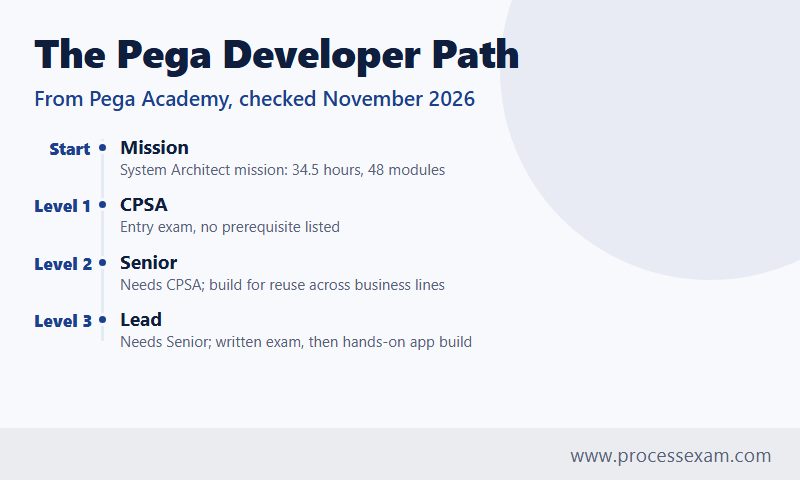
Pega's certification page sets out the developer track in three levels, and each level is a gate for the next.
| Level | Certification | Pega's description | Gate |
|---|---|---|---|
| 1 | Certified Pega System Architect | For developers and technical staff "who want to learn how to develop Pega applications" | No prerequisite listed |
| 2 | Certified Pega Senior System Architect | Checks that a developer can build for reuse in more than one line of the business | You must be a Certified Pega System Architect |
| 3 | Certified Pega Lead System Architect | "The top level of certification" | You must be a Certified Pega Senior System Architect |
Two details stand out. The Senior level shifts the question from "can you build this" to "can you build it so other teams reuse it", which is a different skill from level one and the reason it is not simply a harder version of the same paper. And the Lead level is a two-part process: a written architecture exam first, then a hands-on application exam in which you design and build an application, registered separately.
The CPSA is therefore not a destination. It is the entry point to a ladder Pega has built so that each step requires the one before. If your goal is to design applications rather than only build parts of them, the CPSA is the compulsory first move.
The path also explains why the exam is wide rather than deep. It has to give every future senior and lead the same grounding, so it covers the whole platform at an entry level of depth, and the later levels add depth and design responsibility on top. Pega also offers certifications outside this ladder, for business architects and decisioning roles among others; this article stays on the developer track.
What changes for a developer after earning the certificate?
The honest answer is that the certificate itself changes little overnight, but the preparation changes a lot, and the credential gives that change a visible form. Here is what developers tend to notice, with the caveat that these are practical effects, not promises from Pega.
You start reading projects differently
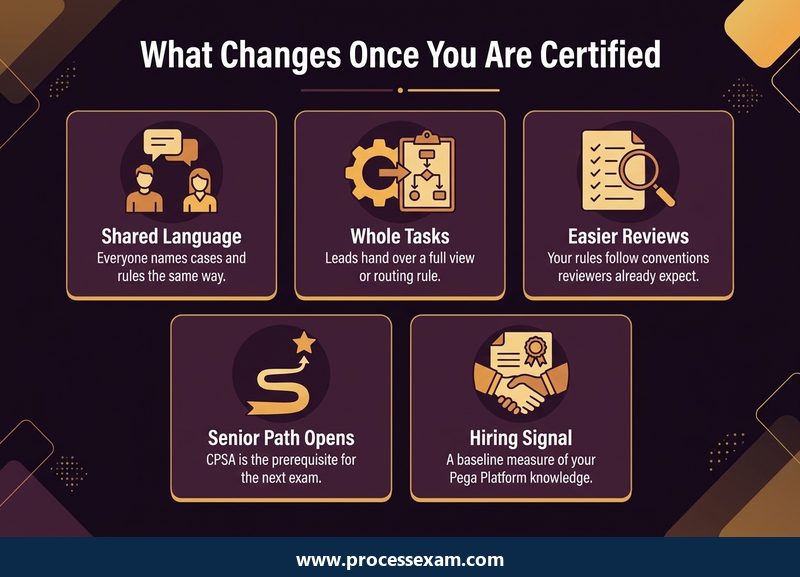
After the mission, an existing application stops looking like a pile of rules. You see the case lifecycle first, then the data pages behind it, then the access settings. That makes debugging faster, because you know where each kind of problem usually lives.
You can take a whole task, not a fragment
Before certifying, a new developer often receives narrow instructions: fix this field, add this button. Afterwards, a lead can hand over an entire view, a routing rule or a notification path, which is the kind of ownership the mission scenario describes.
Your work is easier to review
Because you share the platform's vocabulary and conventions, a reviewer can read your rules against the same mental checklist they use for everyone else's. That tends to shorten review cycles and cut the comments that begin with "in Pega we normally do this another way".
The next step becomes available
Holding the CPSA is the only route to the Senior System Architect exam, since Pega lists it as a prerequisite. If you plan to specialise in architecture, the certificate is not optional.
You become easier to place on a team
A manager choosing between two developers with similar experience, one of whom is certified, has one fewer unknown. That is a small edge, but small edges decide shortlists.
Pega's certification page puts the aim in one sentence: "Prove your commitment to excellence while keeping your skills relevant and you in-demand." The page gives no salary, demand or hiring figures, and this article does not invent any. If you want pay data, look for a published salary survey for your own country instead of relying on a blog's estimate.
Is the certificate enough on its own to get a Pega role?
No, and a candidate who treats it that way is likely to be disappointed. The CPSA tells an employer you know the platform's building blocks. It does not show that you can sit with a business analyst, turn a vague requirement into a case type, and defend your design when a stakeholder objects. Teams value both, and the certificate speaks to the first.
What strengthens the certificate
- A small application you built yourself. The System Architect mission has 48 modules and 18 challenges, and Pega rates the whole mission at 34.5 hours. Working through the challenges in a practice environment gives you something concrete to describe in an interview.
- Specific stories. Be ready to explain one decision you made, such as why a rule sits at a certain level or why a screen reads from a data page.
- Awareness of the newer features. Pega GenAI and Blueprint appear among the mission's foundation topics. A candidate who can say what they are for, and where a human still decides, sounds current.
A sensible way to use your study time
Because the mission is task-based, the best preparation is to do the tasks rather than read about them. Build the case types, break them on purpose, and fix them. When the topics feel familiar, find where your recall is thin; the CPSA practice exam is one way to spot the topics that need a second pass before you book. Pega's own exam page remains the source for the version and the rules on the day.
What to do in the first month after passing
Update your professional profile with the exact credential name and the platform version it covers. Then choose the next learning step deliberately. If your team builds reusable components, the Senior System Architect mission is the natural follow-on, and Pega's certification page lists the next mission and exam for each level.
Is the CPSA worth taking if you already work on Pega?
For a developer already on a project, the case is weaker on skills and stronger on proof. You may already do many of the tasks in the mission, but experience that cannot be shown is easy to discount, and a gap in an unfamiliar area, such as localization or Insights, can surface at the worst moment. The 90 minutes of exam time and the fee are small next to what a mistaken rule costs a delivery team.
For someone new to Pega, the case is stronger on skills: the mission is a structured, beginner-level route into the platform, and the exam gives it a finish line. For a manager building a team, the best reading is the one this article opened with. The CPSA is a baseline, and a team that asks for it gets people who start at roughly the same place.
The decision usually comes down to one question. Do you want to be handed larger pieces of work, and to keep climbing Pega's ladder? If yes, the CPSA is the first required step, and the sooner you hold it, the sooner the later steps are open to you.
Frequently Asked Questions
What is the Pega System Architect certification and who is it for?
The Certified Pega System Architect (CPSA) is Pega's entry-level developer credential. Pega describes the track as for developers and technical staff who want to learn how to develop Pega applications, and as a baseline measurement of Pega Platform knowledge. It is the first level of the System Architect path.
How much does the Pega System Architect certification cost?
The CPSA exam fee is USD $190. Pega Academy's exam page does not show a price, so confirm the current fee when you book through Pearson VUE, because fees can change when Pega moves the exam to a new platform release.
Is the Pega System Architect exam the same as PCSA?
Yes. PCSA is the older name for the credential Pega now calls Certified Pega System Architect, or CPSA. Search results and older study material still use PCSA, but the current exam is coded PEGACPSA25V1 and applies to Pega Platform '25.
Do you need the CPSA before the Senior System Architect exam?
Yes. Pega's certification page states that you must be a Certified Pega System Architect to earn the Certified Pega Senior System Architect credential. The Lead System Architect level in turn requires the Senior certification, so the three levels form a fixed ladder.
How many questions does the CPSA exam have and what score passes?
The CPSA exam has 60 questions and runs for 90 minutes, and the passing score is 65%. That is 39 correct answers out of 60. Pega lists the exam as current for Pega Platform '25, with no retirement date shown.
- Pega System Architect Book |
- System Architect Certification Cost |
- System Architect Certification Requirements |
- Pega System Architect Sample Questions |
- System Architect PDF |
- Pega System Architect Test Questions |
- CPSA Question Bank |
- CPSA Exam Questions Download |
- CPSA Test Questions |
- PEGACPSA25V1 Mock Exam |
- PEGACPSA25V1 Simulator |
- PEGACPSA25V1 Book |
- PEGACPSA25V1 Certification |
- PEGACPSA25V1 Certification Cost |
- PEGACPSA25V1 Certification Requirements |
- PEGACPSA25V1 Question Bank |
- PEGACPSA25V1 Study Guide |
- PEGACPSA25V1 |
- PEGACPSA25V1 Exam Questions |
- PEGACPSA25V1 PDF |
- PEGACPSA25V1 Sample Questions


