
Pega Customer Service Developer: Build the Agent Desk and Weigh the Cost
A Pega Customer Service developer builds the screens, channels and agent guidance that a contact centre runs on, and the certification behind the role costs USD $190 for a 50-question, 90-minute exam. For a system architect that is a second fee the same size as the first, so the real question is what the specialism buys you beyond your existing architect badge.

That question deserves a straight answer, because the exam is not the expensive part. The expensive part is the weeks of hands-on practice in a product area many architects never touch on their current project. This guide follows the decision in order: what the work looks like, where it sits beside general architect work, what the credential costs in money and time, how Pega weights the exam, which topics are heavier than their names suggest, how to prepare around a job, how booking works and when it is smarter to wait. The exam format figures below were read from Pega Academy's exam page in October 2026, when the current paper was the Infinity '25 version, code PEGACPCSD25V1; the USD $190 fee is the listed price, confirmed at booking.
What does a Pega Customer Service developer actually build?
Pega Customer Service is a packaged application for contact centres. A client does not start from a blank Pega Platform project; it starts from this product and shapes it to its own channels, data, business rules and brand. The developer is the person who does that shaping. Pega lists the product under its Customer Service page and its use case of automating customer service, and the exam page frames the developer as someone who implements it effectively.
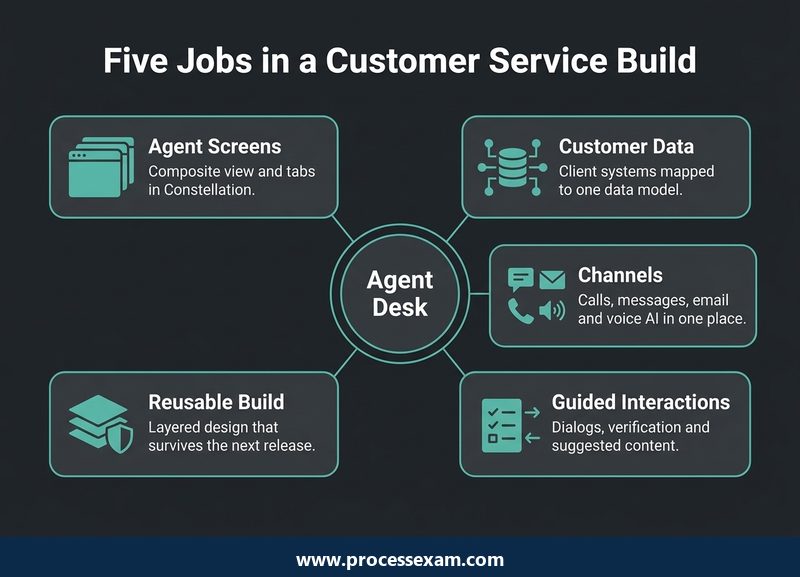
In practice that work falls into five jobs, and the exam blueprint is organised around them. First, the agent experience: the screen a service representative lives in all day, built on Pega's Constellation design system, with a composite view of the customer and tabs that pull the right information forward. Second, customer data: the application reads from the client's systems of record, and the developer connects them through a shared customer data model rather than inventing new field names for each project. Third, channels: phone calls, digital messaging, voice AI, email handling and the newer agentic channels all have to land in one place so the agent sees one conversation, not five. Fourth, interaction management: the guided parts of a conversation, such as dialogs, customer verification, business conditions and suggested content. Fifth, the delivery architecture: how the customer service layer is built so that it can be reused, extended and moved from older user interface styles to Constellation.
Notice what is missing from that list: nothing here is exotic Pega. Every one of these jobs relies on skills a Certified Pega System Architect already holds, such as cases, data pages, rules and user interface configuration. The specialism is knowing how those skills are applied inside one particular product, with its own data model, channel connectors and conventions. A developer who has only built bespoke case types can be productive in the first month of a customer service project, but will keep rediscovering things the product already does.
A realistic day on such a project might involve adjusting how a customer's recent interactions appear in the composite, adding a verification step before an agent can discuss an account, wiring a new messaging channel to an existing queue, or deciding which parts of a legacy interface can stay while new work is built in Constellation. None of this is glamorous, and all of it is the difference between a contact centre that handles a call in one pass and one where the agent opens three windows.
How does the specialist role differ from general system architect work?
Pega states the audience plainly: the exam is designed for System Architects and Senior System Architects who want to validate their ability to implement Pega Customer Service applications. It is therefore a second step, not a first one. Pega Academy lists the Customer Service Implementation '25 mission as the prerequisite, and the certification page groups the exam under its own Customer Service Developer heading, apart from the System Architect, Business Architect, Decisioning, Data Science and Robotics tracks.
The cleanest way to see the difference is by what each role is asked to decide. A system architect decides how to model a case, which rule to specialise and how to keep an application maintainable. A customer service developer inherits many of those decisions from the product and spends more time on decisions that are specific to contact centres: how an agent is guided, what happens when a channel fails over, how much of a customer's history should sit in front of the agent and which actions need verification first. The questions on the paper reflect this. They are scenario questions about a service application, not general rule-resolution puzzles.
That is also why the credential does not replace the architect badges. The paper assumes you already know how to read an application: the Center-out architecture topic, for example, presumes you know what a layered application is. If you hold CPSA, you can add this exam without relearning fundamentals. If you hold only an interest in customer service, the exam will feel like a wall. Pega's own sequencing, with an implementation mission that expects architect-level skills, tells you the same thing.
There is a second contrast worth drawing, with the Business Architect and Decisioning Consultant tracks. A business architect captures requirements and shapes the design; a decisioning consultant tunes next-best-action strategy in Pega Customer Decision Hub. The customer service developer sits closer to the build: configuring, extending and integrating a service application. If your preferred work is hands-on configuration with a clear end user, a call-handling agent, this is the closest of Pega's tracks to that.
What does it cost, in money and in weeks, to add this specialism?
The money first, because it is the smaller number. The exam is listed at USD $190 as of October 2026, the same figure as the System Architect exam, and Pega delivers it through Pearson VUE, so the amount you pay is confirmed when you book. Some employers that run Pega teams reimburse exam fees, which is worth asking about before paying yourself.
The time is the larger number. The exam page puts one prerequisite in front of you, the Customer Service Implementation mission, and a mission is a lot more than a reading list. For an architect already comfortable with Pega, a sensible budget is a month of part-time effort, since the platform is familiar and only the product is new. For someone coming from a non-Pega background the same exam is a much longer road, because you would need the architect foundation first.
Then there is the cost people forget: access to a realistic environment. The exam is about a product you can only learn by using. If your current project does not touch Pega Customer Service, you depend on the Academy's learning environments and any sandbox your employer or Pega partner can give you. Budget for the evenings spent setting that up, not just the evenings spent studying.
| Item | Figure |
|---|---|
| Exam | Certified Pega Customer Service Developer, code PEGACPCSD25V1 |
| Questions | 50 |
| Duration | 90 minutes |
| Passing score | 65% |
| Fee | USD $190, as listed in October 2026 |
| Version | Pega Customer Service '25 (Infinity '25) |
| Language | English |
| Delivery | Pearson VUE test centre or online proctored |
| Prerequisite | Customer Service Implementation '25 mission |
Weigh that against what you get back. Pega's exam listing shows no retirement date for this version, so the paper is not about to be withdrawn. A specialist credential also changes how you are described on a proposal or a CV: instead of "Pega developer", you can say you are certified on the application the client is buying. Whether that moves pay depends on the market and the employer, and no salary figure is quoted here because there is no source for one that we could verify. The honest case for the exam is credibility on customer service projects, not a guaranteed raise.
How is the exam weighted across its seven topics?
Pega publishes seven topics with percentages that add up to 100, and the shape is unusual: three topics carry 20% each, two carry 15% and two carry only 5%. Reading the weights correctly is the single best way to spend your first evening, because it tells you where an hour of study pays best.
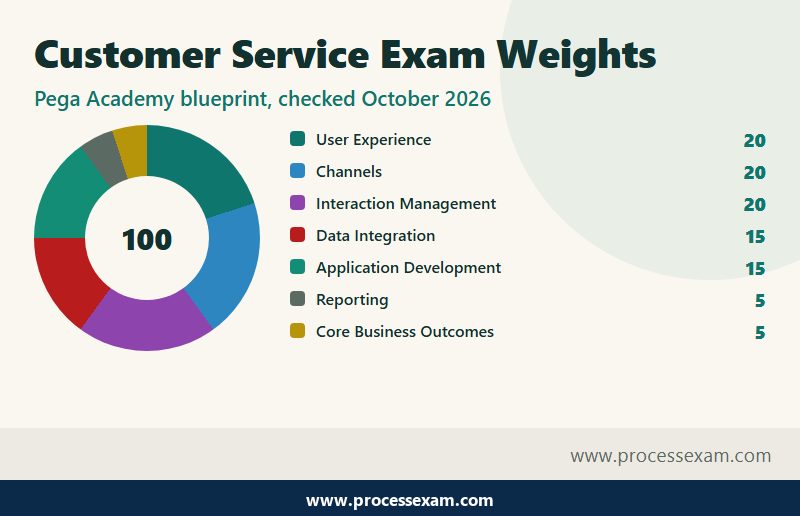
| Topic | Weight | Subtopics Pega lists |
|---|---|---|
| User Experience | 20% | Constellation UX best practices, composite best practices, composite tabs |
| Channels | 20% | Pega Call, Pega Digital Messaging, Pega Voice AI, email bots, agentic channels |
| Interaction Management | 20% | Dialogs, Pega Knowledge Buddy, business conditions, customer verification, suggesting content to agents |
| Data Integration | 15% | Common Data Model |
| Application Development | 15% | Center-out architecture, coexistence, Modular Enterprise Reuse, Pega Blueprint, Customer Service Constellation transition |
| Reporting | 5% | Insights, dashboards |
| Core Business Outcomes | 5% | Contact centre foundations, contact centre value drivers |
With 50 questions, the percentages translate roughly to ten questions for each of the three 20% topics, seven or eight for each 15% topic and two or three for each 5% topic. Pega does not say how many questions come from each topic, so treat those counts as an estimate, not a promise. The practical reading is that three topics, User Experience, Channels and Interaction Management, make up 60% of the paper. A candidate who is excellent on those three and weak elsewhere can still pass, while one who masters Reporting and Core Business Outcomes perfectly has only reached 10%.
Look also at what the list says about the product's direction. Voice AI, Knowledge Buddy, agentic channels and Blueprint appear next to older staples such as dialogs and the data model. The paper is as much about the newer AI-assisted parts of Pega Customer Service as it is about its foundations, so study material written for the '23 or '24 versions will miss part of what is tested. The Academy shows earlier versions of this exam still on its site, with their own exam codes, which is a good reason to check the code on any practice material before you trust it.
Why do channels and interaction management carry so much of the paper?
Because they are where a contact centre's money goes. A service organisation cares about how quickly a conversation is resolved and how many conversations one agent can run at once; channels and guided interaction are the levers for both. That commercial logic is visible in the topic list and in the smaller Core Business Outcomes topic, which asks about contact centre value drivers. A developer who cannot connect a design choice to a measure such as handling time is missing what the exam is probing.
Channels is a topic about arrival. Each channel brings its own technical shape: a voice call, a messaging thread, an email processed by a bot, an interaction started by an agentic process. The exam expects you to know which Pega capability covers which, and what the developer has to configure for each to reach an agent in a usable form. Expect scenario questions that describe a client request, for example adding a messaging channel to an existing service queue, and ask which feature or setup step fits.
Interaction Management is a topic about the conversation once it has arrived. Dialogs guide an agent through what to say or do. Customer verification controls what an agent may discuss until identity is established. Business conditions decide when a piece of guidance applies. Suggested content and Pega Knowledge Buddy put the right answer in front of an agent without a manual search. Candidates who treat this as a soft, business-side topic tend to lose marks, because the questions are about how it is configured, not why it is a good idea.
User Experience completes the 60%. Here the exam looks at Constellation practice and at the composite, the agent-facing view of a customer. Constellation is Pega's newer front-end architecture, and a recurring theme in this paper is the move toward it. Know what the composite is for, how tabs organise information for an agent and what counts as good practice in a Constellation-based design, as opposed to a configuration that technically works but overloads the screen.
The two 15% topics are smaller but not trivial. Data Integration is covered by one named subtopic, the Common Data Model, which makes it a narrow, learnable target: understand why the model exists and how an application maps client data to it. Application Development is the architectural topic. Center-out architecture, coexistence of old and new interface styles, Modular Enterprise Reuse and the transition to Constellation are about structuring an implementation so it survives the next release. This is where a general architect's judgement is most useful, and where Pega Blueprint, the tool that drafts application designs, enters the syllabus.
What does a preparation plan look like for an architect with a day job?
Start from the assumption that you already know Pega and are filling in a product. That changes the plan: you do not need a long foundation phase, you need contact with the product and a way to check what stuck. A plan of about four weeks of evenings fits most architects, and it can stretch to six if the environment is hard to get.
Week one: read Pega's exam page and the seven topics until you can recite the weights, then begin the Customer Service Implementation '25 mission. Keep a simple page with one line per subtopic and a mark for confident, shaky or unseen. Week two: finish the mission's build exercises, and spend extra time on the heavy topics, Channels and Interaction Management, by creating a dialog, a verification step and a business condition yourself instead of reading about them. Week three: take User Experience and Application Development, including the composite and the Constellation transition, and reread anything on your shaky list. Week four: cover the light topics, Reporting and Core Business Outcomes, in a couple of sittings, then test yourself.
Testing is where most plans are thin. Reading about Voice AI or Knowledge Buddy gives a false sense of coverage, because the exam asks you to choose between plausible options. Anchor the final week with a full pass through the CPCSD practice exam, and let the questions you get wrong decide where the last evenings go instead of rereading what you already know. Compare the topic you miss most against the weights in the table above and you will know whether to spend the time or accept the loss.
Two habits help. First, write down a one-line justification for each answer you review, because the exam rewards the reason behind a choice. Second, check each topic against the CPCSD exam syllabus page to make sure nothing on your list is missing; the page repeats Pega's seven topics and weights in one place.
How do you book the exam, and what happens on the day?
Pega runs its certifications through Pearson VUE. Pega Academy's exam page tells you to open a Pearson VUE account first, if you lack one, and book the exam there. The page names two delivery options: a test centre, or online proctored delivery from a quiet, uninterrupted room at home or in an office, watched over webcam. Pearson VUE's Pega page is where you find a test centre and read about online testing.
The sitting is 50 questions in 90 minutes, which works out to a little under two minutes per question. That is comfortable for most architects, so the time pressure is mild; the risk lies in the questions themselves, which describe a client situation and offer several answers that sound reasonable. Read the scenario for what the customer asked for, because options that add features nobody requested are usually wrong. The pass mark is 65%, so with 50 questions you need roughly 33 correct, though Pega publishes the pass mark only as a percentage, so aim comfortably above it.
Choose online proctoring only if you can guarantee the room. The practical failure points are not knowledge but logistics: a noisy household, an unstable connection or a desk that does not meet the proctor's checks. If any of those is a risk, a test centre removes it. Whichever you pick, book a date that follows your last full practice pass by a few days, not the same evening. Fresh recall on the heavy topics matters more than one more night of reading.
Languages are limited: Pega lists English only for this version. If English is not your first language, add margin for reading time and practise on scenario-style questions with the clock running, because the wording of customer service scenarios is where non-native readers are most likely to slow down.
When is the specialism worth it, and when should you wait?
It is worth it when your next project, or your next employer, is a Pega Customer Service project. Then the credential is a direct match for the work, the Customer Service Implementation mission doubles as onboarding and the exam gives a hiring manager a quick signal. It can also be worth it if you work for a Pega partner that bids on contact centre programmes; ask your delivery manager whether certified staff count in your bids rather than guessing.
It is less urgent when your current work is on other Pega applications and no customer service project is in sight. A System Architect or Senior System Architect badge covers more types of work. In that case you may do better to complete the next architect level first and come back to the specialism when a project calls for it. The product moves quickly, with Pega releasing yearly versions, so a certificate earned long before you use it can go stale on knowledge.
The cautious reading is also the honest one: the specialism buys relevance, not a guarantee. Employers hire for project fit, and a credential in the right product area shortens the conversation. If you have already built a Pega Customer Service project, the exam mostly confirms what you know, and the cost is small. If you have not, the Academy mission and the exam give you a structured way to learn the product, and you come out with both the skills and the certificate. Either way, the decision to sit it should follow a concrete project or role, not the general feeling that another badge is a good idea.
If you decide to go ahead, the order is simple. Confirm the version on Pega Academy's exam page on the day you start, because Pega publishes a new version each year. Work through the mission, rehearse the three heavy topics by building, and book your slot through Pearson VUE once practice results are steady.
Frequently Asked Questions
How many questions are on the Pega Customer Service Developer exam?
The exam has 50 questions and lasts 90 minutes, which gives you a little under two minutes per question. Pega lists the passing score as 65%. The questions are scenario based and written for Pega Customer Service '25, and the exam is delivered in English through Pearson VUE.
Who is the Pega Customer Service Developer certification for?
Pega designed it for System Architects and Senior System Architects who want to validate that they can implement Pega Customer Service applications. It is a specialist step after the architect track, and Pega Academy lists the Customer Service Implementation '25 mission as the prerequisite before you sit the exam.
How much does the Pega Customer Service Developer exam cost?
The exam is listed at USD $190 as of October 2026, the same figure as the Certified Pega System Architect exam. Pega delivers it through Pearson VUE, so confirm the final amount in your own currency when you book, and ask your employer whether exam fees are reimbursed.
Which exam topics carry the most weight?
User Experience, Channels and Interaction Management carry 20% each, so together they make up 60% of the paper. Data Integration and Application Development carry 15% each, and Reporting and Core Business Outcomes carry 5% each. Study the three heavy topics hands-on before the lighter ones.
Which version of the exam does Pega offer today?
As of October 2026, Pega Academy lists one current version, code PEGACPCSD25V1, which applies to Pega Customer Service '25 and shows no retirement date. Older versions with codes ending 23V1 and 24V1 appear on the Academy site, so check the code on any study material before relying on it.
- Pega Customer Service Developer Test Questions |
- CPCSD Question Bank |
- Pega Customer Service Developer Book |
- Customer Service Developer Certification Cost |
- Customer Service Developer Certification Requirements |
- Pega Customer Service Developer Sample Questions |
- CPCSD Exam Questions Download |
- CPCSD Test Questions |
- Customer Service Developer PDF |
- PEGACPCSD25V1 Mock Exam |
- PEGACPCSD25V1 Simulator |
- Pega PEGACPCSD25V1 Book |
- Pega PEGACPCSD25V1 Question Bank |
- Pega PEGACPCSD25V1 Study Guide |
- PEGACPCSD25V1 Certification |
- PEGACPCSD25V1 Certification Cost |
- PEGACPCSD25V1 Certification Requirements |
- Pega PEGACPCSD25V1 Exam Questions |
- Pega PEGACPCSD25V1 Sample Questions |
- PEGACPCSD25V1 |
- PEGACPCSD25V1 PDF


