
How to Prepare for the Pega CPDC '26 Exam: Topics and Study Plan
Updated on 29 October 2026. What’s new: updated for the Pega Customer Decision Hub '26 exam, code PEGACPDC26V1, replacing the older Version 8.4 paper
Pega renames its exams with every release, so a CPDC guide from two years ago may describe a paper nobody can book. Pega Academy now lists PEGACPDC26V1, written for Pega Customer Decision Hub '26: 60 questions, 90 minutes and a 70% pass mark. This article shows what that blueprint rewards, how its scenario questions are built, and a five-week plan that follows Pega's own training.

Which CPDC version is Pega running now, and does an older guide still help?
Pega Academy's Certified Pega Decisioning Consultant exam page shows the exam code PEGACPDC26V1 and the line "Applies to: Pega Customer Decision Hub '26". It lists no retirement date. That was the position in October 2026, and Pega can revise the page at any time, so read it again on the day you book.
That matters because searchers still type older labels into Google: PEGACPDC25V1, 88V1, even 72V1. Those codes belong to earlier releases of the product. The training mission carries the same history. The version list on its page runs from Pega Customer Decision Hub 8.4 through 8.5, 8.6, 8.7, 8.8, '23, '24.1, '24.2 and '25 up to '26, one entry for each release. An old article that talks about a "Version 8.4" paper with drag-and-drop questions is describing the oldest entry on that list, not today's exam.
What an older guide still gets right
Do not throw old notes away. The job the exam tests has not changed: use Next-Best-Action Designer and 1:1 Operations Manager, then decision strategies and predictive analytics, on a real customer-engagement problem. A guide written for the '25 release will still explain engagement policies, arbitration and contact limits correctly. What it will not know is the exact topic list, the screens in '26, or features Pega added since, such as managing brand voice with Pega GenAI, which appears among the '26 business-agility topics.
A quick test for any study material
- Does it name PEGACPDC26V1 or Customer Decision Hub '26? If it names another code, treat it as background reading.
- Does it list eight topic areas and their weights? Material with a different count is older.
- Does it quote a price or a date without saying where it was checked? Confirm on Pega Academy before relying on it.
| Exam fact | Detail |
|---|---|
| Applies to | Pega Customer Decision Hub '26 |
| Exam code | PEGACPDC26V1 |
| Questions | 60 |
| Time allowed | 90 minutes |
| Pass mark | 70% |
| Fee | USD 190 |
| Level and language | Beginner, English |
Which Customer Decision Hub concepts carry the most weight?
The exam page splits the paper into eight topic areas. The weights add up to 100%, and the three biggest, engagement policies, decision strategies and business agility, each take 15%. Contact policy and volume constraints take 13%, Next-Best-Action concepts and actions and treatments 12% apiece, channels 10% and AI and Arbitration 8%.
Eight rows are hard to plan around, so this article folds them into three working groups. The grouping is ours, made to help you divide your time, and Pega does not publish it:
| Working group | Pega topic areas inside it | Combined weight |
|---|---|---|
| What may be shown | Engagement policies 15%, contact policy and volume constraints 13% | 28% |
| What is best to show | Next-Best-Action concepts 12%, decision strategies 15%, AI and Arbitration 8% | 35% |
| How it is built and run | Actions and treatments 12%, channels 10%, business agility 15% | 37% |
The largest group is the one many candidates neglect. "How it is built and run" covers writing actions, delivering them through channels and changing them safely after launch. Someone who has watched a Customer Decision Hub project from the design side may meet the change-request material for the first time here, so give it real study hours.
Where do adaptive models fit?
Adaptive models are not a topic area of their own on this blueprint. They sit behind the 8% AI and Arbitration block, which lists action arbitration, action prioritization with AI and prioritizing actions with business levers. An adaptive model learns from how customers respond, accepted or ignored, and turns that into a propensity score for each action. Arbitration then uses the score together with the action's business value and the levers the business sets. For a '26 candidate the key point is simple: the model predicts, the levers steer, and arbitration combines them into an order.
Pega also runs a separate certification for data scientists who build these models. A decisioning consultant needs to understand what the model does for the decision, not how to train it.
What do Next-Best-Action Designer, engagement policies and arbitration each decide?
Candidates often blur three ideas that the exam keeps apart. A useful habit is to attach one question to each, then ask which question the scenario is really about.
Next-Best-Action Designer: where is the decision set up?
Next-Best-Action Designer is the workspace Pega's training uses for authoring next-best-action decisions: which actions exist, which conditions limit them, how they are ranked and which channels carry them. It is also the first of the four tools the exam page names. When a question asks where a business user would configure a new offer or a new limit, think of Designer before anything else.
Engagement policies: is this action allowed?
Engagement policies answer a yes-or-no question for each action and customer. If the answer is no, the action never reaches the ranking. Pega's topic list pairs them with engagement strategies and customer journeys, so expect questions about how an action is kept out, and about how a journey adds a sequence of steps over time.
Arbitration: of those allowed, which goes first?
Arbitration starts only after policies have done their work. Every action that survived is ranked, using the adaptive models' propensity, the value of the action to the business and any levers. A lever lets the business push a whole group of actions up or down without editing each one, which is why Pega lists "prioritize actions with business levers" as its own exam objective.
Where journeys and strategies come in
Two more ideas from the topic list sit between the three above. A customer journey strings several actions into a sequence, so that what happens next depends on what the customer did last. A decision strategy is the logic behind the ranking, and the exam asks you both to create one and to read one that someone else built. Reading practice matters more than most candidates expect: given a diagram of a strategy that uses a credit score, can you say what it will do for a customer with a low score?
A sentence to memorise
Policies decide who is in, arbitration decides who is first, contact limits decide how often. If you can put each scenario sentence into one of those three buckets, most of the first half of the paper becomes straightforward.
The Customer Decision Hub documentation on Pega Docs is worth keeping open beside the training, because it describes the same features in the vendor's own reference wording.
How is a decisioning scenario question built?
Most CPDC questions are short stories with a symptom. The text describes a customer or a team, says what went wrong or what the business wants, then offers four answers that each belong to a different part of Customer Decision Hub. Reading the question is therefore a diagnosis exercise: find the stage that explains the symptom, then pick the answer that acts on that stage.
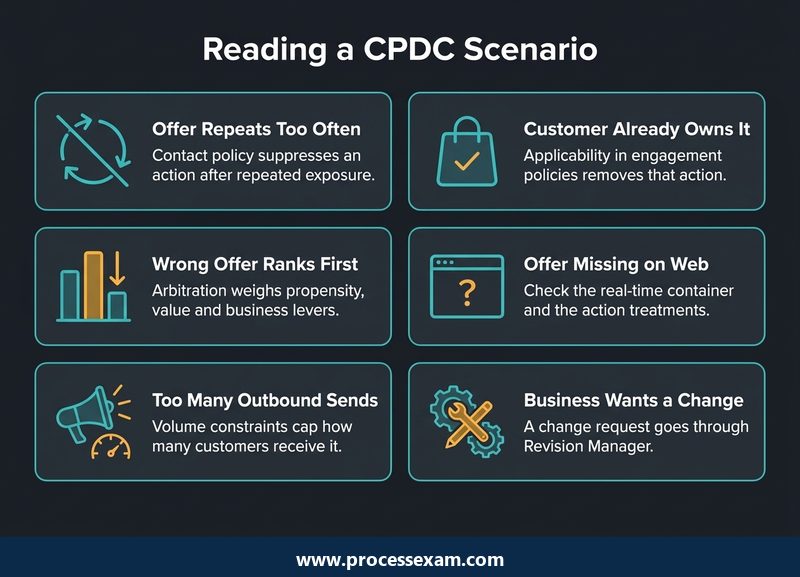
Three worked examples
A health insurer's renewal reminder. A customer renewed their policy last week, but the web portal still shows a renewal prompt. Nothing is wrong with ranking here, because the action should never have been in the running. This points to an engagement rule about whether the action applies to the customer's current status.
A retailer's weekend email. The same loyalty offer has reached the same shopper on four consecutive days. The offer itself is fine and the customer qualifies. What is missing is a limit on repeated exposure, which belongs to contact policy rather than to eligibility.
A utility company's new tariff. Marketing wants a new tariff offer to appear on the web only after the legal team approves the wording. The question here is about process, not about decisioning logic, so the answer concerns a change request and a controlled release, the territory of 1:1 Operations Manager and Revision Manager.
A bank's outbound email run. The marketing team wants to send a savings offer to every customer on the list, but the email platform can only handle a fixed number of sends per day without slowing down. The offer is right and the customers qualify. The constraint is capacity, so the answer is a volume limit on the outbound action, set so that the best-ranked customers are served first.
A travel brand's two offers. A customer qualifies for both a lounge pass and a hotel upgrade, and the business would rather push the hotel upgrade this quarter. Neither offer is excluded, so policies are not the issue. The question is which comes first, and the business-lever answer is the one that changes the order without touching either action.
Reading the answer options
- Cross out answers that fix the wrong stage. Raising a lever does not stop an offer repeating, and a new contact limit does not repair a bad ranking.
- Watch absolute words. "Always", "never" and "only" in an option are usually wrong, as in every vendor exam.
- Prefer the business-user route. Where one option has a developer changing code and another uses a configuration screen in Designer, the exam usually favours configuration.
Which Academy mission parts feed which exam topics?
Pega's Decisioning Consultant mission for Customer Decision Hub '26 is the training that Pega itself ties to this certification. The mission page lists five parts and a total length of 1 day 8 h 35 m. The table below pairs each part with the exam areas it supports. The pairing is ours, made by comparing the part descriptions with the topic list.
| Mission part | Time on the Academy page | Exam areas it mostly supports |
|---|---|---|
| Customer Decision Hub Foundation | 4 h 40 m | Next-Best-Action concepts |
| Cross-Sell on the Web | 6 h 20 m | Actions and treatments, engagement policies, channels |
| Cross-Sell on the Web Extended | 12 h 50 m | Decision strategies, AI and Arbitration |
| Always-On Outbound Customer Engagement | 6 h 10 m | Contact policy and volume constraints, outbound actions |
| Business Agility in 1:1 Customer Engagement | 8 h 15 m | Business agility |
The extended part is the longest and is best treated as the hands-on lab. Its description says the Next-Best-Action strategy framework ships with the product and gives best practice for implementation, which is the background decision-strategy questions assume.
Why the mission is not the whole plan
Watching modules teaches you what a screen does. The exam asks what you would do when a customer complains. Pega's mission includes challenges, which are practical tasks, so do them rather than skipping to the next module. Then add a second layer of your own: after each module, write three symptoms the feature could cause or cure, and map each to a stage.
In what order should the CPDC topics be studied?
The plan below suits someone working full time who can give roughly one hour on weekdays and a longer block at the weekend. It follows the order of Pega's own training because that order builds from the idea to the build to the change process.
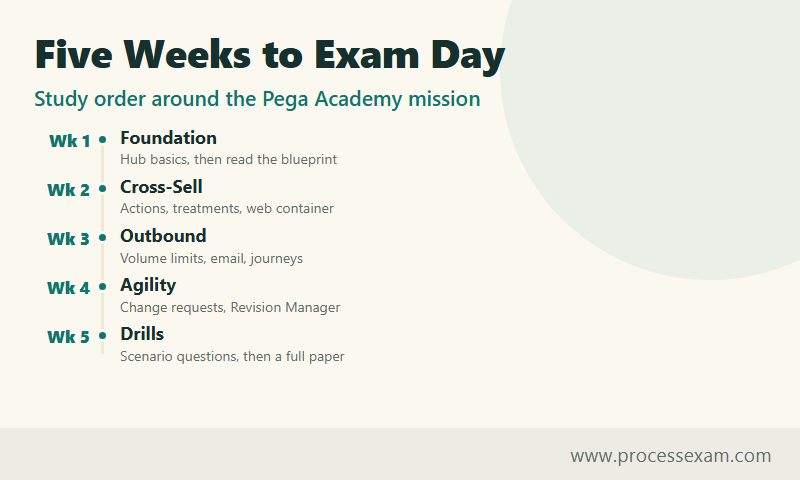
Week 1: foundation and blueprint
Complete the Customer Decision Hub Foundation part and read the eight topic areas on the exam page line by line. For each bullet, write one sentence saying what it means in a customer example you invented. Gaps show up immediately: if you cannot write the sentence, mark the bullet.
Week 2: actions, treatments and the web
Work through Cross-Sell on the Web, including its challenges. Build an action and its treatments in a practice environment if you have access to one, and practise explaining why the action and its treatments are kept apart.
Week 3: outbound and limits
Take the Always-On Outbound part. Concentrate on two ideas: exposure limits on what a customer sees, and volume limits on what the business sends. Many people confuse them because both are "limits", but one protects the customer and the other protects the business's capacity.
Week 4: strategies and change
Spend the first half on decision strategies and arbitration, including the strategy that uses a credit score. Spend the second half on Business Agility in 1:1 Customer Engagement: the life cycle of a change request, request types, bulk updates to actions and implementing business changes with Revision Manager.
Week 5: drills and one full paper
Stop learning new features. Take scenario questions in blocks of ten, and for every miss write which stage the symptom pointed to. Finish the week with one full paper of 60 questions under the real time limit, then spend the remaining days only on the stages you missed.
Revising the smaller topics
Channels, at 10%, and AI and Arbitration, at 8%, are easy to under-study because each looks small beside the 15% areas. Together they are 18% of the paper, close to a fifth of the paper. For channels, make sure you can explain what a real-time container does, how an offer email differs from a web offer, and what it means to share action details with third-party distributors. For arbitration, practise stating in one sentence how propensity, value and levers combine, then test the sentence against a scenario in which only one of the three changes.
Keeping notes that help
A short notebook beats a long one. Give every topic area one page with three headings: what it decides, what goes wrong when it is misconfigured, and the screen where you set it. When you meet a scenario question that surprised you, add one line to the page it belongs to. By week five those pages are your revision pack, and they are written in the words you actually think in.
How do you pace the 90 minutes and decide you are ready?
Sixty questions in 90 minutes leaves about a minute and a half each. Scenario questions run longer than definition questions, so a sensible approach is a first pass in which you answer whatever is clear, flag the rest, and return with the time you saved. A checkpoint at the halfway point of the clock, with roughly half of the questions answered, keeps you honest without needing a stopwatch for every item.
Readiness signs
- You can name, without notes, the stage that explains each of the six symptoms in the graphic above.
- You can describe the change-request life cycle in your own words, because that block is as heavy as engagement policies.
- Your practice scores sit comfortably above 70% over several attempts, not in one lucky run.
When those three hold, a CPDC practice exam is a sensible last step to test your pacing against the real question count, and each missed question tells you which working group to revisit.
Booking and sitting
Pega Academy says Pearson VUE proctors the exam. You register through a Pearson VUE account and choose between a test centre and an online proctored session in a quiet room with a webcam. The fee is USD 190 as listed by Pega; confirm the amount when you register, because Pega can change it.
Where does CPDC fit among the other Pega certifications?
Decisioning is its own track at Pega. CPDC is a beginner-level exam that sits beside the Data Scientist exam, which covers the models behind the decisions, and the System Architect exams, which cover the platform around them. Pega's certifications page lists every current exam, and ProcessExam's Pega certification pages gather the practice material for each in one place.
If you work in marketing operations or analysis, CPDC is a natural first Pega exam, because Pega names the Decisioning Consultant mission, not another certificate, as the preparation. A system architect who is asked to support a Customer Decision Hub programme can add it for the decision layer. Either way, the preparation above turns the exam into a rehearsal of the work: read a symptom, find the stage, change the right thing.
Frequently Asked Questions
What does CPDC stand for, and which exam code applies now?
CPDC stands for Certified Pega Decisioning Consultant. Pega Academy lists the current exam as PEGACPDC26V1, which applies to Pega Customer Decision Hub '26 and showed no retirement date when checked in October 2026. Codes such as PEGACPDC25V1 or 88V1 belong to earlier releases.
How many questions are on the CPDC exam, and what is the pass mark?
The CPDC exam has 60 questions, gives you 90 minutes and needs a 70% score to pass. Pega lists it at beginner level, in English, and the exam fee is USD 190. Pearson VUE proctors it, either at a test centre or online.
Which CPDC topics carry the most weight?
Three topics tie for the largest share at 15% each: engagement policies, decision strategies, and business agility in 1:1 customer engagement. Contact policy and volume constraints take 13%, Next-Best-Action concepts and actions and treatments 12% each, channels 10% and AI and Arbitration 8%.
How long is Pega's Decisioning Consultant mission?
Pega Academy lists the Decisioning Consultant mission for Customer Decision Hub '26 at 1 day 8 h 35 m across five parts, from the Foundation part to Business Agility in 1:1 Customer Engagement. Plan extra time for practising challenges and revising, because watching the modules alone does not prepare you for scenario questions.
Can I take the CPDC exam online?
Yes. Pega Academy states that Pearson VUE proctors the exam and offers two delivery options: a test centre, or online proctored delivery in a quiet, uninterrupted room at home or in an office, supervised by webcam. Register through a Pearson VUE account and read the current rules there.
- Pega Decisioning Consultant Test Questions |
- Pega Decisioning Consultant Book |
- Decisioning Consultant Certification Cost |
- Decisioning Consultant Certification Requirements |
- Pega Decisioning Consultant Sample Questions |
- Decisioning Consultant PDF |
- CPDC Question Bank |
- CPDC Exam Questions Download |
- CPDC Test Questions


