
APMG Lean Six Sigma Green Belt: The Theory Exam and the Two Projects Behind It
Updated on 15 October 2026. What’s new: the theory exam fee is USD $512, and full Green Belt status also needs a practical assessment of two projects.
Meena, an operations lead at a packaging plant, passes the APMG Lean Six Sigma Green Belt theory exam on a Tuesday and changes her CV to "Green Belt" that evening. The certificate that arrives reads Green Belt Theory. Full status takes a second step: a practical assessment of two real improvement projects. The theory part is 60 multiple-choice questions in 180 minutes, open book, with 63% to pass.

That gap between "passed the exam" and "certified Green Belt" is the detail most short summaries of this credential skip, and it changes how you plan. This guide takes the route in the order you will meet it: what you must pass, how the paper behaves, what the syllabus covers, how to use the books you may carry in, what the project assessors look for, what the route costs in time and money, and what each half of the credential is worth on a CV.
What do you have to pass to be a certified APMG Green Belt?
Two things, in this order. First the Lean Six Sigma Green Belt theory exam, which APMG's booking page lists as version 3.2. Then a practical assessment, in which you submit two Lean Six Sigma projects that show real savings. APMG's own candidate guidance calls it a two-step process: pass the theoretical exam, then pass the practical assessment.
Pass only the first step and APMG recognises the theory element: you receive a Green Belt Theory certificate and digital badge. Pass both and you receive the Green Belt Certified certificate and badge. APMG gives its reason in the practical assessment Q&A: certified status is meant for people with a track record of applying Lean Six Sigma at work, an exam cannot test that experience, so projects are required.
The scheme is run by APMG International with the Lean Six Sigma Academy (LSSA), whose "Climbing the Mountain" books underpin the syllabus. APMG's certification page for the scheme is at apmg-international.com, and it confirms that you can enter at any belt level, so a Yellow Belt is not a prerequisite for the Green Belt.
Here are the theory exam facts in one place:
| Exam detail | APMG International Lean Six Sigma Green Belt |
|---|---|
| Full name | APMG International Lean Six Sigma Green Belt |
| Exam code | Lean Six Sigma Green Belt |
| Vendor | APMG International |
| Version | version 3.2 |
| Exam fee | USD $512 |
| Exam duration | 180 minutes |
| Number of questions | 60 |
| Passing score | 63% |
| Format | Multiple choice |
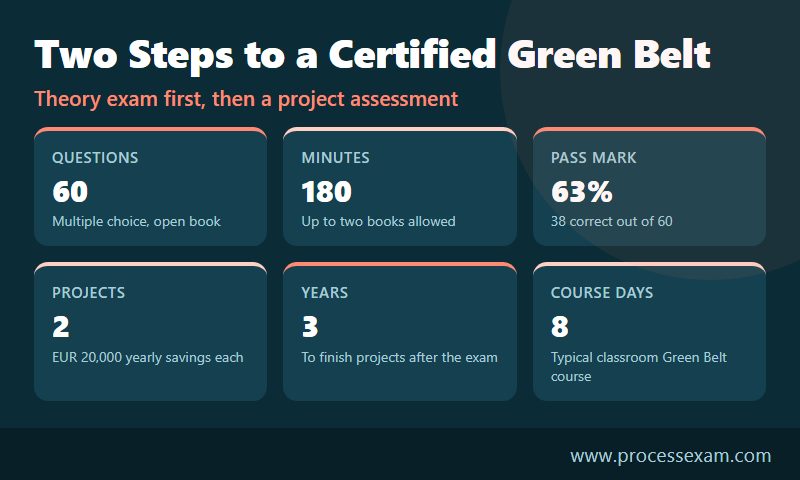
A pass mark of 63% on 60 questions means 38 correct answers, the figure APMG quotes in its candidate guidance. The practical assessment has no score at all: it is marked Pass or Fail.
How does the 180-minute open-book paper behave on the day?
Three minutes per question is generous for multiple choice, and that is deliberate. The paper is open book: APMG's guidance lets candidates take up to two Lean Six Sigma books into the exam, and it states that exercise books are not permitted. Its scheme overview adds that Minitab software may be used. If your preparation leans on a statistics package, ask APMG or your training organisation what applies to your own sitting before you rely on it.
APMG sells the theory exam through its public booking site, where the paper is titled Lean Six Sigma Green Belt Theory Exam (3.2). The price shown there is GBP 470, with the final price and currency worked out after you enter your address, so the dollar figure in the table is a conversion and your own total can differ slightly. After payment, APMG invites you within 24 hours to create an account on its Candidate Portal, where you schedule the sitting for a date of your choosing. The exam can be taken online through APMG's online exam system, in English or Dutch.
What rescheduling and cancelling cost
The booking terms set the rules. An online sitting can be moved at no cost if you change it through the Candidate Portal at least 24 hours before the start; inside 24 hours an administration fee applies, listed as GBP 40 or USD 40. A paper sitting needs ten working days' notice. If you cancel, you write to APMG, the administration fee is deducted and the balance is refunded within 30 days. The fee is not refunded if you simply do not show up. Read these terms before you pick a date close to a project deadline.
What "open book" does and does not do for you
It removes the need to memorise a formula sheet. It does not remove the need to know where things are, and it does not make hard questions easy. A paper that allows two books still has to be answerable in 180 minutes, so the questions test whether you can apply a method to a situation, not whether you can recite a definition. A candidate who knows the content well and carries a tidy book finishes with time to spare; one who is hunting through an unfamiliar book for every answer does not.
Which topics does the syllabus ask you to handle?
APMG's scheme overview says the syllabus is built on the Continuous Improvement Maturity Model (CIMM), a staged framework that draws on total quality management, Kaizen, total productive maintenance, Lean, Six Sigma and Design for Six Sigma. It lists eight key areas: World Class Performance, Policy Development and Deployment, Project Management, and five maturity levels that run from an organised workplace up to designing products and processes that perform at a Six Sigma level from the start.
The learning outcomes APMG publishes line up with those levels roughly as follows. Treat the mapping as a revision frame, not an official weighting, because APMG does not publish a percentage split in the documents it makes available.
- The foundation level. An organised work environment, reliable equipment and standardised work, the base that any further improvement stands on.
- The culture level. Setting up and facilitating Kaizen teams, problem solving and brainstorming, basic quality tools, and the leadership and change management that let improvement spread across an organisation.
- The stable and efficient level. Tools to visualise, analyse and improve the flow of work so processes become more stable, predictable and productive. This is the Lean half of the title.
- The capable level. Six Sigma and statistical tools, including a valid and reliable measurement system, used to reduce variation. This is the Six Sigma half, and the one where calculation questions are most likely to catch a first attempt.
- The top level. Applying Six Sigma tools early in product and service development, so the design performs at a Six Sigma level.
- World class performance, policy deployment and project management. How improvement links to strategy, and how a project is planned, run and signed off.
APMG states the purpose of the Green Belt as knowledge, understanding and application of the methodology, practice and analytical tools, enough to lead a Lean Six Sigma project or to work inside a Black Belt-led one. The topic list on the Green Belt syllabus page is a useful companion when you turn that into a revision checklist.
The reading list is short by certification standards. The syllabus is underpinned by LSSA's "Climbing the Mountain" Green Belt book, written by H.C. Theisens, which APMG's certification page names as the textbook to buy for self-study. APMG also provides a free Green Belt sample exam that is marked automatically. Use that sample early, as a diagnostic, because it shows the question style before you have spent weeks on the wrong chapters.
How should you prepare the two books you carry into the exam?
With the open-book rule, the book you bring is part of your preparation, not just a safety net. A few habits separate a book that saves marks from one that wastes minutes.
- Index it yourself. Add tabs for each maturity level and for the tools you use least: measurement system checks, capability indices, hypothesis tests and control charts. Tabs built from your own study map to the way you think, which is faster than the printed index at question 47.
- Write the decision rules in the margins. The questions that eat time are choices: which chart, which test, which tool for this symptom. A one-line rule beside the relevant page ("two groups, continuous data, compare means") beats rereading a whole section.
- Do not rely on it for the basics. If you have to look up what DMAIC stands for or what a value stream map shows, you will run short on the calculation questions. Learn the vocabulary cold and keep the book for detail.
- Choose the second book on purpose. Two books are allowed, so you can carry the main text plus a reference that is strong where the first is weak. Confirm with APMG or your training organisation that your choice is a permitted Lean Six Sigma book and not an exercise book.
Practise with the same two books you will carry; a practice session that quietly uses the internet teaches a speed you will not have on the day. To see how 60 multiple-choice questions read before you book, the Lean Six Sigma Green Belt practice exam is a way to test your tabs against realistic wording.
Where open-book candidates can lose time
Three habits waste minutes on any open-book paper: reading every option in full before looking at the question stem, chasing a calculation through the book before eliminating the two obviously wrong options, and leaving the hardest-looking item to the last ten minutes without flagging it, so it gets a rushed answer. A budget of about two minutes per question, with the remaining hour kept in reserve for flagged items, uses the 180 minutes better than going strictly question by question.
What must the two project submissions prove?
This is the part short summaries leave out, and it is where a Green Belt becomes a certified one. APMG's practical assessment guidelines, dated December 2023, set out the requirements.
- Two projects. You must have worked on two Lean Six Sigma projects that delivered significant savings or cost reductions. For the Green Belt, each project must show savings or cost reductions of at least EUR 20,000 per year; APMG's scheme overview adds that the bar can alternatively be met by substantially improving another relevant critical-to-quality measure such as lead time.
- A recognised roadmap. Submissions must follow the DMAIC or DMADV roadmap (the scheme overview also lists PDCA).
- Sign-off. The project documentation must be signed off by a Champion or controller inside your organisation.
- A template. You submit on the LSSA practical assessment template, free from the Lean Six Sigma Academy, or an in-house version with the same content, together with a candidate self-assessment and an application form.
- Order and time limit. You must pass the theory exam first, and you must complete the practical assessment within three years of passing it.
There is no minimum length of experience. What matters is whether you have projects to submit. Master Black Belts appointed by LSSA carry out the assessment, and APMG says you can expect a result within four weeks. On a Fail you get short guidance on the criteria marked Missing or Incorrect, and a single resubmission is allowed. Once passed, the Green Belt practical does not expire and needs no surveillance activity to keep.
What assessors expect to see
The guidelines describe what a project at maturity level IV should demonstrate: a deliberate reduction in the variation of the process, not only the removal of special causes; statistical proof that individual inputs significantly influence the output; statistical proof that both the average or median and the variation improved; and evidence that the process is more stable and more capable afterwards. A designed experiment is an extra, not a requirement.
The same document lists the mistakes assessors see most often, and they make a better checklist than any generic advice:
- assuming the reader knows your process, or using acronyms without explaining them;
- presuming the data is sound without investigating the measurement system, or skipping the stability and capability check afterwards;
- jumping between slides without telling the story, or filling slides with text where a diagram or table would do;
- not explaining changes made to the scope or goal during the project;
- saying there is a difference without showing a p-value, and leaving out the stakeholder analysis and communication plan.
Read APMG's Green and Black Belt practical assessment guidelines in full before you start a project, not after, because most of the items are about what you record while the work is happening and cannot be reconstructed later.
What does the whole route cost in time and money?
APMG lists three ways in. A training organisation can run the course and arrange the exam; the typical classroom course for the Green Belt, according to APMG, lasts eight days. You can study through self-paced e-learning or a virtual classroom. Or you can self-study with the textbook and book the exam directly. The exam can also be taken at the end of an APMG-accredited course.
The cost has four parts, and only one of them is the fee in the table above.
- The theory exam. USD $512 in the table; APMG's booking page quotes GBP 470 and converts to your currency at checkout.
- Study material or a course. The Green Belt textbook for self-study, or a course fee set by the training organisation.
- The practical assessment fee. Charged separately by APMG when you submit, whether you apply directly or through your training organisation. Check the current amount at booking, because the figures printed in APMG's older guideline documents are dated.
- Your time on two projects. The largest cost by far, and the one most candidates underestimate.
The practical assessment can only follow the theory exam, but the projects can start long before it. The efficient order is therefore to find your two projects first, run them alongside your study, and book the exam once you can hold the methodology in your head. A candidate who starts looking for a project after passing the exam spends much of the three-year window on the part that has least to do with revision.
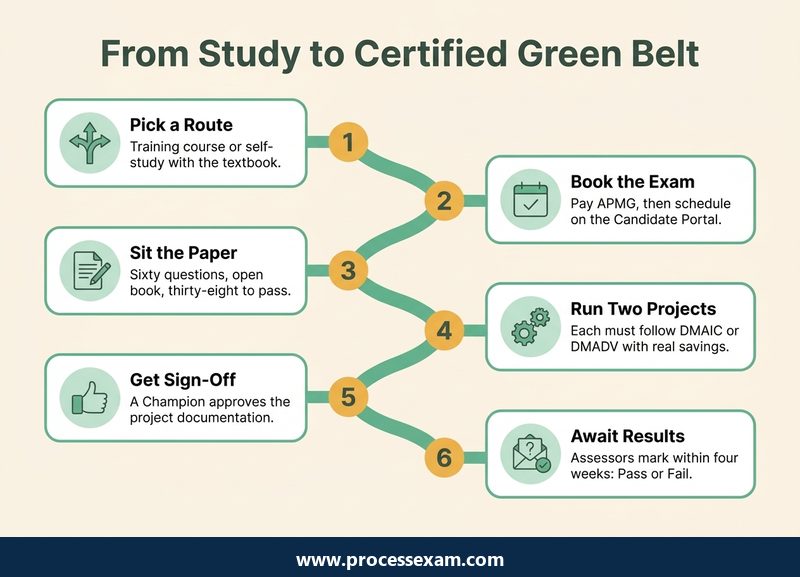
The roadmap below shows the route as milestones, from choosing a study route to receiving the result.
How to share the effort between study and projects
Book the theory exam for a date you can defend, then protect time for the documentation. The write-up is where the three-year limit and the four-week marking window matter: leave room for a possible resubmission, since only one is allowed.
What is a theory-only Green Belt worth, and what does the full credential change?
A Green Belt Theory certificate is real evidence that you have passed a 180-minute exam on the methodology. It is not the same as Green Belt Certified, and APMG issues the two as different certificates. On a CV, write the name of the certificate you hold: an employer who asks for a Green Belt and later reads your certificate will trust the precise claim far more than the approximate one.
The full credential changes the conversation at work because it comes with documented projects, signed off by a Champion, that show a result. That is what a hiring manager or a continuous improvement lead can ask about in an interview. APMG describes the Green Belt as a specialist in implementing Lean Six Sigma projects, working alone or as a junior project manager, or as a team member on a larger Black Belt project, with job roles such as engineers, process owners and project leaders. Its overview also names continuous improvement, operations, team, project, change, finance, IT and HR managers as the people the scheme is aimed at.
It helps to set this route against other Green Belts, because they are built differently. Some vendors' Green Belt credentials, IASSC's for example, are decided by a single exam. APMG's adds a project-based step. That makes it heavier to complete, but it is also the version where the result carries your own organisation's numbers. If you cannot get access to a real project, the theory certificate is the honest outcome; if you can, the second step is what the full credential is worth.
The belts also stack without a fixed order. Because APMG allows entry at any level, someone with project experience can sit the Green Belt directly and add a Black Belt later, which asks for two further projects at a higher savings threshold.
If you are weighing the cost of the route against what you might earn, rely on salary surveys from your own market rather than on any blanket figure for belt holders. APMG publishes no such figure, and a number copied from an unrelated site says nothing about your employer.
Frequently Asked Questions
How many questions are on the APMG Lean Six Sigma Green Belt exam?
The theory exam has 60 multiple-choice questions to be answered in 180 minutes, and the pass mark is 63%, which APMG expresses as 38 correct out of 60. That is a little under three minutes a question, enough to consult the books you are allowed to bring.
Is the APMG Lean Six Sigma Green Belt exam open book?
Yes. APMG's candidate guidance lets you take up to two Lean Six Sigma books into the Green Belt theory exam, and exercise books are not allowed. Its scheme overview also says Minitab software may be used. Confirm the rules for your own sitting when you book.
Do I need the practical assessment to be a certified Green Belt?
Yes, for full status. Passing the theory exam alone earns a Green Belt Theory certificate and badge. To become Green Belt Certified you must also pass the practical assessment of two Lean Six Sigma projects, within three years of passing the theory exam.
How much does the APMG Green Belt exam cost?
The theory exam fee is USD $512. APMG's booking page lists the paper at GBP 470 and shows the final price and currency after you enter your address. The practical assessment is charged separately, so check both amounts before you plan your budget.
Do I need a Yellow Belt before the APMG Green Belt?
No. APMG states that you can enter the Lean Six Sigma certification at any belt level, depending on your knowledge and experience, so you do not have to earn a lower belt before a higher one. You still need the Green Belt theory exam and the practical assessment.
- Lean Six Sigma Green Belt PDF |
- Lean Six Sigma Green Belt Certification |
- Lean Six Sigma Green Belt Certification Cost |
- Lean Six Sigma Green Belt Certification Requirements |
- APMG International Lean Six Sigma Green Belt Quiz |
- Lean Six Sigma Green Belt Questions |
- Lean Six Sigma Green Belt Exam Questions Download |
- Lean Six Sigma Green Belt Sample Exam |
- Lean Six Sigma Green Belt Test Questions |
- Lean Six Sigma Green Belt Practice Test |
- Lean Six Sigma Green Belt Study Guide Material |
- APMG International Lean Six Sigma Green Belt Exam Questions |
- APMG International Lean Six Sigma Green Belt Question Bank |
- APMG International Lean Six Sigma Green Belt Questions |
- APMG International Lean Six Sigma Green Belt Study Guide |
- APMG International Lean Six Sigma Green Belt |
- APMG International Lean Six Sigma Green Belt Book |
- APMG International Lean Six Sigma Green Belt Sample Questions


