
How to Pass the SAFe POPM Exam: Syllabus, Cost and Study Plan
Updated on 21 September 2026. What’s new: updated for the AI-Empowered POPM exam, with the pass mark corrected to 82%, six domains and current attempt terms.
Your team backlog needs refining before Friday, PI planning is three weeks away, and somebody still has to decide what the next increment actually delivers. The SAFe POPM exam is built around that exact week. It asks 45 questions in 90 minutes, needs 82 percent to pass, and moves through six domains that follow a Product Owner or Product Manager from vision and roadmap into PI planning, iteration execution and the responsible use of AI in product work.
That framing matters, because it explains why candidates who know the Scaled Agile Framework well can still fail. The questions rarely ask for a definition. They put you in a situation a product role meets on a normal Tuesday, give four plausible options, and ask which one a SAFe Product Owner or Product Manager would choose. This guide covers what the exam tests, how the current syllabus is weighted, what it costs, how long preparation realistically takes, and the errors that most often turn a near miss into a fail.
What does the POPM exam actually test about your week as a product owner?
Strip away the certification language and the Certified SAFe Product Owner/Product Manager credential is about one question: can you keep a stream of value flowing through an Agile Release Train without losing sight of what the customer is paying for? Everything on the exam maps back to a task a product role performs.
Refining the team backlog so it stays ready an iteration ahead. Writing stories whose acceptance criteria a developer and a tester can read the same way. Splitting a feature that is too big for one iteration. Prioritising with an economic model rather than by whoever shouted last. Walking into PI planning with a vision, a roadmap and a prioritised ART backlog instead of a wish list. Standing at the draft plan review knowing which dependency will break first. Then running the increment: iteration planning, flow on the team Kanban, backlog refinement, iteration review, the PO sync, the system demo and Inspect and Adapt.
Two things follow from this. First, experience helps more than memorisation, because most questions describe a situation you either recognise or you do not. Second, gaps are easy to spot in advance. If you have never sat in a PO sync, or you have never watched a system demo pull an ART back to reality, those are the parts of the syllabus to study hardest, whatever your job title says.
Who the exam is designed for
The credential suits Product Owners and Product Managers working in or joining a SAFe organisation, business analysts and subject matter experts moving into product roles, Scrum Masters who want to understand the demand side of their team, and programme or project managers whose organisation has adopted the framework. It is a foundational credential, so it does not assume years of SAFe experience, but it does assume you can picture an Agile Release Train at work.
Here are the facts you need before you plan anything:
| Exam detail | SAFe POPM |
|---|---|
| Certification | Certified SAFe Product Owner/Product Manager (POPM) |
| Exam code | POPM |
| Vendor | SAFe (Scaled Agile) |
| Number of questions | 45 |
| Duration | 90 minutes |
| Passing score | 82% |
| Exam fee | First two attempts are included in the course registration fee if taken within 60 days of course completion. Each attempt after that is $50. |
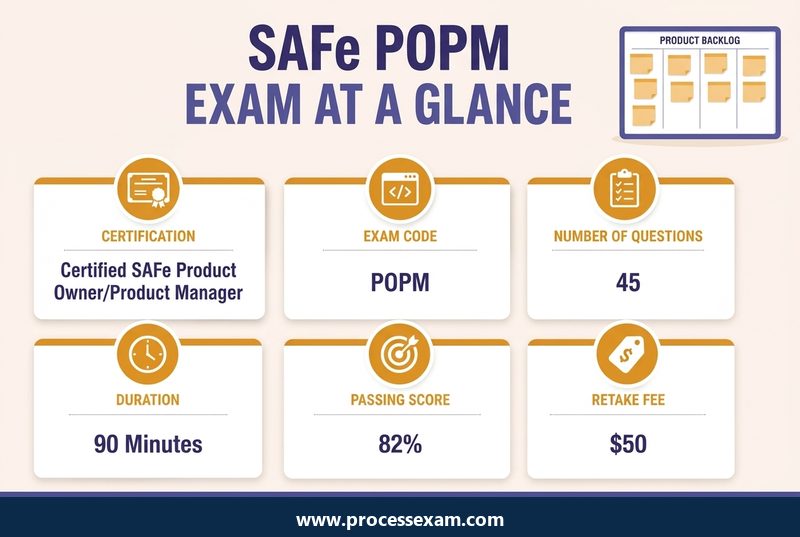
Those five numbers decide how you prepare. Forty five questions in 90 minutes is two minutes each. An 82 percent pass mark means 37 correct answers, so you can afford eight wrong and no more. Nothing in a study plan matters as much as getting comfortable inside those two constraints.
What is on the AI-Empowered POPM syllabus, and how is it weighted?
Scaled Agile has moved away from numbered framework versions for its courses and now names releases by date. As of September 2026, the current release of this course and exam is the AI-Empowered SAFe Product Owner/Product Manager, published in May 2026. The practical change for candidates is that the five familiar domains were re-weighted and a sixth, on applying AI to product roles, was added. Anyone studying from material written for the earlier SAFe 6.0 version will be missing roughly one question in eight.
The six domains and their weightings, as Scaled Agile publishes them on its POPM exam details page, are set out below. Our own SAFe POPM certification exam syllabus lists the same six areas with their objectives, which is the quickest way to turn the weightings into a checklist.
Understanding Product Owner and Product Management roles and responsibilities, 12 to 14 percent
This domain sets the frame for the rest. It covers applying a Lean-Agile mindset to product work, explaining value streams and how development value streams deliver the operational ones, and dividing responsibilities between the Product Manager, who owns the ART backlog and the vision, and the Product Owner, who owns the team backlog and the iteration. Expect questions that hand you a decision and ask which role makes it. Around six questions come from here, and they are among the most reliable marks on the paper if you have the role boundaries clear.
PI Planning preparation, 17 to 19 percent
Everything that has to be true before the ART gathers. Summarising what PI planning is for, explaining the solution vision, forecasting work through roadmaps, defining and splitting features, and managing the ART backlog and its Kanban. This is where economic prioritisation lives, so understand how weighted shortest job first works and why cost of delay and job size drive the order. Scenario questions often describe a backlog in a mess and ask what the Product Manager should do first.
Leadership for PI Planning, 14 to 16 percent
The event itself. Communicating the vision to the train, helping teams write PI objectives that state business value rather than tasks, organising and managing dependencies across teams, and analysing risks so they can be resolved, owned, accepted or mitigated during the ROAM review. Learn the sequence of the two days and what a product role does at each step, because questions here often hinge on timing: what happens in the draft plan review, what happens in the management review and problem-solving session, and what confidence vote actually signals.
Iteration Execution, 28 to 30 percent
The largest domain by some margin, worth about thirteen questions. It covers creating stories, planning an iteration, managing flow with the team Kanban, refining the team backlog, taking part in the iteration review and retrospective, and supporting DevOps and release on demand. Story writing is the heart of it: user story form, INVEST characteristics, acceptance criteria, splitting patterns, enabler stories and the difference between stories and tasks. If your study time is limited, this is the domain that deserves the largest share of it.
PI Execution, 10 to 12 percent
How the train stays honest through the increment. The PO sync, the system demo, innovation in the Innovation and Planning iteration, and the Inspect and Adapt event with its quantitative measurement, demo and problem-solving workshop. The domain is small, but the questions are precise: who attends which event, how often it runs, and what decision comes out of it.
Apply AI to Product Roles, 12 to 14 percent
The newest domain, and the one no older study material covers. It has four objectives: understanding AI basics and terminology, understanding AI prompting, understanding the risks of AI and what responsible use looks like, and augmenting the product role with AI. In practice that means knowing the vocabulary well enough to read a scenario, knowing what makes a prompt produce useful output, knowing where AI-generated content needs human review before it reaches a customer or a compliance officer, and recognising the product tasks AI genuinely helps with, such as drafting story candidates, summarising feedback or sketching a first backlog refinement pass. Treat AI output as a draft that a human owns, and most questions in this domain answer themselves.
How hard is the SAFe POPM exam when 82 percent is the pass mark?
POPM is usually described as one of the more approachable SAFe exams, and by content it is. The difficulty sits in the pass mark and the clock rather than in the material.
Work the arithmetic. Forty five questions, 82 percent to pass, so 37 right answers. Eight wrong ends the attempt. Most candidates lose four or five marks to genuinely hard scenarios; the fails come from the extra three or four given away on questions they knew, through rushing, misreading, or picking the answer that is correct in general Agile practice rather than the one the framework prescribes.
The format adds pressure of its own. Questions are multiple choice with a single correct option. The exam is web-based and closed book, with no outside assistance. The timer is visible once questions appear, and when it runs out the exam submits itself, with anything unanswered marked wrong. That last detail is worth planning for: a question left blank scores exactly the same as a wrong guess, so there is never a reason to leave one empty.
Where the marks actually go
Turn the weightings into question counts and the exam stops feeling abstract. Iteration Execution is roughly thirteen questions, PI Planning preparation about eight, Leadership for PI Planning about seven, roles and responsibilities and the AI domain about six each, and PI Execution about five. If you are strong on iteration work and shaky on AI, you are risking six marks out of an allowance of eight. That is the calculation to run before you book a date.
What does the SAFe POPM exam cost, and what happens if you fail?
The fee structure is unusual, because the exam is attached to the course rather than sold on its own. The first two attempts are included in the course registration fee if they are taken within 60 days of course completion, and every attempt after that costs $50.
The practical consequence is that the expensive part of POPM is the two-day course, not the exam, and that the cheapest way to pass is to sit it while the material is fresh. Candidates who let the window drift are paying to sit an exam on a course they now half remember.
The retake ladder
Failing is not the end of anything, but the waiting periods get longer, so it is worth knowing them before you gamble on an early attempt. Because two attempts come with the course, the ladder only starts on the third. Scaled Agile makes that third attempt available immediately after a second failure, spaces the fourth ten days later, and imposes a 30-day gap before the fifth and every attempt after it. The retake fee is $50. You can check the current wording on the exam details page linked above, since Scaled Agile updates these terms with each release.
The lesson from the ladder is simple. Attempts one and two are free and quick to replace; attempt five is a month of waiting. Use timed practice to make the first attempt the one that counts rather than treating it as a diagnostic.
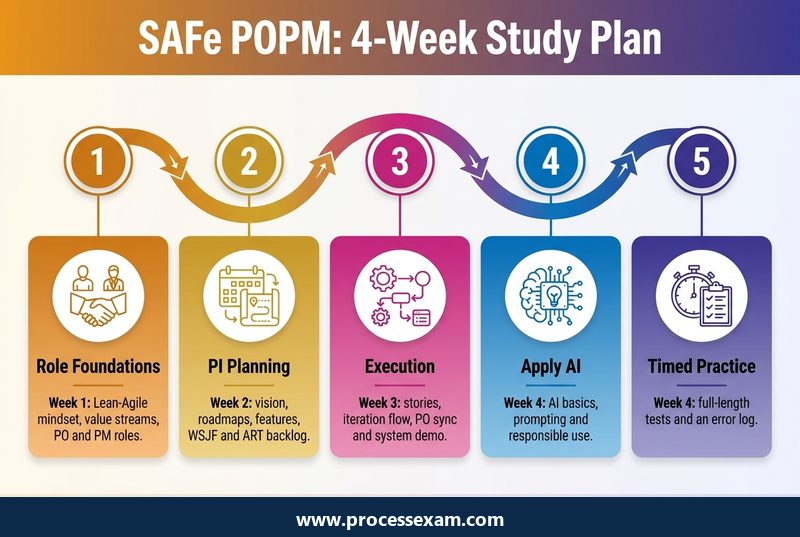
How do you build a four-week SAFe POPM study plan?
Four weeks at roughly an hour a day suits most candidates who have attended the course and work in or near a SAFe organisation. If the framework is new to you, or you have never seen a PI planning event, stretch it to six weeks and add more time in weeks two and three. If you have run an ART backlog for a year, three weeks is usually enough.
The order below follows the exam's own logic rather than the order of the course, which means each week builds on the one before.
| Week | Focus | What to finish |
|---|---|---|
| 1 | Role foundations | Lean-Agile mindset, value streams, and the split of responsibilities between Product Owner and Product Manager |
| 2 | PI planning, start to finish | Vision, roadmaps, feature definition, WSJF, the ART backlog and Kanban, PI objectives, dependencies and ROAM |
| 3 | Execution | Stories and acceptance criteria, iteration planning, team Kanban and flow, backlog refinement, iteration review, PO sync, system demo, Inspect and Adapt |
| 4 | AI domain and timed practice | AI terminology, prompting, responsible use, augmenting product work, then full-length timed tests and an error log |
How to study each week
Give every session a single objective taken from the syllabus, not a chapter. Read the objective, explain it out loud in your own words as if briefing a new team member, then answer questions on it. Anything you cannot explain without notes goes on a one-page revision sheet. By week four that sheet should be short enough to read in ten minutes, and it becomes your final revision the night before.
Two habits pay for themselves. Keep an error log from the first practice question you attempt, recording the question area and, in one line, why you got it wrong. A topic that appears three times in that log is not a knowledge gap, it is a misunderstanding, and it needs the source material rather than more questions. And connect everything to your own train: when you learn how dependencies are managed at PI planning, think about the dependency that hurt your last increment. Memory built on real examples survives exam pressure far better than memory built on lists.
How do you know you are ready to book the POPM exam?
Readiness is not a feeling. Three signals tell you far more than confidence does.
The first is coverage. Take the six domains and rate yourself out of five on each. Nothing below a four should remain when you book. The second is timing: you should be finishing 45 questions with ten minutes left over, not with the clock chasing you. The third is your error log. If the same domain keeps appearing, you are not ready however good the overall score looks.
Timed practice is how you turn those three signals into numbers. Sit a full-length set under exam conditions, closed book, phone away, no pausing, and treat the result as the real thing. Our POPM mock exam mirrors the live format at 45 questions in 90 minutes, which is the point of it: the score matters less than finding out whether you can hold accuracy at two minutes a question. Two clean runs on fresh questions, a week apart, and you can book with confidence.
One caution about scores. A first practice attempt in the sixties is normal and tells you almost nothing. What matters is the direction of travel and whether the same domain keeps failing. Improvement from 64 to 88 over three sittings is a candidate who is ready; three sittings stuck at 78 with the same weak domain is a candidate who needs to go back to the material, not sit a fourth test.
Which mistakes cost candidates the SAFe POPM exam?
The fail patterns are remarkably consistent, and every one of them is avoidable.
- Studying outdated material. Anything written for SAFe 6.0 misses the AI domain entirely and uses the old domain weightings. Check the release date on every resource before you trust it.
- Answering as a generic Agile practitioner. Several options in a typical question are reasonable Agile practice. Only one matches what the framework prescribes, and that is the one being marked.
- Confusing the two roles. Product Manager owns the vision, roadmap and ART backlog; Product Owner owns the team backlog and the iteration. Questions are written precisely to catch candidates who blur them.
- Underestimating Iteration Execution. It is nearly a third of the paper. Story writing, acceptance criteria and flow management deserve more time than any other topic.
- Treating the AI domain as optional. It is worth as much as the roles domain. Skipping it hands back six marks from an allowance of eight.
- Losing the clock. Two minutes a question leaves no room for re-reading long scenarios twice. Read the final sentence first so you know what is being asked before you absorb the detail.
- Leaving questions blank. An unanswered question is scored as incorrect, so always commit to an answer even when you are guessing between two.
- Booking on enthusiasm. Sitting the exam because the 60-day window is closing, rather than because practice scores say you are ready, is the most expensive mistake of all.
Is the SAFe POPM certification worth it for a product career?
For anyone working in an organisation that has adopted the Scaled Agile Framework, the credential is worth holding. Large SAFe adoptions run on shared vocabulary: if a Product Owner does not know what a PI objective, an enabler or a ROAM board is, every planning event costs the train time. Certification is the cheapest way an employer can confirm that shared vocabulary exists before someone joins a train.
It also travels well. POPM is a foundational credential with no formal prerequisites, so business analysts, subject matter experts and delivery managers use it as the entry point into product work, then build towards advanced credentials such as SAFe Agile Product Management as their scope grows from a team backlog to a portfolio of features. Recruiters filtering for SAFe roles frequently list it by name, which means it does practical work on a CV even before the interview.
Be clear about what it is not. It is not a substitute for having shipped anything, and no certification will carry an interview on its own. What it does is get you into the room and give you a framework to describe your experience in, which is exactly what a hiring manager who runs an ART is listening for.
Keeping the credential current
SAFe certifications are renewed annually, and Scaled Agile asks for a minimum of 12 continuing education units each year to maintain them, alongside the renewal terms set out on its Product Owner and Product Manager certification page. Existing SAFe 6 holders were given a route to the AI-Empowered version through a short AI skills module rather than a full re-sit, which is worth checking if you certified before May 2026 and want the current designation on your badge.
Weigh the whole cost honestly. The course fee is the real investment, the exam is included with it, and the renewal is annual. If your organisation runs SAFe, that investment usually repays itself in the first planning increment through the time you stop losing to avoidable confusion. If it does not, and you have no plans to join one, a different credential may serve your career better.
Frequently Asked Questions
How many questions are on the SAFe POPM exam?
The SAFe POPM exam has 45 questions and a time limit of 90 minutes, which works out at two minutes per question. Questions are multiple choice with a single correct answer, and the exam submits itself when the timer ends, with anything unanswered marked as incorrect.
What is the passing score for the POPM exam?
The passing score is 82 percent. With 45 questions on the paper, that means 37 correct answers, so eight wrong answers is the whole allowance. Most fails come from giving away marks on familiar topics rather than from the genuinely difficult scenario questions.
How much does the SAFe POPM exam cost?
The first two attempts are included in the course registration fee if they are taken within 60 days of course completion. Every attempt after that costs $50. The course itself, not the exam, is the main expense of this certification.
Do you have to take the course before sitting the POPM exam?
In practice, yes. Scaled Agile grants exam access through the learning plan issued after you complete the course, and the first two attempts are bundled into the course registration fee. The course is therefore the normal route to the exam rather than an optional extra.
What changed in the AI-Empowered POPM exam?
The May 2026 release added a sixth domain, Apply AI to Product Roles, worth 12 to 14 percent, covering AI basics, prompting, responsible use and augmenting product work. The five existing domains were re-weighted at the same time, so older SAFe 6.0 study material is now incomplete.
- SAFe Product Owner/Product Manager Test Questions |
- POPM Question Bank |
- Scaled Agile |
- SAFe Product Owner/Product Manager Book |
- Product Owner/Product Manager Certification Cost |
- Product Owner/Product Manager Certification Requirements |
- SAFe Product Owner/Product Manager Sample Questions |
- POPM Exam Questions Download |
- POPM Test Questions |
- Product Owner/Product Manager PDF


