
PAL-EBM Certification: An Evidence-Based Management Study Guide for Agile Leaders
Leaders who sit PAL-EBM are tested on one habit above all others. The assessment checks whether you can steer an organisation with evidence instead of opinion: choose goals, measure four kinds of value, run small experiments and decide what to do next. You get 40 questions in 60 minutes, need 85% to pass and pay USD 200 per attempt, so the real preparation is learning to think in measures and hypotheses.

The credential is Scrum.org's Professional Agile Leadership - Evidence-Based Management assessment, and its focus is narrower than its name suggests. Where other Scrum.org assessments ask what a Scrum Master, Product Owner or Developer should do, this one asks what a leader, sponsor or senior product person should do when they want to know whether their organisation is actually getting better. Everything in it traces back to a single short document, the Evidence-Based Management Guide, which makes it one of the more learnable assessments in the Scrum.org range if you read with intent.
This guide walks through what the assessment tests, what the numbers mean for your preparation, how the four key value areas fit together, how an evidence cycle works with a worked example, and a two-week plan for someone with a full-time job. Scrum.org's assessment listing was checked in October 2026, and the assessment is still offered with the fee and format described here.
What is PAL-EBM really testing, and who should sit it?
The assessment tests whether you understand Evidence-Based Management, usually shortened to EBM, as a way of running a product organisation. EBM treats strategy as a set of bets. You state the outcome you want, pick measures that would show whether you are getting it, form a hypothesis about what will move those measures, try something small and then inspect what happened. The assessment asks you to apply that loop to workplace situations, not to recite definitions.
Scrum.org describes the questions as scenario-driven, and the topics draw on empiricism, product value, business strategy and stakeholder and customer management. In plain terms, the people who benefit most are:
- Heads of product, engineering or delivery who report on outcomes to executives.
- Product Owners and product managers who are asked to prove that a release created value, not just that it shipped.
- Agile coaches and transformation leads who need a vocabulary for measuring a change programme.
- Scrum Masters moving towards organisation-level work, where team metrics are no longer enough.
You do not need a technical background. You do need comfort with the idea that a number such as velocity or release count says little about whether customers are better off. If that sentence sounds obvious, you are already halfway into the way the assessment thinks.
How is it different from the other agile-leadership credential?
Scrum.org also runs a broader Professional Agile Leadership assessment, PAL I, which covers agile leadership across self-managing teams, facilitation and stakeholder work. PAL-EBM is the specialist one. It goes deeper on measurement and goals and says less about team dynamics. Candidates who hold neither often start here when their immediate problem is "how do we know it is working?", and move to the broader credential later, or the other way round when their first question is how to lead people differently.
What do you pay, and what does the attempt look like?
The facts below follow Scrum.org's listing for the assessment, which you can read on the PAL-EBM assessment page.
| Detail | PAL-EBM |
|---|---|
| Full name | Scrum.org Professional Agile Leadership - Evidence Based Management |
| Exam code | PAL-EBM |
| Questions | 40 |
| Time allowed | 60 minutes |
| Passing score | 85% |
| Fee per attempt | USD 200 |
| Question types | Multiple choice, multiple answer, true/false |
Two readings of those numbers shape how you prepare. First, 85% of 40 questions is 34 correct answers, so you can miss six. That sounds generous until you remember that a multiple-answer question normally needs the full correct set, and a scenario question often has two answers that look sensible. The margin is smaller in practice than the arithmetic suggests.
Second, 60 minutes for 40 questions is an average of 90 seconds each. That is slower than the 45-second pace of the 80-question Scrum.org assessments, and it is deliberate: the questions are longer and the answers are more alike. You will not be short of time if you read well, but you will be short of time if you re-read every scenario three times because you are unsure of the vocabulary. Knowing the vocabulary cold is what buys you thinking time.
Scrum.org also sells a course on this subject, and class participants receive an assessment password as part of it. Whether you need the course is a separate question, so read the entry rules on the vendor's page before you buy anything. The course outline is on the Scrum.org training page for Professional Agile Leadership - Evidence-Based Management.
Why does one short guide decide most of your marks?
Scrum.org's own advice for this assessment is to read the Evidence-Based Management Guide closely, because it is the primary source for the answers. That is a rare thing to be told. Most professional exams point you to a bookshelf; this one points you to a document you can read in an afternoon. The catch is that reading and understanding are different things. The Evidence-Based Management Guide is dense, and every sentence carries a definition the assessment can lean on.
The guide is organised around a handful of ideas, and your first pass should be to find each one and write it in a sentence of your own:
- Goals. An organisation has a long-term strategic goal, and EBM breaks it into nearer intermediate goals that can be reached and checked.
- Key value areas. Four lenses on value, covered in the next section.
- Key value measures. The specific numbers you track inside each area.
- Hypotheses and experiments. A statement of what you believe will change a measure, and a small, time-boxed attempt to find out.
- Empiricism. Decisions follow what you observe, and what you observe is inspected and adapted.
When you read the second time, change your question from "what does it say?" to "what would a leader do differently because of this?" A sentence about measuring unrealised value is not a fact to memorise; it is an instruction about where to look when the current numbers are good but growth has stalled. Candidates who read only for facts tend to lose points on scenario questions. Candidates who read for decisions tend to find the answers jump out.
The syllabus view helps here too. Matching each guide section to a topic on the PAL-EBM syllabus page gives you a checklist, and it shows you quickly which areas you have only skimmed.
How do the four key value areas fit together?
The four key value areas are the heart of the guide, and they are the likeliest place for a question to try to trip you. Each one answers a different question about the organisation, and the whole point is that you need all four, because a good number in one can hide a problem in another.
| Key value area | The question it answers | Example measures the guide points to |
|---|---|---|
| Current Value | How much value does the product deliver to customers and the organisation today? | Customer satisfaction, employee satisfaction, revenue per employee |
| Unrealized Value | What value could the product deliver that it does not yet? | Market share, the gap between current and desired customer satisfaction |
| Time-to-Market | How quickly can the organisation deliver something new? | Lead time, cycle time, release frequency, mean time to repair |
| Ability to Innovate | How effectively can the organisation deliver new things that customers value? | Technical debt, defect trends, innovation rate |
Treat the measures in the third column as examples. The guide presents them as illustrations, and what the assessment expects is that you can tell which area a measure belongs to and why. It does not expect you to recall a list in order.
Which two areas does everyone confuse?
Time-to-Market and Ability to Innovate sound alike and are easy to swap. Time-to-Market is about speed: how quickly a change reaches customers. Ability to Innovate is about capacity: how much of the organisation's effort goes into new value rather than maintenance, rework and defects. A team can ship every week and still have a poor ability to innovate if most of that shipping is bug fixes. When a scenario describes fast releases and flat customer outcomes, the problem is usually in the second area, and the next move is to look at technical debt or the share of time spent on new work.
Why does Unrealized Value matter to a leader?
Current Value is comfortable, because it shows what you already have. Unrealized Value is uncomfortable, because it measures the distance between today's customer experience and the experience customers would like. Leaders who look only at the first area can feel successful while a competitor closes the gap. In a scenario question, the cue is usually a healthy set of current figures alongside a sign that the market is moving, such as flattening share or a widening satisfaction gap. The expected response is to invest attention in the second area, not to celebrate the first.
How should you use measures with care?
A measure is a signal, not a target. Once a number becomes a goal, people start to bend the work to move it, and a scenario in which a manager sets a team target on the number of releases and then sees quality fall is testing exactly this. Look for answers that keep measures as a way of learning, that pair a speed measure with a quality or value measure, and that review whether the measure still tells you something useful.
How does a goal turn into an experiment, step by step?
The loop is simple to state and surprisingly hard to apply under pressure, so it is worth working one example through. Imagine a company with a customer support portal that gets a lot of traffic but also a lot of repeat tickets. Here is how an EBM-minded leader would handle it.
- Name the goal. The strategic goal is for customers to solve routine problems without contacting support. An intermediate goal for the next quarter is to cut repeat tickets on the three most common topics.
- Pick a measure. The leader chooses repeat tickets per hundred customers as the main measure, in Current Value, and checks customer satisfaction with the portal alongside it so that deflecting tickets does not hide unhappy people.
- State the hypothesis. "If we rewrite the three top help articles around the questions customers actually type, repeat tickets on those topics will fall by a fifth within six weeks."
- Run the experiment. The team changes only those three articles and leaves the rest of the portal alone, so any movement can be connected to the change.
- Inspect the evidence. After six weeks the leader compares the measure with the starting point. If tickets fell, the change is kept and extended. If they did not, the team asks whether the hypothesis, the measure or the execution was at fault, and adapts.
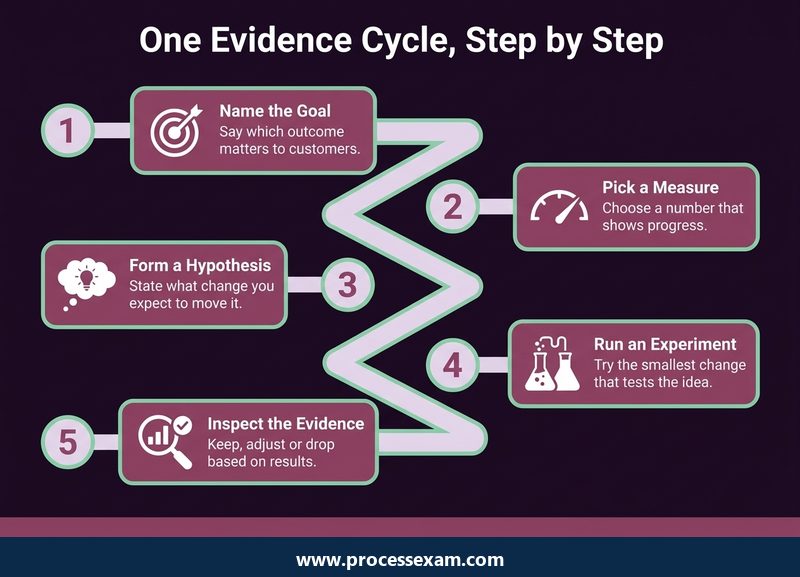
Notice what the leader did not do. They did not launch a portal redesign, they did not set a target for the support team and they did not declare success on the strength of opinions. They kept the experiment small, kept a second measure next to the first and decided in advance how they would judge the result. Those are the habits the assessment rewards.
What do wrong answers look like?
Wrong options in this assessment are rarely absurd. They usually fall into familiar patterns: a big-bang change instead of an experiment, a decision based on an executive's confidence instead of data, a measure that tracks activity instead of value, or a target imposed on a team. If you recognise those patterns, you can often eliminate two of four options before you have worked out the right one.
Where does the Scrum framework come in?
EBM sits alongside Scrum, not inside it. Scrum gives a team a way to produce an Increment each Sprint; EBM gives the organisation a way to tell whether the Increments are creating value. The two meet in the Sprint Review and in how a Product Owner uses outcome measures to order the backlog. If you have taken another Scrum.org assessment, your understanding of empiricism, transparency, inspection and adaptation carries straight over.
Which routine gets a busy leader ready in a fortnight?
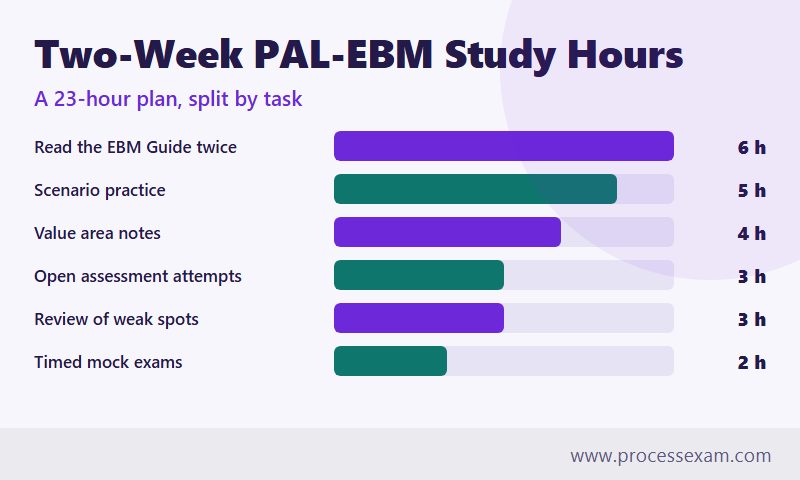
Most people who sit this assessment have little spare time, and a long course is not always possible. The plan below assumes about 23 hours across two weeks, roughly an hour and a half on weekdays and a longer block on each weekend. It suits a person who already knows the basics of Scrum and has managed teams or products. If EBM is entirely new to you, stretch it to three weeks and add time to the first row.
Week one: build the vocabulary and the map
- Days 1 to 3, read the guide twice (six hours). The first read is for the shape. The second read is with a pen: write the definition of each key term in your own words and the question each key value area answers.
- Days 4 and 5, notes on the four value areas (four hours). Draw the four areas on one page, and for each write three measures, one sign it is healthy and one sign it is not. Do this from memory first, then check against the guide.
- Weekend, first open assessment attempts (three hours). Scrum.org provides a free Evidence-Based Management open assessment. Take it, then spend longer reviewing than you spent taking it. Every wrong answer should be traced to a sentence in the guide.
Week two: apply, then rehearse
- Days 8 to 10, scenario practice (five hours). Take situations from your own workplace and run each through the loop: goal, measure, hypothesis, experiment, inspection. Write them out. If you cannot say which value area a measure belongs to, you have found a gap.
- Days 11 and 12, review of weak spots (three hours). Go back to the guide for only the areas you struggled with and re-read them aloud.
- Days 13 and 14, timed mock exams (two hours). Practise 40 questions in 60 minutes, then book the real attempt only if your timed scores sit comfortably above 85%. A PAL-EBM practice exam is a handy way to rehearse that pacing before the paid attempt, and the review of each miss counts for more than the score itself.
A word on the open assessment. Scrum.org itself suggests repeating it until you can score full marks. That is useful for learning the vocabulary, but being able to answer a set you have memorised is not the same as being able to apply a principle to a new case. Use repeat attempts to learn why each option is right or wrong, not to memorise letters.
How should you handle the 60 minutes on the day?
By the day of the attempt your knowledge is mostly fixed. What you can still improve is how you read and how you use the clock. These habits suit this particular assessment.
Read the last line of the question first
Scenario questions often open with several sentences of context before they ask anything. Reading the final line first tells you whether the question wants the best next step, the most likely problem or the measure that fits. Then read the context with that task in mind and note the details that matter, such as the area of value that looks healthy and the one that does not.
Name the value area before reading the options
For measurement scenarios, decide for yourself which of the four areas the situation lives in. Doing so before you look at the options protects you from an answer that sounds clever but addresses the wrong area. If the scenario describes releases that are fast but low in value, say "Ability to Innovate" to yourself and then look for the option that matches.
Count the answers a question wants
Multiple-answer questions state how many options to pick. Check that number before you click, and treat a partly correct set as a risk of losing the whole question. If you are torn between two options on a multiple-answer item, ask which of them depends on the other being true.
Pace by blocks, not by question
Aim to reach question 20 by about the half-hour mark and leave ten minutes at the end. Flag any question where you need more than two minutes and move on. Your second pass is faster because later questions often jog your memory of the vocabulary. Avoid changing answers unless you can point to a sentence in the guide that justifies the change.
Watch for absolutes and for hidden targets
Words such as "always", "never" and "only" make an option suspicious in a framework built on context. Likewise, be wary of any option that makes a measure into a quota. The guide treats measures as a way to learn about value, and options that turn them into goals for individuals tend to be the distractors.
Is PAL-EBM worth holding, and where does it lead?
The honest answer depends on what you want from it. The credential will not make you an expert in measurement on its own. What it does is give you a shared vocabulary and a structured way to ask the questions that leaders often skip: what outcome do we want, how would we know, and what is the cheapest way to find out?
What changes at work?
People who study this seriously tend to change three habits. They separate output measures from outcome measures in their reports. They write a hypothesis before approving a large piece of work, so that there is something to check afterwards. And they start asking which of the four value areas a proposed investment will move. None of that requires special tools, and each of them makes planning conversations shorter and less political.
Where does it sit on a profile?
On a CV or a profile, PAL-EBM signals that you can talk about value and measurement in a way that product, engineering and finance colleagues all follow. It sits well beside a Scrum Master or Product Owner credential and beside the broader agile-leadership assessment from the same vendor. Employers vary in how much weight they give any single certificate, so it is wise not to expect a specific pay rise or promotion from it. The practical value is that it prepares you to run an evidence cycle on a real problem, and a real example of that is worth more in an interview than the certificate alone.
What should you do next?
If you are ready, read the guide once more, take the open assessment one last time and book the attempt. If you are not sure, run a single evidence cycle at work first, using the portal example above as a template. Whichever route you take, keep your notes: the one-page map of the four value areas is a useful reference long after the assessment is behind you.
Frequently Asked Questions
What is the PAL-EBM certification?
PAL-EBM is the Scrum.org Professional Agile Leadership - Evidence-Based Management assessment. It checks whether you can use goals, key value areas, measures and small experiments to guide an organisation, based on the Evidence-Based Management Guide. It suits leaders, product people and coaches rather than team-level practitioners.
How many questions are on the PAL-EBM assessment, and what is the pass mark?
The assessment has 40 questions in 60 minutes and a passing score of 85%, which is 34 correct answers if every question weighs the same. Formats include multiple choice, multiple answer and true/false, and multiple-answer items generally need the full correct set to earn credit.
How much does the PAL-EBM exam cost?
The fee is USD 200 per attempt, as listed on the Scrum.org assessment page at the time of writing. A course is sold separately and may include a password. Prices and retake terms can change, so confirm the current amount and any attempt rules with Scrum.org before you pay.
Is the PAL-EBM exam hard to pass?
It is demanding but learnable. The content comes from one short guide, yet scenario questions reward applying ideas, not repeating them, and 85% leaves room for only six misses. Candidates who read the guide twice, take the free open assessment and rehearse timed sets usually feel well prepared.
What is the difference between PAL-EBM and PAL I?
PAL-EBM focuses on measuring value and running evidence-based experiments, using the four key value areas from the Evidence-Based Management Guide. PAL I is the broader Scrum.org agile-leadership assessment, covering topics such as self-managing teams, facilitation and stakeholder work. Many leaders eventually take both.
- Scrum |
- Scrum.org Professional Agile Leadership Evidence Based Management Test Questions |
- PAL-EBM Question Bank |
- PAL - Evidence Based Management Mock Exam |
- Scrum.org Professional Agile Leadership Evidence Based Management Book |
- Professional Agile Leadership Evidence Based Management Certification Cost |
- Professional Agile Leadership Evidence Based Management Certification Requirements |
- Scrum.org PAL - Evidence Based Management Question Bank |
- Scrum.org PAL - Evidence Based Management Book |
- Scrum.org PAL - Evidence Based Management Study Guide |
- PAL - Evidence Based Management Certification |
- PAL - Evidence Based Management Certi |
- Scrum.org Professional Agile Leadership Evidence Based Management Sample Questions |
- PAL-EBM Exam Questions Download |
- PAL-EBM Test Questions |
- Professional Agile Leadership Evidence Based Management PDF |
- Scrum.org PAL - Evidence Based Management Exam Questions |
- Scrum.org PAL - Evidence Based Management Sample Questions |
- PAL - Evidence Based Management |
- PAL - Evidence Based Management PDF


