
Open Group OGEA-10B: The Definitive EA Credibility Boost

The Open Group OGEA-10B certification serves as a pivotal credential for experienced Enterprise Architecture professionals seeking to validate their understanding and practical application of the TOGAF Standard, Version 9.2. Formally known as The Open Group TOGAF Enterprise Architecture Practitioner Bridge, this exam is specifically designed for individuals who already hold a foundational TOGAF certification and aim to elevate their expertise to a practitioner level. It emphasizes the real-world use of the TOGAF framework within complex organizational contexts, moving beyond theoretical knowledge to practical application. Candidates pursuing the Open Group OGEA-10B demonstrate a commitment to advancing their strategic architecture capabilities, positioning themselves as indispensable assets in driving business transformation and operational efficiency. This comprehensive article delves into the OGEA-10B exam objectives, preparation strategies, benefits for career progression, and practical insights to ensure a well-informed certification journey, covering what the certification means for professional credibility and market value.
Validating Advanced EA Competencies with OGEA-10B
The Open Group OGEA-10B certification validates an individual's ability to apply the TOGAF Standard in complex enterprise architecture scenarios, signaling a shift from understanding concepts to implementing them strategically. This bridge certification is particularly valuable for those looking to solidify their role as active contributors to an organization's architectural strategy, ensuring that theoretical knowledge translates into tangible business outcomes. Achieving this credential demonstrates a practitioner's readiness to tackle intricate architectural challenges, making them highly sought after in a rapidly evolving digital landscape.
Bridging Foundational Knowledge to Practitioner Acumen
For many Enterprise Architecture professionals, the journey begins with foundational TOGAF certifications. The Open Group OGEA-10B exam then acts as a crucial bridge, transitioning certified individuals from a conceptual understanding of TOGAF principles to a deep, practical acumen required for real-world application. This bridge doesn't just add new knowledge; it reframes existing knowledge through a practitioner's lens, focusing on how to effectively use the TOGAF Standard to design, plan, implement, and govern an enterprise information architecture. It’s about moving beyond "knowing what" to "knowing how" to deploy the framework to achieve strategic objectives.
The Strategic Imperative of OGEA-10B Certification
In today's competitive and fast-paced business environment, organizations increasingly rely on robust enterprise architecture to navigate digital transformation and maintain competitive advantage. Professionals certified with the Open Group OGEA-10B are equipped to meet this demand, possessing the skills to align IT initiatives with business goals, optimize processes, and mitigate risks. This certification is not merely an academic achievement; it's a strategic imperative for individuals aiming to lead architectural endeavors and for organizations seeking to build resilient, adaptable, and efficient enterprise ecosystems. It underpins the ability to provide clear, actionable architectural guidance.
Who Benefits Most from This EA Credential?
The OGEA-10B certification is ideally suited for a specific group of professionals ready to elevate their Enterprise Architecture career. This includes:
-
Experienced Enterprise Architects: Those already working in an EA role who wish to deepen their practical application of TOGAF and enhance their problem-solving capabilities within diverse business contexts.
-
Solution Architects and IT Leaders: Individuals responsible for designing and overseeing complex IT solutions, who can leverage TOGAF practitioner skills to ensure architectural coherence and strategic alignment.
-
Consultants and System Integrators: Professionals advising clients on architectural strategies, needing to demonstrate advanced proficiency in the TOGAF Standard to provide credible, impactful guidance.
-
Business Architects and Analysts: Those focused on translating business strategy into actionable architectural requirements, gaining a practitioner-level understanding of how TOGAF facilitates this translation.
-
TOGAF Certified Professionals: Anyone with a TOGAF Foundation (Level 1) certification or an equivalent, seeking to achieve the TOGAF Enterprise Architecture Practitioner (Level 2) designation.
This credential empowers these professionals to contribute more effectively to strategic planning and execution, distinguishing them as leaders in the EA domain.
Examining the OGEA-10B Certification Structure
Understanding the structure and format of the Open Group OGEA-10B exam is crucial for effective preparation and successful certification. This bridge examination is tailored to assess practical application, demanding more than just recall of facts; it requires candidates to demonstrate their ability to apply TOGAF principles to real-world scenarios. Familiarity with the exam's mechanics helps candidates manage their time efficiently and approach each question with strategic intent.
Key Details of the OGEA-10B Exam
The Open Group OGEA-10B exam, officially named The Open Group TOGAF Enterprise Architecture Practitioner Bridge, is designed to be a concise yet rigorous assessment. It specifically targets those with existing TOGAF foundational knowledge, focusing on the practical bridge elements.
The key characteristics are:
-
Exam Code: OGEA-10B
-
Exam Price: USD $385, reflecting the value and industry recognition of this advanced credential.
-
Duration: 60 Minutes, requires candidates to manage their time effectively to answer all questions.
-
Number of Questions: 14, indicating that each question carries significant weight and often presents a scenario-based challenge.
-
Passing Score: 60%, a standard benchmark for professional certifications that ensures a high level of competency.
These details underscore the exam's objective to certify practical application rather than broad theoretical recall, making strategic preparation essential. More details regarding the certification can be found by reviewing the official program information.
Navigating the OGEA-10B Question Format
Unlike foundational exams that might rely heavily on multiple-choice questions testing rote memory, the Open Group OGEA-10B exam often incorporates scenario-based questions. These questions present a realistic enterprise architecture challenge and require candidates to select the most appropriate TOGAF-compliant action or solution. This format assesses not just what candidates know, but how they would apply that knowledge in a given context. Such questions demand a deeper understanding of the TOGAF Architecture Development Method (ADM) phases, governance, and adaptation, encouraging critical thinking and problem-solving skills under timed conditions. Preparing for this format involves extensive practice with realistic scenarios, honing the ability to quickly analyze complex situations and identify optimal architectural responses. Further details on the exam can be found on the Open Group TOGAF Enterprise Architecture Practitioner Bridge OGEA-10B exam page.
Deepening Expertise with OGEA-10B Syllabus Topics
The syllabus for the Open Group OGEA-10B exam is meticulously designed to cover the core areas where an Enterprise Architecture Practitioner must excel. It builds upon foundational TOGAF knowledge, emphasizing the application of the framework in practical scenarios. A thorough understanding of these topics is indispensable for passing the exam and for effective performance in a professional EA role. Each section of the syllabus contributes to a holistic view of the practitioner's responsibilities, from understanding strategic changes to implementing architectural solutions.
Core Areas of Practitioner Knowledge
The OGEA-10B syllabus focuses on enhancing the practical application skills of candidates. It requires a nuanced understanding of how TOGAF principles are adapted and utilized in varied organizational contexts, moving beyond mere definitions to active deployment. Key areas of focus include:
-
Key Changes in the TOGAF Standard: An understanding of the updates and evolutions within the TOGAF Standard is critical, especially how these changes impact implementation strategies and best practices.
-
Introducing the Context for Enterprise Architecture: This topic sets the stage for understanding the broader environment in which EA operates, including its strategic value and alignment with business objectives.
-
Enterprise Architecture and the Practitioner Role: Focuses on the specific responsibilities, activities, and challenges faced by an EA Practitioner within an organization.
-
Applying TOGAF Concepts in the Context for Enterprise Architecture: This is a cornerstone, demanding the ability to practically deploy TOGAF principles to solve architectural problems and guide development.
-
Stakeholder Management: Recognizing the importance of engaging and managing diverse stakeholders throughout the architecture development lifecycle.
These areas collectively ensure that a certified practitioner can effectively navigate both the technical and interpersonal aspects of enterprise architecture.
Navigating the Architecture Development Method (ADM) Work
The TOGAF Architecture Development Method (ADM) is the heart of the framework, providing a structured approach to developing and managing enterprise architecture. For the Open Group OGEA-10B exam, candidates must demonstrate not just knowledge of the ADM phases, but also the ability to apply them practically. The syllabus breaks down this application into several critical stages:
-
Phase A, the Starting Point: Understanding the preliminary and architecture vision phases, including how to establish the architecture capability and define the scope.
-
Architecture Development: A deep dive into Phases B (Business Architecture), C (Information Systems Architecture), and D (Technology Architecture), focusing on how to develop the baseline and target architectures for each domain.
-
Implementing the Architecture: Covers Phases E (Opportunities and Solutions) and F (Migration Planning), detailing how to identify and plan for implementation projects.
-
Supporting the ADM Work: This includes Phases G (Implementation Governance) and H (Architecture Change Management), along with requirements management, ensuring ongoing architectural integrity and adaptation.
Mastering these ADM application aspects is vital for any TOGAF Practitioner. The official Open Group TOGAF Practitioner Certification data sheet provides additional information regarding exam content.
Strategic Considerations Beyond Core Frameworks
Beyond the direct application of the ADM, the OGEA-10B syllabus also touches upon broader strategic considerations that influence successful enterprise architecture. This includes understanding the impact of key changes in the TOGAF Standard on existing architectural practices and future adaptations. Practitioners must be aware of how the standard evolves to remain effective. Moreover, the emphasis on "Introducing the Context for Enterprise Architecture" highlights the need for architects to view their work within the larger organizational and business strategy framework. This strategic perspective ensures that architectural solutions are not only technically sound but also align with the overarching business goals and industry trends. Professionals looking to refine their understanding of the broader TOGAF ecosystem can explore relevant resources from The Open Group's publications.
Cultivating Effective Preparation Strategies for OGEA-10B
Achieving success in the Open Group OGEA-10B exam demands more than casual study; it requires a structured, comprehensive, and strategic preparation approach. Given the exam's focus on practical application and scenario-based questions, candidates must move beyond rote memorization to develop a deep, actionable understanding of the TOGAF Standard. Effective preparation involves a combination of official resources, hands-on practice, and strategic review, ensuring that every effort contributes directly to exam readiness.
Leveraging Official Study Materials and Training
The foundation of a solid preparation strategy lies in utilizing credible and official study materials. The Open Group provides extensive documentation and resources that are indispensable for OGEA-10B candidates.
These typically include:
-
The TOGAF Standard, Version 9.2: This is the primary source of truth. Candidates should not only read but also deeply understand its principles, phases, and guidelines. Focus on the nuances of the ADM and its practical application.
-
Official Documentation and Whitepapers: The Open Group often releases supplementary materials that clarify specific aspects of the TOGAF Standard, including updates and best practices.
-
Accredited Training Courses: Engaging in an Open Group accredited training course for the TOGAF Enterprise Architecture Practitioner Bridge is highly recommended. These courses are designed to provide structured learning, practical exercises, and expert guidance directly aligned with the exam objectives. Many candidates find this invaluable for consolidating their knowledge.
These resources provide the theoretical backbone required to confidently approach the exam.
Mastering Application Through Practice Questions and Scenarios
Given the practitioner-focused nature of the Open Group OGEA-10B exam, mere theoretical knowledge is insufficient. Success hinges on the ability to apply TOGAF concepts effectively to real-world scenarios. This necessitates extensive practice with scenario-based questions that mirror the exam's format and difficulty.
Consider these practice methods:
-
High-Quality Practice Questions: Utilize practice questions that test your understanding of how to implement TOGAF principles, not just recall them. Look for detailed explanations for both correct and incorrect answers.
-
Scenario Analysis: Work through complex architectural scenarios, identifying the relevant TOGAF phases, techniques, and governance mechanisms. Practice articulating your reasoning for proposed solutions.
-
Time Management Drills: With only 60 minutes for 14 questions, effective time management is critical. Practice answering questions under timed conditions to improve speed and accuracy.
-
Self-Assessment and Gap Identification: Regularly assess your performance on practice tests to identify areas of weakness. Focus your subsequent study on these gaps to ensure comprehensive coverage.
Engaging with comprehensive practice questions on platforms like ProcessExam can significantly enhance a candidate's readiness by simulating the actual exam environment and reinforcing practical application skills.
Developing a Strategic Study Plan
A well-structured study plan is paramount for managing the breadth of the OGEA-10B syllabus and optimizing learning. This plan should be personalized to fit individual learning styles and schedules, ensuring consistent progress without burnout.
Essential components of a strategic study plan include:
-
Syllabus Mapping: Break down the official syllabus into manageable topics and sub-topics. Allocate study time proportionally based on the complexity and weighting of each area.
-
Scheduled Review Sessions: Incorporate regular review sessions to reinforce learned material and prevent knowledge decay. Spaced repetition can be particularly effective.
-
Hands-on Experience: Where possible, try to apply TOGAF concepts in your current professional role. Practical experience helps solidify theoretical understanding and prepares you for scenario-based questions.
-
Peer Study Groups: Collaborating with other candidates can provide valuable alternative perspectives, facilitate discussion, and help clarify complex topics through shared understanding.
-
Maintain Focus on the "Practitioner" Aspect: Always consider how each piece of TOGAF knowledge translates into practical action and decision-making within an enterprise context.
By following a disciplined and focused study plan, candidates can build the confidence and competence required to successfully pass the Open Group OGEA-10B certification exam.
Overcoming Common OGEA-10B Exam Challenges
Candidates often encounter specific hurdles when preparing for the Open Group OGEA-10B exam. Recognizing these challenges upfront and preparing strategies to overcome them can significantly improve the chances of success.
Common challenges include:
-
Interpreting Scenario-Based Questions: Many struggle with extracting the core problem from complex scenarios and identifying the most appropriate TOGAF solution. Practice by breaking down scenarios, identifying key constraints, and evaluating options against TOGAF principles.
-
Nuance of TOGAF Standard Updates: Keeping up with "Key Changes in the TOGAF Standard" can be difficult. Focus on understanding the impact of these changes on practitioner activities rather than just memorizing new features.
-
Applying ADM in Context: Moving from theoretical knowledge of ADM phases to knowing when and how to apply specific steps in different contexts requires practical insight. Use case studies and architectural examples to deepen this understanding.
-
Time Pressure: The 60-minute duration for 14 questions means approximately 4 minutes per question. This is a tight schedule for scenario-based queries. Regularly timed practice tests are essential to build speed without sacrificing accuracy.
-
Avoiding "Brain Dump" Materials: Relying on unofficial or "brain dump" resources is counterproductive and unethical. Such materials do not foster genuine understanding and can lead to failure. Stick to official guides and reputable practice platforms to build true competency.
By proactively addressing these areas, candidates can transform potential weaknesses into strengths, ensuring a more robust and ethical preparation journey.
Realizing Career Advancement with OGEA-10B Credentials
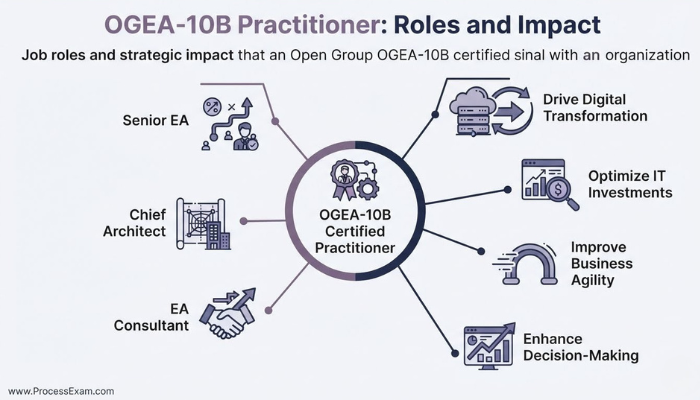
The Open Group OGEA-10B certification is more than just a badge of honor; it is a powerful catalyst for career advancement within the Enterprise Architecture domain. Earning this credential signals to employers and peers a high level of expertise, practical capability, and commitment to professional excellence. In an increasingly competitive global market, this distinction can open doors to new opportunities, higher earning potential, and leadership roles in strategic business and IT initiatives.
Enhanced Professional Credibility and Market Value
In the realm of Enterprise Architecture, credibility is paramount. The Open Group OGEA-10B certification significantly enhances a professional's credibility by validating their ability to practically apply the TOGAF Standard to complex organizational challenges. This official recognition from The Open Group provides a standardized benchmark of skill, reassuring potential employers and clients of a candidate's proven capabilities. For individuals, this translates into increased market value, making them more attractive to top-tier organizations seeking skilled EA practitioners. It can lead to better job prospects, higher salaries, and a stronger negotiating position in the job market, as the demand for such certified experts continues to grow.
Opening Doors to Advanced Enterprise Architecture Roles
The Open Group OGEA-10B certification is a stepping stone to more advanced and influential roles within the Enterprise Architecture field. With a practitioner-level understanding of TOGAF, professionals are better equipped to take on leadership responsibilities, guiding architectural development and ensuring alignment with strategic business objectives.
Potential career paths and roles that become more accessible include:
-
Senior Enterprise Architect: Leading architectural projects, defining enterprise-wide standards, and ensuring architectural integrity across the organization.
-
Chief Architect: Holding ultimate responsibility for an organization's architectural vision, strategy, and governance.
-
EA Consultant: Providing expert advice and guidance to various clients on implementing and optimizing TOGAF-based architecture frameworks.
-
Solution Strategist: Bridging the gap between business strategy and technological solutions, ensuring that implementations are architecturally sound and meet business needs.
-
Architecture Governance Lead: Establishing and enforcing governance processes to ensure compliance with architectural principles and standards.
These roles require a blend of technical expertise, strategic thinking, and leadership, all of which are validated by the OGEA-10B credential.
Strategic Contribution to Organizational Success
Certified Open Group OGEA-10B practitioners are uniquely positioned to make significant strategic contributions to their organizations. Their ability to apply the TOGAF Standard effectively enables them to:
-
Drive Digital Transformation: Architect solutions that support new business models, streamline operations, and enhance customer experience.
-
Optimize IT Investments: Ensure that technology expenditures are aligned with strategic goals, reducing redundancy and increasing ROI.
-
Improve Business Agility: Design flexible and adaptable architectures that can respond quickly to market changes and emerging threats.
-
Enhance Decision-Making: Provide clear architectural insights that inform strategic business and IT decisions.
-
Strengthen Governance and Compliance: Implement robust architectural governance frameworks that ensure adherence to regulatory requirements and internal policies.
By enabling these critical functions, OGEA-10B certified professionals become indispensable assets, directly influencing an organization's long-term success and resilience. The certification signifies a proven capacity to not only understand but also to actively shape and guide the architectural landscape of an enterprise.
Conclusion
The Open Group OGEA-10B certification stands as a definitive benchmark for Enterprise Architecture professionals aspiring to validate and elevate their practical application of the TOGAF Standard, Version 9.2. It marks a critical transition from theoretical understanding to demonstrable practitioner acumen, equipping individuals with the skills necessary to navigate complex architectural challenges and drive strategic organizational change. This credential not only boosts professional credibility and market value but also unlocks advanced career opportunities, positioning certified individuals as indispensable leaders in the evolving digital landscape.
For those committed to advancing their career in Enterprise Architecture and making a tangible impact on organizational success, pursuing the Open Group OGEA-10B is a strategic investment. With diligent preparation, leveraging official resources, and extensive practice with scenario-based questions, achieving this certification is a highly attainable goal that will significantly enhance your professional journey. Elevate your expertise and solidify your standing as a top-tier Enterprise Architecture Practitioner. Explore comprehensive preparation resources and practice exams to ensure your success by visiting ProcessExam.
FAQs
1. What is the Open Group OGEA-10B certification?
The Open Group OGEA-10B is the The Open Group TOGAF Enterprise Architecture Practitioner Bridge certification. It is designed for individuals who already hold a foundational TOGAF certification and wish to validate their practical application skills of the TOGAF Standard, Version 9.2, in real-world enterprise architecture scenarios.
2. Who should consider taking the OGEA-10B exam?
The OGEA-10B exam is ideal for experienced Enterprise Architects, Solution Architects, IT Leaders, and Consultants who have a TOGAF Foundation (Level 1) certification or equivalent. It is for those who seek to advance their practical expertise and take on more strategic architectural roles.
3. What kind of job roles are suitable for OGEA-10B certified professionals?
Professionals with the OGEA-10B certification are well-suited for roles such as Senior Enterprise Architect, Chief Architect, EA Consultant, Solution Strategist, and Architecture Governance Lead. The certification demonstrates an ability to contribute strategically to architectural planning and implementation.
4. How does the OGEA-10B certification enhance professional credibility?
The OGEA-10B certification significantly enhances professional credibility by providing official validation from The Open Group of a practitioner's ability to apply the TOGAF Standard. This differentiates certified individuals in the job market, signaling proven practical skills and a commitment to industry best practices, leading to increased market value and career opportunities.
5. What is the passing score for the Open Group OGEA-10B exam?
To pass the Open Group OGEA-10B exam, candidates must achieve a score of 60%. This benchmark ensures that certified individuals possess a robust understanding and practical application capability of the TOGAF Standard at the practitioner level.
- Enterprise Architecture |
- Open Group TOGAF Enterprise Architecture Bridge Test Questions |
- OGEA-10B Question Bank |
- TOGAF Enterprise Architecture Bridge Simulator |
- TOGAF Enterprise Architecture Bridge Mock Exam |
- Open Group TOGAF Enterprise Architecture Bridge Book |
- TOGAF Enterprise Architecture Bridge Certification Cost |
- TOGAF Enterprise Architecture Bridge Certification Requirements |
- Open Group TOGAF Enterprise Architecture Bridge Sample Questions |
- OGEA-10B Exam Questions Download |
- OGEA-10B Test Questions |
- TOGAF Enterprise Architecture Bridge PDF


