
Open Group Certifications: Which One Fits Your Career?
Updated on 12 October 2026. What’s new: open professions certification at level 1 now costs USD $1,100 in total, with no annual programme fee
An architect who already holds one credential usually asks the same thing next: which second one is worth the money? The Open Group runs six exam families plus an experience-based route, and the right pick depends on your job title more than on difficulty. This guide maps TOGAF, ArchiMate, IT4IT, Open FAIR, Open Agile Architecture and DPBoK to the roles they suit, in the order that makes sense, with fees from The Open Group's own schedule. The anchor exam, OGEA-101, costs USD $405.

Plenty of people treat "Open Group certification" as a synonym for TOGAF. That is only the largest branch. The consortium also owns the ArchiMate modelling language, the IT4IT reference architecture for running IT as a business, the Open FAIR approach to quantifying risk, the Open Agile Architecture standard and the DPBoK body of knowledge for digital products. Each has its own exam, its own audience and its own level of depth. Choosing between them is a career decision, so the sections below start from the job you do and work backwards to the paper you sit.
Which Open Group certifications can you still take today?
Two routes exist. The knowledge-based programmes are exam-driven: you study a standard, sit a multiple-choice or scenario paper and receive a credential. The experience-based Open Professions programme has no exam at all; you document your work and are judged by peers. Everything below was checked against The Open Group's certification pages and its fee schedule that applies from 1 February 2026, and anything the pages did not confirm has been left out.
The exam-based side currently lists these families:
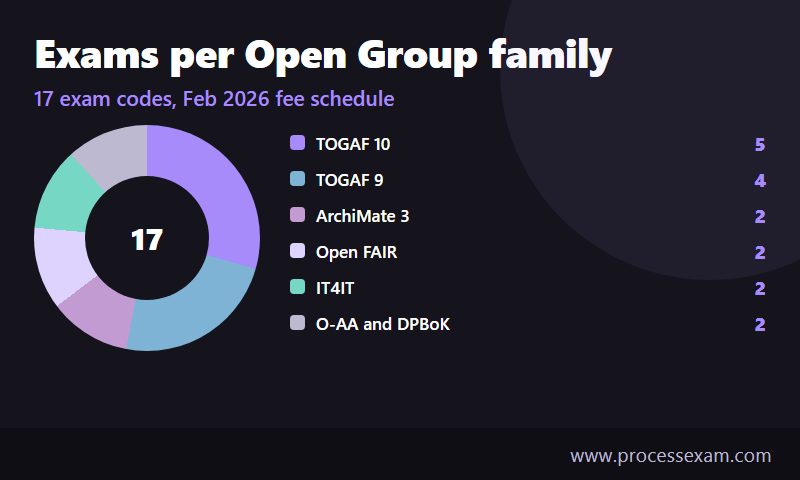
- TOGAF. The portfolio page names five credentials: two for TOGAF 9 (Foundation and Certified) and three for the 10th Edition, which are Enterprise Architecture Foundation, Enterprise Architecture Practitioner and Business Architecture Foundation.
- ArchiMate. The ArchiMate 3 programme covers the 3.2 release of the specification, with a Foundation level and a Practitioner level.
- IT4IT. The programme holds IT4IT Foundation (standard version 2.1) and IT4IT 3 Foundation (standard version 3.0).
- Open FAIR. The programme holds Open FAIR Foundation and Open FAIR 2 Foundation, built on newer versions of the risk analysis and risk taxonomy standards.
- Open Agile Architecture. One Practitioner credential for architects working in agile organisations.
- DPBoK. One Foundation credential for people leading digital product work.
Counting each exam once, whatever language it is offered in, the fee schedule lists 17 exam codes across these families. The chart shows how they split.
The family table below puts each programme next to its exam codes and its booking fee, so you can see the price band before you decide.
| Family | Credential levels | Exam codes | Booking fee (USD) |
|---|---|---|---|
| TOGAF, 10th Edition | Enterprise Architecture Foundation, Practitioner, Business Architecture Foundation | OGEA-101, OGEA-102, OGEA-103 (combined), OGEA-10B (bridge), OGBA-101 | 405 to 610; bridge 385 |
| TOGAF 9 | Foundation, Certified, Business Architecture Part 1 | OG0-091, OG0-092, OG0-093 (combined), OGB-001 | 325 to 570 |
| ArchiMate 3 | Foundation, Practitioner | OGA-031, OGA-032 | 375 each |
| IT4IT | Foundation (v2.1), 3 Foundation (v3.0) | OG0-061, OGIT-101 | 375 and 405 |
| Open FAIR | Foundation, 2 Foundation | OG0-041, OGOF-101 | 375 and 405 |
| Open Agile Architecture | Practitioner | OGAA-001 | 375 |
| DPBoK | Foundation | OGD-001 | 375 |
The Open Group reserves the right to change fees without notice, and local taxes may apply, so read the current fee schedule on the day you book.
Which family matches which job title?
Read the families by what they let you do on Monday morning, not by the length of the syllabus. A credential pays back when it changes how a colleague or a hiring manager reads your profile, and each family speaks to a different reader.
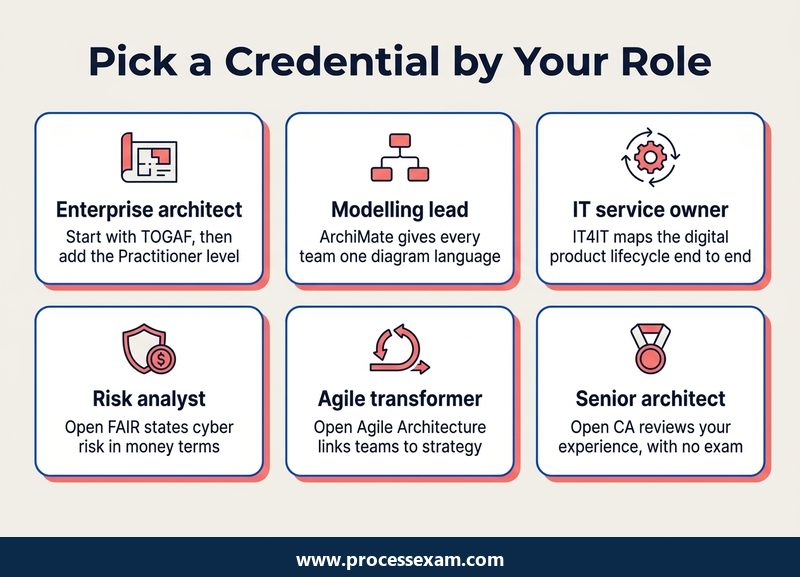
| Your role | First credential to consider | What it changes for you |
|---|---|---|
| Enterprise or solution architect | TOGAF Enterprise Architecture (OGEA-101, then OGEA-102) | A shared method, the Architecture Development Method, that other architects and consultancies already use |
| Business analyst, strategy or planning lead | TOGAF Business Architecture Foundation (OGBA-101) | Vocabulary for capabilities and value streams without the technology layers |
| Architect or analyst who draws diagrams for stakeholders | ArchiMate 3 Foundation (OGA-031) | One notation for business, application and technology views |
| IT service, portfolio or operations manager | IT4IT 3 Foundation (OGIT-101) | A reference architecture for the whole lifecycle of digital products and services |
| Security or risk analyst | Open FAIR 2 Foundation (OGOF-101) | A way to express cyber risk as a financial range that managers can compare |
| Architect inside an agile organisation | Open Agile Architecture Practitioner (OGAA-001) | Common ground between architects and agile delivery teams |
| Product, transformation or programme lead | DPBoK Foundation (OGD-001) | A map of how digital products are created, run and changed |
The pattern behind the table is simple. TOGAF and ArchiMate belong to people who design the structure of an organisation. IT4IT and DPBoK belong to people who run it. Open FAIR belongs to people who defend it, and Open Agile Architecture belongs to people who need architecture to keep up with fast-moving teams. If your day job sits in two of those groups, you already know which pair to look at first.
When the job title is unclear
Many careers straddle two columns. A cloud architect may design landscapes in the morning and argue for budget in the afternoon; a service delivery manager may inherit an architecture function. Look at the verbs in your last three performance reviews. If they are "designed", "modelled" and "reviewed", start with TOGAF or ArchiMate. If they are "operated", "reported" and "improved", start with IT4IT. If they are "assessed", "estimated" and "reduced", Open FAIR comes first.
In what order should an architect stack these credentials?
Sequence matters for two reasons: some papers build on others, and some orders let you skip a fee. These are the routes the programme pages describe, followed by sensible pairings that rest on a reading of how the families overlap.
The enterprise architecture route
The portfolio page lays out four ways to reach TOGAF Enterprise Architecture Practitioner status. Hold the TOGAF 9 Certified credential and you take the bridge exam, OGEA-10B. Hold the Enterprise Architecture Foundation and you take OGEA-102. Start from nothing and you either sit OGEA-101 and then OGEA-102, or take the combined paper, OGEA-103, in one session. For a newcomer who is confident in the material, the combined sitting costs less than two separate bookings, which the fee section below works out.
The modelling route
ArchiMate is the natural second credential for an architect who already knows the method, because it supplies the diagrams. The fee schedule treats the language as a Part 1 and Part 2 pair, OGA-031 and OGA-032. Take Part 1 first to learn elements, relationships and viewpoints, and Part 2 once you can apply them to a scenario. The same schedule notes an automatic discount when the two are booked back to back at a test centre, so check the booking options before you pay for them separately.
The operations route
IT4IT and DPBoK pair well because one describes the machinery of IT management and the other the product thinking that sits on top. Sit OGIT-101 first if you run services, and OGD-001 afterwards if your organisation is reorganising around digital products.
Pairings that make sense, and one that rarely does
- TOGAF then ArchiMate. Method, then notation. This is the most common pairing for consulting roles.
- TOGAF then Open Agile Architecture. Useful when the organisation is moving from annual planning cycles to continuous delivery and you are the person explaining where architecture fits.
- IT4IT then DPBoK. Strong for service and portfolio managers.
- Open FAIR beside any of them. It stands apart, so it can be added at any point by someone whose work touches security or audit.
- Rarely worth it: two credentials from the same layer at once, such as TOGAF Business Architecture and TOGAF Enterprise Architecture in the same quarter, unless your job truly needs both vocabularies. Finish one, use it, then decide.
A worked example of choosing the second credential
Picture an enterprise architect at a retail group who passed OGEA-101 last year and is now leading a cloud migration. Her stakeholders keep asking for diagrams they can read, and her security colleagues keep asking what a given design decision does to the risk figure. Two credentials compete for her next exam fee. ArchiMate answers the first problem directly, because the notation is what her diagrams will use. Open FAIR answers the second, but only helps if she is the one quantifying risk, which she is not; the security team is. The sensible choice is ArchiMate Foundation, with Open FAIR left for a colleague. The reasoning is worth copying: pick the credential that solves a problem you personally own this quarter, not the one with the most impressive name.
A different reader, a service delivery manager with no architecture background, would reach the opposite answer. TOGAF would give her vocabulary she never uses, while IT4IT 3 Foundation maps directly onto the incident, change and release work she already manages. The same list of families, two different best answers, because the starting job differs.
Where does OGEA-101 sit in the line-up, and what does it ask of you?
OGEA-101 is the first paper on the TOGAF Enterprise Architecture route and the most common entry point to the whole portfolio. It tests knowledge and comprehension of the TOGAF Standard, 10th Edition: the vocabulary, the structure of the Architecture Development Method and the main supporting concepts. The areas it draws on are laid out in the OGEA-101 syllabus, and the facts below are the ones to plan around.
| Item | Detail |
|---|---|
| Exam code | OGEA-101 |
| Credential | The Open Group TOGAF Enterprise Architecture Foundation - Level 1 |
| Questions | 40 |
| Duration | 60 minutes |
| Passing score | 60% |
| Price | USD $405 |
| Booking | Through Pearson VUE, per The Open Group |
The other exams you might pair with it are built along similar lines. Here they are side by side, so you can judge the workload before choosing a second paper.
| Exam | Fee (USD) | Questions | Minutes | Pass mark |
|---|---|---|---|---|
| OGEA-102 TOGAF Enterprise Architecture Part 2 | 405 | 8 | 90 | 60% |
| OGBA-101 TOGAF Business Architecture Foundation | 405 | 40 | 60 | 60% |
| OGA-031 ArchiMate 3 Foundation | 375 | 40 | 60 | 60% |
| OGA-032 ArchiMate 3 Practitioner | 375 | 8 | 90 | 65% |
| OGIT-101 IT4IT 3 Foundation | 405 | 40 | 60 | 65% |
| OGOF-101 Open FAIR 2 Foundation | 405 | 40 | 60 | 60% |
| OGAA-001 Open Agile Architecture | 375 | 40 | 60 | 70% |
| OGD-001 DPBoK Foundation Part 1 | 375 | 40 | 60 | 70% |
Two things stand out. First, the Foundation-level papers are alike: 40 questions in an hour, which leaves about 90 seconds a question. The pass mark is the real difference. A 70% bar for Open Agile Architecture or DPBoK means 28 correct answers out of 40, while a 60% bar means 24. Second, the Practitioner-level papers drop the question count to eight and stretch the time to 90 minutes, because each item is a scenario that you answer by working through the standard rather than recalling a definition.
Because OGEA-101 is the gateway to the rest of the TOGAF branch, it makes sense to confirm you can handle its pace before you add a second family to the plan. Two or three sittings of the OGEA-101 practice exam will tell you whether Part 1 is a fortnight away or a couple of months away.
What if you would rather prove experience than sit an exam?
The Open Professions programme is for people whose track record already speaks for them. Open Certified Architect (Open CA) has no training course and no written exam. You submit written evidence against a set of conformance requirements and defend it in an interview with peers. The programme page reports more than 5,000 certified professionals from 180 companies in over 60 countries.
Open CA now comes in four specialisations: Business Architect, Digital Architect, Enterprise Architect and Solution Architect. Each is available at Certified, Master Certified and Distinguished levels, so a mid-career architect can enter at the first level and return for the next as responsibilities grow. Certification is built in stages: you submit five separate milestones that are evaluated independently, and each approved milestone earns a badge, so progress is visible long before the full credential arrives.
The money side is different from an exam, because you pay per milestone and per certification rather than per sitting. On the Open Professions fee schedule, a Professional Communication or Professional Development milestone badge costs USD $50 each, and an Experience Profile badge costs USD $300. Level 1 needs two Experience Profile badges, and the certification fee is USD $400, which the schedule totals at USD $1,100. Levels 2 and 3 need three Experience Profile badges and cost USD $1,500 in total. The schedule says there is no separate re-certification fee, and the annual programme fee that older write-ups mention was discontinued in July 2019.
The Open Professions list also holds Open Certified Data Scientist (Open CDS), Open Certified Technical Specialist (Open CTS) and Open Certified Trusted Technology Practitioner (Open CTTP). The programme page adds that every Open Professions credential is recognised by BCS as a route to Chartered IT Professional status, which matters if you work in the United Kingdom or for a UK-based employer.
How the two routes complement each other
An exam credential answers "does this person know the standard?". An experience credential answers "has this person delivered architecture at scale?". Hiring managers read them differently, and they do not overlap in effort. Many architects sit a TOGAF paper in their first years, then collect Open CA milestones from the projects they are already running. If you hate memorising, start with the experience route. If you have only two years behind you, the exam route is the only one that will accept you.
What will a two-credential plan cost in exam fees?
Exam fees are the smallest part of a career investment compared with study time, but they are the easiest to plan. The figures below use the booking fee on the February 2026 schedule. The schedule also shows a higher retail voucher fee for people who buy through an approved voucher account, so treat the booking fee as the baseline for an individual paying by card.
| Plan | Exams | Fees added up (USD) |
|---|---|---|
| Architect adds modelling | OGEA-103 (combined), OGA-031 | 985 |
| Architect adds agile practice | OGEA-103 (combined), OGAA-001 | 985 |
| Security architect adds risk analysis | OGEA-101, OGOF-101 | 810 |
| Service manager adds digital product thinking | OGIT-101, OGD-001 | 780 |
| TOGAF 9 Certified holder moves to the 10th Edition | OGEA-10B (bridge) | 385 |
The combined TOGAF paper is the one real saving. Booking OGEA-101 and OGEA-102 separately adds up to USD 810, whereas OGEA-103 is USD 610, a difference of USD 200. The catch is that you must be ready for both parts in one sitting; if you are not, the separate route lets you bank the first pass and learn from the experience. For most candidates with architecture experience, the combined paper is the cheaper and quicker option.
Budget separately for training. The Open Group lists accredited training providers, and many candidates pass from self-study, but if your employer will pay for a course, ask whether the exam voucher is included, because that can change the effective fee.
Which claims in older Open Group career guides no longer hold?
Articles written a few years ago, this one included, describe a programme that has moved on. Check these points before you rely on any older guide.
- "Five subprogrammes." The programme is now better described as two routes, knowledge-based and experience-based, with the knowledge-based side holding six families.
- Open CA with a single track. Older write-ups describe an IT Architecture stream only. The programme now lists four specialisations, and the number of certified holders is above 5,000.
- TOGAF equals one version. The portfolio lists both TOGAF 9 and 10th Edition credentials. The newer ones are named Enterprise Architecture Foundation, Enterprise Architecture Practitioner and Business Architecture Foundation. The portfolio page also explains why there is no "TOGAF 10 Foundation" under that name.
- IT4IT and Open FAIR as one level. Both programmes now carry a second, newer Foundation credential, IT4IT 3 and Open FAIR 2, next to the earlier one.
- Naming. Some older articles list an "Open CITS" credential. The current Open Professions list names Open CTS (Technical Specialist), and the data science, trusted technology and architect credentials sit beside it.
When two sources disagree, the Open Group's own certification pages win, so open the TOGAF certification portfolio or the ArchiMate certification page and compare the exam names before you book. If a vendor page and an article ever give different exam codes, trust the vendor page.
A short decision rule sums up the whole map. If you design structure, pick TOGAF and add ArchiMate. If you run services, pick IT4IT and add DPBoK. If you reduce risk, pick Open FAIR. If you bridge architecture and agile teams, pick Open Agile Architecture. If your record already speaks for itself, start Open CA milestones and skip the exam fee entirely.
Frequently Asked Questions
Which Open Group certification should I take first?
Start with the family that matches your job. Architects usually begin with TOGAF Enterprise Architecture (OGEA-101), service and portfolio managers with IT4IT 3 Foundation, and risk analysts with Open FAIR 2 Foundation. Experienced architects can skip exams entirely and apply for Open CA.
How much does OGEA-101 cost?
OGEA-101 costs USD $405. It has 40 questions, a 60-minute limit and a 60% pass mark. The Open Group's schedule lists a higher retail voucher fee for people who buy through an approved voucher account, and local taxes may apply, so check the schedule on booking day.
Is there an Open Group certification without an exam?
Yes. Open Certified Architect (Open CA) and the other Open Professions credentials are earned by written evidence and peer interviews rather than a written exam. Open CA has four specialisations: Business, Digital, Enterprise and Solution Architect, each at Certified, Master Certified and Distinguished levels.
Can I take the two TOGAF Enterprise Architecture parts in one sitting?
Yes. The combined paper, OGEA-103, covers both parts in one booking at USD $610 and 150 minutes. Booking OGEA-101 and OGEA-102 separately costs USD $810 in total, so the combined paper saves USD $200 if you are ready for both parts.
Does ArchiMate certification need TOGAF first?
No. The Open Group lists the families as separate programmes, and OGA-031 can be taken without a TOGAF credential. Many architects take TOGAF first because it gives the method that ArchiMate diagrams then illustrate, but that is a choice of order rather than a requirement.
- Enterprise Architecture |
- Open Group TOGAF Enterprise Architecture Part 1 Test Questions |
- OGEA-101 Question Bank |
- TOGAF Enterprise Architecture Foundation Simulator |
- TOGAF Enterprise Architecture Foundation Mock Exam |
- Open Group TOGAF Enterprise Architecture Part 1 Book |
- TOGAF Enterprise Architecture Part 1 Certification Cost |
- Open Group TOGAF Enterprise Architecture Foundation Question Bank |
- Open Group TOGAF Enterprise Architecture Foundation Book |
- Open Group TOGAF Enterprise Architecture Foundation Study Guide |
- TOGAF Enterprise Architecture Foundation Certification |
- Open Group TOGAF Enterprise Architecture Part 1 Sample Questions |
- OGEA-101 Exam Questions Download |
- OGEA-101 Test Questions |
- TOGAF Enterprise Architecture Part 1 PDF |
- Open Group TOGAF Enterprise Architecture Foundation Exam Questions |
- Open Group TOGAF Enterprise Architecture Foundation Sample Questions |
- TOGAF Enterprise Architecture Foundation |
- TOGAF Enterprise Architecture Foundation PDF


