
OCEB 2 Business Advanced (OMG-OCEB2-BUSADV300): Syllabus, Fee and Study Plan
Imagine your finance director asks you to set up a BPM Center of Excellence by January. The OMG OCEB 2 Business Advanced exam, code OMG-OCEB2-BUSADV300, is the credential built around that job. It has 90 multiple-choice questions, needs 59 correct answers (66%) to pass and costs US$350 plus taxes. Only 15% of it is BPMN modeling; the rest is management, governance and change.

That balance surprises people who arrive from the Fundamental and Intermediate exams expecting more diagrams. The Advanced paper treats you as the person who decides which processes get funded, who owns them, how they are audited and how the people affected are brought along. This guide covers the facts, the six syllabus areas, the standards OMG points to, a six-week plan and what the credential does afterwards. Every figure comes from OMG's own information sheet for the exam, checked in October 2026.
Is the OCEB 2 Business Advanced exam still offered, and what are its basic facts?
Yes. OMG still lists the BPM 2 Advanced exam on its BPM certification program page, and its BPM 2 Advanced exam information sheet carries the figures below. The program is called OCEB 2, short for OMG Certified Expert in BPM 2, and this is its Business Advanced level. Delivery is through Pearson VUE, either at a test center or online.
| Item | Detail |
|---|---|
| Exam code | OMG-OCEB2-BUSADV300 |
| Certification | OMG Certified Expert in BPM 2 - OCEB 2 - Business Advanced Level |
| Questions | 90 |
| Fee | USD $350 |
| Duration | 90 minutes (English-speaking countries) or 120 minutes (everywhere else) |
| Passing score | 59 of 90 correct answers (66%) |
| Format | Multiple choice, text and images |
| Language | English |
Two details from the sheet are easy to misread. The longer time depends on where you live, not on how well you read English, and it is confirmed by email after your exam order is complete, so do not count on it until that message arrives. The exam itself is delivered in English only, and OMG states that translation apps are not allowed during the sitting.
The pass line is worth turning into a plan. With 59 correct answers needed out of 90, you can miss 31. That is a generous margin on paper, but it is only generous if you do not leave a whole syllabus area empty: the six areas below are weighted, and a candidate who skips the 22% on compliance has already spent most of that margin.
Which exams must you pass first, and how long does the credential last?
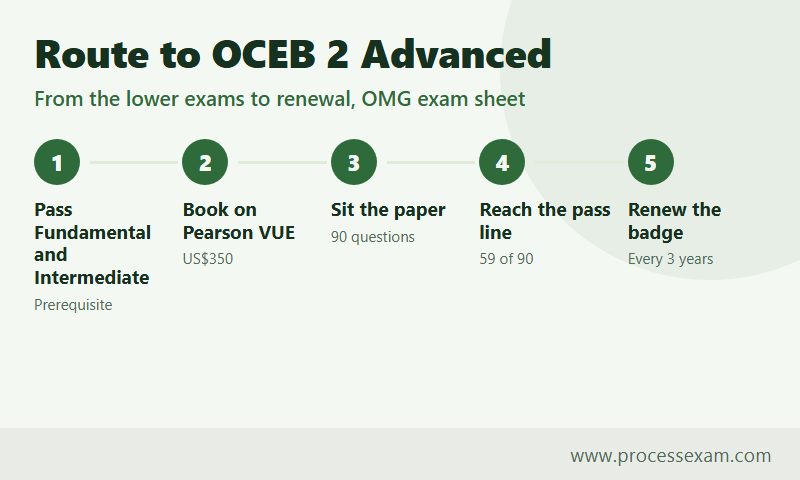
OMG lists passing scores on the BPM 2 Fundamental and Intermediate exams as the prerequisite for Advanced, so you cannot book it as a first step. If you are still at the start of that route, the Fundamental exam is the place to begin, and the Advanced material will make more sense once you have met its vocabulary there.
Booking, retakes and cancellations
- Create or sign in to a Pearson VUE account, which handles booking, payment, cancellation, rescheduling, receipts and score reports.
- Choose a secure test center or an online sitting. If you pick online, run the Pearson VUE system test on your computer before you schedule, not on exam morning.
- Cancel more than 24 hours before the appointment for a full refund; later than that and the exam price is forfeited.
- If you fail, your score report contains a 20% discount code toward a retake. OMG also publishes discount and promo rules, and bulk vouchers, for employers and training partners.
- Accommodations for a learning or physical disability are arranged by writing to OMG's certification office rather than through Pearson VUE.
Validity and renewal
The certification expires three years after the exam date. OMG's way of extending it is to take the same exam or a higher-level one, so there is no separate renewal fee schedule to learn, only another exam. After you pass, OMG issues a Credly digital credential within hours, which you can claim and share, and you can print the certificate as a PDF or on paper.
Which six areas decide the 90 questions?
OMG splits the paper into six areas with fixed weights. Read them as a budget for your revision time, not as a list of equal chapters. The full wording of each area is also set out on our OMG-OCEB2-BUSADV300 syllabus page.
| Syllabus area | Weight |
|---|---|
| Management of BPM Programs | 27% |
| Compliance and Assurance | 22% |
| Advanced Business Process Modeling with BPMN | 15% |
| Advanced Topics in Process Improvement | 14% |
| Aligning BPM with Enterprise Goals and Resources | 11% |
| Advanced Change Management | 11% |
The first two areas together make 49% of the paper, so nearly half the marks reward knowing how a BPM function is run and controlled. The next sections go through each one in the words OMG uses.
Management of BPM Programs, 27%
This is the largest block and the one most like a manager's job description. OMG lists developing a BPM Center of Excellence, building an enterprise roadmap for BPM, techniques to drive business adoption, writing business cases, developing a business architecture, resourcing a BPM team, process ownership, process portfolio management, and global and local process guidelines.
A useful way to study it is to imagine you have to launch the function yourself. Who sponsors it? What does the business case promise, and how do you show the promise was kept? Who owns a process that crosses three departments? Which rules are set once for the whole company and which are left to each country? Questions in this area tend to turn on a sensible sequence or a clear allocation of responsibility, so practice explaining why one option comes before another rather than memorizing lists.
Compliance and Assurance, 22%
The sheet defines this as Governance, Risk and Compliance. It names corporate governance, Enterprise Risk Management, strategic compliance management, corporate social responsibility, information assurance, process assurance and quality assurance. The word to hold on to is assurance: the exam is less interested in whether you can recite a regulation than in whether you know how an organization gains confidence that its processes behave as designed.
Separate the layers when you revise. Governance sets who decides and who is accountable. Risk management identifies and weighs what could go wrong. Compliance checks conformity with rules, internal or external. Quality assurance and process assurance look at whether the process and its changes are fit for use. Candidates who blur those layers into one idea called "control" are the ones who find the answer options look all alike.
Advanced Business Process Modeling with BPMN, 15%
Despite the title, this is not a second round of drawing symbols. OMG describes advanced process discovery, working with large models, splitting a model for outsourcing and model validation. The skill being tested is judgment about models as business assets: how you find out what really happens, how you keep a large model manageable, where you can cut it so another party can work on a piece, and how you confirm that it is right.
Advanced Topics in Process Improvement, 14%
Here OMG lists business process and transition quality assurance techniques, the structure and major features of the Business Process Maturity Model, and the major features, approaches and benefits of Six Sigma and of Lean. Expect to compare approaches: what each is for, what it measures and where it fits. Knowing that Six Sigma attacks variation while Lean attacks waste is the beginning of the answer, not the end.
Aligning BPM with Enterprise Goals and Resources, 11%
This area covers aligning processes with stakeholders' goals, aligning them with the resources available, changing processes so they keep serving business goals when conditions change, and enterprise decision management. The last item is the least familiar to many candidates and has its own reading in OMG's list, so give it a dedicated evening rather than hoping it appears in the other material.
Advanced Change Management, 11%
The final area covers implementing and aligning organizational change, rollout strategies, assessing degrees of impact and advanced change techniques. Think about the people on the receiving end of a redesigned process: how much does it change for them, how fast should the rollout go, and which approach suits a small shift versus a deep one? The recommended reading here is a short, people-focused book, which makes this one of the cheaper areas in which to collect marks.
Which parts of BPMN 2.0.2 and BPMM 1.0 does OMG actually point you to?
The information sheet names two OMG standards as standard areas covered. Treating them as whole documents would waste weeks, because the sheet lists the sections that matter.
BPMN version 2.0.2
The BPMN 2.0.2 specification is examined through a short list of chapters and tables. OMG names the scope chapter, the process types, the descriptive and analytic conformance sub-classes, the overview with its focus on process and collaboration diagrams, the basic and extended modeling element tables, conversations, sub-processes, call activities, handling events, the complex gateway, compensation, the table of end event types, an introduction to choreography, diagram definition and interchange, execution semantics up to sequence flow considerations, the complex gateway's execution rules, interchanging incomplete models, and the events chart. The sheet adds that attributes are not emphasized.
That list tells you something useful: the exam wants you to recognize what a construct is for and when a model is complete enough to hand over, not to memorize attribute tables. A good test of yourself is to take one process and ask where a call activity would replace a sub-process, what a compensation would undo, and which end event type says the right thing about the outcome.
Business Process Maturity Model version 1.0
The Business Process Maturity Model, BPMM 1.0, is the second standard. OMG points to the normative content and structure chapter, the introduction, the BPMM family, the concepts chapter, the structure of the model and institutionalization. Pay attention to the idea of institutionalization, which asks whether an improvement survives staff turnover and changed priorities. It shows up again when the exam asks about governance and about change.
What should you read first from a reading list that runs to thirty-odd titles?
OMG's sheet lists a long set of recommended materials, from full books to single papers and chapters. Nobody reads all of them in six weeks, so triage by syllabus weight. The sheet itself gives chapter numbers for most of the books, which is a hint that chapters, not covers, are the unit of study.
| Syllabus area | Reading from OMG's list to start with |
|---|---|
| Management of BPM Programs | Harmon, Business Process Change (chapters on business architecture and scoping process problems); the short papers on establishing a BPM Center of Excellence and process governance; Smith and Fingar, Business Process Management: The Third Wave |
| Compliance and Assurance | The corporate governance, enterprise risk management and compliance management chapters the sheet specifies; the NIST risk management guide for information technology systems |
| BPMN modeling | Bridgeland and Zahavi, chapter 7 on creating a good model; the paper on the challenge of process discovery |
| Process improvement | Lean for Dummies, chapters 1 and 2; Harrington on process improvement; the paper on the marriage of BPM and Six Sigma |
| Enterprise goals and resources | Ross, Enterprise Architecture as Strategy, chapters 1 to 4; Taylor and Raden, Smart Enough Systems, for decision management |
| Change management | Hiatt and Creasey, Change Management: The People Side of Change, chapters 1 to 6 |
Two habits help with this material. First, read each chapter with one question in mind: which sentence in the syllabus does this chapter answer? If you cannot name it, skim. Second, keep a one-page glossary as you go, because the same idea appears under different names across authors, and exam options often choose one author's word.
Can six weeks of evening study carry you through the Advanced paper?
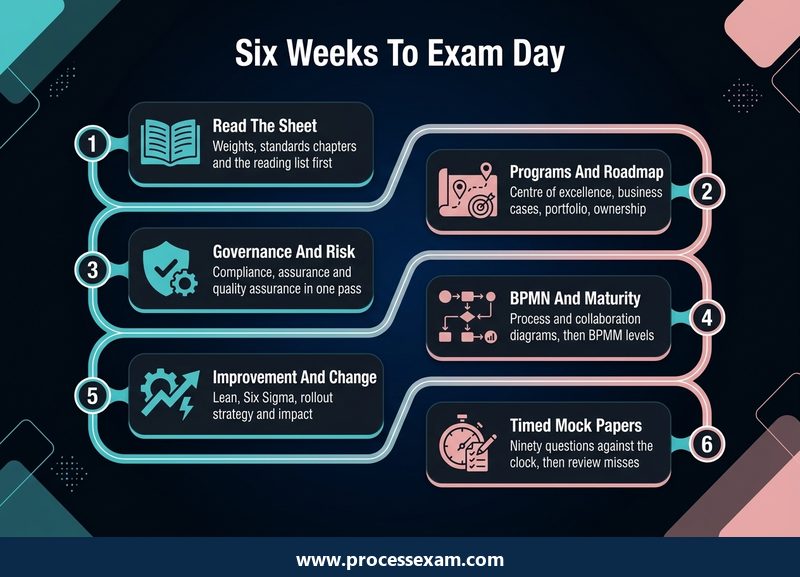
The plan below assumes about eight to ten hours a week for someone who has already passed the lower exams and works in or near process management. Stretch it to eight weeks if your BPMN is rusty, and shorten it if you run a BPM function today. These hours are a suggestion, not an OMG figure.
| Week | Focus | What you finish |
|---|---|---|
| 1 | Information sheet, standards list, reading triage | A weighted study calendar and the one-page glossary started |
| 2 | Management of BPM Programs | A written outline of a Center of Excellence launch, from sponsor to portfolio |
| 3 | Compliance and Assurance, then Aligning BPM with Enterprise Goals | A table separating governance, risk, compliance and assurance with an example each |
| 4 | BPMN and the Maturity Model | One end-to-end model with a call activity, an event and a compensation; BPMM levels from memory |
| 5 | Process improvement and Change Management | A Lean versus Six Sigma comparison sheet and a rollout plan for a small and a deep change |
| 6 | Timed mock papers and review | Two full 90-question sittings against the clock, every miss traced to a syllabus line |
The last week deserves care. Sit at least one full paper under exam conditions, with the 90 or 120 minutes you will really have. A practice set such as our OMG-OCEB2-BUSADV300 practice exam is useful at this stage because it tells you which of the six areas costs you marks, which is information a re-read of the books cannot give.
When you review a miss, write the cause in one of three words: knowledge, reading or time. A knowledge miss means a gap to close with the book. A reading miss means you answered a question that was not quite the one asked, which is common when two options differ by one qualifier. A time miss means you rushed the end. The pattern across your two mocks shows where the last days of study should go.
How should you pace a paper that gives you about a minute per question?
At 90 questions in 90 minutes the arithmetic is one minute each; at 120 minutes it is about 80 seconds. Management and compliance questions are usually wordier than modeling ones, so they take longer to read, which is another reason to practice on timed papers rather than untimed quizzes.
- Do a first pass at a steady pace and flag any question that needs more than two minutes. Come back after you have banked the easy marks.
- With a long scenario, begin at the final sentence to see the actual ask, then go back and pick out only the facts that bear on it.
- Eliminate options that answer a different layer than the one asked: a risk answer to a governance question, or a change-management answer to a process-improvement question.
- Do not leave blanks. The pass mark counts correct answers, so a guess costs nothing that an empty answer would not.
- With about ten minutes left, stop reviewing flagged items one by one and make sure every question has an answer.
Because the pass line is 59 of 90, set yourself a checkpoint: roughly two thirds correct at the halfway point means you are on course, and you can spend remaining time on the flagged items. This is a rule of thumb for staying calm, not a scoring rule from OMG.
Where can the Advanced credential take a BPM practitioner?
The credential tells an employer that you have been examined on the management side of BPM: running a program, controlling it and changing the organization around it. That is a different signal from a tool or notation certificate, and it fits roles such as BPM program lead, process owner, process excellence manager, or consultant helping a client set up a Center of Excellence. OMG's sheet does not promise a job or salary, and this guide does not either.
Practical effects after a pass include the Credly badge, which you can add to a profile or email signature the same day, and a certificate for HR files. The three-year validity creates a natural plan: decide in the third year whether to renew with the same exam or aim at a higher one.
Some of the most lasting value is vocabulary. People who studied for this exam tend to describe BPM projects in terms of ownership, portfolio, assurance and institutionalization, which makes proposals read as more credible to executives. That is a reason to take notes in your own words while you study, since you will reuse them at work.
If you want to continue after this level, the OMG information sheet's own rule is the guide: any equal or higher exam extends your validity. Check OMG's BPM certification page for what sits above it before you commit to a path.
Frequently Asked Questions
What are the prerequisites for the OCEB 2 Business Advanced exam?
OMG lists passing scores on the BPM 2 Fundamental and Intermediate exams as the prerequisite for the Advanced exam. You cannot book Advanced as your first OCEB 2 exam. Check that your earlier results are on your Pearson VUE record before you schedule, because that account is where OMG exams are booked and paid.
How many questions are on OMG-OCEB2-BUSADV300 and what is the pass mark?
The exam has 90 multiple-choice questions, with text and images, and you need at least 59 correct answers, which is 66%. You have 90 minutes if you live in an English-speaking country and 120 minutes in all others. OMG delivers the paper in English only, and translation apps are prohibited.
How much does the OCEB 2 Advanced exam cost, and what if you fail?
The fee is USD $350 plus taxes, in the regional currency equivalent. If you fail, your score report includes a 20% discount code for a retake. A booking can be cancelled for a full refund if you do it through Pearson VUE more than 24 hours before the appointment.
How long is the OCEB 2 Advanced certification valid?
OMG's information sheet says certifications expire three years after the exam date. You extend validity by taking the same exam again or a higher-level one. Passing gives you a Credly digital credential within hours, which you can claim and share, and a certificate you can print.
Is there an OCEB 2 Advanced certification guide in PDF form?
Yes. OMG publishes a free exam information sheet for each OCEB 2 level as a PDF. The Advanced sheet gives the six syllabus weights, the BPMN 2.0.2 and BPMM 1.0 chapters examined, and the recommended reading list. Start there before buying any book, because it tells you which chapters matter.
- BPM 2 Certifications |
- OMG OCEB 2 Advanced Exam Questions |
- OMG OCEB 2 Advanced Question Bank |
- OMG OCEB 2 Advanced Test Questions |
- OMG OCEB 2 Advanced Study Guide |
- OMG-OCEB2-BUSADV300 Question Bank |
- OCEB 2 Advanced Certification |
- OMG-OCEB2-BUSADV300 Exam Questions Download |
- OMG-OCEB2-BUSADV300 Test Questions |
- BPM 2 Advanced Mock Exam |
- BPM 2 Advanced Simulator |
- BPM 2 Advanced Certification |
- BPM 2 Advanced Certification Cost |
- BPM 2 Advanced Certification Requirements |
- OMG BPM 2 Advanced Book |
- OMG BPM 2 Advanced Question Bank |
- OMG BPM 2 Advanced Study Guide |
- BPM 2 Advanced |
- BPM 2 Advanced PDF |
- OMG BPM 2 Advanced Exam Questions |
- OMG BPM 2 Advanced Sample Questions


