
OGB-001 Exam Cost, Syllabus and Value: Is USD $325 Worth It?
OGB-001 is one of the cheaper Open Group exams: a USD $325 booking fee buys one 30-question, 45-minute attempt, and 18 correct answers earn the TOGAF Business Architecture Level 1 credential. It is still sold today, but a newer 10th Edition exam, OGBA-101, now sits beside it at a higher price. This guide weighs the money against what you get back, then covers the syllabus and how long to study.

People who type "OGB test" into a search box usually want three things settled before they spend anything: whether the exam still exists, what the total bill really is, and whether a Level 1 badge changes anything at work. The sections below answer those in that order, using the figures The Open Group publishes. Where a figure comes from a particular Open Group document, the text says which one, so you can check it yourself before you pay.
Is OGB-001 still on sale, and how does it sit beside OGBA-101?
Yes. The Open Group's TOGAF examinations datasheet, whose footer carries a 2023-2025 copyright, still lists the TOGAF Business Architecture Part 1 exam under the code OGB-001, in English, based on the TOGAF Standard, Version 9.2. The Open Group's retail exam fee schedule, applicable from 1 February 2026 with corrections applied on 12 February 2026, still prices it. I read both documents in October 2026, and neither marks the exam as withdrawn.
The Open Group's credentials page adds an important note. It describes the TOGAF Business Architecture Level 1 credential as based on Version 9.2 and says that a newer TOGAF Business Architecture Foundation certification exists, based on the TOGAF Standard, 10th Edition, with a migration path for people who already hold the Level 1 credential. That newer exam is OGBA-101. So the honest picture is two live exams on the same subject, one for each edition of the standard.
| Point of comparison | OGB-001 (version 9.2) | OGBA-101 (10th Edition) |
|---|---|---|
| Award on passing | TOGAF Business Architecture Level 1 credential, with an Open Badge | TOGAF Business Architecture Foundation certification |
| Questions | 30 | 40 |
| Time limit | 45 minutes | 60 minutes |
| Pass mark | 60% (18 of 30) | 60% (24 of 40) |
| Exam booking fee | USD $325 | USD $405 |
| Retail voucher fee | USD $355 | USD $435 |
Both are closed-book, supervised, multiple-choice papers with no prerequisite, so the choice is not about difficulty. It is about which edition your employer, your training provider or the job advert names. Choose OGB-001 when a course, a hiring requirement or an internal learning path specifically asks for the Level 1 credential or the 9.2 standard. Choose OGBA-101 when you want the credential tied to the current edition and are happy to pay $80 more for ten extra questions and fifteen extra minutes. If you hold nothing yet and no one has named a version, the newer exam is the one the vendor is steering new candidates toward, and the fee gap is the price of that.
What does the OGB-001 fee cover, and what else adds to the bill?
The fee schedule lists two prices for OGB-001. The exam booking fee is USD $325, which the schedule describes as the fee Pearson charges for booking an individual exam directly with payment by credit card. The retail voucher fee is USD $355. Retail vouchers are bought in The Open Group's shop and, according to the schedule, require an approved retail voucher account and come with their own terms. For an individual candidate paying with a card, $325 is the number that matters.
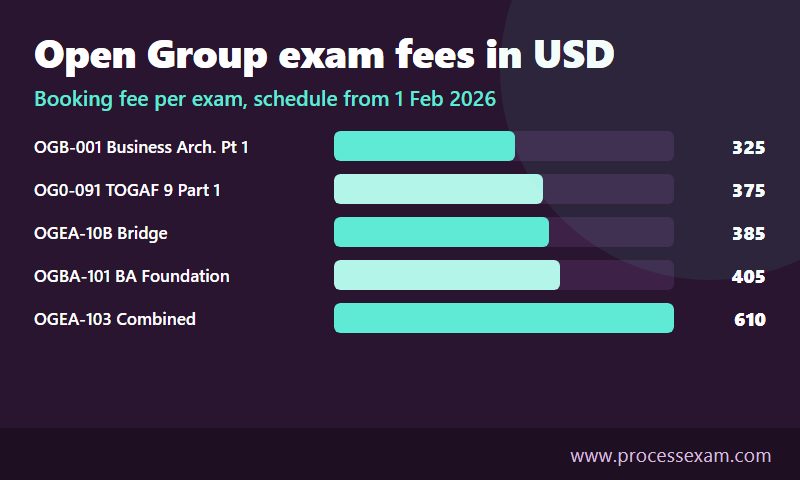
The chart above puts that figure in context. OGB-001 is the cheapest exam on the schedule I compared it with: $50 below the TOGAF 9 Part 1 exam, $60 below the 10th Edition Bridge exam, $80 below OGBA-101, and little more than half the price of the 10th Edition combined Part 1 and Part 2 exam at $610. Per question, OGB-001 works out at about $10.83 ($325 divided by 30), against about $10.13 for OGBA-101 ($405 divided by 40), so the cheaper exam is cheaper in total but not per question. That detail matters only if you are choosing purely on value; most people are choosing on the badge they need.
Costs the fee does not include
- Tax and currency. The schedule states that exams are priced in USD, that extra taxes may apply in some countries and that fees may move with exchange rates. Your card statement can differ from $325.
- A repeat sitting. The schedule lists a fee per booking. Unless the booking terms you see at checkout say otherwise, assume a second attempt is charged at the same rate, which makes two attempts $650 before tax. That is the strongest argument for finishing your practice before you book rather than after.
- Study material. The Open Group's shop lists a study guide for this exam, and the TOGAF Standard, Version 9.2 is the body of knowledge it is built on. Budget for one of them, not a stack.
- Training, if you choose it. The datasheet recommends attending an accredited training course but is careful to say that training does not guarantee a pass.
When the exam fee is already paid for
The datasheet also notes that every accredited training course includes the exam in the course fee, with a voucher code for use at the exam provider's public test centre. If an employer is sending you on a course, ask whether the voucher is part of it before booking separately; paying $325 twice is the easiest saving to miss. The same note says payment can instead be made directly to the exam provider at the time of booking.
The Open Group reserves the right to change the fees without notice, so treat any figure in an article, including this one, as a snapshot. The schedule is linked in the sources at the end of this section, and it takes thirty seconds to confirm the price on the day you book.
Sources for this section: The Open Group's examination fee schedule for people and the TOGAF examinations datasheet.
What does the OGB test look like once you sit down?
It is a single multiple-choice paper. Each correct answer scores one point, there is no negative marking described in the datasheet, and you need 18 of the 30 questions right to pass. That leaves room for 12 wrong answers, so the exam rewards solid coverage of every topic more than perfection in a few.
| Exam detail | OGB-001 |
|---|---|
| Full name | The Open Group Business Architecture Part 1 |
| Exam code | OGB-001 |
| Vendor | Open Group |
| Version | Version 9.2 |
| Number of questions | 30 |
| Duration | 45 minutes |
| Passing score | 60% |
| Exam fee | USD $325 |
The datasheet adds the delivery rules: the exam is supervised and closed book, there is no prerequisite, and you can sit it at an authorised test centre or remotely through Pearson VUE's online delivery. The paper is available in English only. Passing leads to the award of an Open Badge, and the credential is listed on Credly, which is how employers can check it without phoning anyone.
What 90 seconds per question means
Forty-five minutes for 30 questions is exactly 90 seconds each. These are knowledge questions, not long case studies, so most should take less than that, and the saved time is what you spend on the two or three that need careful reading. The datasheet also points out that the listed time is the time actually allowed for the exam; the exam provider's own booking information may quote a longer slot because registration, a tutorial and a survey are added, typically another 15 minutes. Candidates who are not first-language English speakers may be offered extra time; ask the provider when you book rather than assuming.
What kind of question to expect
Questions test whether you can recognise and apply a technique, not whether you can recite a page. A typical item gives a short business situation and asks which concept fits: is this a capability or a value stream, which ADM phase produces this output, what does an information map show that a data model does not. That is why reading the standard once is not enough and why a few timed practice sets pay off: they train the recognition. The OGB-001 practice exam is one way to rehearse the 30-question, 45-minute shape before the real fee is spent.
What do the six OGB-001 learning areas ask of you?
The Open Group describes the credential as validation that you understand business modelling, business capabilities, TOGAF business scenarios, information mapping and value streams, and how to apply them in developing a business architecture with the TOGAF Standard, Version 9.2. In practice that becomes six areas. The syllabus listing on this site, the OGB-001 syllabus topics, groups them the same way, and the vendor publishes no per-topic weightings I could find, so plan for equal attention to each.
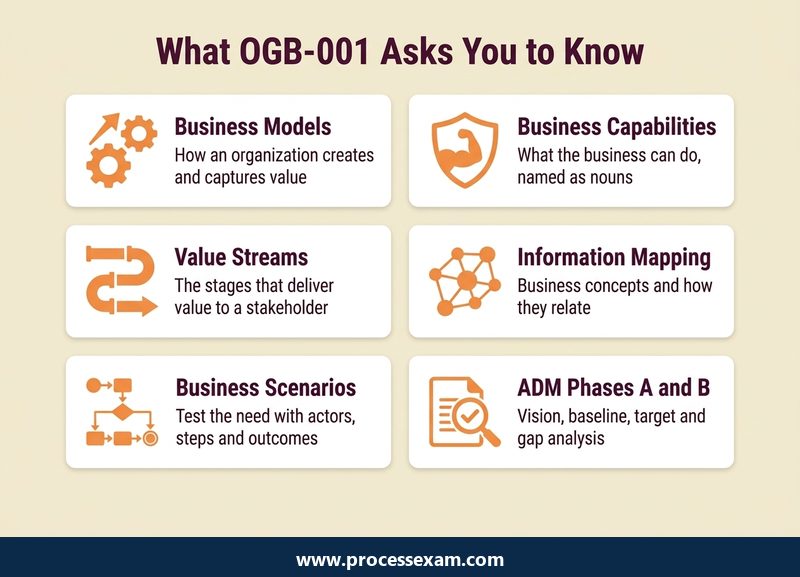
Business models
Expect to explain what a business model is, how one is developed, what business model innovation is for and why a business architecture framework adds value. Think of a business model as the answer to "how does this organization create, deliver and capture value?" The exam is interested in the purpose and use of models inside TOGAF, not in fashionable canvases. Be ready to say what impact a model has on the decisions an architect supports.
Business capabilities
A capability is something the organization can do, regardless of who does it or which tool is used. Learn the parts of a well-written capability, learn why capability names are noun phrases such as Claims Assessment rather than verb phrases, and learn how capabilities are modelled and mapped to other business architecture concepts. A frequent trap is confusing a capability with a process or a department; the first is stable, the second changes weekly.
Value streams
Know the definitions of value and of a value stream, the guiding principles for creating one, and how streams are decomposed into stages and analysed for the value each stage adds. A value stream is named from the stakeholder's side and is written as a verb phrase, such as Receive Treatment. Questions often ask you to mix this with capabilities: the stream says what the stakeholder experiences, the capabilities say what the organization needs in order to deliver each stage.
Information mapping
An information map shows the business concepts that matter, such as Patient, Appointment and Referral, and how they relate, in business language. Learn what it is for, and learn how it relates to the wider business architecture and to data models. The key distinction is audience and level: an information map describes the business, while a data model is a design for storing data.
Business scenarios
This area covers the benefits of business scenarios, how they fit into the TOGAF Architecture Development Method and the development phases of a scenario with the steps in each. The central idea is that a scenario tells a short story, with actors, steps and outcomes, in order to check that the architecture addresses the right problem before money is spent on a solution.
Developing a business architecture with the ADM
The final area is the ADM itself, with the emphasis on Phase A (architecture vision) and Phase B (business architecture): their approach, vision, inputs and outputs, plus gap analysis between the baseline and the target. If you know what goes into Phase B and what comes out of it, you can usually reason your way through the neighbouring questions.
One small example that joins the areas
Picture a regional hospital whose outpatients wait too long for scan results. The value stream is Receive Diagnostic Result, from the patient's side: referral, booking, scan, report, consultation. The capabilities underneath include Appointment Scheduling, Diagnostic Imaging and Clinical Reporting. The information map shows Patient, Referral, Scan and Report. A scenario describes a patient, a radiographer and a consultant and the outcome they each need, and Phase B records the baseline, the target and the gap, perhaps weak Clinical Reporting capacity. One case, five of the six areas, and the sixth, the business model, explains why shorter waits matter to the hospital at all.
How much study time protects a $325 booking?
Treat study time as the cheapest way to avoid a second fee. For someone who already works in business analysis, strategy or architecture, about three weeks at six to eight hours a week is a reasonable starting point; for someone new to the vocabulary, stretch it to four or five. These are my recommendations rather than vendor figures, and the right length is the one in which your timed practice scores stop moving.
A three-week outline
- Week 1, the concepts. Read the Level 1 material for business models, business capabilities and value streams. Write a one-line definition of each term in your own words and one example from a company you know.
- Week 2, the maps and the method. Cover information mapping, business scenarios and Phases A and B of the ADM. Draw one capability map and one value stream by hand for the same fictional organization, then connect them.
- Week 3, the rehearsal. Take two or three timed sets of 30 questions in 45 minutes, review every wrong or guessed answer and revisit the topic behind it. Book only when you clear 24 or more out of 30 (80%) on fresh questions, because the real paper will not word things as your practice did.
Study with one source at a time
The cost angle applies to study material as much as to the exam. Pick one primary source, either the study guide the Open Group's shop lists for this exam or the TOGAF Standard, Version 9.2 itself, and one practice source, and resist adding more. The topics are narrow enough that one clear explanation of each is better than five overlapping ones, and every extra purchase makes the total drift toward the cost of the exam itself.
Signs you are ready to book
- You can explain the difference between a capability, a value stream and a process without notes.
- You can name what Phase B takes in and what it produces.
- Your last two timed sets finished with at least five minutes to spare and a score of 24 or better.
- You can say what an information map is for and why it is not a database design.
Is the Level 1 credential worth the money, and for whom?
The honest answer depends on who is paying and what you are trying to change. The Open Group describes this as a certification credential at the first learning level, so it proves knowledge and understanding, not years of practice. It will not make you an architect. What it does is give a verifiable, vendor-issued badge that says you share the vocabulary used when strategy, architecture and delivery teams plan change together.
Where the return is clearest
- Business analysts and product owners who are asked to describe what an organization does before a transformation programme starts. Capability maps and value streams are the tools they will be handed.
- Strategy, portfolio and transformation staff who need to explain where investment goes and why. A common language is useful when many teams review the same map.
- Enterprise and solution architects who want to work comfortably with the business side. Level 1 covers the business-facing side of the framework.
- Candidates in a training programme or a role that names the credential. If it is a written requirement, the fee is a fixed cost with a clear payoff, and an employer may reimburse it.
Where the money is less well spent
If you only need to understand capabilities and value streams for one project, reading the material is enough and the exam adds cost without adding skill. If nobody around you has asked for a TOGAF credential and you cannot yet say where you would use it, wait. If you are early in your career and want the broadest TOGAF recognition, compare the other exams on the fee schedule with the Level 1 credential first, since the Level 1 credential is about business architecture and not about the whole framework.
A fair way to judge it
Add up what you will really pay: the $325 booking fee, any study material, and the cost of a repeat if you book too early. Then ask whether one concrete thing, a role application, a promotion discussion or a client request, depends on the badge. If the answer is yes, the fee is small next to the benefit. If the answer is no, spend a month with the material first and decide afterwards. For background on the framework behind the credential, the overview of the TOGAF framework on Wikipedia is a neutral starting point.
What should you check before you pay for a slot?
A short checklist protects the fee better than any discount. Run through it on the day you book, using The Open Group's own pages rather than anyone's summary, this one included.
- Confirm the exam code and version. You want OGB-001, the 9.2 exam, if that is what your employer or course specifies. The newer 10th Edition exam has a different code and price.
- Check whether a voucher already exists. An accredited training course includes the exam fee and issues a code. Do not book separately until you know.
- Check the fee on the day. Read the current figure on the fee schedule and expect tax or exchange-rate differences at checkout.
- Choose how you will sit it. A test centre and online supervision are both available through Pearson VUE. Pick the one where you will be calmer, and test your equipment early if you choose online.
- Ask about time allowances. If English is not your first language, ask the provider about extra time before the booking is final.
- Plan the day. Allow for the extra 15 minutes of registration, tutorial and survey that the datasheet mentions, so that you start the 45 minutes relaxed.
On the day itself, answer the sure questions first, mark anything that takes more than two minutes and return to it, and use the 12 questions you are allowed to miss as a cushion rather than a target. Finish with a quick scan for unanswered items before you submit.
Once you pass, the badge is yours to share through the Open Badge and Credly listing the Open Group describes on its TOGAF certification credentials page. If you later want the 10th Edition credential, that same page describes the migration path for Level 1 holders, so passing OGB-001 now does not close the door on the newer exam.
Frequently Asked Questions
What is the OGB test?
OGB-001 is The Open Group's TOGAF Business Architecture Part 1 exam. It is a closed-book, supervised, 30-question multiple-choice paper with a 45-minute limit, based on the TOGAF Standard, Version 9.2. Passing earns the TOGAF Business Architecture Level 1 credential and an Open Badge.
How many questions are on OGB-001 and what is the pass mark?
OGB-001 has 30 multiple-choice questions to answer in 45 minutes. The pass mark is 60%, which means 18 correct answers out of 30. Each correct answer scores one point, so you can miss 12 questions and still pass, and there is no case study or open-book section.
How much does the OGB-001 exam cost?
The Open Group's fee schedule, applicable from 1 February 2026, lists a USD $325 exam booking fee for OGB-001 and a USD $355 retail voucher fee. Local taxes and exchange rates can change what you pay, and accredited training courses include the exam in the course fee.
Is OGB-001 still available, or has OGBA-101 replaced it?
OGB-001 is still listed on The Open Group's exam datasheet and fee schedule. OGBA-101, the TOGAF Business Architecture Foundation exam for the 10th Edition, now sits beside it at USD $405. The Open Group describes a migration path from the Level 1 credential to the newer certification.
Are there prerequisites for the OGB-001 exam?
No. The Open Group's datasheet lists no prerequisites for OGB-001. Anyone can book the exam, and training is recommended but not required. You can sit it at an authorised test centre or remotely with online supervision, both delivered through Pearson VUE, and the paper is offered in English.
- Business Architecture |
- Open Group TOGAF Business Architecture Part 1 Test Questions |
- OGB-001 Question Bank |
- TOGAF Business Architecture Part 1 Simulator |
- TOGAF Business Architecture Part 1 Mock Exam |
- Open Group TOGAF Business Architecture Part 1 Book |
- TOGAF Business Architecture Part 1 Certification Cost |
- TOGAF Business Architecture Part 1 Certification Requirements |
- Open Group TOGAF Business Architecture Part 1 Sample Questions |
- OGB-001 Exam Questions Download |
- OGB-001 Test Questions |
- TOGAF Business Architecture Part 1 PDF


