
LEED AP ID+C: Exam Facts, Cost and Career Value
Updated on 29 September 2026. What’s new: the exam now follows LEED v5, with 85 scored questions across seven content areas, and the LEED v4 version closed on 28 June 2026
LEED AP ID+C is the USGBC credential for professionals who design, specify and build commercial interiors, and it earns its place when tenant fit-outs are your daily work. The exam is 100 multiple-choice questions in 120 minutes, with 170 out of 200 needed to pass. It now tests LEED v5, so older study material no longer fits. This guide covers the exam facts, the interior-specific content, what the credential changes on real projects and a study route.

Who is LEED AP ID+C really for, and who should pick a different specialty?
LEED AP ID+C sits in the family of LEED AP with specialty credentials that USGBC and its certifying body GBCI run. Each specialty pairs the same core green-building knowledge with one rating system. USGBC describes the Interior Design and Construction specialty as serving people who take part in the design, construction and improvement of commercial interiors and tenant spaces that offer a healthy, sustainable and productive place to work. The phrase to hold on to is tenant space. An ID+C project is usually a fit-out inside a building somebody else owns, so the decisions on the table are partitions, ceilings, floor finishes, lighting, furniture, fixtures, mechanical zoning inside the lease line and the way the site is run while the work goes on. It is not about the shell, the core or the structure.
That focus is the reason to choose it, and also the reason to think twice. If most of your work is new buildings or full renovations, the Building Design and Construction specialty covers your decisions better. If you manage existing buildings, Operations and Maintenance fits. Neighbourhood Development and Homes are separate worlds again. The table below matches common roles to the ID+C credential.
| Role | What you decide on interiors work | What ID+C lets you show |
|---|---|---|
| Interior designer or workplace strategist | Layout, finishes, furniture, lighting, acoustics | You can justify material and lighting choices against LEED requirements, not just taste |
| Architect on tenant improvement work | Space planning, daylight access, accessibility | You can link design moves to credits before the drawings are issued |
| MEP engineer or energy modeller | Ventilation, lighting power, metering, controls | You understand what the fit-out can and cannot change inside a shared building |
| Contractor or construction manager | Sequencing, waste, protection of air quality, submittals | You can run the construction-phase requirements and the paperwork they generate |
| Product specifier or manufacturer representative | Which products reach the spec | You can speak precisely about emissions, ingredient reporting and environmental product declarations |
| Tenant representative or facility manager | Lease terms, move planning, ongoing operation | You can set sensible green requirements for a landlord conversation and a brief |
USGBC strongly recommends previous experience on a LEED-registered project. It is a recommendation, not a formal condition. Candidates who have never seen a scorecard or a documentation package find the process questions harder than those who have, so build that exposure into your preparation if you lack it.
Which LEED version does the ID+C exam test in autumn 2026?
The exam now follows LEED v5. We checked USGBC's LEED v5 exam information page in September 2026, when it showed an update dated 28 September. The LEED v5 rating systems launched in April 2025 for the commercial family, and GBCI then rebuilt the matching credential exams. LEED AP ID+C is one of them, alongside Green Associate, BD+C and O+M. Only the AP ND and AP Homes exams stay on LEED v4.
What that means for your registration
The last day to sit the LEED v4 version of an AP with specialty exam was 28 June 2026. Anyone still holding an unused registration was moved to the English LEED v5 exam with the same 12-month eligibility period. Since 30 June 2026 the exam on offer has been a beta version. You can opt in to the data collection phase when you register, which brings a discounted fee and continuing education hours after a pass, but the opt-in closes for registration on 21 October 2026 and the testing window shuts on 27 October. Register through the standard route and the version you meet depends on your test date: a sitting between November 2026 and January 2027 is still a beta, and the final exam is due in February 2027. USGBC says every one of these dates may shift, so read the page again before you book.
Two practical points follow. First, beta results are not shown on screen. USGBC currently expects scores for the AP with specialty beta candidates in the first quarter of 2027, once the passing standard has been set. Second, the combined exam that lets a newcomer sit Green Associate and the specialty together is not offered during the beta, so you need an active Green Associate credential when you register. A Green Associate earned on LEED v4 still qualifies. Whichever version you sit, you earn the same credential.
Our syllabus outline for this exam already follows the LEED v5 structure, so it is safe to use alongside USGBC's own references. Materials built on the LEED v4 interiors credits are not.
What are the ID+C exam format, fees and pass mark?
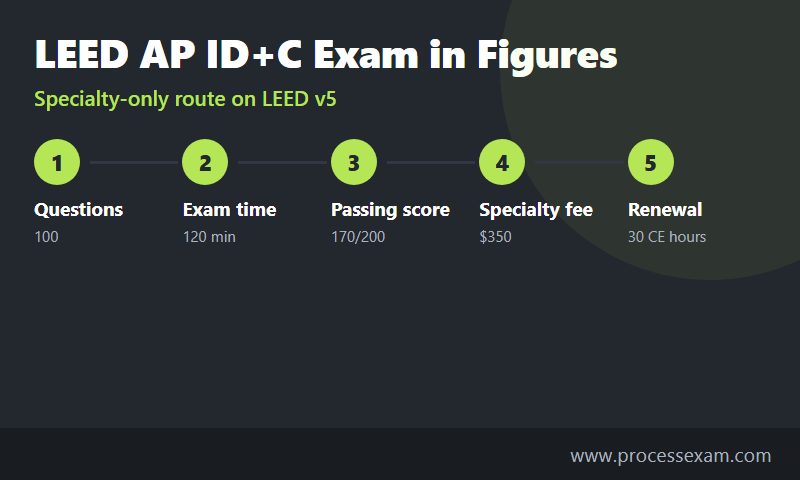
The figures below come from our exam records and match USGBC's LEED AP with specialty page. GBCI delivers the exam at Prometric test centres or through remote online proctoring.
| Item | Detail |
|---|---|
| Credential | Certified LEED Accredited Professional Interior Design and Construction (AP ID+C) |
| Exam code | AP ID+C |
| Questions | 100 |
| Duration | 120 minutes |
| Passing score | 170 out of 200 |
| Format | Multiple choice |
| Specialty-only fee | $350 ($250 for USGBC members) |
| Combined exam fee | $550 ($400 for USGBC members) |
| Delivery | Test centre or remote online proctoring |
How to read the score
The 170 out of 200 is a scaled score, not a percentage of correct answers, and GBCI sets the standard from exam data. Do not turn it into a target such as 85 per cent. Your practice tests should tell you whether you are consistently sound in every content area, because a candidate who is excellent in two areas and weak in the rest is taking a risk.
Which route suits you
If you already hold Green Associate, the specialty-only route at $350 ($250 for USGBC members) is the one you need, and during the beta it is the only one available. If you are new to LEED, the combined exam at $550 ($400 for members) covers both credentials in one sitting once it is offered again for LEED v5, so watch USGBC's page for news on it. Membership saves $100 on the specialty exam and $150 on the combined exam, so check whether it pays for itself before you book.
Which interiors topics does the exam weigh most heavily?
Our syllabus outline lists seven content areas that together account for 85 questions. The remaining questions in the 100 are unscored trial items scattered through the paper, and nothing on screen marks them, so answer each one as if it counts. The seven content areas in our syllabus outline break down like this.
| Content area | Questions | Interiors angle |
|---|---|---|
| LEED Process and Project Priorities | 7 | Minimum requirements, project boundary, documentation, pilot and regional credits |
| Integrative Process, Planning, and Assessments | 9 | Climate resilience, community context, carbon assessment, early design workshops |
| Location and Transportation | 8 | Walkable access, transit, bicycle storage and showers, electric vehicle parking |
| Water Efficiency | 10 | Fixtures inside and outside the tenant space, appliance and process water, metering, leak detection |
| Energy and Atmosphere | 17 | Energy performance, electrification, renewable supply, refrigerants, commissioning, metering |
| Materials and Resources | 17 | Interiors life-cycle assessment, low-carbon procurement, reuse, stewardship, waste |
| Indoor Environmental Quality | 17 | Thermal, sound and lighting environments, biophilia, accessibility, ventilation, construction air quality |
Three areas of 17 questions each make up 51 of the 85. That is 60 per cent of the scored questions falling in the energy, materials and indoor environment areas, so they deserve well over half of your study hours. Here is how each one shows up on interiors projects.
Materials and Resources: the credit family that interiors own
This is where an interiors credential is most different from BD+C. Expect questions on the life-cycle assessment of interior materials and how global warming potential is quantified, the use of environmental product declarations to procure low-embodied-carbon products, and the reuse of existing non-structural elements such as walls, doors, floor coverings and ceilings, along with furniture reused, salvaged or refurbished. Material stewardship covers where products came from, what happens at the end of their life, design for disassembly and recycled content. Low-emitting materials are tested by product category: paints and coatings, adhesives and sealants, flooring, ceilings, walls, insulation, composite wood and furniture. Learn which emissions or ingredient evidence suits which category, because the answer options often differ by one detail. Waste is split in two, with construction and demolition waste on one side and ongoing operational waste on the other.
Indoor Environmental Quality: comfort and health as design decisions
The outline reads like a brief for a workplace designer. Thermal environment questions cover overcooling, thermal safety and control. Sound covers background noise, reverberation, acoustical privacy and quiet or sensory zones. Lighting includes colour rendering, glare, luminance, lighting controls and daylight measures, namely spatial daylight autonomy and annual sunlight exposure. The same area covers biophilic design, accessibility and inclusion (wayfinding, safety and ageing, neurodiversity, adaptable spaces), ventilation strategy, air quality improvement, risk events such as wildfire smoke or power outages, and construction management. Construction indoor air quality is easy marks for a contractor and a trap for a designer who has never managed a site.
Energy and Atmosphere: what a tenant can and cannot control
The nine topics range from performance standards and energy modelling to electrification readiness, renewable energy procurement, refrigerants and their global warming potential, commissioning, metering, power resilience and grid interaction. Designers often skip this area because so much of it looks like base building territory. That is a mistake. A fit-out changes lighting loads, plug and process loads, controls and sometimes air distribution, and the exam asks who is responsible for which decision. Focus on commissioning in particular, including the owner's project requirements, the basis of design and the role of the commissioning provider.
The smaller areas that still decide close results
Water Efficiency at 10 questions is highly learnable: fixtures, fittings, prescriptive versus performance paths, water types, reuse, metering and leak detection. Integrative Process at 9 rewards anyone who has worked with a design workshop or a carbon assessment. Location and Transportation at 8 is mostly definitions and simple reasoning about density, transit and electric vehicle supply. LEED Process at 7 is the smallest area but it is the one where a candidate without project experience loses the easiest marks, because it asks about boundaries, prerequisites, documentation and appeals.
What does the credential change on a tenant fit-out project?
Employers do not hire a credential; they hire what it lets a person do on a project. The honest case for ID+C rests on four things it changes in your working day, none of which needs a salary figure to justify.
You can run the conversation between tenant and landlord
Interiors projects live inside a lease. The tenant controls some decisions, the landlord controls others, and much of the friction comes from not knowing which is which. A holder who knows the requirements for project boundaries, base building conditions and the variation among project types can tell a client early what is realistic in a leased suite and what needs the landlord's agreement. That saves rework, which is worth more than most of the other benefits combined.
You catch material and product problems before they are specified
Because the exam tests emissions categories, ingredient reporting, environmental product declarations and multi-attribute products, holders learn to check product evidence at specification stage rather than at submittal, when a substitution is expensive. Contractors benefit in the same way: they know what documentation is coming and can ask suppliers for it in advance.
You become useful across disciplines
An interior designer who understands commissioning, energy metering and ventilation strategy can hold a sensible conversation with the engineer. An engineer who understands acoustics, biophilic design and accessibility can see why the designer resists a layout. That range makes a person a natural coordinator, and coordinators tend to move into project lead roles. It is a reason to think of the credential as a career tool, not a certificate to hang on the wall.
You give clients something checkable
A credential from a recognised body is easy for a client, a bid panel or a recruiter to verify. It signals that you have passed an exam built on USGBC's reference documents, and it is a sensible shortlist criterion for RFPs that ask for LEED experience. It does not replace project experience, and it does not by itself guarantee a raise or a role. We do not quote salary figures for it here because we found no reliable source we could stand behind. If you need a number for a pay discussion, use a current salary survey for your country and job title.
For background on the rating system behind the credential, the Wikipedia article on LEED is a useful neutral overview.
How should you prepare if you work on interiors, not whole buildings?
Start with USGBC's exam references for this exam. The LEED v5 exam information page lists the LEED v5 Reference Guide for Interior Design and Construction, February 2026 edition, Foundations of LEED (January 2023), Guide to Certification: Commercial and the USGBC addenda database. Those documents, not a blog post or a course summary, are what the question writers work from. Your plan should then match your weak side, and that depends on where you come from.
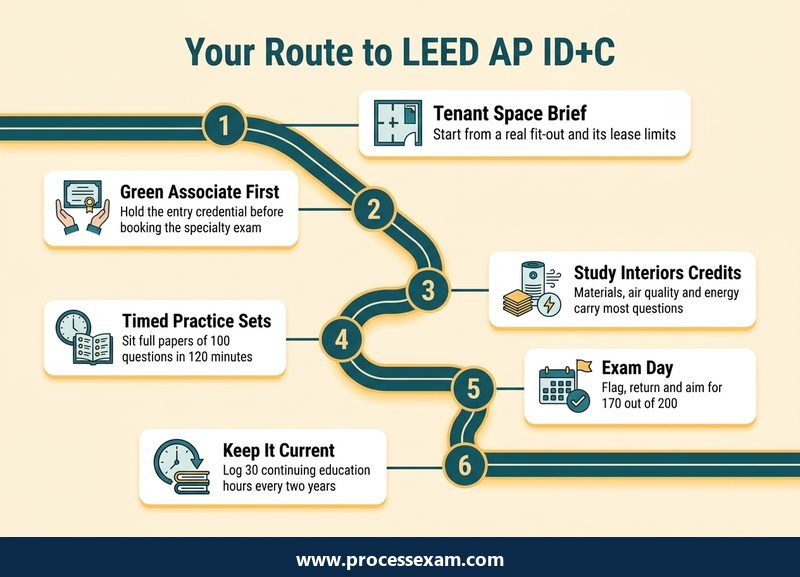
A six-week plan that starts with your gaps
- Week 1, orientation. Read the exam outline in full, list every topic, and mark each one green, amber or red. Refresh the basics of the rating system and how a project moves from registration to certification.
- Week 2, Materials and Resources. Work through life-cycle assessment, product declarations, reuse and waste. Build a one-page table of product categories against the evidence they need.
- Week 3, Indoor Environmental Quality. Study thermal, sound and lighting requirements, then construction indoor air quality and ventilation. Write the daylight measures and their meanings in your own words.
- Week 4, Energy and Atmosphere. Cover commissioning first, then metering, refrigerants, renewable procurement and resilience. Designers should spend extra time here, and engineers can move faster.
- Week 5, the smaller areas. Finish Water Efficiency, Integrative Process, Location and Transportation and LEED Process. Do a first timed set of practice questions at the end of the week.
- Week 6, exam conditions. Take at least two full 100-question sets in 120 minutes, review every wrong or guessed answer against the reference guide, and stop learning new material two days before the sitting.
Adjust the plan to your background
Designers and specifiers usually need extra time on Energy and Atmosphere and on the process rules. Engineers usually need extra time on Materials and Resources and on the human-centred parts of Indoor Environmental Quality. Contractors tend to know the construction-phase topics but need work on the design-stage credits and the integrative process. Whatever your background, use scenario practice: the exam gives you a project situation and asks for the best action, so answering practice questions that explain the reasoning teaches more than rereading a chapter. Practice questions written to this outline help with that step, provided you use them to find gaps rather than to memorise answers.
Habits that protect your marks on the day
Flag and return rather than spend four minutes on one question. Read the last line of every scenario first so you know what is being asked. Notice absolute words such as always and only. And remember that the unscored trial items look exactly like the rest: a strange question is not a reason to panic.
What does it take to keep LEED AP ID+C after you pass?
USGBC requires every LEED AP to collect 30 continuing education hours in the two years after the pass, and it publishes the details in its Credential Maintenance Program guide. Read that guide when you pass rather than at month 22, because it explains which hours count, how to report them and what happens if the period lapses. If you opted into the beta, USGBC also grants continuing education hours toward credential maintenance when you pass.
Two habits make maintenance painless. First, count the learning you already do: courses, webinars and project-based learning on interiors topics can qualify when they meet the guide's rules. Second, use the two years to stay current with the rating system. LEED v5 is new, and the interiors community will spend the next two years working out how its requirements apply to real tenant spaces. A holder who keeps reading, and who reports hours as they go, arrives at renewal with nothing to chase.
There is a wider point about value. A credential you keep current continues to signal that you know today's version of the rating system, not the one you studied. Given that this exam has just moved from LEED v4 to LEED v5, that signal matters more than it did a year ago.
Frequently Asked Questions
What is LEED AP ID+C?
LEED AP ID+C is USGBC's professional credential for people who design, construct and improve commercial interiors and tenant spaces. You earn it by passing a specialty exam run by GBCI. The credential shows expertise in green building and in the LEED Interior Design and Construction rating system.
How much does the LEED AP ID+C exam cost?
The specialty-only exam costs $350, or $250 for USGBC members. The combined exam that includes Green Associate costs $550, or $400 for members. During the LEED v5 beta the combined exam is not offered, and candidates who opt in to the beta pay a discounted registration fee.
How many questions are on the LEED AP ID+C exam, and what is the pass mark?
The exam has 100 multiple-choice questions in 120 minutes, and you need 170 out of 200 to pass. Our syllabus outline counts 85 questions across seven content areas; the rest of the 100 are unscored trial items. Beta candidates receive their results after the analysis ends.
Do I need LEED Green Associate before LEED AP ID+C?
Yes, while the LEED v5 beta runs. The combined exam that normally lets newcomers sit both parts together is not offered in the beta, so you need an active Green Associate credential to register. One earned on LEED v4 still qualifies. USGBC strongly recommends experience on a LEED-registered project.
How do you maintain the LEED AP ID+C credential?
LEED APs must collect 30 continuing education hours in the two years after passing. The Credential Maintenance Program guide sets out which activities count and how to report them. Beta candidates also receive continuing education hours toward maintenance when they pass.
- LEED Accredited Professional |
- USGBC LEED Accredited Professional Interior Design and Construction Test Questions |
- AP ID+C Question Bank |
- LEED AP ID+C Simulator |
- LEED AP ID+C Mock Exam |
- USGBC LEED Accredited Professional Interior Design and Construction Book |
- LEED Accredited Professional Interior Design and Construction Certification Cost |
- LEED Accredited Professional Interior Design and Construction Certification Requirements |
- USGBC LEED AP ID+C Question Bank |
- USGBC LEED AP ID+C Book |
- USGBC LEED AP ID+C Study Guide |
- LEED AP ID+C Certification |
- LEED AP ID+C Certification Cost |
- LEED AP ID+C Certification Requirements |
- USGBC LEED Accredited Professional Interior Design and Construction Sample Questions |
- AP ID+C Exam Questions Download |
- AP ID+C Test Questions |
- LEED Accredited Professional Interior Design and Construction PDF |
- USGBC LEED AP ID+C Exam Questions |
- USGBC LEED AP ID+C Sample Questions |
- LEED AP ID+C |
- LEED AP ID+C PDF |
- USGBC AP ID+C Handbook


