
LEED AP BD+C Exam Preparation Guide: 10 Proven Study Tips
Updated on 22 September 2026. What’s new: updated for the LEED v5 AP BD+C exam, now a standalone English-only beta after LEED v4 testing ended on 28 June 2026.
If you are getting ready for the LEED AP BD+C exam this autumn, you are getting ready for a LEED v5 exam. USGBC stopped offering the LEED v4 version on 28 June 2026, and the only Building Design and Construction exam on offer today is the LEED v5 beta: 100 questions in two hours, 170 out of 200 to pass, and no score on the day. This guide explains the new eight-domain outline and gives ten study tips written for it.

Which version of the LEED AP BD+C exam can you take right now?
The answer depends on the date you test, not the date you register, and it changed twice in 2026. We checked USGBC's LEED v5 exam information page (last updated 14 August 2026) and GBCI's LEED AP with Specialty Candidate Handbook (updated September 2026) in September 2026. Here is the position they describe.
LEED v4 is gone for BD+C
The last day to register for the LEED v4 AP with Specialty exams was 24 June 2026, and the last day to sit one was 28 June 2026. Anyone who had registered but not tested by then was moved automatically to the English version of the LEED v5 exam, keeping the original 12-month eligibility period. There is no route back to the v4 paper, even if your project work is still on LEED v4.
The LEED v5 beta runs in two phases
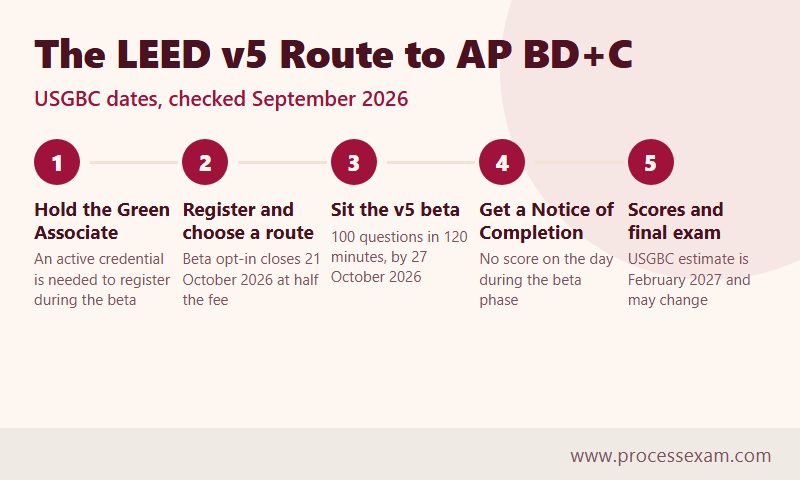
The LEED v5 beta for BD+C, ID+C and O+M opened on 30 June 2026. Its first phase is data collection: GBCI gathers answers to set the final passing score. Candidates who opt in to this phase at registration must register by 21 October 2026 and test by 27 October 2026. After that, USGBC describes a testing-only phase, running roughly from November 2026 to January 2027, in which the beta stays open but the answers no longer feed the analysis. The final LEED v5 exam is expected in February 2027. USGBC marks all of these dates as subject to change.
Scores arrive later than you are used to
During the beta you receive a Notice of Completion, not a score. Results are released once the beta closes and the psychometric analysis is finished. USGBC's help page gives February 2027 as the tentative date for AP with Specialty scores, while one section of the handbook says December 2026; both call the estimate provisional. Once the final exam is live, candidates will again see their result as soon as they finish.
What stays the same
The credential does not change. USGBC says candidates who pass either version earn the same LEED AP BD+C credential with the same industry recognition, and a Green Associate earned on LEED v4 still qualifies you for the new specialty exam. Only the LEED AP Homes and LEED AP ND exams remain on LEED v4. For BD+C, every hour you spend on a LEED v4 study guide is an hour spent on credits the exam no longer tests.
Should you opt in to the beta before 21 October or wait for the final exam?
Registration now offers two routes. You can opt in to the LEED v5 beta during registration, or you can continue with standard registration and take whichever version is running when your appointment falls. The trade-off is money and credit against time and certainty.
What the beta opt-in gives you
- Half off the exam registration fee.
- Continuing education hours toward credential maintenance once you pass.
- Half off a second attempt if you need one.
- A part in setting the passing standard for the final exam.
What it costs you
- A fixed two-month testing window that ends on 27 October 2026. Miss it and the registration is forfeited.
- English only, including the tutorial, the non-disclosure agreement and the end-of-exam survey.
- No combined exam. The beta is available only as a standalone specialty exam, so you must already hold an active LEED Green Associate credential.
- A long wait for your result, and with it a long wait before you can put the credential on a proposal or a CV.
A simple way to decide
The beta suits a candidate who has already worked through the LEED v5 BD+C material, can sit before the end of October and has no hiring or bid deadline riding on the result. Standard registration suits someone who would rather test later: an appointment before the final exam still lands in the beta and waits for its score, but one after the final exam's expected February 2027 launch shows the result on screen. It also suits anyone who needs a translated exam when one is announced, or who would rather wait for the combined format if GBCI brings it back. If you took the Green Associate beta, note one more rule: candidates still waiting for a Green Associate beta score cannot register for an AP with Specialty exam until a passing Green Associate score is released.
What do the LEED AP BD+C exam format, fees and pass mark look like?
The core figures below are the ones in our exam records, and they match USGBC's LEED AP with specialty credential page. The right-hand column shows how the v5 beta applies each one.
| Item | Figure | During the LEED v5 beta |
|---|---|---|
| Credential | Certified LEED Accredited Professional Building Design and Construction (AP BD+C) | Same credential for v4 and v5 passes |
| Exam code | AP BD+C | Unchanged |
| Number of questions | 100 | Scored and unscored questions mixed |
| Duration | 120 minutes | Plus an optional 10-minute tutorial |
| Passing score | 170 out of 200 | Result released after the beta analysis |
| Specialty-only fee | $350 ($250 for USGBC members) | Half off for candidates who opt in to the beta |
| Combined exam fee | $550 ($400 for USGBC members) | Combined format not offered in the beta |
| Delivery | Prometric test center or remote online proctoring | English only |
Who can sit it
You must be at least 18, hold an active LEED Green Associate credential when you register (the combined exam normally waives this, but it is not available in the beta), and agree to GBCI's disciplinary and exam appeals policy and its credential maintenance requirements. USGBC strongly recommends experience on LEED-registered projects. It is not a formal condition, but the handbook is clear that practitioner competence is tested objectively, and scenario questions are much easier if you have seen a real project's documentation.
How the two hours work
Allow for the optional 10-minute tutorial on top of the two-hour exam when you plan your day. Each question is multiple choice with a single correct option. You can skip, flag and return to questions, and you can change answers until you finish. Some questions are unscored trial items placed at random, so treat every question as if it counts. If a question seems technically wrong, use the comment button on the navigation bar during the exam and write to GBCI within 10 business days; a successful appeal earns a free retest, never a changed score.
Rescheduling, and a fee most candidates miss
Moving or cancelling an appointment costs nothing if you act 46 or more calendar days out. From 45 down to 30 days before the exam the charge is $30, and from 29 down to 4 days it rises to $60. Inside three days you cannot move it, and a missed appointment loses the fee. One cost-saver is easy to overlook: the U.S. Department of Veterans Affairs has approved LEED professional exams for GI Bill reimbursement of up to $2,000, which covers eligible veterans, service members, reservists, spouses and dependants.
How are the 85 scored questions spread across the BD+C domains?
The LEED AP BD+C v5 exam specifications divide 85 scored questions across eight knowledge domains that mirror the LEED v5 credit categories. The rest of the 100 are unscored items. The split is far from even.
| Knowledge domain | Scored questions | Typical subject matter |
|---|---|---|
| LEED Process | 7 | Minimum Program Requirements, boundaries, rating system selection, occupancy |
| Integrative Process Planning and Assessments | 8 | Design charrettes, climate resilience, carbon assessment, Core and Shell |
| Location and Transportation | 8 | Site constraints, transit access, parking, electric vehicles |
| Sustainable Sites | 9 | Habitat, heat island, exterior lighting, rainwater, open space |
| Water Efficiency | 9 | Irrigation, fixtures, process water, reuse, metering, leaks |
| Energy and Atmosphere | 18 | Efficiency, electrification, renewables, refrigerants, commissioning, grid |
| Materials and Resources | 13 | Whole-building LCA, low-embodied-carbon purchasing, reuse, waste |
| Indoor Environmental Quality | 13 | Thermal, sound, lighting, ventilation, accessibility and inclusion |
Energy and Atmosphere, Materials and Resources and Indoor Environmental Quality together carry 44 of the 85 scored questions, more than half. The full v5 topic list for this exam on our site sets out every subtopic in the handbook's order, which makes it a practical checklist.
Energy and Atmosphere: the largest domain
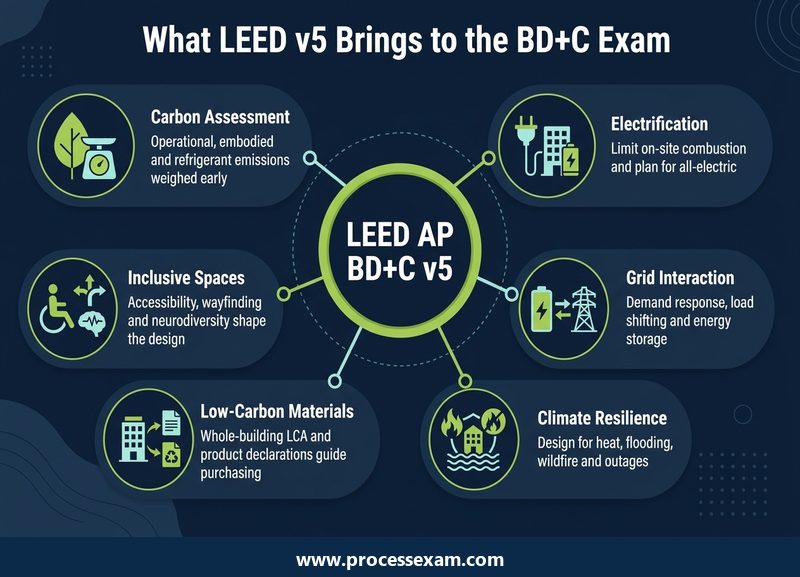
Eighteen questions cover energy performance through prescriptive and modelled paths, electrification and limits on on-site combustion, reducing peak thermal loads through ventilation, thermal bridging and infiltration, on-site and off-site renewables and Energy Attribute Certificates, refrigerant management against global warming potential benchmarks, commissioning, advanced metering, power resilience and grid-interactive operation such as demand response and load shifting. Several of these, grid interaction and electrification readiness in particular, had little presence in older BD+C guides.
Materials and Resources: carbon moves to the front
The v5 domain opens with whole-building life-cycle assessment and procurement of low-embodied-carbon materials, including environmental product declarations and buy-clean ideas. It then covers carbon emissions from construction activity itself, building and material reuse, material stewardship and extended producer responsibility, low-emitting products, ingredient reporting, and waste during construction and operation.
Indoor Environmental Quality: people, not just air
Alongside ventilation, filtration and construction indoor air quality, the domain now names thermal safety in extreme heat and cold, acoustic comfort and quiet zones, glare and daylight metrics such as spatial Daylight Autonomy and Annual Sunlight Exposure, biophilic design, accessibility and inclusion including neurodiversity and wayfinding, and management modes for risk events such as wildfire smoke or infection risk.
The five smaller domains
Sustainable Sites and Water Efficiency each carry nine questions. Sites ranges from construction pollution prevention and bird-friendly glass to heat island, night-sky lighting, rainwater and extreme climate events; Water Efficiency expects a conceptual grasp of irrigation and fixture calculations, not long arithmetic. Location and Transportation and Integrative Process carry eight each, the latter adding climate resilience, community and social context, and carbon assessment across operational, embodied, transportation and refrigerant sources. LEED Process carries seven, but they are some of the easiest marks to lose, as the next section shows.
Which BD+C topics trip up candidates with a design or engineering background?
Architects, engineers and contractors usually find the technical domains familiar. Where they drop marks is in the LEED-specific rules that no amount of site experience teaches. Five areas come up again and again.
Choosing the rating system
USGBC's rating system selection guidance sets out the 40/60 rule. If a rating system suits less than 40% of a project's gross floor area, it should not be used; if it suits more than 60%, it should be used; between the two, the team decides. A typical question describes a mixed-use building and asks which system applies. Candidates who guess from the building's name rather than its floor area get it wrong.
Three kinds of boundary
The property boundary, the project boundary and the LEED boundary are separate ideas, and the specifications list them together for a reason. Expect scenarios where a campus, a shared parking structure or a phased site makes the difference matter.
Counting occupants
Full-time equivalent occupants, transients, visitors and residents feed into several credits, from bicycle facilities to water use. Learn who counts as what before you meet a question that depends on it.
Commissioning roles and documents
Engineers know commissioning, but the exam asks about its documents and roles precisely: the commissioning authority, the owner's project requirements, the basis of design, envelope commissioning, monitoring-based commissioning and staff training. Be clear which party produces each document and when.
Core and Shell
Where the developer does not control the fit-out, tenant design and construction guidelines and green lease provisions carry the project's intent to the tenants. The specifications list this under Integrative Process, where many candidates do not expect it.
What are 10 proven study tips for the LEED v5 BD+C exam?
These tips are written for the v5 outline and for the beta calendar. Start at the top; the first three decide whether the rest of your hours are well spent.
1. Confirm your exam version before you buy anything
Look at your registration and your appointment date together, then match them to USGBC's key-dates table. Anything booked from 30 June 2026 onwards is a LEED v5 exam. Put LEED v4 BD+C books, flashcards and question sets aside, however good they were, and check that every new resource names LEED v5 on its cover or first page.
2. Build your study around the BD+C v5 Reference Guide
The exam references for BD+C are the LEED v5 Reference Guide for Building Design and Construction, together with USGBC's Addenda Database, the Guide to LEED Certification: Commercial and Foundations of LEED. The reference guide is the spine; the other three fill in process and corrections. Read the credit intent and requirements first, then the explanatory material only where a requirement is not clear to you.
3. Split your hours by the question counts
Energy and Atmosphere earns more than twice the questions of LEED Process. A reasonable plan starts with Energy and Atmosphere, moves to Materials and Resources and Indoor Environmental Quality, and leaves the five smaller domains for the second half of your schedule, while still covering every one.
4. Keep a carbon ledger for one sample project
Carbon now appears in three domains: carbon assessment in Integrative Process, electrification and refrigerants in Energy and Atmosphere, and life-cycle assessment and construction emissions in Materials and Resources. Choose one project and, as you study, record each decision that changes its operational, embodied, transportation or refrigerant emissions. By the end you will have one page that ties three domains together.
5. Learn calculations as methods, not arithmetic
The water domain asks for a conceptual understanding of irrigation and fixture calculations, and energy questions assume you know how a baseline is compared with a proposed design. Practise explaining each calculation in a sentence: what is being compared, which way a change moves the result, and which inputs a design team controls.
6. Read the addenda for the credits you know best
GBCI reviews exam questions each year against LEED addenda published through January. An addendum can quietly change a threshold or a documentation rule that you learned on a live project. Check the Addenda Database for the BD+C v5 credits you use most at work, since those are the ones where old habits cost marks.
7. Rehearse full timed sittings
A hundred questions in 120 minutes leaves little room for rereading long scenarios. Sit at least two complete papers under exam conditions, one sitting each, with the same break rules you will face on the day. An AP BD+C practice test that follows the v5 domains shows whether your pace holds for the full two hours and which domains still pull your score down.
8. Turn every wrong answer into a project decision
After each practice session, take the questions you missed and rewrite each as a decision on a real project: who would make it, at what stage, and what it would change. A missed question on refrigerant leakage becomes a note about equipment selection at design development. The exercise builds the application and analysis skills that the handbook says the exam tests.
9. Walk one project through certification
Using the Guide to LEED Certification: Commercial, follow a project from registration through Minimum Program Requirements, prerequisites, documentation, review and a final certification level, including Platinum's requirements. Add where a credit interpretation request or a LEED equivalency would fit. The LEED Process domain has only seven questions, and this walk-through covers most of them.
10. Prepare the room as carefully as the content
For an online exam, install Prometric's ProProctor application and run the system check a week ahead, use a laptop or a desktop with an external webcam, use one monitor only, cover any windows or glass doors, and connect by Ethernet if you can. You will work on a digital notepad and calculator, not paper. At a test center, arrive 30 minutes early. Either way, the name on your ID must match your registration exactly, in Roman characters.
What happens after you sit the exam, and how do you keep the credential?
For a beta candidate, the day ends with a Notice of Completion confirming that your answers were submitted. You will be told when results are released. Once you pass, the LEED AP BD+C credential replaces your LEED Green Associate, which then expires. Your certificate is a PDF you download from the Credentials Dashboard; GBCI does not post paper copies.
Using the credential correctly
The handbook allows the signifier "LEED AP BD+C" after your name as soon as you receive written confirmation that you passed. It also says the spelled-out phrase "LEED Accredited Professional" should never be used as a title, and that you should stop listing LEED Green Associate once the specialty credential supersedes it.
If the result is not a pass
Beta candidates who do not pass register again through the standard process, and those who opted in to the beta receive half off that second attempt. The general limit applies to everyone: a third failed attempt inside a 12-month period, which starts on the date of your first failure, brings a 90-day wait before you can register again. Each attempt carries its own fee.
Maintaining the credential
LEED APs must earn 30 continuing education hours within each two-year reporting period, which starts on the exam date. The credential maintenance program guide lists the activities that count and how to report them in your dashboard. Passing the beta can itself contribute CE hours, which gives early candidates a head start on their first cycle.
Who benefits most
The credential suits architects, mechanical and electrical engineers, energy and commissioning specialists, contractors' project managers and sustainability consultants who work on new construction and major renovation. It shows a client or an employer that you can take a project team through LEED v5 BD+C from the first charrette to certification. For anyone planning to test this year, that version question matters more than anything else in this guide: study for LEED v5, choose between the beta and the final exam with the dates in front of you, and put your hours where the 85 scored questions are.
Frequently Asked Questions
How much does the LEED AP BD+C exam cost?
The specialty-only exam costs $350, or $250 for USGBC members. The combined exam is listed at $550, or $400 for members, but it is not offered during the LEED v5 beta. Candidates who opt in to the beta before 21 October 2026 pay half the registration fee.
Does the LEED AP BD+C exam still use LEED v4?
No. The final day to sit the LEED v4 AP BD+C exam was 28 June 2026, and the LEED v5 beta began on 30 June 2026. USGBC expects the final LEED v5 exam in February 2027. Either version leads to the same credential.
What is the passing score for the LEED AP BD+C exam?
You need 170 out of 200. The exam has 100 multiple-choice questions in two hours, of which 85 are scored across eight knowledge domains. During the LEED v5 beta your result is released only after GBCI completes its analysis, not on screen when you finish.
Do I need the LEED Green Associate before taking the LEED AP BD+C exam?
Yes, while the beta runs. The combined format that normally lets you sit both parts together is not offered during the LEED v5 beta, so you need an active Green Associate credential when you register. A Green Associate earned on LEED v4 still qualifies.
When will I get my LEED AP BD+C beta exam score?
Beta candidates receive a Notice of Completion on the day and a score once the beta ends and the analysis is complete. USGBC currently gives February 2027 as the tentative date, while its handbook mentions December 2026, and both say the estimate may change.
- USGBC LEED Accredited Professional Building Design and Construction Test Questions |
- AP BD+C Question Bank |
- LEED Accredited Professional |
- LEED AP BD+C Simulator |
- LEED AP BD+C Mock Exam |
- USGBC LEED Accredited Professional Building Design and Construction Book |
- LEED Accredited Professional Building Design and Construction Certification Cost |
- LEED Accredited Professional Building Design and Construction Certification Requirements |
- USGBC LEED AP BD+C Question Bank |
- USGBC LEED AP BD+C Book |
- USGBC LEED AP BD+C Study Guide |
- LEED AP BD+C Certification |
- LEED AP BD+C Certification Cost |
- LEED AP BD+C Certification Requirements |
- USGBC LEED Accredited Professional Building Design and Construction Sample Questions |
- AP BD+C Exam Questions Download |
- AP BD+C Test Questions |
- LEED Accredited Professional Building Design and Construction PDF |
- USGBC LEED AP BD+C Exam Questions |
- USGBC LEED AP BD+C Sample Questions |
- LEED AP BD+C |
- LEED AP BD+C PDF |
- USGBC AP BD+C Handbook


