
ITIL Foundation: What It Certifies and How to Earn It
Updated on 21 September 2026. What’s new: rewritten for ITIL 4 Foundation under PeopleCert, replacing retired ITIL v3 content, with the current exam fee and pass mark.
A service desk that works does the same handful of things every day. It takes what users report, sorts it, fixes what it can, hands on what it cannot, and keeps people told. ITIL 4 is the vocabulary and the structure behind that work, and ITIL 4 Foundation is the exam that certifies you know it: 40 questions in 60 minutes, 65% to pass.

That framing matters, because ITIL is often sold as an abstraction. It is not. Every idea the Foundation syllabus tests has a counterpart on the floor of a support team: the ticket nobody owns, the change that went in on a Friday, the service level agreement written for a service nobody can define, the improvement everyone agrees with and nobody schedules. The exam asks whether you can name those things correctly and explain why the framework handles them the way it does.
This guide sets out what the ITIL 4 Foundation exam covers, what passing it actually proves to an employer, what it costs, how to prepare for it around a working week, and where it leads once you hold it. The figures throughout come from the certification's current published details.
What does a service desk look like when ITIL 4 is working?
Start with a day in a mid-sized IT team, because that is the setting ITIL 4 describes. A user cannot log in. That is an incident, and incident management exists to restore normal service as fast as possible, not to find out what caused it. The same fault appears eleven times in a fortnight. That is a problem, and problem management exists to find and remove the cause. A user wants a new laptop. That is a service request, which is routine and pre-approved, and the mistake most teams make is running it through the same queue as outages.
Somebody wants a database patched tonight. That is a change, and change enablement asks who assessed the risk, who authorised it, and what happens if it fails. The service desk itself is the practice that ties these together as the single point of contact, and service level management is the practice that decides whether any of it is good enough, in terms the business recognises rather than in terms the infrastructure team finds convenient.
What ITIL 4 adds on top of that day is a way of seeing it as one system rather than five queues. The framework's central claim is that value is co-created: the provider does not hand value to the customer like a parcel, it is produced in the interaction between them. A perfectly resolved ticket that arrives after the user has given up and gone to the shadow IT tool has not created value. That single idea is behind a surprising number of Foundation exam questions, and it is the reason the syllabus spends as long on outcomes, costs and risks as it does on the practices themselves.
What does the ITIL 4 Foundation exam actually certify?
Foundation is a knowledge exam, not a skills assessment. It certifies that you can recall and understand the language and structure of ITIL 4 well enough to take part in a conversation about service management without being lost. Specifically, it certifies four things.
First, that you understand the key concepts of service management: service, product, utility and warranty, outcome, cost and risk, and the idea of co-created value described above. Second, that you understand how the ITIL guiding principles apply to everyday decisions. Third, that you know the components of the service value system and how the service value chain turns demand into value. Fourth, that you can describe a group of ITIL practices well enough to say what each is for and where it starts and stops.
It is worth being blunt about what Foundation does not certify. It is not evidence that you have run a change advisory board, designed a service catalogue, or recovered a major incident. Employers know this. What they use it for is a baseline: a person who holds ITIL 4 Foundation can be dropped into a team that already runs on ITIL vocabulary and will understand the standups, the ticket categories and the escalation rules from the first week. That is a real and modest benefit, and describing it accurately in an interview is more persuasive than overselling it.
According to PeopleCert, the organisation that now owns and examines ITIL, the certification is suitable for any career stage, and the official ITIL 4 Foundation certification page lists no prior certification as a prerequisite. In practice, the candidates who find it easiest are the ones with some exposure to a ticketing system, because they already recognise the situations the questions describe.
Which topics does the ITIL 4 Foundation syllabus test?
The syllabus splits into a small number of areas that build on each other. Studying them in the order below tends to work better than studying them in the order they appear in any one book, because each area explains the next.
Service management concepts
This is the foundation underneath the Foundation. A service is a means of enabling value co-creation by facilitating outcomes customers want to achieve, without the customer having to manage specific costs and risks. Pull that sentence apart and you have most of the vocabulary: outcomes rather than outputs, costs and risks that shift from customer to provider, and utility (fit for purpose) paired with warranty (fit for use). Exam questions in this area often present a short scenario and ask which term describes it, so learn the distinctions rather than the definitions word for word.
The four dimensions of service management
ITIL 4 insists that any service be looked at from four angles: organisations and people; information and technology; partners and suppliers; and value streams and processes. The point of the four dimensions is that neglecting one of them breaks the others. A well-designed workflow fails if nobody is trained on it; an excellent tool fails if the supplier contract does not cover out-of-hours support. Expect questions that describe a failure and ask which dimension was ignored.
The guiding principles
The guiding principles are recommendations that apply in any situation: focus on value, start where you are, progress iteratively with feedback, collaborate and promote visibility, think and work holistically, keep it simple and practical, and optimise and automate. These are the most heavily tested items in the syllabus relative to how little text they occupy. The questions are almost always applied rather than recall: a scenario is described, and you pick the principle it illustrates or violates. Learn one concrete workplace example for each principle and this section becomes straightforward.
The service value system and the service value chain
The service value system is the overall model: opportunity and demand come in, value goes out, and in between sit the guiding principles, governance, the service value chain, the practices and continual improvement. Inside it, the service value chain is the operating model with six activities: plan, improve, engage, design and transition, obtain and build, and deliver and support. The examinable idea is that these activities are not a sequence. A value stream runs through them in whatever order the work requires, and the same activity can be visited more than once.
The ITIL practices
ITIL 4 describes a large set of management practices, grouped into general management practices, service management practices and technical management practices. Foundation does not ask you to master all of them. It asks you to recall what most of them are for, and to explain a smaller group in detail: incident management, service desk, problem management, service request management, change enablement, service level management and continual improvement. Those seven are the ones worth writing your own notes on, with a purpose sentence and two or three key terms each.
Continual improvement, service levels and metrics
The last stretch of the syllabus covers the continual improvement model, what makes a service level agreement useful rather than decorative, and the metrics and performance indicators that tell you whether a service is delivering. The recurring theme is that a measure which nobody acts on is not a measure, it is a report. ProcessExam publishes a topic-by-topic breakdown of this syllabus if you want to see how the areas are weighted before you plan your study time.
What are the exam facts, and what does it cost?
The exam is short, closed-book and multiple choice. There is no negative marking, so an unanswered question is simply a lost mark: answer every one, even the four you are unsure about.
| Exam detail | ITIL 4 Foundation |
|---|---|
| Certification | PeopleCert Certified ITIL 4 Foundation |
| Exam code | ITIL 4 Foundation |
| Vendor | PeopleCert |
| Number of questions | 40 |
| Duration | 60 minutes |
| Exam fee | USD $463 |
| Passing score | 65% |
| Format | Multiple choice, closed book |
Sixty minutes for 40 questions is ninety seconds each, which sounds generous and is, provided you do not stall. The 65% pass mark means 26 correct answers out of 40. Put another way, you can get fourteen questions wrong and still pass, which should calm anyone who is treating this as a memory test.
Two practical points about the fee. It is quoted in US dollars here, and PeopleCert prices in local currency, so the amount you pay depends on where you sit the exam and whether tax is added. It is also often bundled with training, and a bundle price is not comparable with a bare exam price. Check the current price for your region on the vendor's own page before you budget.
One more thing the vendor's page states that candidates routinely miss: the certification is renewed every three years, and renewal needs 60 CPD points logged through PeopleCert's membership scheme, or a pass in another exam from the same product suite before the renewal date. Budget for that at the start rather than discovering it in year three.
How do you prepare for ITIL 4 Foundation around a full-time job?
Most people sitting this exam are already working, which means preparation has to survive interruptions. Six weeks of a few focused evenings a week is a realistic shape, and it maps neatly onto the syllabus areas.
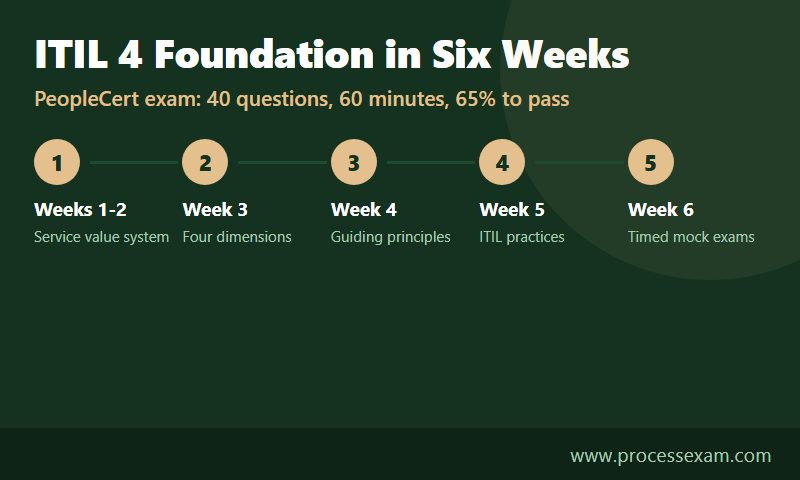
Weeks one and two go on service management concepts and the service value system, because everything else references them. Week three is the four dimensions, which are quick to learn and easy to lose marks on. Week four is the guiding principles, studied by example rather than by rote. Week five is the practices, with your own purpose-sentence notes for the seven that need detail. Week six is nothing but timed practice: full 40-question runs against the clock, followed by a review of every question you got wrong or guessed.
Two things make the difference in that final week. The first is the vendor's own sample material. PeopleCert publishes an PeopleCert's official ITIL 4 Foundation mock exam, and it is the most accurate available signal of how the real questions are phrased, which is often where candidates come unstuck rather than on the subject matter. The second is volume: enough varied questions that you stop recognising them and start reasoning through them.
That is where a question bank earns its place. Working through an ITIL 4 Foundation practice exam under the real 60-minute limit will tell you two things the books cannot: whether your pace is right, and which syllabus area you quietly skipped. Do it twice, a week apart, and compare the two error lists rather than the two scores.
How to take notes that survive to exam day
Keep one page per syllabus area and nothing longer. For the guiding principles, one line each plus a real example from your own workplace. For the practices, a purpose sentence and the two terms that define its boundary, such as the difference between an incident and a problem, or between a service request and a change. On the evening before the exam you should be reading six or seven pages, not a textbook.
Which mistakes cost candidates the pass mark?
The failures cluster in a small number of places, and every one of them is avoidable.
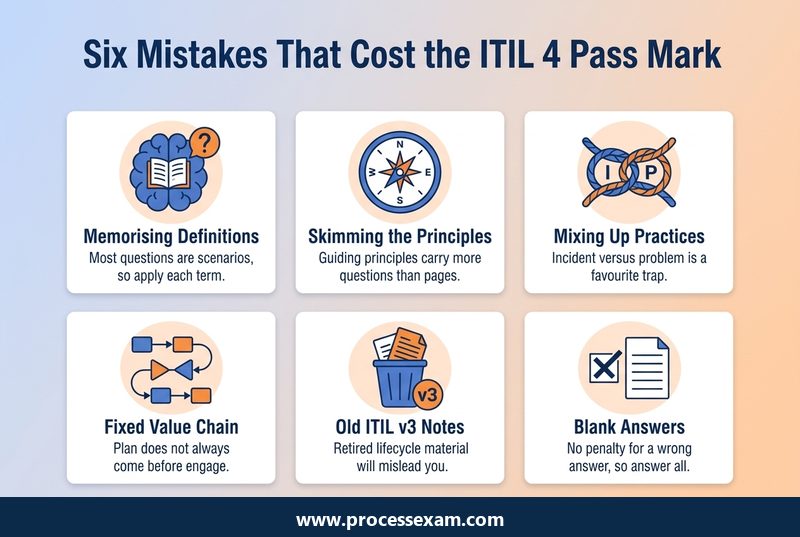
- Memorising definitions instead of applying them. Most questions are scenarios. Being able to recite the definition of warranty does not help if you cannot spot warranty in a sentence about capacity and availability.
- Skimming the guiding principles. They are short, so they get half an evening. They carry far more questions than their page count suggests.
- Confusing neighbouring practices. Incident against problem, service request against change enablement, and service level management against continual improvement are the pairs the examiners lean on.
- Treating the service value chain as a sequence. Answering as if plan comes before engage, every time, is a reliable way to lose marks.
- Studying old material. A great deal of freely circulating ITIL content still describes the retired ITIL v3 lifecycle and its processes. It will actively mislead you for this exam.
- Leaving questions blank. There is no penalty for a wrong answer. Flag, move on, and come back with the time you saved.
What changed when PeopleCert took over ITIL, and is ITIL v3 still worth studying?
ITIL was published by AXELOS for years, and a great deal of the material online still says so. PeopleCert now owns and examines the ITIL portfolio, which is why the certification, the scheme and the exam booking all sit on PeopleCert's own site today. Nothing about the Foundation syllabus changed because of the ownership change, but two practical things did: the place you book, and the place you should check when you want an authoritative answer about format, fees or renewal.
The version question is more consequential. ITIL v3, sometimes labelled ITIL 2011, is retired. Its service lifecycle of service strategy, service design, service transition, service operation and continual service improvement, along with its long list of processes, is not what this exam tests. ITIL 4 replaced the lifecycle with the service value system and the service value chain, and replaced processes with practices. If a study guide, a video or a diagram leads with the five-stage lifecycle wheel, it is teaching a retired version, and it will cost you marks.
The old ITIL Practitioner qualification belongs to that retired scheme too. Candidates who read older career advice sometimes plan a route from Foundation into Practitioner; that route no longer exists, and the modules described in the next section are what follows Foundation now.
Where does ITIL 4 Foundation lead after you pass?
Foundation is the entry point to a scheme, not a destination. Above it, the ITIL 4 scheme offers managing professional and strategic leader routes for people who want to specialise in service delivery, service value streams, high-velocity IT, or the direction and planning of service management as a whole.
There is also a newer development worth knowing about before you plan a path. PeopleCert has introduced a Version 5 line of ITIL modules, including ITIL Product and ITIL Service, aimed at managing digital products and services as integrated value streams. Both sit above Foundation: PeopleCert's own module pages state that they require the completion of any ITIL 4 certification or an ITIL Foundation at Version 5. You can see the current shape of the whole scheme, and which modules are open to you, on PeopleCert's ITIL certification listing. The practical implication is that ITIL 4 Foundation is not a dead end even as the scheme evolves: it remains a valid entry ticket to the modules above it.
Career-wise, the honest position is that Foundation rarely wins a job on its own. What it does is remove an obstacle. Service desk, incident, problem, change and service delivery roles increasingly list an ITIL qualification as desirable, and a hiring manager scanning a shortlist reads its absence as a gap. It is also one of the few certifications that is equally useful outside IT operations: project managers, business analysts and vendor managers all end up negotiating with service teams, and knowing what a service level agreement is supposed to contain changes those conversations.
The most useful thing you can do with the certification, once you have it, is to use its vocabulary deliberately at work for a month. Call the recurring fault a problem rather than a run of incidents, insist that a routine request stop being treated as an outage, and ask what outcome a proposed change is meant to produce. That is when the syllabus stops being exam material and starts being the way your team works.
Frequently Asked Questions
What is ITIL Foundation?
ITIL Foundation is the entry-level certification in the ITIL service management scheme, currently examined as ITIL 4 Foundation by PeopleCert. It certifies that you understand ITIL's key concepts, its guiding principles, the service value system and the main management practices used to run IT services.
How many questions are in the ITIL 4 Foundation exam?
The exam has 40 multiple-choice questions and a time limit of 60 minutes, which works out at about 90 seconds per question. It is closed book, and the passing score is 65%, so 26 correct answers out of 40 are needed to pass.
How much does the ITIL 4 Foundation exam cost?
The exam fee is USD $463. PeopleCert prices in local currency and often sells the exam bundled with training material, so the amount you actually pay depends on your region, on local tax and on whether you buy the exam on its own or as part of a package.
Do you need experience or a prerequisite for ITIL 4 Foundation?
No prior ITIL certification is required, and PeopleCert describes the certification as suitable for any career stage. Some exposure to a service desk or ticketing system helps, because many questions describe everyday support situations and ask which ITIL concept or practice applies to them.
Is ITIL 4 Foundation difficult to pass?
It is a knowledge exam rather than a technical one, and the 65% pass mark allows fourteen wrong answers out of 40. Candidates who fail usually memorised definitions instead of applying them, skimmed the guiding principles, or studied retired ITIL v3 material by mistake.
- ITIL 4 Foundation Question Bank |
- ITIL 4 Foundation Test Questions |
- ITIL 4 Foundation Body of Knowledge (BOK) |
- ITIL 4 Foundation Certification Cost |
- ITIL 4 Foundation Certification Requirements |
- ITIL 4 Foundation PDF |
- PeopleCert ITIL 4 Foundation Test Questions |
- ITIL 4 Foundation Simulator |
- ITIL 4 Foundation Mock Exam |
- PeopleCert ITIL 4 Foundation Book |
- PeopleCert ITIL 4 Foundation BOK PDF |
- PeopleCert ITIL 4 Foundation Sample Questions |
- ITIL 4 Foundation Exam Questions Download


