
ISTQB CTAL-AT Agile Tester: Syllabus, Scoring and Study Plan
A CTAL-AT paper has 40 questions, yet you cannot score 40: it is marked out of 52 points, because ISTQB weights each question by its difficulty. Thirty-one questions are worth one point, six are worth two and three are worth three. You need 34 points in 90 minutes. Answer every one-point question correctly and you still finish on 31, three points short of a pass.

That arithmetic shapes everything below: which chapters you study hardest, how you spend the clock and why the Agile Tester syllabus that ISTQB released in April 2026 is not the one your colleague studied in 2018. The details here were checked in October 2026 against ISTQB's own certification page, the v2.0 syllabus and its exam rules.
How does a 40-question paper turn into 52 points?
ISTQB's exam rules give Advanced Level papers a sliding scale. A question that tests understanding (cognitive level K2) is allocated one point. An applying question (K3) is allocated two points in general, and an analysing question (K4) three. For CTAL-AT the published structure sets the mix at 31 K2 questions, 6 K3 and 3 K4, which gives 31 + 12 + 9 = 52 points. The pass line is 65 percent of 52, which is 33.8, and the rules round up to 34 points.
| Item | Detail |
|---|---|
| Exam name | ISTQB Certified Tester Advanced Level - Agile Tester |
| Code and version | CTAL-AT 2.0 |
| Fee | USD $199 |
| Duration | 90 minutes |
| Questions | 40 |
| Passing score | 34 / 52 |
| Category | Core Advanced |
| Entry requirement | ISTQB Foundation Level certificate (CTFL) |
Two practical consequences follow. First, the nine heavy questions are where the pass is decided: with all 31 one-pointers right you still need at least three more points, so one K4 question or two K3 questions must land. Second, you can afford to lose 18 points in total. That is generous on the easy questions and unforgiving if the nine hard ones all go wrong, because losing them all costs 21.
The clock is less of a problem than it first looks. ISTQB's guideline allowances are 1 to 2 minutes for a K2 question, 3 for a K3 and 4 for a K4. Added up for this paper, a candidate who takes the full allowance on every question would need between 61 and 92 minutes, so 90 minutes is close to the ceiling only if you linger on the short questions. ISTQB's rules also add 25 percent to the paper when the exam language is not the candidate's native language, which turns 90 minutes into 113.
Who should sit the Agile Tester exam, and what must you hold first?
The syllabus sets two entry criteria: an interest in testing in Agile environments, and the ISTQB Foundation Level certificate. ISTQB's certification page adds that CTFL v4.0 or any earlier version counts. It strongly recommends, but does not require, about six months of experience as a system or user acceptance tester or as an Agile team member, and an accredited training course.
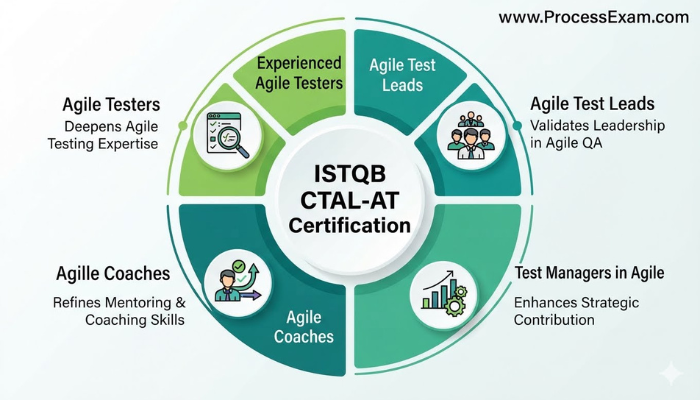
ISTQB's audience list is wider than the job titles most people expect. The graphic below shows testers, test leads, coaches and managers; the vendor's page also names test analysts, test engineers, developers, business analysts, product owners, Scrum Masters and quality managers. If you work in a cross-functional team and share ownership of quality, you are in the intended audience.
Accredited courses must run at least 13 hours over at least two days. Self-study is allowed too, using the syllabus and its recommended reading. Exams are taken through an ISTQB exam provider, and the vendor's page links a provider finder at istqb.org/exam-providers. Delivery options differ by country, so check what your provider offers before you set a date.
The sibling exam, CTAL-ATT (Agile Technical Tester), is a different certification with its own syllabus. It is version 4.0, has its own fee and is marked out of 64 points with 42 needed. It is not a newer edition of CTAL-AT, so do not mix up the two when you buy books or book a slot.
What changed when ISTQB rewrote the syllabus as v2.0?
The old Agile Tester extension (v1.0, 2014) is superseded. Version 2.0 of the renamed CTAL Agile Tester syllabus was released on 17 April 2026, and ISTQB describes it as a revamp and repositioning rather than an edit. Because Agile is now standard practice, the basics are no longer learning objectives. They sit in an introduction that is not examined directly.
| What happened | Topics |
|---|---|
| Moved down to the Foundation syllabus | Test-first approach, test pyramid, independent testing, collaborative user story creation, retrospectives, test effort estimation |
| Kept and raised in depth | Testing quadrants (now an analysis-level objective), exploratory testing, the whole team approach |
| New in v2.0 | Mnemonics, heuristics, test tours, biases, coverage metrics for reporting, holistic testing, tissue testers, mob testing, vibe testing, storyboarding, example mapping |
If you own an older study book, treat it with care. A guide written for v1.0 spends its time on test-first development, the pyramid and retrospectives, which this exam now assumes from Foundation level, and says nothing about vibe testing or test smells. Download the v2.0 syllabus from ISTQB's download page and mark every learning objective as you cover it. There are 31 of them, and every examinable sentence in the document traces back to one of them.
Which chapters pay the most marks for the time you put in?
The syllabus recommends 780 minutes of accredited teaching across six chapters, and ISTQB's exam tables decide how many questions and points each chapter supplies. Putting them side by side shows where a study hour earns the most.
| Chapter | Questions (K2 / K3 / K4) | Points | Share of 52 | Points per teaching hour |
|---|---|---|---|---|
| 1 Test strategy and test approach challenges | 5 (5 / 0 / 0) | 5 | 9.6% | 5.0 |
| 2 People and teams | 5 (5 / 0 / 0) | 5 | 9.6% | 5.0 |
| 3 Test management and test process improvement | 7 (5 / 0 / 2) | 11 | 21.2% | 3.1 |
| 4 Shift left | 9 (7 / 2 / 0) | 11 | 21.2% | 4.9 |
| 5 Agile approaches and test techniques | 12 (7 / 4 / 1) | 18 | 34.6% | 3.8 |
| 6 Test automation and test tools | 2 (2 / 0 / 0) | 2 | 3.8% | 4.0 |
Three readings stand out. Chapter 5 alone supplies more than a third of the points, and it holds five of the nine heavy questions. Chapters 3, 4 and 5 hold all nine heavy questions between them (two, two and five), so chapters 1, 2 and 6 are pure one-point recall and understanding: twelve questions, twelve points, and the cheapest marks on the paper. Finally, chapter 4 gives the best return among the long chapters, with nine questions drawn from 135 teaching minutes.
The surprising one is chapter 6. A tester's instinct is that automation must matter most on an Agile exam, yet it receives 30 of the 780 minutes and two questions. ISTQB points readers who want depth to its separate test automation syllabi. Do not neglect those two points, but do not give them a week.
What do the first three chapters expect you to do?
Chapter 1: choosing the right test for the moment
The chapter is built on contrasts. Test types are compared during and after an iteration: during it, functional checks follow the acceptance criteria, non-functional testing stays light, white-box testing arrives with test-driven development and exploratory sessions probe for emergent behaviour; after it, integration, fuller non-functional runs and wider exploratory sessions on a staging environment take over. Expect a scenario that asks which activity belongs in the sprint and which can wait for a hardening phase.
End-to-end testing is framed as costly: slow to run, hard to maintain and weak at pinpointing a fault. The syllabus lists three factors for deciding to use it: risk, feedback time and the maturity of the delivery pipeline. It also offers contract testing between services as a lighter alternative, and says the pyramid remains valid. You also compare formal testing (traceable, repeatable, easy to automate, but rigid and late) with holistic testing (many perspectives, quality built in, but dependent on culture), and tell five regression approaches apart: incremental, risk-based, DevOps-oriented, exploratory and collaborative.
Chapter 2: whole team, and the tissue tester
Three learning objectives cover the whole team approach: generalists against specialists, ways to motivate business representatives to take part in testing, and how testers help developers. The fourth is the odd one out. A tissue tester (also called a fresh-eyes tester) is a temporary outsider, such as a colleague from another team, who gives quick informal feedback on a design before the team commits to expensive choices. The value expires the moment they have seen the design, and explaining too much spoils it. Expect a question about when to use one and when the value has gone.
Chapter 3: strategy, reporting and improvement
This is where the first analysis-level questions appear. One objective asks you to outline a project test strategy using the testing quadrants. Take a team shipping a shop checkout every week: quadrants 1 and 2 (component tests and business-facing functional tests) carry the automation that keeps weekly releases safe, quadrant 3 gets exploratory sessions and acceptance trials, and quadrant 4 gets performance and security checks. The syllabus adds that a regulated domain such as healthcare pushes the strategy toward documented coverage, while a young product leans on exploration.
The second analysis question asks you to select improvement measures from metrics. The syllabus reads metrics as prompts for conversation: slow defect cycle times can point to silos, low coverage on a critical path points to missing component tests, flaky tests and long commit-to-feedback times point to tooling work, and production escape rate or time to recovery points to monitoring. Test reporting uses coverage types that suit short cycles: requirements, code, exploratory and infrastructure coverage. Be ready to say what each one hides, for example that high code coverage alone does not show meaningful testing.
How do shift left and the exploratory chapters turn into exam questions?
Chapter 4: making the test basis better before code exists
Shift left means improving what the team tests against. The syllabus covers testware used as requirements, storyboarding and testboarding, example mapping, biases, user story slicing and the link to requirements engineering. Example mapping is the most question-friendly: coloured cards represent the story (yellow), business rules (blue), examples (green) and open questions (red). Take a story where a shopper applies a discount code. The rules might be one code per order and no expired codes; the examples are the concrete baskets that prove each rule; a red card asks whether a code can combine with free delivery. Many rule cards, or one rule with a pile of examples, signals that the story is too big and should be sliced.
Slicing is the chapter's applying (K3) objective. The syllabus names six cuts: by workflow step, by data complexity, by interface, by scenario, as a vertical slice through all layers, and by constraint. Practise taking one story and cutting it three ways, then rewriting the acceptance criteria for each slice, since the syllabus stresses that you cannot just cut the story. Biases get three named examples: confirmation bias (testing only expected behaviour), anchoring (early requirements fixing the team on happy paths) and conformity (copying a dominant voice). Mitigations include pair testing, session debriefs and, tying back to chapter 2, tissue testers.
Chapter 5: the heaviest chapter
Heuristics are rules of thumb, mnemonics are memory aids such as SFDIPOT (Structure, Function, Data, Interfaces, Platform, Operations, Time) for planning charters and RCRCRC (Recent, Core, Risky, Configuration, Repaired, Chronic) for regression, and test tours borrow city districts as a metaphor for exploring a product. The analysing objective asks you to build test charters from user stories and epics. A charter needs at least a mission, a priority and the data required; sessions are time-boxed, uninterrupted and usually 60 to 120 minutes. A sample charter might read: explore the discount-code flow with expired and stacked codes to find pricing errors, priority high, using three prepared shopper accounts.
The assisted-testing objectives cover mob testing, pair testing and vibe testing. Vibe testing is the newest and the most discussed: an informal, AI-assisted approach for code that was generated from natural-language prompts. The tester checks intent rather than the script, asking what a booking form should do that the prompt never stated, such as rejecting a double booking. Treat it as a defined topic with a known risk (hidden defects and hallucinated behaviour), not as hype.
Test smells close the chapter with an applying objective: you evaluate a manual test case against named smells. The list includes Interdependent Tests, Hidden Dependencies, Call on Me, ORacle (decision logic inside the steps), No Clear Expected Results, One More Step (verification hidden in the expected-result column), Ambiguous Steps, Hotstepper and Bulk Steps. A typical item gives you a short test case and asks which smell it shows and how to fix it. Learn each smell with its fix, because the fix is what separates a K3 answer from a K2 one.
Chapter 6: two questions, one idea
The automation chapter is short because it asks for judgement. Automate what is repetitive, deterministic and high in risk reduction; leave exploratory, one-off and usability checks to people; decide during refinement which stories to automate; and follow the pyramid with component, API and a few end-to-end tests. Tool categories include task tracking, communication, test design and execution, and continuous integration. Each of the two questions is a recognition item.
What study routine suits a tester who prepares after work?
Order your effort by points and by difficulty, not by chapter number. The sequence below fits roughly five weeks at about six hours a week; stretch it if you are new to Agile teams, and shorten it if you already run exploratory sessions and example mapping at work.
- Week 1, orientation and the cheap marks. Read the introduction to Agile, then chapters 1 and 2 and work through every contrast table you can build: during and after the iteration, formal against holistic, the five regression approaches. These are twelve guaranteed one-point questions with chapter 6.
- Week 2, chapter 5 first half. Heuristics, mnemonics, tours, charters and the exploratory session. Write three real charters from stories in your own backlog.
- Week 3, chapter 5 second half and chapter 4. Mob, pair and vibe testing, test smells, then example mapping and slicing. Review ten of your own manual test cases for smells.
- Week 4, chapter 3. The two K4 objectives. Draw a quadrant map for a product you know and defend each choice in one sentence, then pair every metric with the question it should trigger.
- Week 5, chapter 6 and full papers. Take timed papers, mark the nine heavy questions separately, and go back to the objective behind every one you lose.
Use ISTQB's own free sample exam for v2.0 first, linked from its certification page at istqb.org, then move to a CTAL-AT practice exam and note whether the three- and two-point questions still cost you the pass line. Review the scoring, not just the total: a 36 made of 31 easy points and five heavy ones is a different result from a 36 that leaned on guesses.
On exam day, answer the one-pointers fast. A K2 question that takes more than two minutes is usually a reading problem, so mark it and move on. Spend the saved time on the K3 and K4 scenarios, where the allowance is three to four minutes and each question carries two or three points. Read the syllabus breakdown for every chapter on ProcessExam's CTAL-AT syllabus page when you want a second view of the objectives before you build your plan.
Is the Agile Tester credential worth adding to your CV?
The syllabus lists eight business outcomes. Among them: collaborating in cross-functional teams, adapting existing testing experience to Agile values, supporting test planning, applying approaches and techniques that give adequate coverage, helping stakeholders write testable stories and criteria, and contributing to test automation. ISTQB's page adds that holders may move on to other Core, Agile or Specialist certifications, and the syllabus names Agile Test Leadership at Scale as a special focus. Read those outcomes as a job description for the senior tester in an Agile team: the person who helps shape stories, plans exploration and reads metrics, rather than the one who only executes scripts.
Be realistic about what a certificate does. It shows employers that you can describe and apply a recognised body of Agile testing practice, and the v2.0 content is current enough to include practices that are only just entering team conversations. It does not substitute for the evidence in your portfolio: charters you wrote, stories you sliced, flaky tests you removed. Salary figures vary too widely by country and employer to quote responsibly here, so check a salary survey for your market before you promise yourself a raise.
Frequently Asked Questions
How many points do you need to pass CTAL-AT?
You need 34 points out of 52, which is 65 percent of the available points rounded up. The paper has 40 questions, but ISTQB weights them: K2 questions carry one point, K3 questions generally two and K4 questions three, so the harder questions count for more.
Do you need CTFL before taking CTAL-AT?
Yes. The syllabus lists the ISTQB Foundation Level certificate as an entry criterion, and ISTQB's certification page accepts CTFL v4.0 or an earlier version. Around six months of Agile or acceptance-testing experience and an accredited course are strongly recommended, but they are not requirements.
How much does the CTAL-AT exam cost?
The listed fee is USD $199 for the 90-minute, 40-question paper. ISTQB sells exams through its exam providers, so the final price, taxes and delivery options can differ by country. Confirm the amount with your chosen provider before you book a slot.
Do non-native English speakers get extra time on CTAL-AT?
ISTQB's exam rules allow an additional 25 percent when the exam language is not the candidate's native language. For CTAL-AT that turns 90 minutes into 113. The extra time is arranged through the exam provider, so ask about it when you book rather than on the day.
Is CTAL-AT the same as CTAL-ATT?
No. CTAL-AT is the Agile Tester exam, now at version 2.0. CTAL-ATT is the Agile Technical Tester exam, a separate certification with its own syllabus, its own fee and 42 points needed out of 64. Check the code before you buy study material.
- ISTQB Agile Tester Exam Questions |
- ISTQB Agile Tester Question Bank |
- ISTQB Agile Tester Questions |
- ISTQB Agile Tester Study Guide |
- ISTQB Agile Tester Sample Questions |
- Agile Tester Certification |
- Agile Tester Certification Cost |
- ISTQB CTAL-AT Quiz |
- CTAL-AT Certification |
- CTAL-AT Questions |
- CTAL-AT Practice Test |
- CTAL-AT Sample Exam |
- ISTQB CTAL-Agile Tester Questions |
- ISTQB CTAL-AT BOK PDF |
- ISTQB CTAL-Agile Tester Question Bank |
- ISTQB CTAL-Agile Tester Book |
- ISTQB CTAL-Agile Tester Study Guide |
- CTAL-Agile Tester Certification |
- CTAL-Agile Tester Certification Requirements |
- CTAL-AT Exam Questions Download |
- CTAL-AT Test Questions |
- ISTQB CTAL-Agile Tester Exam Questions |
- ISTQB CTAL-Agile Tester Sample Questions |
- CTAL-Agile Tester |
- CTAL-Agile Tester PDF


