
ISTQB Model-Based Testing (CT-MBT): Cost, Prerequisite and Study Hours
Updated on 10 October 2026. What’s new: the exam requires the ISTQB Foundation Level certificate first and runs on syllabus v1.1, dated February 2024
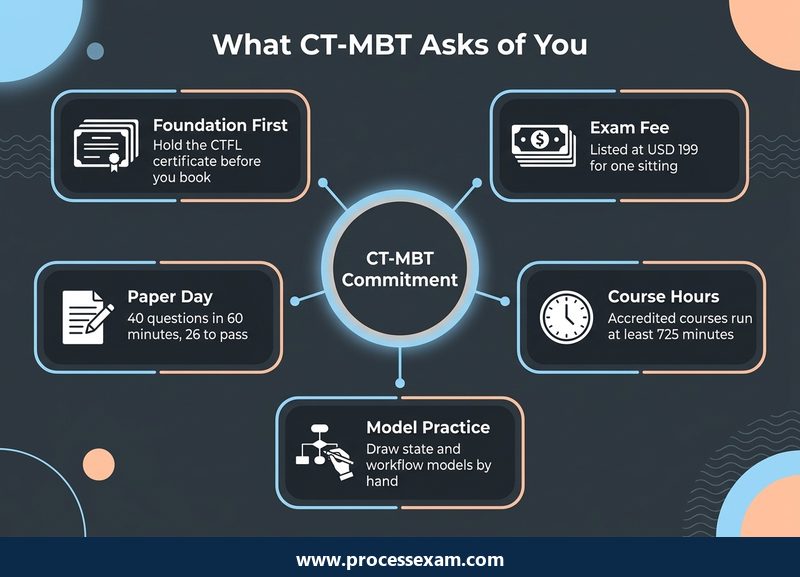
Counting the cost of CT-MBT starts one step before the exam: ISTQB requires the Foundation Level certificate first, so a newcomer pays for two papers, not one. The Model-Based Tester paper is listed at USD 199 for 40 questions in 60 minutes, and the syllabus sets 725 minutes of accredited teaching, just over twelve hours, before any practice of your own.
That makes CT-MBT a small purchase measured in money and a larger one measured in attention. The syllabus is short, but it is not a memory exercise: three of its five chapters ask you to apply a technique, which means drawing a model and deriving tests from it. This guide adds up the real bill, explains what each chapter expects, and ends with a study plan you can size to your own week.
What does CT-MBT really cost in money, prerequisites and hours?
Three costs sit behind the single exam fee. The first is the exam itself, listed at USD 199. ISTQB's own certification page does not print a fee, because exams are sold through national boards and exam providers who set their own prices, so treat USD 199 as the reference figure and confirm the amount when you book.
The second cost is the prerequisite. ISTQB states that candidates must hold the Certified Tester Foundation Level certificate, and the syllabus repeats it as an entry requirement note. If you already passed CTFL, this cost is zero. If you have not, the Foundation exam is listed at USD 229, which lifts a first-time route to USD 428 in exam fees alone, before any course.
The third cost is time, and it has three layers:
- Teaching time. Accredited courses must provide at least 725 minutes, which is 12 hours and 5 minutes, spread across five chapters. ISTQB recommends an accredited course but does not make one compulsory for this exam.
- Practice time. Chapters 2, 3 and 4 are written at application level, so reading alone will not carry you. Plan to draw at least a handful of models yourself.
- Background. The syllabus recommends, but does not require, roughly six months of hands-on work, either in system or acceptance testing or in software development.
Here is how those costs add up for two typical candidates. The hours are planning estimates, not ISTQB figures, built on the 725-minute course length and a modest allowance for practice.
| Candidate | Exam fees (USD) | Prerequisite | Study time to plan for |
|---|---|---|---|
| Already holds CTFL | 199 | None to add | About 20 to 30 hours over 3 to 5 weeks |
| Starting from scratch | 428 (229 plus 199) | Pass CTFL first | CTFL preparation, then the same 20 to 30 hours |
Because the sum is modest, the real risk is not the fee but a failed first attempt that adds a second booking. Spend the effort on the chapters that carry application-level questions and the paper rarely needs a repeat.
Which CT-MBT syllabus does ISTQB examine today?
Yes. ISTQB's CT-MBT page names the ISTQB CT-MBT Syllabus v1.1, and the document itself is dated 23 February 2024. It replaced the original 2015 release, which was titled as a Foundation Level model-based tester syllabus. ISTQB's certification page, read in October 2026, carries no retirement or replacement notice, and sample exam set A, version 1.2, is published against v1.1.
That matters because older study notes still circulate. A guide built on the 2015 text can describe a different chapter layout, so check the syllabus version printed on page one of whatever you study from. The five chapters on today's paper are Introduction to Model-Based Testing, MBT Modeling, Selection Criteria for Test Case Generation, MBT Test Implementation and Execution, and Evaluating and Deploying an MBT Approach.
Two sources deserve a bookmark: ISTQB's CT-MBT certification page for the current rules and ISTQB's CT-MBT v1.1 syllabus PDF for the learning objectives. Everything about content in this guide comes from that syllabus.
What does the paper look like, and how many answers do you need?
The exam is 40 multiple-choice questions in 60 minutes, and you need 26 correct out of 40 points to pass. ISTQB grants candidates sitting in a language other than their first an extra 25 per cent of time. At 40 questions in an hour you have 90 seconds per question, which is ample for recall items and tight for those that ask you to read a diagram.
| Detail | CT-MBT |
|---|---|
| Certification | ISTQB Certified Tester - Model-Based Tester (CT-MBT) |
| Syllabus version | CT-MBT V1.1 |
| Vendor | ISTQB |
| Category | Specialist |
| Exam fee | USD 199 |
| Duration | 60 minutes |
| Number of questions | 40 |
| Passing score | 26 / 40 |
| Prerequisite | ISTQB Certified Tester Foundation Level |
The pass mark is 65 per cent, so you can drop 14 points. Every point counts the same, which means a candidate who is strong on Chapters 2 and 3 can carry a weaker Chapter 5, provided the applied questions are reliable. ISTQB publishes its own sample set for this version, so you can see the question style before you book: ISTQB's CT-MBT sample exam A is the one aligned with v1.1.
Which chapters take the most classroom time, and why does that matter?
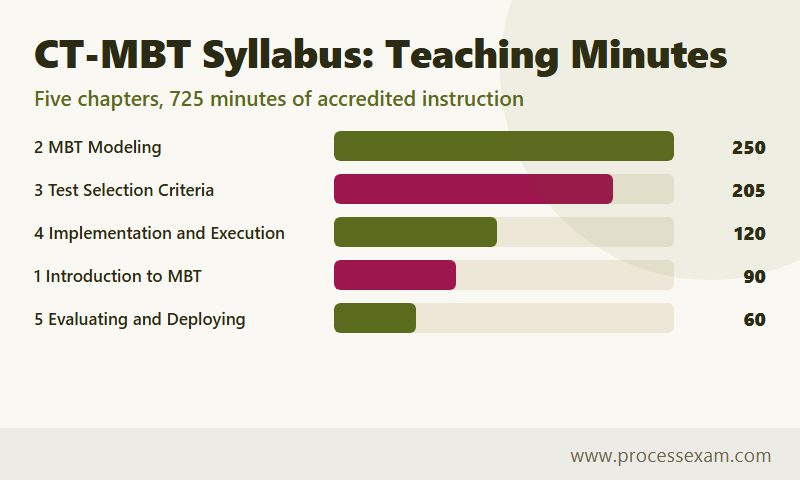
The syllabus gives time only at chapter level, and the split tells you where to spend your evenings. Modeling and test selection together take 455 of the 725 minutes, about 63 per cent. They are also the chapters written at K3, the apply level, so they hold the questions most likely to ask for a worked answer rather than a definition.
| Chapter | Teaching minutes | Level |
|---|---|---|
| 1. Introduction to Model-Based Testing | 90 | K2 |
| 2. MBT Modeling | 250 | K3 |
| 3. Selection Criteria for Test Case Generation | 205 | K3 |
| 4. MBT Test Implementation and Execution | 120 | K3 |
| 5. Evaluating and Deploying an MBT Approach | 60 | K2 |
Behind those minutes sit 36 learning objectives: 6 in Chapter 1, 13 in Chapter 2, 7 in Chapter 3, 4 in Chapter 4 and 6 in Chapter 5. Teaching minutes are a guide to weight, not a statement of how many exam questions each chapter gets, because the syllabus does not publish a question count per chapter. Use them to rank your study time, and read the full learning-objective list on ProcessExam's CT-MBT syllabus breakdown to tick items off.
K1 means remember, K2 means understand and K3 means apply. The syllabus adds that every keyword is examinable at K1 wherever it appears, so even the applied chapters contain vocabulary questions.
How does a model become a test, and which model fits which goal?
Chapter 2 is the biggest and the one most newcomers underestimate. It starts from the idea that an MBT model is built to derive test cases, so it must hold enough detail to generate test cases, an oracle and traceability back to requirements. The syllabus calls designing that model an essential and demanding activity, because the quality of the model sets the quality of everything downstream.
Structural and behavioral models
Structural models describe what exists, such as class diagrams or classification trees. Behavioral models describe what happens, such as activity diagrams, business process models and state transition diagrams. The syllabus also separates three subjects a model can describe: the system as intended, the environment or usage of the system (a Markov chain of expected usage is the example it gives), and the test itself. A real model usually blends them.
Matching the model to the objective
The syllabus pairs objectives with models, and the pairing is a reliable exam topic:
- Verify that a business workflow is implemented correctly: a business process model.
- Verify correct responses when the system is in a particular state: a UML state machine.
- Verify that an interface is available: a description of the interface structure.
- Gain confidence that the object suits expected users: a usage model.
You are also expected to recall the language families: structural, data, behavioral and integrated languages. UML is the integrated example, BPMN and activity diagrams are behavioral, and decision tables suit business rules in system testing. Two simplified graphical languages appear in the syllabus appendix, one for workflows and one for state transition diagrams, and the syllabus says exam preparation should cover both, so practise on those rather than only on full UML.
Model quality and classic mistakes
Three quality characteristics recur: syntactic quality (the model obeys its language rules), semantic quality (it describes the right behavior) and pragmatic quality (it suits the objective and the generator). Tools can check syntax and some semantics, reviews cover semantics and pragmatics, and simulators add a dynamic check. Newcomers' typical mistakes are the wrong level of detail and one model that tries to cover everything. The syllabus prefers two focused models, for example a state transition diagram to verify the implementation and an activity diagram to validate the workflow.
Linking model elements to requirements also appears here. It lets tools generate traceability matrices, choose tests by requirement priority and size regression after a change, and the model can carry risks, priorities, durations and required equipment as extra attributes.
How do selection criteria turn one model into many test suites?
A model can generate far more tests than you can run, so Chapter 3 teaches you to select. The syllabus presents six families of test selection criteria:
- Requirements coverage: every selected requirement linked to the model is covered by at least one test.
- Model coverage: states, transitions, decisions, activities, gateways, conditions or statements in the model.
- Data-related: equivalence partitions, boundary values and pairwise or n-wise combinations.
- Random and stochastic: a walk through the model, where stochastic selection weights the alternatives.
- Scenario-based and pattern-based: predefined use cases, user stories or partly defined patterns applied to the model.
- Project-driven: risk, priority or required test equipment recorded in the model.
A worked example you can redo on paper
Take a library loan with four states and seven transitions: Available, Reserved, On loan and Overdue. The transitions are reserve (Available to Reserved), cancel (Reserved to Available), collect (Reserved to On loan), check out (Available to On loan), return (On loan to Available), due date passes (On loan to Overdue) and return late (Overdue to Available).
| Criterion on the same model | Items to cover | Smallest test set |
|---|---|---|
| State coverage | 4 states | 1 test: reserve, collect, due date passes, return late |
| Transition coverage | 7 transitions | 3 tests: the long path, reserve then cancel, check out then return |
| Transition-pair coverage | 13 consecutive pairs | Several more tests, because every way into a state must be followed by every way out of it |
The 13 comes from counting at each state: Available has three ways in and two ways out (6 pairs), Reserved has one in and two out (2), On loan has two in and two out (4) and Overdue has one in and one out (1). The lesson is the one the exam wants: stronger criteria grow the suite quickly, and the choice must follow the test objective.
Why combinatorial data can explode
Data-related criteria can be heavily combinatorial. Four parameters with three values each give 81 full combinations, while a pairwise selection that covers every value pair needs only 9 tests. The syllabus names test case explosion as a risk and points to adapted generation strategies and filters as the remedy. Know the pros and cons it lists: requirements coverage is often mandatory but needs a precise definition, model coverage shows where gaps are but can explode, random selection finds the unexpected but may produce meaningless long tests, scenarios suit regression but need maintenance, and project-driven selection helps managers but needs extra linking effort.
Combining criteria and the degree of automation
Criteria can be combined by composition, where a test must satisfy all of them (an intersection), or by addition, where a test satisfying any one qualifies (a union). Selection must be reproducible, so you document the choices and reasons. Generation can be manual, semi-automated or fully automated, and the syllabus calls manual generation a low-maturity approach that loses most of the efficiency benefits.
What changes after generation: abstraction, adaptation and online or offline runs?
Chapter 4 begins where the generator stops. Generated tests may be high-level, with no concrete input values, or low-level, with concrete values, expected results and detailed steps. High-level tests suit review by business analysts; low-level tests can be run directly. Moving from one to the other needs complete test actions, concrete input data and concrete expected results, held in the model or in an outside table that maps abstract values to concrete ones.
Execution styles and the adaptation layer
Execution can be manual or automated. For automation, an MBT tool may convert tests into the scripting language of the execution tool, or you may build a test adaptation layer, a wrapper around the test object much like keyword-driven testing. The layer separates test design from interface detail, so a small screen change touches only the layer, not the model. Two terms to keep apart: offline MBT generates scripts, with expected results, first and runs them afterwards, while online MBT, also called on-the-fly, generates each step after executing the previous one, so a result can change the path through the model.
Keywords, data tables and change impact
For keyword-driven automation the keywords live in the model, you export the tests as scripts and implement each keyword in the tool's language. For data-driven automation the model holds abstract data, and you supply concrete values in a table and link them to the model's data. Preconditions must be set at the start of each script, or by the previous script's post-conditions, for scripts to chain.
The syllabus also asks you to trace the effect of change. A requirement change can reach the model, the selection criteria and the adaptation layer. An interface change without a functional change touches the adaptation layer only. A changed test objective reaches the model and the selection criteria. Handling this is a K3 objective, so expect a short scenario that asks which work products to update.
Does the investment pay back?
Chapter 5 is the shortest, at 60 minutes, and mostly asks you to recall and describe. Adoption follows five steps: awareness, interest, evaluation, trial use with measurable indicators, and adoption. Costs arise at introduction and continue during operation; savings come from early requirements validation, less duplicated test design, automated generation of test work products, earlier defect detection and a single point of maintenance when requirements change. You should also recall that the MBT tool needs integrating with configuration, requirements, test management and test automation tools.
Chapter 1 supplies the warnings that balance this: MBT does not solve every problem, is not just a matter of tooling, does not guarantee a correct model, and can produce test case explosion. Models need review, because any change propagates to all the generated testware. For a neutral background read on the technique itself, see this overview of model-based testing.
How many weeks should you plan, and what can come after the certificate?
Build the plan around the minutes, not the chapter numbers. Roughly one third of your time belongs to Chapter 2, about a quarter to Chapter 3, a sixth to Chapter 4, and the remainder to the two understanding-level chapters. A candidate holding CTFL can reasonably cover this in four weeks at five hours a week, which is a planning estimate and not an ISTQB figure.
| Week | Focus | Finish the week able to |
|---|---|---|
| 1 | Chapters 1 and 2.1 | List MBT benefits and pitfalls; draw a workflow and a state model from a short text |
| 2 | Chapters 2.2 and 2.3 | Match a test objective to a model type; name the quality traits and classic mistakes |
| 3 | Chapter 3 | Apply state, transition and pair coverage to a model and count the tests |
| 4 | Chapters 4 and 5, then a timed paper | Explain high and low-level tests, offline and online runs, adaptation and ROI factors |
In week four, sit ISTQB's sample set in one go, then check the miss pattern: if the misses sit in Chapters 2 and 3, the extra hours go there, not into rereading Chapter 5. Before you book the paper, run the CT-MBT mock exam against a 60-minute timer and note which chapter's questions slowed you down.
As for what follows, the syllabus places CT-MBT on the ISTQB career path alongside the Core Advanced Levels in Test Analyst, Technical Test Analyst and Test Manager, and beyond them the Expert Level, which has one track for managing testing and another for improving the test process. The certificate sits next to those rather than before them, and it speaks to the five business outcomes the syllabus lists: collaborating in an MBT team with standard terminology, applying MBT in a test process, creating and maintaining models, selecting and maintaining test work products by risk and value, and helping the organisation improve its quality assurance process.
Frequently Asked Questions
How much does the CT-MBT exam cost?
The CT-MBT exam is listed at USD 199 for 40 questions in 60 minutes. ISTQB's page does not print a fee because national boards and exam providers set their own prices, so confirm the amount when you book. Without the Foundation certificate, add the Foundation exam, listed at USD 229.
Do you need CTFL before taking CT-MBT?
Yes. ISTQB states that candidates must hold the Certified Tester Foundation Level certificate to gain the Model-Based Tester certification, and the syllabus repeats this as an entry requirement. The syllabus also recommends, without requiring, about six months of testing or development experience and an accredited course.
How many questions are on the CT-MBT exam and what is the pass mark?
The paper has 40 questions in 60 minutes, and you need 26 of 40 points to pass, which is 65 per cent. Candidates sitting in a language other than their first receive 25 per cent extra time, according to ISTQB's certification page for this exam.
How long does it take to study for CT-MBT?
The syllabus sets 725 minutes, just over 12 hours, as the minimum for an accredited course. Add practice drawing models and deriving tests. As a planning estimate rather than an ISTQB figure, a CTFL holder can prepare in about four weeks of five hours each, weighted toward Chapters 2 and 3.
Which syllabus version does the CT-MBT exam use?
ISTQB's CT-MBT page names syllabus v1.1, dated 23 February 2024, which replaced the 2015 release. Sample exam set A, version 1.2, is published for v1.1. Check the version on the first page of any study material, because older notes can describe a different structure.
- ISTQB Model-Based Tester Test Questions |
- ISTQB Model-Based Tester Book |
- Model-Based Tester Certification Cost |
- Model-Based Tester Certification Requirements |
- ISTQB Model-Based Tester Sample Questions |
- Model-Based Tester PDF |
- CT-MBT Question Bank |
- Specialist |
- CT - Model-Based Tester Simulator |
- CT - Model-Based Tester Mock Exam |
- ISTQB CT - Model-Based Tester Question Bank |
- ISTQB CT - Model-Based Tester Book |
- ISTQB CT - Model-Based Tester Study Guide |
- CT - Model-Based Tester Certification |
- CT - Model-Based Tester Certification Cost |
- CT - Model-Based Tester Certification Requirements |
- CT-MBT Exam Questions Download |
- CT-MBT Test Questions |
- ISTQB CT - Model-Based Tester Exam Questions |
- ISTQB CT - Model-Based Tester Sample Questions |
- CT - Model-Based Tester |
- CT - Model-Based Tester PDF


