
How to Study for the IIBA CBDA Exam, One Domain at a Time
The CBDA rewards a study order more than a study marathon. IIBA built the exam on six knowledge areas taken from its Guide to Business Data Analytics, so the quickest route is to take them one at a time: read the matching part of the guide, practise one technique on a small data set, then check that area with scenario questions before you move on. This article sets that method out, using IIBA's May 2026 handbook.
Everything below is checked against three IIBA pages in November 2026: the CBDA certification page, the CBDA handbook (May 2026 edition) and the CBDA competencies page. Where IIBA does not publish a figure, the article says so instead of guessing. The sister article on this site covers whether the credential is worth having; this one is only about how to prepare.
| Exam detail | IIBA CBDA |
|---|---|
| Exam code | CBDA |
| Exam name | IIBA Certification in Business Data Analytics |
| Category | Specialized Business Analysis |
| Questions | 75 |
| Duration | 120 minutes |
| Question style | Multiple-choice, scenario-based, competency-based |
| Delivery | Online, remote proctored |
| Knowledge areas | Six, each with a published percentage of questions |
| Result | Pass or fail on screen when you finish |
| Work experience required | None (two years in business data analytics work is recommended) |
Which IIBA materials should anchor your CBDA study?
Start with what IIBA itself tells you the exam is drawn from. The handbook says the exam covers the six knowledge areas "discussed in the Guide to Business Data Analytics", and it lists the guide first under self-directed learning. IIBA's certification page marks that guide as members-only, with a purchase option beside it, so check which route you have before you plan your weeks.
Around the guide, IIBA names a handful of other sources, and they are worth reading in a particular order.
- The handbook comes first. It is short, free and holds the exam structure and the blueprint percentages that drive your hours.
- The competencies page breaks each knowledge area into tasks and competencies, each tagged with a proficiency level. It is the closest thing to a syllabus you can read without membership.
- The two "Introduction to Business Data Analytics" papers, one from a practitioner view and one from an organizational view, give the vocabulary the guide then builds on.
- IIBA's nine-question self-assessment on the certification page comes with an answer key. Use it once at the start to see how scenario questions read, and keep the result as a baseline.
- Chapter study groups and IIBA-listed prep courses are optional; the handbook mentions both.
For extra scenario questions beyond IIBA's nine, our CBDA sample questions give you more to check an area against. They supplement the guide; they do not replace it.
What the proficiency levels tell you about depth
Almost every competency on IIBA's page is tagged "General Awareness", "Basic Knowledge" or "Practical Knowledge". That wording is a study instruction. Most of the analytics techniques sit at Basic Knowledge or General Awareness: you must recognise a method, know when it fits and read its output, not write code for it. The communication competencies in the fourth knowledge area are different; several are marked Practical Knowledge, which means following rules to actually produce a narrative, a visualisation or a stakeholder package. Spend your effort where the level is highest, not where the maths is hardest.
How should the blueprint weights set your study hours?
IIBA publishes the share of questions each knowledge area carries, and the figures add up to 100%. Three areas carry 20% each, which is why a candidate who only revises models can fail while knowing the models well: a large part of the paper is about questions, communication and decisions.
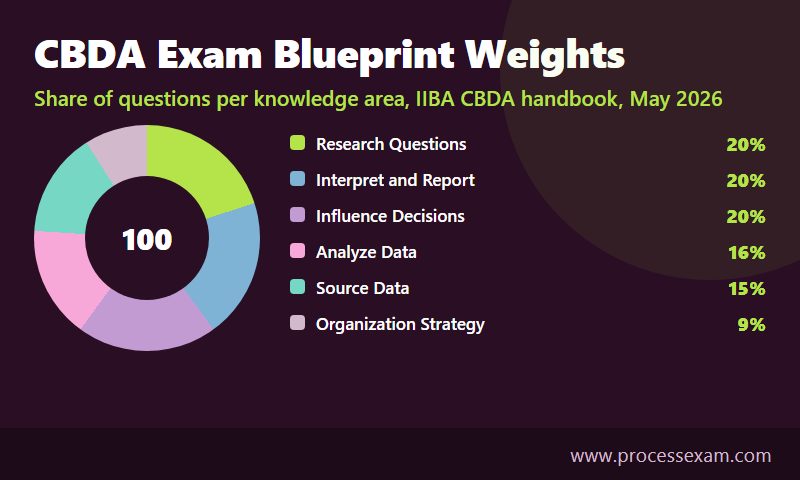
| Knowledge area | Share of questions | Hours out of every 20 spent studying |
|---|---|---|
| Identify the Research Questions | 20% | 4 |
| Source Data | 15% | 3 |
| Analyze Data | 16% | 3 |
| Interpret and Report Results | 20% | 4 |
| Use Results to Influence Business Decision Making | 20% | 4 |
| Guide Organization-level Strategy for Business Analytics | 9% | 2 |
The first two columns are IIBA's blueprint. The third is our own rounding of those shares to a 20-hour block, offered as a starting point rather than an IIBA recommendation. If you already work in reporting, move an hour from the fourth area to the first or second; if you come from a modelling background, do the reverse.
The percentages also tell you what a weak area costs. The smallest area, at 9%, is roughly one question in eleven, so it cannot rescue a poor result elsewhere and does not deserve a week of its own. A 20% area that you skim is the opposite: it is where the result is decided.
What do you read and practise for the first two knowledge areas?
Identify the Research Questions: practise reframing
On IIBA's competencies page this area has two tasks: identify and frame the business situation, and plan the analytics approach. The competencies behind them include defining the business need, analysing the current state, setting the KPIs or metrics that measure success, fixing scope, listing assumptions, constraints and dependencies, and formulating the research questions the analytics will answer.
The practice that works is rewriting. Take a vague request such as "tell us why customers leave" and turn it into a question that data can answer: which customers, over what period, measured by what, and compared with what. Write down the assumption you are making and the decision the answer will feed. Then write the same request for a second, different business, so the habit does not attach to one example. If you can state the current state, the desired future state and the gap in three short lines, you have covered the first task.
Scenario questions in this area usually hide the real problem inside a long description. Train yourself to find the sentence that names the decision, because the right option almost always serves that decision and the wrong ones answer an easier question.
Source Data: practise inspecting a small table
This area is where the competencies list gets practical: deciding what data is needed, finding which of it is already collected, knowing the common storage forms (IIBA names data lakes, marts, vaults and warehouses), judging data frequency and flow, assessing quality, sampling, linking sources, cleaning, and detecting outliers and noise.
Make a dummy table of eight order rows and break it on purpose: duplicate one order number, leave one region blank, record one order at 9,400 when the others sit between 40 and 60, and enter one date in a different format. Now write, for each fault, what it would do to an average, a count or a join, and what you would ask the data owner. That single exercise touches quality, integrity, outliers, cleaning and linkage in one short sitting.
Then ask the sampling question in words: if the table held eight million rows, how would you choose a sample, and what could bias it? The exam does not expect statistics at degree level here, but it does expect you to know that sample size and sample method change what a result can claim.
Which techniques should you try on a small data set for Analyze Data?
This is the area people fear, and IIBA's own wording takes some of the fear away. Most competencies here are "Basic Knowledge" or "General Awareness": producing scope, data and decision models, creating architectural diagrams, developing mathematical models, suggesting predictive models "such as regression, logistics regression, decision trees/random forest, neural nets", preparing and analysing data, and interpreting regression output and adjusting models. The page also asks whether results are helping answer the business question and whether the approach needs adjusting.
Work through each technique once on a data set small enough to hold in your head, and write one sentence on when you would reach for it.
- Regression. Put six weeks of advertising spend (1 to 6, in thousands) beside weekly sales (12, 15, 19, 21, 26, 28, in thousands) in a spreadsheet and fit a line with its slope function. The slope comes out near 3.3: each extra thousand of spend goes with about 3.3 thousand more in sales. Then say what the number does not prove, since association is not cause, and what you would check before trusting it, such as whether six points is enough.
- Logistic regression. Change the outcome to yes or no, such as "renewed or did not renew". The skill to keep is recognising that the outcome is a category, so a straight-line regression is the wrong tool.
- Decision trees and random forests. Take twelve customers and split them by one rule, such as "more than three support tickets". Notice how easily the rule can be explained to a manager, and that a forest combines many such trees.
- Neural nets. At exam depth this is vocabulary: when a method of this kind is overkill, and what you give up in explainability.
- Clustering and sensitivity analysis. IIBA mentions both under data dependencies. Group customers by spend and visit frequency with no labels, then change one assumption in your regression and see how far the result moves.
Reading regression output without being a statistician
IIBA lists interpreting regression output and adjusting the model as a competency, so learn to read four things from any output: the direction and size of each coefficient, how well the model fits, whether a variable is doing real work, and whether the residuals show a pattern you have missed. You do not need to derive them. You need to say what a business analyst would do next: drop a variable, add one, change the model type, or go back and question the data.
Finish each technique by asking the last competency in the list: are these results actually helping to answer the research question? Many wrong options on scenario questions describe a technically sound analysis that answers a different question from the one the sponsor asked.
How do you practise reporting results and influencing decisions?
Interpret and Report Results
On IIBA's competencies page, interpreting results, deriving insights, refining the problem statement and putting forward recommendations sit at "General Awareness". Developing the business narrative, building visualisations, preparing the analytics package, choosing how to package and communicate, and working out what each stakeholder needs are all "Practical Knowledge". The exam therefore tests whether you can do communication work, not only describe it.
Use the regression example from the last section as your raw material and produce three things.
- A three-sentence narrative for a finance director: what you found, how sure you are and what you recommend.
- One chart that carries only that message, with the axis and the title chosen so a reader cannot misread it.
- A second version of the same finding for an operations team that wants to know what to change on Monday.
Compare the two versions. The facts match and the framing differs; the exam's scenario questions test exactly that judgement, and the wrong options typically give the right content to the wrong audience.
Use Results to Influence Business Decision Making
This area asks whether the results answer the research question, how well they meet the business need, whether to recommend the proposed solution, how to plan implementation, and how ready the organization is for the change. The last two are the ones candidates forget, because they feel like project management rather than analytics.
Practise with a one-page decision memo. Write the recommendation, the evidence for it, the one result that would change your mind, a three-step implementation plan and the readiness question you would ask first (does the team have the data, the skills and the time to act on this?). A memo that cannot name its own weak point is not yet ready to influence a decision, and a scenario answer that ignores readiness is usually the distractor.
What does the smallest knowledge area, at 9%, still ask of you?
Guide Organization-level Strategy for Business Analytics is the area most candidates leave to the last evening. IIBA's competencies page, which titles it slightly differently as company-level strategy, splits it into recommending action, evaluation, master data management, data curation, metadata management and performance improvement. These are data-governance ideas more than analysis ones.
Your practice here is a short glossary and a one-page checklist, built for any data set you have used in this study plan.
- Write the definition of two terms that different teams might use differently, such as "active customer", and note who owns each definition. IIBA lists maintaining a glossary and representing data consistently.
- Name the difference between master data and operational or transactional data, which is also on IIBA's list.
- List the privacy and security rules that would apply to the table, and who would validate the KPIs built from it.
- Note how the analytics requirements and sampling method could be kept for reuse by another team.
At roughly one question in eleven, a couple of evenings of this are enough. The point is not to become a governance specialist; it is to recognise when a scenario's real issue is consistency, ownership or privacy and not a modelling choice.
How can practice tests confirm each domain before you move on?
A practice test is most useful as a measuring tool for a single area, not as a final exam you take at the end. The method is to study an area, answer a short set of questions on that area only, and record the result before opening the next one. Keep one tally sheet with a row for every area and a column for each attempt.
| For each question you miss | What to write down |
|---|---|
| Area | Which of the six knowledge areas the scenario belongs to |
| Cause | Misread the scenario, did not know the concept, mixed up two techniques, or ignored the audience |
| Source | The guide section or competency that explains it |
| Fix | One small example you will redo in your own data set |
After a week the cause column shows a pattern, and the pattern is more useful than the score. A run of "mixed up two techniques" sends you back to the small data sets in the analysis section. A run of "ignored the audience" sends you to the three-sentence narrative exercise. The graphic below shows six causes behind many scenario misses.
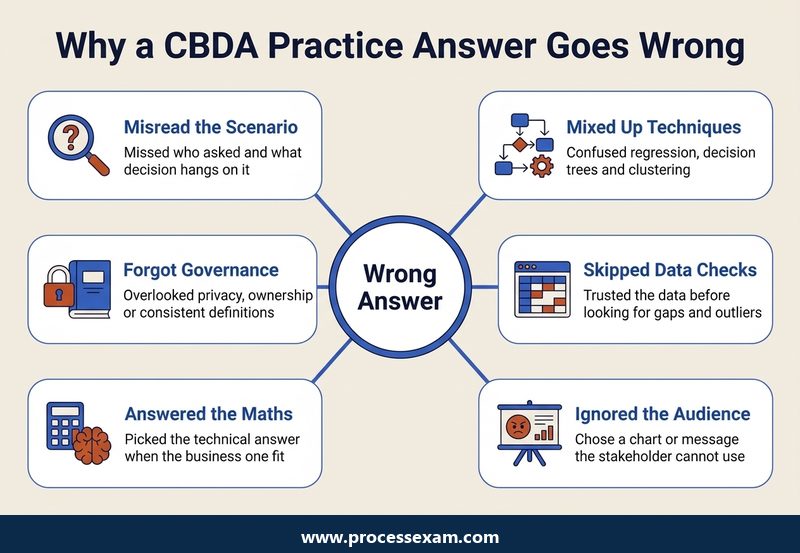
Two cautions keep the method honest. First, do not read a single score as a forecast of your result. IIBA reports the outcome on screen without a published percentage mark in its handbook, so your aim is even strength across the six areas, and the three largest ones should never trail the rest. Second, avoid question dumps. They train recall of a particular wording, while IIBA describes the CBDA as competency-based and scenario-based, so a question you have memorised teaches nothing about the next scenario.
When an area feels settled, the CBDA practice exam gives you fresh scenarios on it to check against, which is the point of the tally sheet: you move on only when the new scenarios behave like the ones you have already mastered.
Once all six areas have been through that loop, take one full-length attempt, and treat it as a rehearsal of pacing. With 75 questions in two hours, you have a little over a minute and a half for each, so a long scenario deserves a first read for the decision, not a word-by-word study.
What should be settled before you launch the exam from your IIBA account?
The handbook is clear that the exam is delivered online with a remote proctor, and that most avoidable losses happen before the first question. These are the items it spells out.
- Your window. From the day IIBA receives payment you have six months to schedule and take the exam. Refund requests are accepted for 30 days from payment.
- Your name. Spelling must be identical on your ID, in your IIBA profile and in the PSI booking. Only IIBA can correct a profile name, and it must do so a week or more before the exam.
- Your ID. It must be valid, original and government-issued, with your photo and signature, written in Western characters.
- Your equipment. Use a personal laptop, not a company one, with a working camera, microphone and a reliable connection, in a quiet room with a clear workspace.
- The tutorial test. Before exam day, run PSI's tutorial test, which the handbook allows up to three times. It is a rehearsal of the room scan and the exam screens, and it takes roughly half an hour.
- Rescheduling. A change or cancellation needs at least 48 hours' notice, or the exam fee is forfeited.
- Launch. Log in through the IIBA portal, never directly through PSI; the launch opens up to half an hour before your start time.
In the last few days, do light work only: reread your tally sheet, redo the two or three examples that gave you the most trouble, and set up the room. Cramming a new area at that point adds little, whereas a short equipment check can save the whole attempt. On the day, read each scenario for the decision it describes, answer the one IIBA asked about, and move on if a question is taking more than its share of the clock.
Frequently Asked Questions
How do you study for the CBDA exam?
Work through IIBA's six knowledge areas one at a time. Read the matching part of the Guide to Business Data Analytics, practise one technique on a small data set, then answer scenario questions on that area alone. Weight your hours by the blueprint, which gives three areas 20% each, and keep a tally of missed questions by cause.
Is there a CBDA study guide PDF?
IIBA's Guide to Business Data Analytics is members-only, with a purchase option on its certification page. The CBDA handbook and two Introduction to Business Data Analytics papers are linked as PDFs, and the page offers a nine-question self-assessment with an answer key. Read the handbook first, because it holds the blueprint percentages.
Which techniques should you learn for the CBDA?
IIBA's competencies page names regression, logistic regression, decision trees, random forests and neural nets, plus clustering and sensitivity analysis. Most are tagged Basic Knowledge or General Awareness, so you need to recognise when a method fits and read its output, including regression output, rather than build models from scratch.
How many questions and how long is the CBDA exam?
The exam has 75 multiple-choice, scenario-based questions to complete in 120 minutes, delivered online with a remote proctor. IIBA shows a pass or fail result on screen when you finish and emails a confirmation within 48 hours. The handbook does not publish a percentage pass mark.
Are CBDA dumps a good way to prepare?
No. Dumps teach the wording of particular questions, while IIBA describes the CBDA as competency-based and scenario-based, so memorised answers do not transfer to a new scenario. Candidates also agree to IIBA's Code of Ethical Conduct. Practice questions are best used to find weak knowledge areas, then fixed by returning to the guide.
- CBDA Question Bank |
- CBDA Exam Questions Download |
- CBDA Test Questions |
- IIBA Business Data Analytics Test Questions |
- Business Data Analytics Simulator |
- Business Data Analytics Mock Exam |
- IIBA Business Data Analytics Book |
- Business Data Analytics Certification Cost |
- Business Data Analytics Certification Requirements |
- IIBA Business Data Analytics Sample Questions |
- Business Data Analytics PDF |
- Specialized Business Analysis


