
Is the IIBA Agile Analysis Certification Worth It for Business Analysts?
Yes, for most business analysts who already work in sprints, the IIBA Agile Analysis Certification is worth its $250 member or $405 non-member exam fee. It proves you can do analysis inside an agile team, not just talk about it. It is a poor fit if you never touch a backlog. This guide shows how to decide, what the exam covers and how to prepare.

Searchers often ask whether an agile certification for a business analyst is a career move or just another badge. The honest answer depends on where your work sits today. The IIBA credential, known as the AAC, is one of the few that are written for the analyst rather than the delivery manager, so the value shows up in specific situations. Below, each situation is spelled out with the exam facts, and the figures are the ones we hold for the exam in September 2026.
Is the IIBA Agile Analysis Certification worth it for a business analyst?
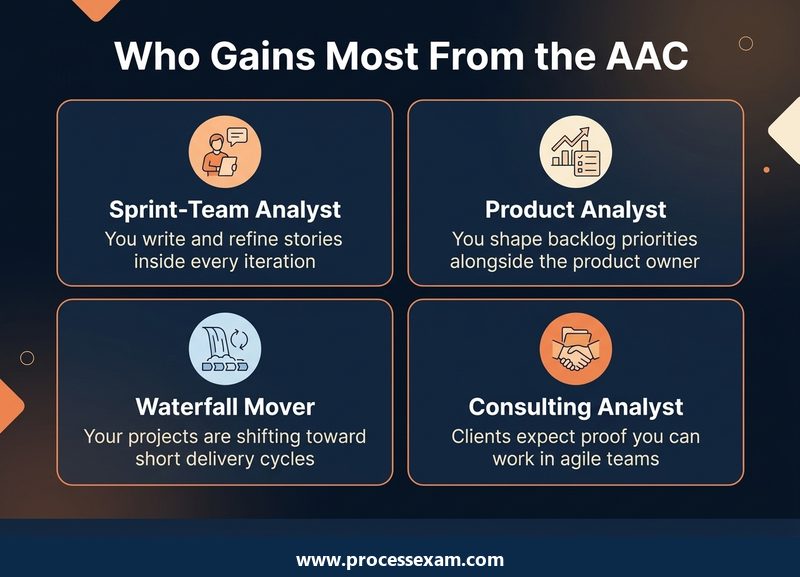
It is worth it when three things are true: your team already delivers in short cycles, your title or your daily work involves shaping backlog items, and you want a credential that says so in the vocabulary of business analysis. It is worth less when your projects are still plan-driven, because you would be certifying a way of working you cannot practise yet.
What the credential actually proves
IIBA describes the AAC as recognising the ability to perform business analysis in an agile environment, and it tests that through scenario-based multiple-choice questions rather than definitions. Passing tells an employer that you can pick a sensible next action when a story is vague, a stakeholder changes their mind mid-sprint or two priorities collide. That is a narrower claim than "knows Scrum", and it is the reason the credential sits comfortably beside a Scrum or product owner course rather than replacing one.
What it does not do
No certificate creates an opening that the market has not made. If the job advertisements in your area ask for the Certified Business Analysis Professional or a project management credential and never mention agile analysis, the AAC will be a supporting line on your CV rather than the headline. It also does not replace experience: IIBA's own competency material talks about two to three years of analysis work in an agile setting, and the questions reward people who have lived through a messy iteration.
A quick self-test before you spend money
- Could you explain, without notes, how a large epic becomes stories a team can finish in one iteration?
- Have you ever changed a priority because of feedback from a demo rather than from a plan?
- Do you write acceptance criteria, or at least review them?
- Would a hiring manager on your target team recognise the IIBA name?
Three or four yes answers suggest the AAC will confirm what you already do. One or none suggests spending the first month simply working closer to an agile team, then coming back to the decision.
Who should take the AAC, and who can skip it?
The natural candidate is a business analyst, systems analyst, product analyst or business process analyst who has been placed inside a delivery team. Product owners and proxy owners who spend their week on backlog work also gain, because the exam is built around analysis decisions rather than ceremonies.
The AAC beside the CCBA and CBAP
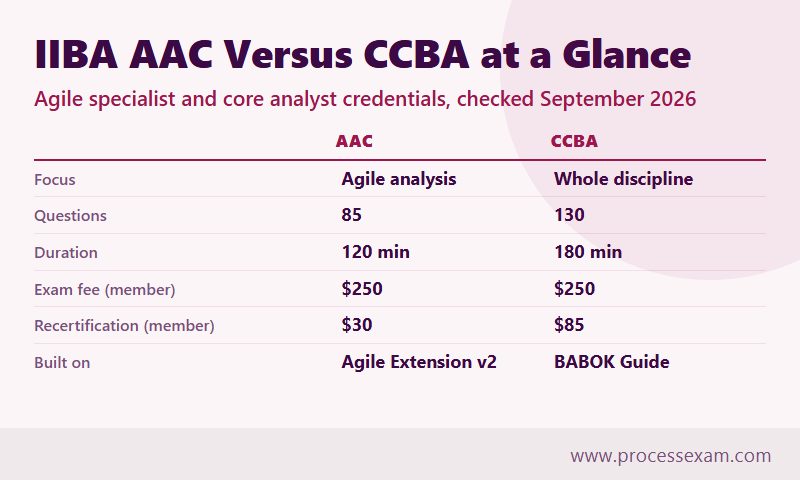
IIBA's core credentials, the CCBA and CBAP, measure analysis experience across the whole discipline and ask you to document working hours before you may sit them. The AAC is a specialised credential on a different axis: it is about the way of working rather than career level. The table above sets the AAC against the CCBA on the points candidates ask about most. Many analysts hold one of each, since the core credential shows breadth and the agile one shows the current delivery style.
The AAC beside project-side agile credentials
Agile qualifications aimed at project managers, such as AgilePM, test planning, governance and team leadership. The AAC tests something different: how requirements are discovered, sliced, ranked and confirmed when nobody has promised a fixed scope. If you manage the schedule and budget, a project-side credential fits better. If you manage the understanding of what should be built, the AAC fits better. Holding both is unusual and rarely necessary.
Who can safely skip it
- Analysts on long, fixed-scope waterfall programmes with no plan to move.
- Complete beginners to business analysis, who are better served by IIBA's entry certificate and a few real projects first.
- Delivery managers whose accountability is schedule and cost rather than requirements.
What does the AAC exam cover across its four domains?
According to the IIBA Agile Analysis Certification page, the exam is spread over four domains with these weightings: Agile Mindset 30%, Strategy Horizon 10%, Initiative Horizon 25% and Delivery Horizon 35%. The content comes from IIBA's Agile Extension to the BABOK Guide, Version 2, which the page names as the governing standard. Our AAC syllabus page lists the topics under each domain for study planning.
Agile Mindset (30%)
This domain is about how an analyst thinks, not which tool they use. Agile is treated as a mindset that guides how work is approached, not a method that prescribes it, and analysis in an agile setting means applying that mindset to the familiar knowledge and techniques of business analysis. Expect situations about responding to change, delivering small pieces of value early, collaborating with the business daily and inspecting what you did in order to improve. The traps are answers that sound disciplined but quietly restore heavy upfront documentation.
Strategy Horizon (10%)
The extension describes three horizons of planning that nest inside each other, and the strategy horizon is the widest: why the organisation is changing at all. Questions at this level are few, but they matter for the analyst who is asked which initiatives deserve funding first, how a product vision links to enterprise goals and how to keep a long-range roadmap loose enough to change. Think of it as the domain that supplies the "why" for everything below it.
Initiative Horizon (25%)
The middle horizon covers an initiative or release: what is being built, for whom and in what order. Typical themes are shaping the initiative scope, splitting it into features, deciding which slices give the earliest learning, forecasting roughly how much fits and keeping stakeholders aligned as understanding grows. Techniques that live here include story mapping, personas and product roadmaps. A common exam pattern gives a stakeholder request and asks how to fit it into what is already planned.
Delivery Horizon (35%)
The largest domain is the closest to the daily work: preparing stories, refining the backlog, writing acceptance criteria, clarifying with the team during the iteration, supporting testing and confirming the result with the business. It is also where the most scenario questions land, so it deserves the biggest share of your study hours. Focus on what a business analyst should do first when a story is unclear, when a developer challenges its value or when the team finishes early.
Techniques worth knowing by name
The Agile Extension carries a catalogue of techniques, and scenario answers often turn on knowing which one fits. User stories and acceptance criteria describe what a slice of value should do. Story mapping arranges those stories along the user's journey so that a first release can be cut sensibly. Backlog refinement keeps the next few iterations ready. Personas keep a real user in the conversation, a roadmap shows the order of bets, and a retrospective feeds lessons back into the way the team works. For each one, be able to say who uses it, at which horizon and what goes wrong without it.
How the weightings translate into questions
With 85 questions in total, the weightings imply roughly 26 on the mindset, about 9 on strategy, around 21 on the initiative horizon and close to 30 on delivery. Treat those as estimates, since IIBA does not publish an exact count per domain. The practical lesson is that delivery plus mindset make up about two-thirds of the paper, which is where a limited study week should go.
What are the AAC exam format, cost and pass mark?
The exam is delivered online, needs a computer with a webcam, microphone and internet connection, and is proctored. The table gives the figures we hold, which match the IIBA page when we checked it in September 2026.
| Item | AAC figure |
|---|---|
| Exam code | AAC |
| Questions | 85 multiple-choice, scenario-based |
| Duration | 120 minutes |
| Passing score | 70 |
| Exam fee | Member - $250, Non-Member - $405 |
| Retake fee | Member - $195, Non-Member - $350 |
| Recertification fee | Member - $30 USD, Non-Member - $50 |
| Governing standard | Agile Extension to the BABOK Guide, Version 2 |
What the numbers mean in practice
Two hours for 85 questions leaves a little under a minute and a half for each one. Scenario stems are longer than a definition question, so the pace is comfortable only if you decide quickly on questions you know and mark the rest. The IIBA page does not state the pass mark in its own text; the 70 above is the figure in our exam data, so confirm it in the IIBA store when you book. IIBA notes that all amounts are in US dollars and can change without notice.
Membership and the real cost
The non-member price is described by IIBA as including membership, so the gap between the two fees is smaller than it first looks, and analysts who intend to use IIBA resources for a year usually find the membership route natural. Budget also for study material and for a possible retake, which costs less than the first attempt. Recertification is a small recurring fee, and the handbook on the IIBA recertification page explains how continuing development requirements work for each credential.
Is there an eligibility gate?
The certification page does not list an application with hours and references as the CCBA and CBAP do. It refers to a competencies document that suggests two to three years of analysis work in an agile context. Read that as a guide to readiness, not a rule: nothing stops a motivated analyst with less time from sitting the exam, but the scenarios assume you have seen a real iteration.
How does an AAC scenario question work?
Every AAC question puts you in a short situation and asks for the best response. Several options are usually reasonable in general; only one fits the agile principle being tested. Reading the stem for the constraint is the skill.
A worked example
Suppose a team is midway through an iteration when a senior stakeholder sends the analyst an email asking for a new approval screen to be added "as soon as possible". The options are to add it to the current iteration, refuse politely because scope is fixed, place it in the backlog and discuss its value and priority with the product owner, or write a full specification and circulate it for sign-off.
The best answer is to place it in the backlog and talk through value and priority. Adding it silently breaks the team's commitment and hides the trade-off. Refusing ignores the mindset that welcomes change. A full specification is the heavy upfront documentation that agile analysis avoids. The winning option keeps the request visible, protects the iteration and lets the person accountable for priorities decide.
A repeatable way to read stems
- Find which horizon the situation lives in: a product vision, a release or a single story.
- Identify who owns the decision. Analysts recommend and facilitate; they seldom decide alone.
- Remove options that add ceremony, delay feedback or hide a problem.
- Choose the answer that keeps collaboration close and delivers or learns something soon.
How long should you study for the AAC, and in what order?
Analysts with regular agile experience typically need four to six weeks of steady study, around five hours a week. Those new to agile teams should allow closer to eight, because the vocabulary is only half the task; the judgement comes from seeing techniques used. This is a planning suggestion, not an IIBA figure.
A six-week plan
- Week 1: mindset. Read the mindset chapters of the Agile Extension and list how each principle changes a routine analyst task.
- Week 2: strategy and initiative. Study the three-horizon model, roadmaps, story maps and how scope is sliced across a release.
- Week 3: delivery. Cover backlog refinement, acceptance criteria, story decomposition and working with testers and developers in an iteration.
- Week 4: techniques. Work through the technique catalogue, noting for each the horizon where it is used and the problem it solves.
- Week 5: scenarios. Answer scenario questions under time and write a one-line reason for every option you reject.
- Week 6: review. Retake a timed set, revisit weak domains and rest the day before.
Materials worth using
Start with IIBA's own material: the exam page, the sample questions it links and the Agile Extension, described on the IIBA Agile Extension page. Add your own project artefacts, since rewriting a real vague story into a clear one is the best rehearsal available. When you want a timed run that mirrors the scenario style, our AAC exam practice set gives you one to time yourself against. Avoid memorising leaked answer lists; the scenarios change and the reasoning is what is being tested.
Which plan-driven habits cost marks on the AAC?
Most lost marks come from habits carried over from plan-driven projects, not from ignorance of terms.
- Choosing the tidy, documented answer. Options that produce a thorough document before conversation tend to be traps.
- Acting as the decision-maker. The analyst supports prioritisation; the product owner decides. Options where you decide alone are usually wrong.
- Treating agile as a list of ceremonies. Knowing what happens in a retrospective is less useful than knowing what to do with what it reveals.
- Ignoring the horizon. A strategy-level question answered with a story-level tactic sounds sensible and scores nothing.
- Spending too long on early questions. With roughly ninety seconds each, a stubborn item should be marked and revisited.
- Skipping the smallest domain. Strategy is only 10%, but a few uncovered questions can decide a borderline result.
Treating the exam as a learning project
Many candidates find that the preparation pays off before the result arrives. Rewriting a vague story into a testable one, or sketching a story map for the current release, produces artefacts you can show at work. Keep a short log of what you changed in your team because of what you studied; it doubles as interview material and as a check that the credential is turning into practice.
On exam day
Test the webcam, microphone and connection beforehand, clear your desk, and read IIBA's proctoring instructions in the store before your slot. Keep a steady rhythm, flag doubtful items and use the last ten minutes to revisit them.
What happens after you pass the AAC?
You receive the credential, can list it as a certification on your CV and profile, and take on the renewal cycle set out in IIBA's handbook, with the recertification fee shown in the table. In interviews it is most useful as a starting point for stories: describe a backlog you refined, a change you handled mid-iteration and how you kept stakeholders aligned.
What a day looks like once you work this way
The certification is meant to describe real routines, so it helps to picture them. An agile analyst might open the day by clarifying a story with a developer who has started it, spend the middle of the day refining backlog items with the product owner for the next iteration, and finish by reviewing a demo with a business user and turning the feedback into new items. Compare that with a plan-driven week of writing a long specification and waiting for sign-off. The exam asks which habits from the first pattern you can defend under pressure.
Where it leads
Analysts commonly use the AAC to move into agile analyst, product analyst and product owner-adjacent roles, or to stay relevant when a waterfall employer adopts agile delivery. If you later want the broader recognition of a core IIBA credential, the experience you log in agile teams counts towards it. Do not expect an automatic pay rise: pay follows the scope you carry, and we quote no salary figures because we have no survey to cite.
Is now the right time?
If you are already working in an agile team, yes: the concepts are fresh, and the exam rewards recent practice. If you are about to join one, wait a few months. Either way, check the price and the exam details on the IIBA page before paying, because IIBA states that amounts can change without notice.
Frequently Asked Questions
Is the IIBA Agile Analysis Certification worth it?
It is worth it if you already analyse work inside an agile team and want that skill confirmed in business analysis terms. It is less useful for analysts on plan-driven projects with no move planned, because the scenario questions assume recent hands-on iteration experience.
How much does the IIBA Agile Analysis Certification cost?
The exam fee is Member - $250, Non-Member - $405. A retake costs Member - $195, Non-Member - $350, and recertification is Member - $30 USD, Non-Member - $50. IIBA quotes amounts in US dollars and says they can change without notice.
How many questions are on the AAC exam?
There are 85 multiple-choice, scenario-based questions to answer in 120 minutes, delivered online with a webcam and microphone under a proctor. The paper is weighted across four domains: Agile Mindset 30%, Strategy Horizon 10%, Initiative Horizon 25% and Delivery Horizon 35%, so delivery and mindset carry most marks.
Is the AAC better than the CBAP for agile business analysts?
They do different jobs. The CBAP is a senior core credential that measures broad experience, while the AAC is a specialised credential showing you can analyse in an agile setting. Analysts who work in sprints often take the AAC first, and some hold both credentials over time.
What does the AAC exam study material come from?
IIBA names the Agile Extension to the BABOK Guide, Version 2 as the governing standard. It covers the agile mindset and the strategy, initiative and delivery horizons, plus a technique catalogue. Adding your own project experience helps with the scenario-style questions, which reward judgement over memorised definitions.
- IIBA Agile Analysis Test Questions |
- AAC Question Bank |
- IIBA Agile Analysis Book |
- Agile Analysis Certification Cost |
- Agile Analysis Certification Requirements |
- IIBA Agile Analysis Sample Questions |
- AAC Exam Questions Download |
- AAC Test Questions |
- Agile Analysis PDF |
- Specialized Business Analysis


