
ICLL Certification: IASSC Lean Leader Exam, Topics and Fee
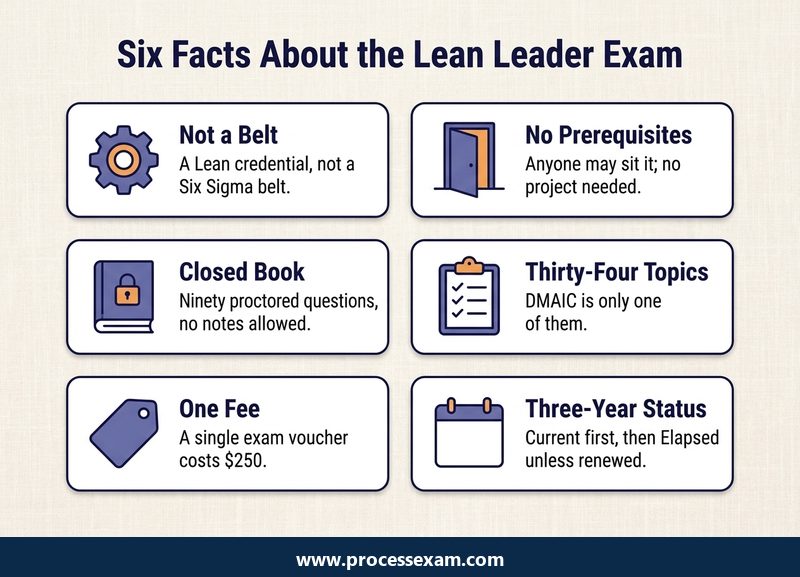
A common belief is that the ICLL is a Six Sigma belt with a Lean label on it. It is not. IASSC calls the Certified Lean Leader an intermediate-level Lean credential, and its exam is 90 closed-book questions in 120 minutes, with a 70% pass mark and a voucher price of USD $250. DMAIC appears as just one of its topics, and the rest of the paper is about waste, flow, pull and the habits of a Lean workplace.
Is the Lean Leader a Six Sigma belt, or something else?
The confusion is understandable. IASSC is best known for its Yellow, Green and Black Belt exams, and its own Lean Leader page says that Lean Leaders are also called Lean Green Belts or Lean Silver. The name suggests a belt, but the content does not. A Six Sigma Green Belt paper leans on hypothesis tests, control charts and capability, while the Lean Leader paper is built around the shop floor and the office floor: where work waits, where it is overloaded, and what stops it flowing at the pace customers want.
IASSC describes a Lean Leader as someone who drives and leads Lean improvement efforts across an organisation or within their own field, area or operation. It lists the working skills as leading and managing Lean improvement teams and projects, applying Lean principles and techniques to remove wasteful practice, setting the key metrics that show progress, and starting and sustaining a Lean change in the organisation. It also expects a Leader to train and coach Lean Practitioners and to guide Lean Experts on the opportunities they manage. The three Lean levels therefore sit one above another: Practitioner, Leader, Expert.
What the myth gets right and wrong
There is a grain of truth in the belt comparison. Both credentials sit in the middle of a ladder, both are knowledge exams with no project to submit, and both are written for people who lead improvement work part time or full time. What differs is the toolbox. A Leader who passes the ICLL has shown they can read a value stream map, choose between a kanban loop and level scheduling, and ask why a defect was possible in the first place. They have not been asked to run a regression. If your role is in manufacturing, logistics, a hospital, a service desk or a back office where the pain is delay and rework, the Lean Leader is aimed at you. If your work is mostly statistical, the Green Belt route fits better.
IASSC adds that the skills carry into Lean manufacturing, production, office, IT and development settings alike, so a Leader is not limited to factories. The topics talk about a production line, but the thinking carries to a ticket queue or an invoice approval chain, which is why analysts and managers from non-manufacturing teams sit the exam too.
What does the ICLL paper look like, and what does the voucher cost?
The facts below are the ones to plan around. The price is the fee for the exam voucher only, not for training or books.
| Item | ICLL detail |
|---|---|
| Exam | IASSC Certified Lean Leader (ICLL) |
| Vendor | IASSC |
| Questions | 90 |
| Duration | 120 minutes |
| Passing score | 70% |
| Exam voucher fee | USD $250 |
| Format | Closed book, proctored, multiple-choice and true/false |
| Prerequisites | None to sit the exam |
Spread evenly, 120 minutes gives you 80 seconds for each question, and 70% of 90 means 63 correct answers. IASSC adds that some forms of the exam carry up to nine extra non-graded questions. You cannot tell them apart from the scored ones, so treat every item as if it counts, and do not be thrown if the paper feels slightly longer than 90 questions.
Who can sit it
IASSC sets no prerequisite for the Lean Leader exam. Passing with 70% or more is the one condition for the designation. It recommends, but does not require, training from a qualified institution, trainer or corporate programme, and says Lean Leader training usually runs to roughly 48 to 72 hours, the equivalent of six to nine classroom days, not counting the time spent applying it on a project. It also recommends some real-world Lean and project experience. Read that as a hint about the style of question: many are scenarios in which you have to recognise a situation, so a candidate who has only memorised definitions can stall.
Where the exam is delivered
The Lean Leader exam is offered through IASSC's on-demand web-based testing system, and the voucher is bought in IASSC's online shop. IASSC also says Lean exams are planned for its affiliate partners and for Pearson VUE testing centres, but today's route is the web-based one, so look at what the shop lists on the day you book. Since 2020 IASSC has operated as part of PeopleCert, which owns and governs the certification scheme, so you may see PeopleCert branding around the purchase.
Which of the 34 topics does IASSC actually examine?
IASSC's Lean Leader Body of Knowledge says it consists of 34 individual topics. The page numbers 38 entries, but four of them are marked as excluded from the intermediate level: total productive maintenance, the six big losses, Hoshin Kanri and change management. That detail matters, because a Lean Expert study guide will teach all four at length and you can leave them out. Everything else is fair game. The 34 topics fall naturally into six groups, set out below in our own grouping.
Foundations and people
This group covers an introduction to Lean (definitions, benefits, principles and history), Gemba, Kaizen, KPIs, and teamwork and team skills. Gemba is the habit of going to the place where the work really happens. Kaizen is continuous, incremental improvement by the people who do the work. KPIs are the metrics that show progress toward critical organisational goals. Teamwork includes consensus, brainstorming and motivation.
Waste, flow and pull
This is the largest block. It holds the three families of loss, Muda (waste), Mura (fluctuation) and Muri (overburden); the Kano model; just-in-time; bottleneck analysis; continuous flow; takt time; heijunka (level scheduling); and kanban. IASSC notes that Mura drives Muda: if you do not smooth demand, you put unfair demands on processes and people and create inventory and other waste. Just-in-time is described as pulling parts through production on customer demand instead of pushing them on a forecast.
Mapping and layout
Here the exam asks you to draw and read pictures of work: value stream mapping, flow or swim-lane diagrams, spaghetti diagrams and layout planning (product, process and cellular layouts). A value stream map shows current and future state. A swim-lane diagram puts each actor on a parallel lane to expose complexity and lost time. A spaghetti diagram draws the actual walking and transport routes on the floor plan, and so exposes handling waste and safety risk.
Quality at source
Jidoka, the zero-defect principle, is the umbrella, and under it sit andon, poka-yoke (error proofing), root cause analysis and risk analysis, which includes the ideas behind FMEA. The root cause topic names the Ishikawa fishbone and the 5 Whys as common approaches. The theme running through them is prevention: stop the line, signal the problem, fix it for good.
Standardise and sustain
Next come 5S, SMED, OEE, standardized work, sustainment, visual management and short interval control. 5S is sort, set in order, shine, standardize and sustain. SMED aims to bring changeover under ten minutes. OEE tracks losses of availability, performance and quality. IASSC wants standardized work to be living documentation that is easy to change, and short interval control to be a rhythm of brief checks through the shift (a stand-up huddle, a walk of the work area, a hand-over review) so that problems surface within hours.
Methods and goals
The final group is the problem-solving frame: Kaizen task-force workshops (also called Kaizen blitz or Kaizen events, typically three to five days), DMAIC, SMART goals, stakeholder management and PDCA. DMAIC is one of 34 here, and IASSC pitches it at the lowest cognitive level, so recall of the five phases is enough. For the full topic list in a study-friendly layout, the ICLL syllabus page follows the same structure.
How hard does the paper make you think, going by IASSC's own cognitive levels?
IASSC builds its Lean Body of Knowledge on the revised Bloom's taxonomy and gives each topic a target level, from least to most complex: Remember, Understand, Apply, Analyze, Evaluate, Create. Counting the 34 topics in scope from the page gives a picture of what to expect. Seventeen are pitched at Analyze, eight at Apply, five at Create, two at Understand, and one each at Evaluate and Remember.
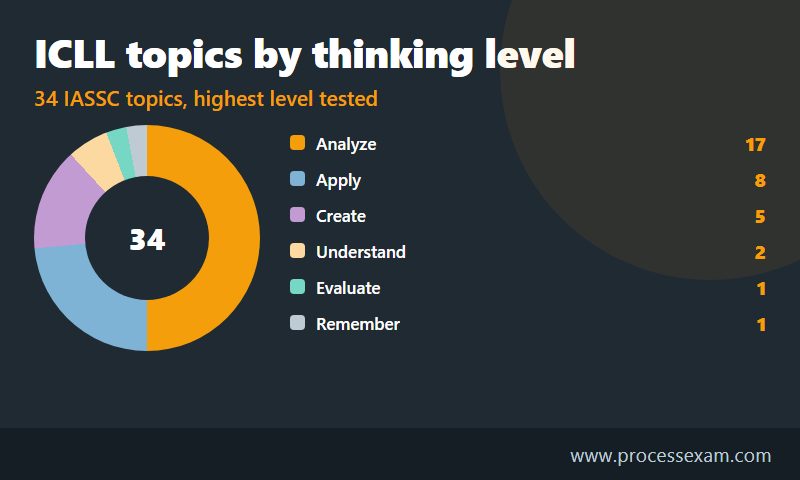
The practical reading is that the paper is not a vocabulary test. Half the topics ask you to break a situation into parts and see how they relate, which is what IASSC means by Analyze. On a question about a queue at a packing bench, you might be given figures for waiting, moving and processing and have to decide which waste dominates. The five Create-level topics are 5S, takt time, value stream mapping, standardized work and visual management, and they are the ones where you may have to build or choose a design, not just identify it. By contrast, DMAIC and heijunka sit near the bottom, so spending a week on DMAIC detail is poor value for this exam.
What to do with that information
Study each topic to the level IASSC sets, not beyond it. For an Understand topic such as OEE, you need to explain its three loss categories. For an Analyze topic such as kanban, you should be able to explain why a card loop stops overproduction and also spot, in a scenario, where it has been bypassed. For a Create topic like value stream mapping, practise drawing a current-state map from a short case and marking the delays. A useful habit is to write, for every topic, one sentence beginning "I would use this when..." and one beginning "It fails when...". The second sentence is what Analyze questions test.
What do the numeric and diagram questions look like on a shop-floor example?
IASSC does not publish its question bank, and the numbers below are invented, so treat them as a way to practise the mechanics. They avoid the formula-heavy topics that other Lean levels lean on, and focus on four tools in the Leader syllabus.
Bottleneck analysis
A five-step cell has cycle times of 40, 55, 72, 48 and 60 seconds. The slowest step, at 72 seconds, limits the whole cell, so the best it can produce is 3,600 / 72 = 50 units an hour. If a team spends a week trimming the 55-second step to 45, output stays at 50, because the constraint has not moved. The exam logic is simple: improve the constraint, and when it moves, look for the next one. Improvement elsewhere only lengthens the queue in front of the bottleneck.
Heijunka, or levelling the mix
Daily demand is 60 units of product A, 30 of B and 30 of C. Building all of A in the morning, then B, then C, is a big-batch schedule, and customers of C wait until the afternoon. Heijunka mixes variants in small batches inside the same process, so a repeating sequence of A, B, A, C across the shift matches the 2:1:1 ratio. The point of the question is usually why you do it, which is to smooth demand on the process and cut inventory, not how to arrange the letters.
Reading a value stream map
A purchase request spends 3.5 hours being worked on out of a 56-hour lead time. The value-adding share is 3.5 / 56 = 6.25%, which means nearly 94% of the elapsed time is waiting or non-value-adding movement. A Lean Leader reading this map does not start by asking people to work faster. They look for the long queues between steps, then use a swim-lane diagram to see which hand-offs create them. The same arithmetic works for a patient pathway or an insurance claim.
Ranking risks with FMEA ideas
IASSC's risk analysis topic refers to the concepts of the FMEA method. The usual convention scores each failure mode for severity, occurrence and detection from 1 to 10 and multiplies them into a risk priority number. Failure A scores 8, 3 and 4, giving 96. Failure B scores 5, 6 and 5, giving 150, so B gets attention first despite its lower severity, because it is both frequent and hard to detect. A trap is to rank by severity alone. At Leader level, you are asked to apply the idea in a project, not to run a full FMEA workshop.
Where should a month of revision go if you already work in Lean?
Four weeks is enough for most people with workplace Lean exposure, but the right split depends on where your experience is thin. A production supervisor already knows the floor topics and might never have drawn a swim-lane diagram. An analyst from a service team usually draws maps well and has never met poka-yoke or SMED in practice.
First week: audit and fill the foundations
Read the whole Body of Knowledge once and rate each of the 34 topics as explain, recognise or blank. Spend this week on the blanks in foundations and people, then on the three families of loss and the Kano model, since many later questions assume them. Leave the four excluded topics for now.
Second and third weeks: tools by cluster
Work through one group at a time rather than reading in the order of the page. Do the pull-system cluster (just-in-time, continuous flow, takt, heijunka, kanban) together so the links are clear: takt sets the pace, flow and kanban keep work moving, and heijunka smooths the mix. Do the quality-at-source cluster in a second sitting. Keep a one-page sheet for each group, with the definition, the level and a scenario.
Fourth week: timed scenarios and review
Use this week to answer questions against the clock and then rebuild the topics you missed. A timed run on the ICLL practice exam is the cheapest way to find out whether your gaps are knowledge or pace. Sort every miss by cause: a term you had never met, a term you knew but paired with the wrong tool, or a scenario you read too fast. Each cause needs its own cure. IASSC also sells a non-proctored Lean evaluation exam, which it describes as a way to judge whether you are ready for the proctored one.
Three habits that waste the month
Treating Lean as a vocabulary list is the first: the names of the Japanese terms matter less than being able to say which one fits a situation. Over-studying DMAIC is the second, given its single, low-level slot. The third is ignoring the Kano model, SMART goals and stakeholder management because they feel soft. They are examined topics and some of the cheapest marks on the paper.
What does the credential change once you are back at work?
The ICLL is a knowledge credential, so the paper does not prove you have led a project. What it does is give a manager, recruiter or client a clear and independent signal that you know the Lean toolbox and its language, issued by a body that is not your employer or training provider. On passing, IASSC sends a PDF certificate carrying your certification number plus a digital badge, lists you on its certification register, and lets you quote the designation in a CV or on LinkedIn, subject to its marks usage policy.
The strongest use is as a starting point for a conversation. A line supervisor who passes can explain to the plant manager why shortening a non-bottleneck step will not raise output. An operations analyst can say why a request spends 94% of its life waiting. Pair the certificate with one documented improvement, with a before and after metric, and you have something concrete to put in front of an interviewer.
How do you book the sitting, and what happens to your status after three years?
Buy the voucher from IASSC's shop, schedule the on-demand exam when you are ready and sit it on the web-based system. The paper is proctored and closed book, so read IASSC's instructions when you book and prepare your room and equipment to match them.
Current and Elapsed status
IASSC recognises certified professionals with no end date, but since 1 March 2017 each certification carries a status. It is Current for three years from the date you receive it, then shows as Elapsed unless you have recertified. IASSC's recertification policy sets out shortened re-exams. On the October 2026 check, the three it described were for the Yellow, Green and Black Belt, with nothing for the Lean Leader. If your three years are close to ending, ask IASSC what applies to a Lean Leader certificate rather than assuming a shorter paper exists, and re-read the page, since policies change.
Check the vendor's exam page before you pay. This guide was written against the Lean Leader page and Body of Knowledge IASSC lists in October 2026, and it also confirmed that the exam is still sold. If either page has changed by the time you read this, the vendor's wording wins.
Frequently Asked Questions
Is the ICLL a Six Sigma belt?
No. The ICLL is IASSC's intermediate-level Lean credential, which IASSC says is also called a Lean Green Belt or Lean Silver. Its Body of Knowledge covers waste, flow, pull systems, quality at source and Lean management routines, and DMAIC is only one of 34 topics, so it does not test the statistics of a Six Sigma belt.
How many questions are on the ICLL exam and what is the pass mark?
The paper has 90 closed-book, proctored multiple-choice and true/false questions, with two hours allowed. You need 70% to pass, which is 63 correct answers. IASSC says some forms add up to nine non-graded questions, and you cannot tell which ones they are, so answer every question as if it counts.
How much does the ICLL certification cost?
IASSC sells the Lean Leader exam voucher for USD $250 through its online shop. That covers the exam only, not training or books. IASSC recommends training from a qualified provider but does not require it, and it lists no prerequisites, so the voucher is the main fixed cost to plan for.
Do you need experience to take the ICLL exam?
No. IASSC states there are no prerequisites to sit the Lean Leader exam, and a score of 70% or more is the one condition. It does recommend some real-world Lean and project experience and Lean Leader training of roughly 48 to 72 hours, because many questions are scenarios that reward practical judgement.
How long does the ICLL certification last?
IASSC never withdraws recognition, but a certification is labelled Current for its first three years and Elapsed after that unless it is recertified. The shortened re-exams on the policy page cover three belts and not the Lean Leader, so put a question to IASSC well before the third anniversary.
- Lean |
- IASSC Lean Leader Test Questions |
- ICLL Question Bank |
- ICLL Body of Knowledge (BOK) |
- Lean Leader Simulator |
- Lean Leader Mock Exam |
- IASSC Lean Leader Book |
- IASSC ICLL BOK PDF |
- Lean Leader Certification Cost |
- Lean Leader Certification Requirements |
- IASSC Lean Leader Sample Questions |
- ICLL Exam Questions Download |
- ICLL Test Questions |
- Lean Leader PDF


