
CPM Certification vs PMP and PRINCE2: Which Fits a Working Project Manager?
Is the IAPM Certified Project Manager (CPM) a real alternative to the PMP or PRINCE2? For proving what you know, yes: it asks for no experience record, no course and no renewal. For satisfying a recruiter whose advert names PMP or PRINCE2, usually not, because those two carry the wider name recognition. This guide sets the three side by side on entry rules, exam format, fee and the way employers read each one.
Does each credential test what you know, what you have done, or a method?
The three are built on different ideas, and that matters more than any difference in difficulty. The CPM checks knowledge of project management as IAPM defines it. The PMP checks that you have already led projects and then tests your judgement. PRINCE2 teaches one structured method and tests whether you can apply it. A working project manager should decide which of those three claims a future employer needs to see before comparing anything else.
IAPM CPM: a knowledge exam that anyone can book
IAPM states plainly that no project experience is required for the CPM. The certificate is aimed at people who want a career in project management or are looking for a certification in the field, and the exam draws on twenty topics that run from project check, project file and stakeholders through the work breakdown structure, cost breakdown and budget, risk analysis and project close-out to soft skills. IAPM does not review your projects, does not ask for a reference and does not sell a compulsory course. The entry gate is the exam itself: one online sitting through the Classmarker system, taken on your own device at a time you choose, after you have paid the invoice.
That openness cuts both ways. Nobody can doubt that you may sit the exam, but nobody reading your certificate can tell from it how many projects you have run. The credential speaks for your knowledge and leaves your record to your CV and your references.
PMP: an application first, an exam second
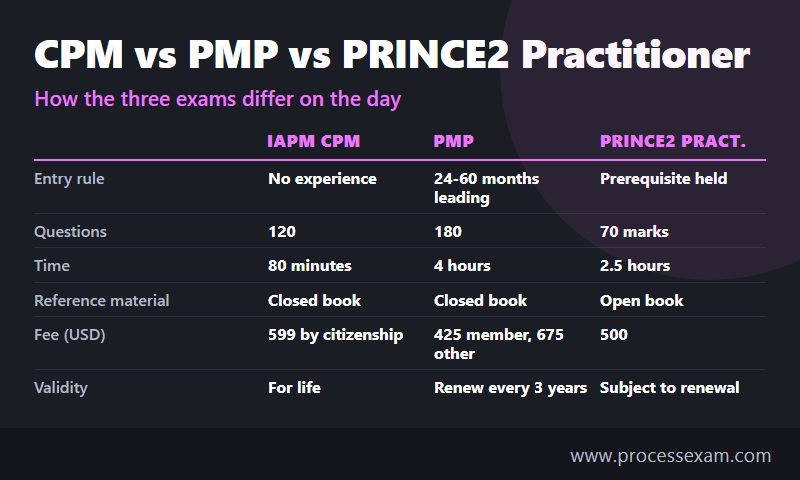
PMI treats the PMP as a credential for people who already lead projects. Under its July 2026 exam content outline you apply, and the application must show between 24 and 60 months of experience leading projects, the number depending on your education, plus 35 hours of project management training. PMI can audit what you declare. Only after that does the exam begin: 180 questions in four hours, with the result reported as a performance band (Above Target, Target, Below Target or Needs Improvement) rather than a percentage you can aim at.
For a project manager with several years behind them, the application is a chore but also a filter that employers understand. For someone who has run two or three small projects, it is a locked door.
PRINCE2: a method with two levels
PRINCE2 7 is published through PeopleCert, which describes it as a method trusted by over two million professionals. Foundation is the entry level, is listed as suitable for any career stage and lists no prerequisite. The Practitioner level lists prerequisites: you must already hold one of a set of certificates, which includes PRINCE2 Foundation, an earlier PRINCE2 Foundation or Practitioner, the PMP and the CAPM. Foundation checks that you know the principles, practices and processes; Practitioner checks that you can use them on a scenario.
Put the three together and a pattern appears. If you cannot yet show years of project leadership, the PMP is closed to you for now. The CPM and PRINCE2 Foundation are the two credentials you can book this month, and they test very different things.
How different do the three exam papers feel on the day?
Start with the CPM itself, then set it against the other two.
| Detail | Figure |
|---|---|
| Name | IAPM Certified Project Manager (CPM) |
| Exam code | CPM |
| Questions | 120 |
| Duration | 80 minutes |
| Passing score | 65% |
| Fee | USD 599 (IAPM sets the fee by citizenship) |
| Delivery | Online, through Classmarker |
The CPM is a sprint with no way back
Eighty minutes for 120 questions leaves 40 seconds for each. IAPM adds three rules that shape how you work: the exam must be taken without aids, which you confirm by signing an affidavit when you enrol; you cannot pause the clock once it starts; and you cannot go back to an earlier question or skip one. Items mix multiple choice (sometimes with several correct answers) and right/wrong statements. Speed and a clean first reading matter more than clever second thoughts, because there is no second pass.
The PMP is an endurance test
Four hours for 180 questions gives about 80 seconds each, twice the CPM allowance, but the questions are longer scenarios about people, process and the business environment, and concentration has to last. The PMP rewards experience you have lived through; a candidate who only memorised terms struggles with the judgement calls.
The practical difference shows in how you rehearse. For the CPM you practise speed and a forward-only habit: read once, decide, commit. For the PMP you practise stamina and long scenarios, usually across several full-length mocks. For PRINCE2 Practitioner you practise navigating the manual quickly, because an open-book paper punishes anyone who has to search from scratch.
PRINCE2 separates learning from application
The Foundation paper has 60 multiple-choice questions in one hour, closed book, with a 60% pass mark. The Practitioner paper runs two and a half hours, is open book and is scored out of 70 marks, again with a 60% threshold, so it tests how quickly you can find and apply the method rather than whether you remember it. PeopleCert states that official results arrive in two business days; IAPM sends the CPM result by e-mail within three working days.
| On exam day | IAPM CPM | PMP | PRINCE2 Foundation |
|---|---|---|---|
| Time per question | 40 seconds | 80 seconds | 60 seconds |
| Reference material | None, affidavit signed | None | None |
| Result | Pass wording, e-mailed within three working days | Performance band | Pass or fail at 60%, in two business days |
One honest conclusion follows. The CPM is the shortest paper, but its pace and its one-way navigation make it less forgiving than the number of questions suggests. Do not assume a lower fee or a shorter clock means an easier exam.
What does each route cost, and why is the CPM fee not one number?
The exam-only fees are the easiest part of the comparison to get wrong, because IAPM prices by country while PMI and PeopleCert publish a list price.
IAPM sets the CPM fee by your citizenship
IAPM's FAQ explains that, since income varies widely between countries, the gross domestic product of the country of your citizenship is the basis for the fee. The figure listed for the CPM is USD 599; on IAPM's fee page you pick your nationality and the page shows the amount that applies to you. IAPM gives pupils, students and active employees of charities a 20% discount when they send proof of status. Payment is by invoice, through bank transfer, PayPal or Wise, and once you hold the invoice you have 12 months to sit the exam.
PMP and PRINCE2 have list prices
The PMP costs USD 425 for PMI members and USD 675 for non-members. PRINCE2 needs two papers for the full route: Foundation at USD 338 and Practitioner at USD 500, which is USD 838 in exam fees. PeopleCert also sells bundles that add books and eLearning, priced well above the exam-only figures, so check which product you are looking at. The PMP's 35 hours of training is a further cost that the exam fee does not cover.
| Route | Exam fees | Papers |
|---|---|---|
| IAPM CPM | USD 599, varies by citizenship | One |
| PMP | USD 425 (member) or USD 675 | One, after an application |
| PRINCE2 7, both levels | USD 338 plus USD 500 | Two |
What failing costs under IAPM's rules
If you fail the CPM, IAPM lets you repeat it with new questions and charges the fee again. Repeated failure brings a 12-month wait, and the FAQ warns that failing again after that can close IAPM exams to you altogether, so read its wording on repeat attempts before you book rather than treating the exam as a free first try.
Who recognises each credential, and what can you honestly say for the CPM?
Recognition is the weakest part of the CPM's case, and it is better to say so than to oversell it. IAPM describes its certificates as recognised worldwide and valid for life, and it states that its methods have been recognised since 2018 by the Procurement Office of the German Federal Ministry of the Interior. It is a registered non-profit association in Liechtenstein, and its menu lists a certificate validation service, which gives an employer a way to check a certificate.
What IAPM does not publish is evidence that employers ask for the CPM by name in large numbers. PRINCE2 can point to a user base of over two million professionals on PeopleCert's page, and PMP is the credential many advertisements name outright. Treat those as tendencies, not rules. The practical test is cheap: collect ten adverts for the job you want in the country where you want it and count which credentials they name. If most name PMP or PRINCE2, the CPM is a supplement. If most name none, the CPM is a respectable and inexpensive way to show you have studied the field.
How to read the wording of an advert
Adverts use three phrases that mean different things. "PMP required" is a filter: applications without it are often dropped before anyone reads them, and no other certificate will substitute. "PMP or equivalent" leaves room for a case, which is where a CPM with a strong project record can be argued. "Project management certification preferred" asks for any credible credential, and there the CPM competes on equal terms with the others. Knowing which of the three you face tells you whether to spend your fee on the CPM at all.
Whichever credential you choose, say what it proves in a single line on your CV. For the CPM, that line is knowledge of traditional project management confirmed by a closed-book online exam; leave the experience claim to your project list, where a reader can check it against names, dates and outcomes.
The certificate recognition service
One feature of IAPM has no counterpart at the other two. Under its certificate recognition service you upload an existing certificate, a certified training partner reviews it by hand, and IAPM issues an equivalent IAPM certificate if it accepts it. IAPM says even expired certificates can be recognised and that a rejection costs nothing. The page does not list which certificates qualify, so treat it as an enquiry, not a promise.
What you actually receive
IAPM no longer issues paper certificates. After a pass you receive a cover letter, the certificate and a report by e-mail, and the certificate carries a wording for your score: pass for 65% to 70%, good pass for 71% to 80%, very good pass for 81% to 90% and pass with distinction for 91% to 100%. You can print it yourself for a manager or an application.
Is a certificate that never expires better than one you must renew?
The CPM never expires. IAPM argues that the exam, like a school leaving examination or a driving test, is taken once and valid for a lifetime, and it deliberately avoids what it calls costly and time-consuming recertification. The PMP works the other way: holders renew every three years by earning 60 professional development units. PRINCE2 Foundation is listed with renewal every three years and 60 CPD points, and the Practitioner certificate is also subject to renewal.
Neither design is plainly better. A lifetime certificate costs nothing to keep and cannot lapse because you changed jobs or missed a deadline. A renewable one gives an employer a recent, checkable signal that you are still learning, and it gives you a regular reason to read about methods that have changed. The risk with a lifetime certificate is that it ages: a CPM earned long ago says only that you passed once. If you choose it, keep a short log of later courses, projects and results so your CV shows the knowledge is current.
Could the CPM be a first step toward the PMP or PRINCE2?
It can help your study, but do not count on it for entry to either. PeopleCert's prerequisite list for the Practitioner exam, in the part of the page shown, names PRINCE2 Foundation, the PMP, the CAPM and several other qualifications, and the CPM is not among them, so assume you need Foundation unless PeopleCert says otherwise. For the PMP, PMI asks for 35 hours of training aligned to its own exam outline, and whether a given course counts is PMI's decision. IAPM sells its exam without any training, so check PMI's rules before assuming that your preparation will be accepted.
The overlap in content is more useful. The vocabulary the CPM tests, including project charter, work breakdown structure, work packages, stakeholders, risk analysis and project closure, appears in every serious method, and learning it in IAPM's terms makes the PMP's scenarios and PRINCE2's roles easier to follow. Within IAPM's own ladder, the CPM leads to the Senior level, which asks for five years of experience with three in a management position, and to the International certificate, which requires a CPM or another IAPM certificate at that level or above.
Which one fits your situation?
Match the credential to your position, not to a ranking.
You have no project record yet
The PMP is closed, so the choice is between the CPM and PRINCE2 Foundation. Pick the CPM if your goal is a broad, general knowledge base at a fee that suits your country. Pick Foundation if your target employers already use PRINCE2 vocabulary in their adverts.
Your adverts say PMP
Build the experience record and go for the PMP, even if it takes a year to reach the application threshold. The CPM can fill that year productively, but it will not replace the named credential in an advert that asks for it.
Your employer already runs projects the PRINCE2 way
Foundation first, then Practitioner if your role involves applying the method. The CPM adds little to a team that speaks PRINCE2 daily, although its stakeholder and risk topics still help.
You already hold another certificate
If you hold an older PRINCE2 or another project management certificate, the recognition service described above may be cheaper than a fresh exam, since a rejection costs nothing. If you hold the PMP, the CPM adds little beyond a second name on your CV, and your money is better spent on keeping the PMP current.
Cost is the deciding factor
Check the amount IAPM shows for your nationality before comparing it with the list prices above. Because IAPM bases its fee on national income, the CPM can cost much less than a PMP or a two-level PRINCE2 route in some countries, and sit closer to them in others. Where it sits close, the decision rests on recognition.
If the CPM is your pick
The twenty topics are laid out on the IAPM CPM syllabus page, and because a forward-only paper leaves no room to recover, the CPM practice exam is a good place to find out whether forty seconds per question is a pace you can hold across 120 questions. Read the stem once, answer, and move on.
The honest rule of thumb: the CPM is the cheapest and quickest way to get a recognised statement of knowledge, the PMP is the strongest signal of experience, and PRINCE2 is the choice when the method is the point. Many project managers end with two of the three, and the order should follow what your next employer will read first.
Frequently Asked Questions
Is the IAPM CPM better than the PMP?
Neither is better outright. The PMP carries wider employer recognition but needs documented project leadership, a 180-question exam and renewal every three years. The CPM needs no experience, lists a fee of USD 599, never expires and is simpler to book. Choose by what your next employer asks for.
Does the CPM certification require project experience?
No. IAPM states that no professional experience is required for the Certified Project Manager level. You need a good grasp of project management knowledge and a pass on one online exam of 120 questions in 80 minutes, with 65% to pass. Experience matters only for IAPM's Senior level.
How much does the CPM exam cost compared with PMP and PRINCE2?
IAPM sets the CPM fee by citizenship, with USD 599 listed and a 20% discount for students. The PMP is USD 425 for PMI members or USD 675 for others. PRINCE2 7 costs USD 338 for Foundation and USD 500 for Practitioner, which makes USD 838 for both levels.
Is the CPM exam open book?
No. IAPM requires you to take the exam without aids and asks you to sign an affidavit at enrolment. The exam is online, runs for 80 minutes without a pause and does not let you return to or skip a question. By contrast, the PRINCE2 Practitioner exam is open book.
Does the IAPM CPM certificate expire?
No. IAPM says the certification exam is taken once and the certificate is valid for life, with no recertification. The PMP and PRINCE2 do expire unless renewed, each on a three-year cycle with 60 points of development activity. A lifetime certificate is simpler, but you must show recent learning yourself.


