
HRCI Certification Salary: What HR Roles Actually Pay
Ask what an HRCI certification pays and you will be handed a number from somewhere. None of those numbers measure a certificate. What is measured and published is what HR jobs pay: the United States Bureau of Labor Statistics puts the median for human resources managers at $149,280 a year and for human resources specialists at $75,940, in figures collected in May 2025. An HRCI credential is one of the ways you argue that you belong in the higher group.

What do the HR jobs behind these credentials actually pay?
Start with the occupation, because that is the only level at which anyone publishes reliable pay. The Bureau of Labor Statistics collects wages from employers rather than inviting people to type their own salary into a website, which makes its medians a far steadier reference than a job board average. Here is the HR range as its May 2025 survey records it.
| Occupation | Median annual wage, May 2025 | Median hourly | Jobs, 2025 | Projected change, 2025-35 |
|---|---|---|---|---|
| Human resources managers | $149,280 | $71.77 | 224,900 | 6 percent |
| Compensation and benefits managers | $149,230 | $71.75 | 23,700 | 1 percent |
| Training and development managers | $133,000 | $63.94 | 50,200 | 6 percent |
| Compensation, benefits and job analysis specialists | $78,210 | $37.60 | 118,100 | 6 percent |
| Human resources specialists | $75,940 | $36.51 | 939,700 | 6 percent |
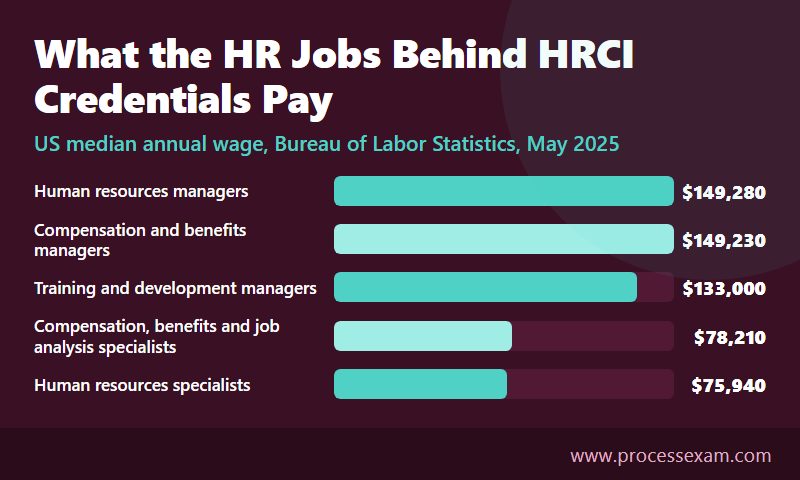
Two patterns matter more than any single figure. The first is the size of the step between running HR work and owning it: about $73,000 a year separates the median human resources manager from the median human resources specialist. That step, and not the letters after anyone's name, is where the money in this profession is. The second is that the specialist rungs are crowded and the manager rungs are not. Nearly 940,000 people work as human resources specialists; fewer than 225,000 are human resources managers, and only 23,700 manage compensation and benefits.
Where you work moves the same job title a long way as well. In the same May 2025 survey, human resources managers had a median of $170,590 in professional, scientific and technical services and $166,200 in management of companies and enterprises, against $128,650 in government and $126,900 in healthcare and social assistance. The spread between those five industries is wider than the price of any credential in this article.
On certification itself the Bureau is careful in a way that certification marketing rarely is. Its profile for human resources managers notes that although certification is voluntary, it shows professional expertise and credibility, and that it may enhance job opportunities. It attaches no figure to that, because none exists in its data. Read every number above as the price of a job, not the price of a credential.
Why can nobody tell you what an HRCI certification adds to your salary?
Because no current public study separates the pay of certified and uncertified people doing the same HR job. That sentence is worth more to you than any percentage you will read elsewhere, so it is worth showing the working.
The one piece of pay research HRCI itself hosts is a PayScale report on the market value of the PHR and SPHR. It is a real study, built on PayScale's database of self-reported salary profiles, and it found that certified HR professionals moved up faster and earned more than uncertified ones across industries and metropolitan areas. It also limited itself to data from March 2012 to March 2013. Its most durable finding is structural rather than financial: almost half of the HR vice presidents in the sample held a PHR or an SPHR, and the share of certified people rose at every step up the management ladder.
That tells you who holds these credentials. It does not tell you that the exam caused the salary. Senior people are more likely to be certified partly because HRCI's senior exams require years of senior experience before you may sit them, so the credential and the pay arrive from the same cause. HRCI's own current answer to the "is it worth it" question, published on its blog in October 2025, is a page of testimonials from certified professionals rather than a salary survey, which is a fair signal of what evidence exists.
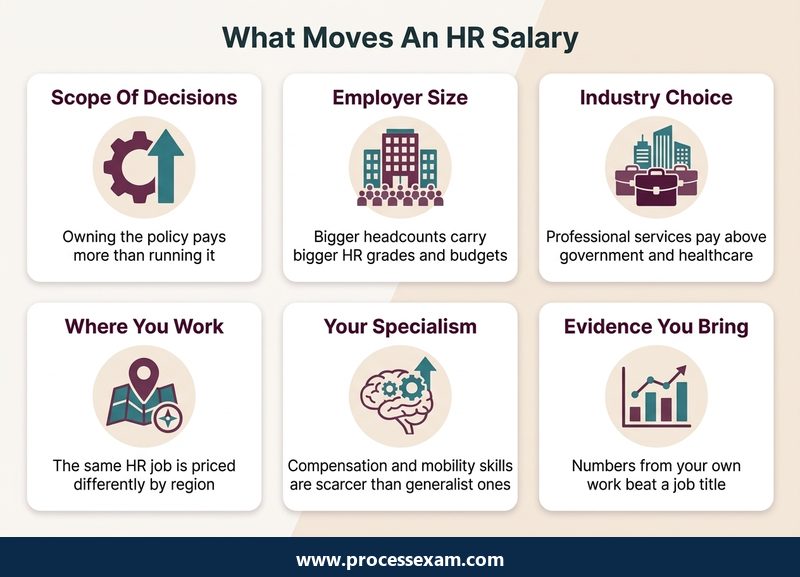
So treat an HRCI credential as leverage rather than as a raise with a percentage attached. It gets an application past a screening filter that names it. It gives a manager an external benchmark when arguing for your grade. It shortens the part of an interview where you have to prove that you understand classification, leave law or total rewards. What it will not do is move you from the specialist median to the manager median on its own, because the thing that moves you is being trusted to decide rather than to administer.
Which HRCI credential matches which of those jobs?
HRCI files its eight credentials in three tiers, and the tiers line up with the pay table above more neatly than the marketing does. Knowledge certifications are for people with no HR record yet. Professional certifications sit under specialist and generalist work. Strategic certifications sit under the manager and director roles where the medians jump.
| Credential | HRCI tier | Fees | Testing time | Credits to renew every three years |
|---|---|---|---|---|
| SPHR | Strategic Certification | Exam Fee: $495, Application Fee: $100 | 150 Minutes plus 30 minutes administration time | 45 HR plus 15 Business |
| SPHRi | Strategic Certification | Exam Fee: $495, Application Fee: $100 | 165 Minutes plus 30 minutes administration time | 45 HR plus 15 Business |
| GPHR | Strategic Certification | Exam Fee: $495, Application Fee: $100 | 135 Minutes plus 30 minutes administration time | 45 HR plus 15 Global |
| PHR | Professional Certification | Exam Fee: $395, Application Fee: $100 | 120 Minutes plus 30 minutes administration time | 60 HR |
| PHRi | Professional Certification | Exam Fee: $395, Application Fee: $100 | 135 Minutes plus 30 minutes administration time | 60 HR |
| PHRca | Professional Certification | Exam Fee: $395, Application Fee: $100 | 135 Minutes plus 30 minutes administration time | 45 HR plus 15 California |
| aPHR | Knowledge Certification | Exam Fee: $300, Application Fee: $100 | 105 Minutes plus 30 minutes administration time | 45 |
| aPHRi | Knowledge Certification | Exam Fee: $300, Application Fee: $100 | 105 Minutes plus 30 minutes administration time | 45 HR |
The renewal column is the one most people skip, and it is the one that tells you HRCI is pricing a three-year commitment rather than a single morning. Every figure in that table is HRCI's own, taken from its certifications overview and the individual credential pages, checked in September 2026.
The "i" versions are not lesser versions. They are the same tier written for HR practised outside United States employment law, which is why an HR manager in Dubai or Singapore is better served by SPHRi than by SPHR. PHRca is the opposite case, narrowing rather than widening the ground it covers.
What do the strategic exams ask before the pay follows?
This is the tier that sits above the $149,280 median, and HRCI guards it with experience rules rather than difficulty alone. For the SPHR you need four years in a professional-level HR role with a master's degree or higher, five years with a bachelor's degree, or seven years without one. The exam runs to 140 questions - 115 scored and 25 unscored pretest items - and HRCI reports the result as a scaled score with 500 to pass on a 100 to 700 scale.
The content tells you what the money is for. A third of the SPHR sits in Leadership and Strategy, and Talent Management takes another near-quarter; information management, safety and security together account for a tenth. This is an exam about deciding, budgeting and defending, which is precisely the difference between the two medians in the pay table.
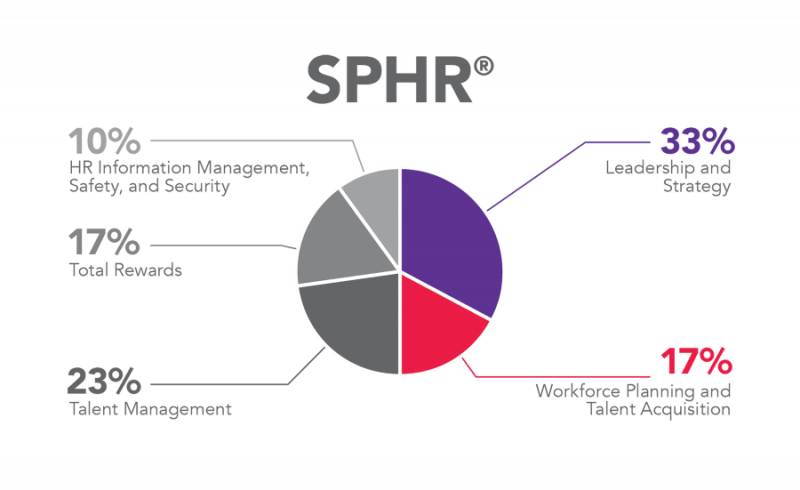
SPHRi is built on the same five functional areas in the same proportions, tested without United States employment law and over a longer 165-minute sitting. If your work spans several countries but sits inside one legal system at a time, that is the paper to hold.
The GPHR is the outlier, and the one HR credential whose subject matter maps onto a scarce skill rather than a senior grade. Eligibility is lighter than the SPHR - two years in a professional-level HR role with a master's degree, three with a bachelor's, or four with less than a bachelor's - but the syllabus is unusual. A quarter of it is strategic global HR, a fifth global talent management, and a further fifteen percent is global mobility, the practical business of moving an employee between tax and immigration systems and bringing them home again.
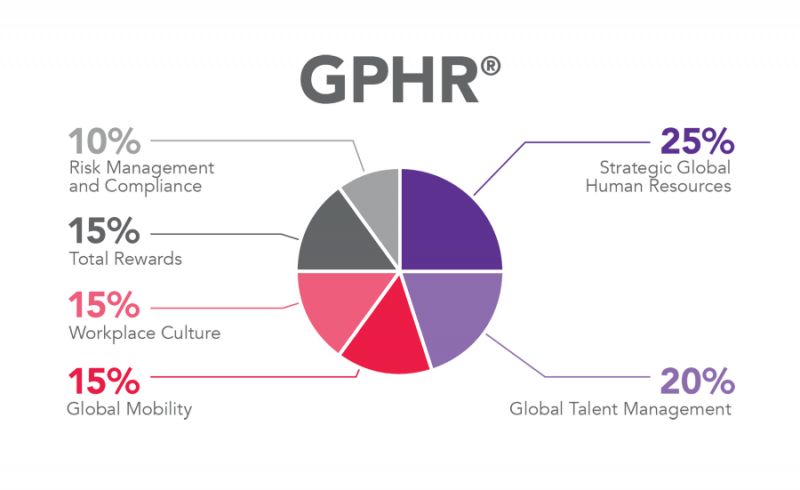
Scarcity is the argument here. Employers hiring for cross-border HR choose from a small pool, which is why "GPHR salary" is such a common search. The honest answer to it is that the pay belongs to the role, usually a human resources manager post with international scope, and the credential is what gets you shortlisted for that role. If the strategic tier is where you are aiming, a timed SPHR mock exam is the fastest way to find out whether your experience has already taught you two thirds of the syllabus or none of it.
Where do the professional and knowledge credentials fit a pay plan?
They fit at the point where you are trying to leave the crowded part of the table. The PHR asks for one year in a professional-level HR role with a master's degree, two years with a bachelor's, or four years without a degree, and tests 115 questions in two hours of testing time. Its 2024 content outline spreads the exam across seven functional areas, with employee and labour relations the heaviest at a fifth of the paper and employee engagement close behind.

PHRi carries the identical seven areas at identical weights for HR practised outside the United States, with fifteen minutes more testing time. If your employer is a multinational and your team works to one global policy set, the choice between them is a question of which body of law your daily decisions are made under, not of which one is harder.
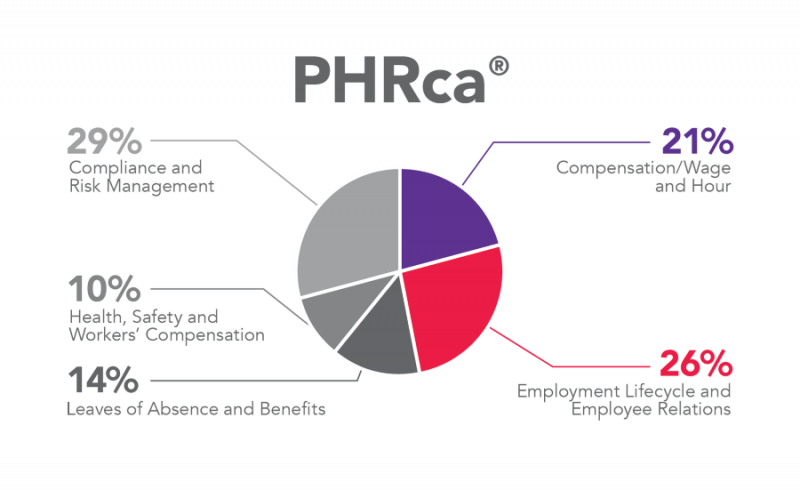
PHRca is the narrowest of the eight, and the only one built around a single state. All five of its areas are California-specific: compliance and risk management alone takes 29 percent, employment lifecycle and employee relations 26 percent, and compensation and wage-and-hour rules 21 percent. It exists because California wage, leave and classification rules diverge far enough from federal law to be examined on their own, not because HRCI publishes a pay premium for holding it.
At the entry end, the aPHR asks for no HR experience at all, which is exactly why it cannot carry a salary claim. It is 90 questions - 65 scored plus 25 pretest - in 105 minutes of testing time, weighted towards compliance and risk management and employee relations. Its job is to get a first application read, not to raise an offer. The aPHRi does the same work outside United States law and reorganises the syllabus around HR operations, which takes a third of that paper.
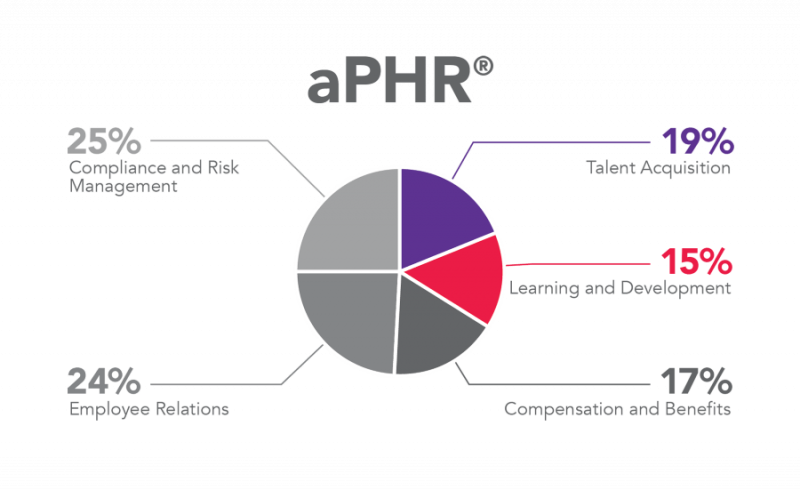
Every functional-area share quoted above comes from HRCI's published exam content outlines, checked in September 2026. They are revised periodically, so check the outline for your own credential before you build a study plan around any percentage.
What does it cost to hold an HRCI credential for three years?
More than the exam fee, and the difference is the part that catches people out. Every HRCI credential is valid for three years, and every one of them is renewed either by collecting recertification credits or by sitting the exam again.
- The application fee is separate and non-refundable. HRCI charges $100 to process an application on top of the exam fee, and states that once an application is approved no refunds are made.
- Renewal is 45 or 60 credits. The knowledge credentials need 45 over three years. The professional and strategic ones need 60, and in most cases 15 of those must come from a specific category: Business for SPHR and SPHRi, Global for GPHR, California for PHRca.
- Credits cost time or money or both. Conference sessions, courses, webinars and qualifying work projects all count, but nothing accumulates by itself. Fifteen specialist credits in three years is the requirement most people leave until the last six months.
- A failed attempt is a second exam fee. Budget for the possibility rather than assuming it away, particularly on the strategic exams, where the experience rules mean candidates often sit them while running a full workload.
Set against a manager median of $149,280, none of this is expensive. Set against an entry-level HR wage it is a real decision, and it is the reason the order in which you take these exams matters more than which of them is theoretically the most valuable.
How do you turn an HRCI credential into a higher offer?
By treating it as one piece of evidence in an argument you are making with several. The credential proves a standard of knowledge on a date. What pays is the work you can point at, and the credential is what makes a stranger believe your account of it.
Three habits do most of the work. Keep a running file of what you changed and what it was worth - the absence rate before and after the return-to-work process you rewrote, the days you cut from time-to-fill, the classification audit that closed an exposure. Write to the job, not to the certificate: an advert that names the PHR wants the credential and two years of the duties listed beneath it, and your application should answer both. And time the exam so that it lands before the conversation, not after it, because a credential in progress is worth nothing in a review meeting.
When you do sit down to negotiate, use the published medians rather than an invented uplift. Naming the occupation, the industry and the survey month makes the case checkable, and a checkable case is harder to refuse than an assertion about what certified professionals supposedly earn. If you are preparing for the exam that supports that conversation, work through a full-length PHR practice test under exam timing so the result tells you something about exam day rather than about your reading speed.
Which HRCI certification should you choose if pay is the goal?
Choose the one that matches the job you want to be doing in eighteen months, not the one with the biggest number attached to it in a listicle. In practice that resolves quickly.
- No HR record yet - aPHR, or aPHRi outside the United States. It buys you the first interview, and nothing beyond it.
- Professional-level HR work under United States law - PHR. It is the tier written for specialist and generalist duties, and the usual stepping stone to the strategic exams.
- The same work under another legal system - PHRi, for the same reason, without the federal law you will never apply.
- Any HR role touching California - PHRca, alongside whatever else you hold. It is the narrowest of the eight and the easiest to justify to an employer.
- Setting policy, budgets and headcount - SPHR, or SPHRi outside the United States. This is the tier that sits under the manager medians.
- Work that crosses borders - GPHR. Scarce skill, small pool of candidates, and the credential that explains what you do in one line.
Whichever you pick, hold on to the honest version of the argument: the pay belongs to the job, the job belongs to people who are trusted to decide, and the credential is how you shorten the time it takes someone to believe you are one of them.
Frequently Asked Questions
How much does HRCI certification cost?
HRCI charges a $100 application fee on top of the exam fee. The exam fee is $300 for aPHR and aPHRi, $395 for PHR, PHRi and PHRca, and $495 for SPHR, SPHRi and GPHR. Every credential then needs 45 or 60 recertification credits every three years, so budget for the renewal as well as the sitting.
What is the salary for a GPHR-certified HR professional?
No public survey reports pay for GPHR holders specifically. The Bureau of Labor Statistics measures the occupation instead, and puts the median for human resources managers at $149,280 a year in May 2025. Global HR roles usually sit in that occupation, so treat the figure as the role's median rather than the credential's.
Which HRCI certification pays the most?
The strategic tier sits under the best-paid jobs, so SPHR, SPHRi and GPHR are the credentials held by people earning most. That is because HRCI requires several years of senior experience before you may sit them, not because the exam itself raises pay. The experience and the salary arrive together.
What are the requirements for HRCI certification?
The aPHR and aPHRi need no HR experience. PHR, PHRi and PHRca need one year of professional-level HR work with a master's degree, two with a bachelor's, or four without a degree. SPHR and SPHRi need four, five or seven years on the same scale. GPHR needs two, three or four.
Is HRCI certification worth it if you are new to HR?
It is worth it for getting read rather than for getting paid. The aPHR requires no experience and answers job adverts that ask for a credential, which removes the most common reason an entry-level application is set aside. Expect it to open the door to the specialist pay band, not to lift you above it.
- HRCI HR Professional Exam Questions |
- HRCI HR Professional Question Bank |
- HRCI HR Professional Questions |
- HRCI HR Professional Study Guide |
- HRCI PHR Quiz |
- PHR Certification |
- PHR Questions |
- PHR Practice Test |
- PHR Study Guide Material |
- PHR Sample Exam |
- HR Professional Certification |
- HRCI HR Professional Book |
- HR Professional Certification Cost |
- HR Professional Certification Requirements |
- HRCI HR Professional Sample Questions |
- PHR Exam Questions Download |
- PHR Test Questions |
- HR Professional PDF |
- HRCI Professional in Human Resources


