
How to Become a Quality Technician: Skills and Certification
A quality technician checks that what leaves a factory matches its drawing and specification, and you can start in the job with a high school education and a sharp eye. Employers hire on care, measuring skill and honest record keeping. The ASQ Certified Quality Technician credential then proves that skill on paper. Read on for the daily work, the skills, the exam and the next steps. Our CQT practice exam is there once you decide to sit it.

What does a quality technician actually do all day?
Picture a machined bracket coming off a line at seven in the morning. Someone has to pull it, read the drawing, choose a gauge, measure four features, record the numbers and decide whether the lot moves on. That person is the quality technician. Some companies say quality inspector, quality control technician, tester or sampler; the core task is the same: compare the product with what the customer and the drawing asked for, and leave a record that anyone can follow later.
The work splits into a few repeating jobs.
Inspect and measure
Incoming material, work in progress and finished goods are all checked. In one plant that means hand tools and gauges; in another it means a coordinate measuring machine, an optical comparator or a torque tester. Some technicians look at every item, others pull a sample using a sampling plan and decide on the lot from it.
Record and interpret data
A measurement nobody writes down cannot be used. Technicians fill in check sheets, update control charts, keep calibration stickers current and log which lot each part came from. A supervisor or engineer reads those records to spot drift before it turns into scrap.
Deal with nonconforming product
When something fails, the technician tags it, moves it out of the flow and documents why. What happens next, rework, scrap, or a concession from the customer, is decided by a review process, but the first clear note usually comes from the technician.
Support audits and improvement
Technicians help with internal audits, answer customer complaints with measurement evidence and join problem-solving teams that use tools such as 5 Whys or a fishbone diagram. In lean plants they also help keep workplaces organised so that defects are easier to see.
The job sits between the machine operator and the quality engineer. You are closer to the product than an engineer and you see the numbers an operator does not have time to study. That is why it suits people who like practical work and also like to know why a result came out as it did.
Which skills get you hired as a quality technician?
Hiring managers rarely ask for a long list of theory. They ask whether you can pick up a micrometer, read a print, tell a good part from a bad one and say clearly what you found. The table below turns the usual skills into things you can show at an interview.
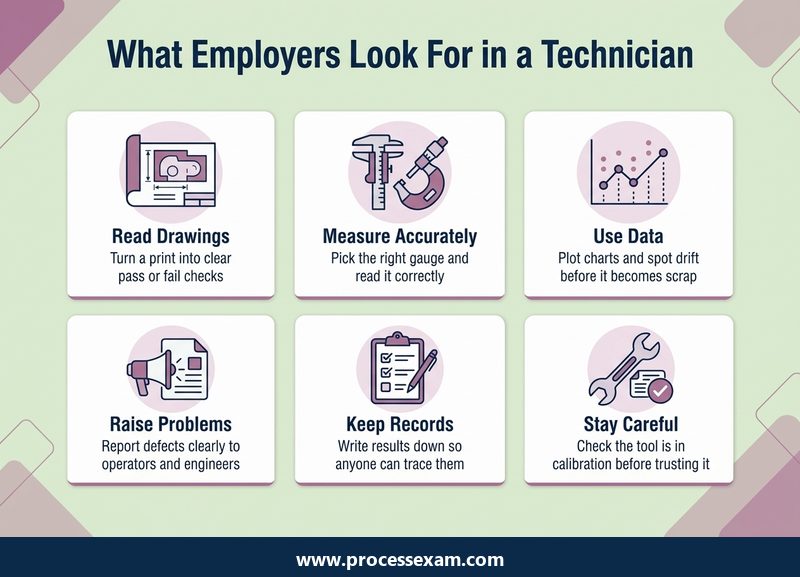
| Skill | What it looks like at work | How you can show it |
|---|---|---|
| Reading drawings | Finding the tolerance on a hole and knowing which datum it refers to | Bring a print you read and explain one feature on it |
| Measuring | Choosing calipers, a micrometer or a gauge block and reading it without parallax | Describe how you would check a shaft to plus or minus 0.02 mm |
| Basic statistics | Plotting a control chart and spotting a run of points on one side of the centre line | Explain the difference between a control limit and a specification limit |
| Documentation | Filling a check sheet in a way that the night shift can understand | Show a record you kept or a template you improved |
| Communication | Telling an operator that a part is out of tolerance without starting an argument | Tell a short story of a defect you raised and what changed |
| Attention to detail | Noticing that the gauge sticker expired last week | Give an example of a mistake you caught before it left your desk |
Nobody expects a beginner to hold all six. If you have to choose, pick measuring and documentation first, because employers can teach the rest on the job and cannot easily teach carefulness.
The soft side matters more than it looks
A technician who stops the line has to be believed. That trust comes from being consistent: measuring the same way every shift, writing results exactly as read and admitting when a gauge might be at fault. Technicians who do this become the people engineers ask for by name.
Numbers, but not advanced mathematics
You need comfortable arithmetic, unit conversion between metric and inch, rounding and a working grasp of averages and spread. The certification exam expects roughly a fifth of its questions to involve calculation, so it helps to be at ease with a basic calculator well before exam day.
Do you need a degree, or is experience enough?
Many technician jobs are open to people with a high school diploma or equivalent who show mechanical aptitude, and employers often train new hires on site. Trade-school or associate coursework in quality, manufacturing or metrology helps, but is rarely a hard requirement. Regulated industries such as medical devices or aerospace may ask for more, so read each advert closely.
The certification is different because ASQ sets its own entry rule. According to ASQ's Certified Quality Technician page, you need four years of paid work that touches at least one part of the exam outline, and holding another ASQ certification such as Quality Engineer or Quality Auditor also counts toward that time. Education can reduce the requirement, but only one waiver applies to a candidate:
- A community college or vocational quality technology programme: one year waived.
- An associate degree: two years waived.
- A bachelor's, master's or doctorate: three years waived.
So a graduate with one year of relevant paid work can apply, while a school leaver usually needs to work for a few years first. That is not a barrier to starting a career: it simply tells you that the job comes first and the credential follows.
How to get your first hands-on year
Look for entry roles such as inspector, receiving inspector, lab technician or production quality assistant. Ask whether the employer will teach you the gauges, the sampling plan and the calibration routine, and volunteer for calibration checks or audit support, because that experience maps directly onto the exam. Keep a simple log of the tasks you did, so you can describe your experience accurately when you apply.
What does the Certified Quality Technician credential prove, and what does it cost?
The ASQ Certified Quality Technician credential shows that you can apply inspection, measurement, sampling and problem-solving methods to real production work. It is written for people who do the checking, not for the engineers who design the quality system, so questions are practical: pick the gauge, read the chart, decide what to do with the lot.
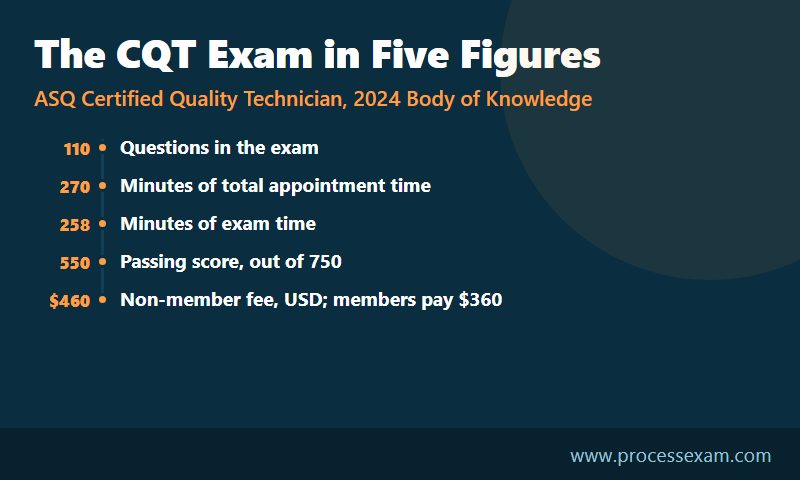
| Item | Detail |
|---|---|
| Exam | ASQ Certified Quality Technician (CQT) |
| Body of Knowledge in force | 2024 edition (checked on asq.org in September 2026) |
| Questions | 110 |
| Time | Total appointment time 270 minutes; exam time 258 minutes |
| Passing score | 550 out of 750 |
| Fee, ASQ members | $360 |
| Fee, non-members | $460 |
| Retake fee | $260 |
| Language | English only |
| Open book | Yes, with permanently bound reference material |
The passing score is quoted on a 750-point scale, so treat 550 as a scaled result and not as a count of questions. That is a good reason to prepare across the whole Body of Knowledge instead of trying to calculate how many questions you can afford to miss.
Is the certification worth the fee?
If you are early in your career, the credential is a way to stand out among applicants with similar experience. If you are already established, it can support a move to lead technician, calibration technician or supplier quality roles, because it shows that your knowledge reaches beyond the one product you know. It will not replace experience, and no exam can promise a raise, so treat it as evidence, not a guarantee.
Before paying, add up the total cost: the exam fee, a copy of the handbook or a course if you want one, bound reference material and the practice you do. Members of ASQ pay $100 less than non-members on the initial exam, which is worth working out if you would join anyway.
What do the six areas of the 2024 Body of Knowledge ask?
ASQ publishes the exam blueprint as a Body of Knowledge, and the version in force in September 2026 is the 2024 edition. It lists six areas, each with a question count, and states the highest level of thinking that a topic is tested at, from remember and understand up to analyze and evaluate. The counts below add up to 100; the computer-based exam is listed at 110 questions, so use the counts as a guide to proportion rather than an exact split. The full outline is in the ASQ 2024 CQT Body of Knowledge, and our syllabus page walks through the same topics.
| Area | Questions listed | Where you meet it at work |
|---|---|---|
| Quality Concepts and Tools | 19 | Cost of quality, the seven basic tools, problem solving |
| Statistical Techniques | 17 | Control charts and process capability |
| Metrology and Calibration | 16 | Choosing, controlling and calibrating gauges |
| Inspection and Test | 21 | Drawings, sampling, nonconforming material |
| Quality Audits | 13 | Audit types, steps and tools |
| Risk Management | 14 | FMEA, corrective and preventive action |
Quality Concepts and Tools (19 questions)
This area covers internal and external customers and suppliers, quality principles for products and processes, standards and specifications, and the four categories of cost of quality: prevention, appraisal, internal failure and external failure. It also asks you to select, build and read the seven basic tools: cause and effect diagrams, flowcharts, check sheets, Pareto charts, scatter diagrams, control charts and histograms. Problem-solving methods such as 5 Whys and 8D, lean ideas such as 5S and value-stream mapping, continuous improvement cycles and the ASQ Code of Ethics complete it. The seven tools are tested at the highest level in the outline, so learn to interpret them, not just name them.
Statistical Techniques (17 questions)
Expect terminology such as population, sample and parameter, the normal distribution, mean, median, mode, standard deviation, range and variance, and confidence limits. Control charts take the largest share: control versus specification limits, variables charts such as individuals and moving range, X-bar and R, and X-bar and s, attributes charts such as p, np, c and u, capability indices such as Cp and Cpk, and the difference between common and special cause variation. Most topics here are tested at the analyze level, so practise reading a chart and stating what to do next.
Metrology and Calibration (16 questions)
You should be able to describe the main families of measuring equipment: hand tools, gauges, optical tools, coordinate measuring machines, electronic equipment, balances, surface plates, surface analyzers and force tools. Then come identification and control of equipment for traceability, customer-supplied equipment, calibration intervals based on usage and risk, how to interpret calibration results, the causes of calibration error and the hierarchy of standards from reference to transfer.
Inspection and Test (21 questions)
This is the largest area and the heart of the job. It includes reading drawings and applying geometric dimensioning and tolerancing from the ASME Y14.5 standard, classifying defects as critical, major or minor, and choosing the right kind of measurement and gauge. Measurement system analysis, including gauge repeatability and reproducibility, rounding rules, unit conversion, inspection points from receiving to final, inspection error, traceability and certificates of compliance also sit here. Sampling adds lot size, acceptance numbers, sampling types and how to pick a sample size. Finally, the material review process covers what to do with nonconforming product.
Quality Audits (13 questions)
The smallest area covers audit types and terminology, including first-, second- and third-party audits, audit components from scope and plan to opening and closing meetings, and audit tools such as checklists, objective evidence, tracing and sampling. It is tested mostly at the understand and apply levels, so precise definitions and order of steps carry the marks.
Risk Management (14 questions)
Here you meet trend analysis, failure mode and effects analysis (both process and design versions), root cause analysis, control plans and monitoring reports as inputs to risk assessment. Corrective action follows the sequence of identify, contain, find the cause, propose a permanent fix, verify and validate. Preventive action asks how to spot potential failures before they occur and to select ways to prevent them, such as error-proofing.
How do you prepare for an open-book, 110-question exam?
An open book is a help only if you can find things quickly. ASQ wants books that are firmly bound or held inside a cover with fasteners, so loose sheets are out. The calculator rule is also strict: a silent, hand-held, battery-operated model without programmable memory is permitted, and programmable models such as the TI-89 are not. Check both on the ASQ page before you pack.
A six-week plan that fits a working technician
| Week | Focus | What to produce |
|---|---|---|
| 1 | Read the 2024 outline end to end; rate each topic red, amber or green | A one-page gap list |
| 2 | Inspection and Test: drawings, GD&T, sampling, nonconforming material | Worked sampling examples in your own notes |
| 3 | Metrology and Calibration, then measurement system analysis | A gauge selection cheat table |
| 4 | Statistical Techniques: build control charts by hand and with a calculator | Formulas tabbed in your reference book |
| 5 | Quality Concepts and Tools, Audits and Risk Management | A step-order sheet for audits, 8D and corrective action |
| 6 | Two timed full-length practice sets; fix only weak spots | Final tabbed reference book |
Adjust the weeks to what you already do. A calibration technician may spend a day on metrology and three on statistics; a lab person may do the opposite. When you are ready to test yourself under time, work through a set of scenario questions such as the ones in a practice exam, then review every miss until you can explain why the right answer is right.
Build the reference book as you study
Do not spend the last week creating a reference from scratch. Tab each Body of Knowledge area as you study it, and add the formulas, a cause-and-effect template, the audit steps, an 8D outline and the sampling terms you found hard. Keep it thin enough to find an answer in ten seconds: a book you have to search for a minute per question costs you the exam.
Practise the calculation questions separately
Around one question in five needs a calculation. Set aside short sessions that do only calculation: process capability, sample size from a plan, unit conversion, rounding and control limits. Write out every step until they are automatic, because under time pressure the mistake is usually arithmetic, not concept.
What trips up technicians who know the job well?
Experienced technicians tend to lose points in predictable ways, and almost all are about habit, not knowledge.
- Answering from your own plant. Your site may skip a step that the standard requires. The exam answers from the Body of Knowledge, not from how your line runs.
- Confusing control limits with specification limits. One comes from the process, the other from the customer. Mixing them is the most common statistics slip.
- Rounding too early. Carry extra digits through a calculation and round at the end, unless the question tells you otherwise.
- Skipping the audit and risk sections. They are smaller, but together they are over a quarter of the listed questions, and many technicians spend less time on them.
- Reading the question stem too fast. Words such as first, best and except change the answer.
- Losing time in the book. If a question needs more than about two minutes, flag it and move on. With 258 minutes for 110 questions you have a little over two minutes each, so pace matters more than you expect.
On the day
Plan to arrive early with acceptable identification, your bound references and an approved calculator. Read each stem slowly, answer what you know first, and return to flagged items at the end. If you are applying for the first time, use ASQ's application page to submit your experience and choose your testing route, and do this well ahead of the date you want.
Where can a quality technician go after the CQT?
The credential opens more than one route, and it is worth deciding early which one you want.
Stay technical and go deeper
Lead technician, calibration specialist, CMM programmer and metrology lab roles reward the exact skills in the Metrology and Inspection areas. Your CQT tells an employer that your measurement knowledge is broad and your reading of standards is sound.
Move toward improvement and engineering
Technicians who like charts and problem solving often move to process improvement or supplier quality, where the seven tools, control charts and corrective action are daily work. Further ASQ certifications, such as Quality Engineer, are a natural next step once you have the experience and study time for them.
Move toward auditing
The audit and risk areas of the outline give you a taste of it. Internal auditors are often drawn from the shop floor because they know how work is really done.
Automation is changing the job, because machines now measure more parts in less time. That raises the value of people who can decide what the data means, set up and verify the measuring system and investigate the cause of a trend, which is the part of the work a machine does not do for you. If you keep learning and record what you achieve, the role gives you a clear ladder rather than a dead end.
Check the current recertification rule on ASQ's page before you sit the exam, so you know from the start what keeping the credential will ask of you.
Frequently Asked Questions
How do I become a quality technician?
Most people start in an inspector or lab assistant job with a high school diploma, learn gauges, drawings and record keeping on site, and add coursework or a certification later. Employers look for care, measuring skill and clear documentation more than for a specific degree.
What skills does a quality technician need?
Core skills are reading drawings, using measuring tools correctly, basic statistics such as control charts, accurate record keeping and clear communication. Attention to detail matters most, because a missed defect or an unrecorded result can cost far more than the time saved.
Do I need a certification to work as a quality technician?
No, many technicians are hired without one. A credential such as the ASQ Certified Quality Technician is optional but can help you stand out, and it needs four years of paid work experience, with education waivers of one to three years available to some candidates.
How much does the ASQ Certified Quality Technician exam cost?
The exam costs $360 for ASQ members and $460 for non-members, and a retake is $260. It has 110 questions and a total appointment time of 270 minutes, with 258 minutes of exam time and a passing score of 550 out of 750.
Is the Certified Quality Technician exam open book?
Yes. ASQ lets you bring firmly bound reference books and a quiet, battery-powered calculator that has no programmable memory. Loose notes and programmable calculators such as the TI-89 are not allowed, so prepare your reference book carefully.
- ASQ Quality Technician Test Questions |
- CQT Question Bank |
- CQT Body of Knowledge (BOK) |
- ASQ Quality Technician Book |
- ASQ CQT BOK PDF |
- Quality Technician Certification Cost |
- Quality Technician Certification Requirements |
- ASQ Quality Technician Sample Questions |
- CQT Exam Questions Download |
- CQT Test Questions |
- Quality Technician PDF |
- Technician |
- CQT Handbook


