
How to Get PRINCE2 Foundation Certification (Version 7)
You take over a project that is already in trouble: the money is mostly spent, the sponsor has stopped coming to meetings, and nobody can show you who approved the last three changes. PRINCE2 is built to stop a project reaching that point. To be certified in it, you pass PeopleCert's PRINCE2 Foundation (Version 7) exam: 60 multiple-choice questions in 60 minutes, closed book, 60% to pass, and no prerequisites.

This guide starts with the failing project, because that is the fastest way to see why the method is shaped the way it is. It then covers how PRINCE2 certification works, what the seventh edition changed, how the Foundation exam is run, the order in which to study, the terms that trip people up, how renewal works now, and where Foundation fits beside Practitioner and PMP.
What would PRINCE2 have caught on a project that was already failing?
Go back to the project you inherited and ask a simple question at each point where it went wrong: which part of PRINCE2 would have raised a hand? The answers map almost one for one onto what the Foundation exam tests.
The business case nobody reopened
Most failing projects were justified once, at the start, and never again. The costs grew, the expected benefits shrank, and the project kept going because stopping felt like admitting a mistake. PRINCE2's first principle, continued business justification, requires the business case to be checked at every stage end. If the case no longer holds, the project board changes it or closes the project. A project that is allowed to die early is a PRINCE2 success, not a failure.
The sponsor who drifted away
On a PRINCE2 project the sponsor is not an informal supporter. The Executive sits on the project board, owns the business case and is the single point of accountability for the project. The Senior User speaks for the people who will use the products, and the Senior Supplier for the people who build them. When those three chairs are filled by named people with written responsibilities, a sponsor cannot quietly disappear without it becoming a visible gap.
The changes nobody could trace
Untraceable change is usually a sign that there was no agreed baseline and no route for requests. PRINCE2 records every request for change, off-specification and problem as an issue, assesses its impact, and sends it to whoever holds the authority to decide. The issue register and the project's agreed way of handling issues make the trail visible, so a new project manager can see who approved what and why.
The overspend that surfaced too late
A project manager on a PRINCE2 project works inside tolerances: an agreed plus-or-minus on targets such as time and cost. As soon as a stage is forecast to go outside its tolerance, the project manager raises an exception report and the board decides what happens next. That is management by exception. It keeps senior people out of day-to-day detail while making sure they hear about a real problem the week it appears, not the month after.
The "nearly finished" deliverables
A project that reports being 90% done for months usually never defined what "done" meant. PRINCE2 insists on product descriptions with quality criteria written before the work starts, which is the focus on products principle. A product is either accepted against its criteria or it is not, and progress is measured in accepted products rather than hours spent.
None of this needs heroics. It needs a small set of rules applied consistently, and that is exactly what the PRINCE2 Foundation certificate says you know.
How do you get PRINCE2 certification, starting with Foundation?
PRINCE2 certification has two main levels for project management, both examined by PeopleCert, which acquired AXELOS and now owns and examines PRINCE2.
- PRINCE2 Foundation shows you understand the method well enough to work on a PRINCE2 project: the principles, the people element, the practices, the processes, the roles and the main management products. It has no prerequisites.
- PRINCE2 Practitioner shows you can apply and tailor the method to a scenario. It is a longer, open-book exam and it has prerequisites; PRINCE2 Foundation is the usual way to meet them.
The path to a Foundation certificate is short and has four steps:
- Choose how to prepare. PeopleCert sells exam bundles with the official eBook and eLearning, and accredited training organisations run instructor-led courses. Self-study with the manual also works if you are disciplined.
- Learn the method in a sensible order (the study order is set out below).
- Book the exam. PeopleCert delivers it as a web-based exam with an online proctor, so you can take it at home or at work if your room and computer meet the requirements.
- Sit and pass. You need 60% of the 60 questions, which means 36 correct answers.
Search results for "PRINCE2 certification" mix these two levels with PRINCE2 Agile and older editions. If you are starting out, the one you want is PRINCE2 Project Management Foundation (Version 7). Everything below refers to that exam.
What is in PRINCE2 7, and why do older guides still say "themes"?
PRINCE2 has been revised several times since it was first published. The seventh edition replaced the sixth (2017) edition, and plenty of books, blog posts and question banks still describe the sixth. If a study source talks about "the seven themes", "the change theme" or "the organization theme", it is teaching the previous edition's vocabulary. The exam you will sit uses the seventh edition's terms.
PRINCE2 7 is organised around five integrated elements: principles, people, practices, processes and the project context. PeopleCert's own description of the Foundation course names the principles, practices, processes, roles and responsibilities, and tailoring, and it highlights two additions in Version 7: a people element, and the integration of sustainability into project performance.
The seven principles
The principles are the non-negotiable part of the method. A project that ignores any one of them is not a PRINCE2 project, however many PRINCE2 documents it produces.
- Ensure continued business justification: there must be a valid reason to carry on at every point.
- Learn from experience: lessons are sought at the start, recorded during the project and passed on at the end.
- Define roles, responsibilities and relationships: everyone knows who decides, who does and who is consulted, and the working relationships are planned rather than assumed.
- Manage by stages: the project is planned, monitored and controlled one management stage at a time.
- Manage by exception: tolerances are delegated down, and only forecast breaches come back up.
- Focus on products: the scope is defined as products with quality criteria.
- Tailor to suit the project: the method is adapted to the project's size, complexity, risk and environment.
The seven practices (the old themes)
In PRINCE2 7 the aspects of project management that must be handled continuously are called practices. Two of the names changed from the sixth edition, which is where older material causes confusion.
| PRINCE2 7 practice | Sixth-edition theme | What it answers |
|---|---|---|
| Business case | Business case | Why are we doing this, and is it still worth it? |
| Organizing | Organization | Who is responsible for what? |
| Plans | Plans | How, how much and when? |
| Quality | Quality | What does "fit for purpose" mean for each product? |
| Risk | Risk | What might happen, and what will we do about it? |
| Issues | Change | How are requests, problems and off-specifications handled? |
| Progress | Progress | Where are we, and should we continue? |
The seven processes
The processes describe who does what, and when, from the first idea to closure. Directing a project is the project board's process and runs from start to finish; the other six follow the project's life.
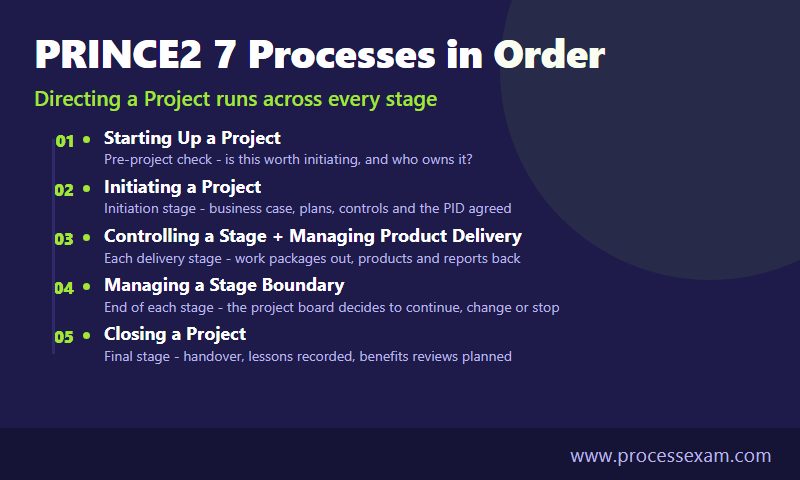
- Starting up a project: a short pre-project check that the idea is viable and worth initiating, with the Executive and project manager appointed.
- Directing a project: how the project board authorises initiation, each stage and closure, and gives ad hoc direction.
- Initiating a project: building the project initiation documentation (PID), including the business case, project plan and the management approaches.
- Controlling a stage: the project manager's day-to-day work of authorising work packages, tracking progress and handling issues and risks.
- Managing product delivery: the team manager's side of the work package agreement: accept it, build the products, deliver them.
- Managing a stage boundary: reporting on the stage just finished, planning the next one and updating the business case so the board can decide.
- Closing a project: confirming acceptance, handing over, evaluating the project and making sure benefits reviews are planned.
People and project context
The people element is new in the seventh edition. It deals with leading and working with people: the relationships inside the project team, with the business, with suppliers and with the users whose work will change. The project context covers the environment the project sits in, such as whether it is run by a single organisation or several, and which delivery approach the work suits. Both appear in the Foundation exam, usually in questions about tailoring and roles rather than as memorised lists.
Sixty questions in sixty minutes: how is the Foundation exam run?
The exam is short and it rewards clear recall. Here are the facts in one place. The first rows are ProcessExam's exam record for this certification; the rows marked PeopleCert come from PeopleCert's PRINCE2 Foundation (Version 7) page, checked in September 2026.
| Exam detail | PRINCE2 Foundation |
|---|---|
| Exam name | PRINCE2 Project Management Foundation (Version 7) |
| Exam code | PRINCE2 Foundation |
| Certification | PeopleCert PRINCE2 Foundation Certified - Project Management |
| Vendor | PeopleCert |
| Number of questions | 60 |
| Duration | 60 minutes |
| Passing score | 60% (36 of 60) |
| Exam price | USD 338 |
| Question type (PeopleCert) | Multiple choice, closed book |
| Delivery (PeopleCert) | Web-based exam with an online proctor |
| Languages (PeopleCert) | 14, including English, Chinese, Dutch, French, German, Japanese, Polish, Brazilian Portuguese and Spanish |
| Renewal (PeopleCert) | Every 3 years; 60 CPD points |
A minute per question sounds tight, but most Foundation questions are one or two lines long. Time pressure rarely comes from slow reading; it comes from reading each question twice because the PRINCE2 terms still feel unfamiliar. That is why the study order below puts terms before practice.
Two features of the question style are worth knowing in advance. First, many questions test which role or process owns something, so "who" matters as much as "what". Second, some questions use a negative stem ("which is NOT a purpose of..."); underline the NOT in your head before you look at the options. PeopleCert reports official results in two business days.
Price varies by how you buy. The figure above is the exam alone; PeopleCert and training organisations also sell bundles that add the eBook, eLearning or a mock exam, and prices in local currency may differ. Check the current options on PeopleCert's page before you book.
Which study order makes the PRINCE2 method stick?
PRINCE2 is easiest to learn from the outside in: first the reasons, then the people, then the rules, then the sequence. Candidates who start with the processes tend to memorise a list of activities they cannot connect to anything. The order below takes most people between three and five weeks at an hour a day; a classroom course compresses it into a few days.
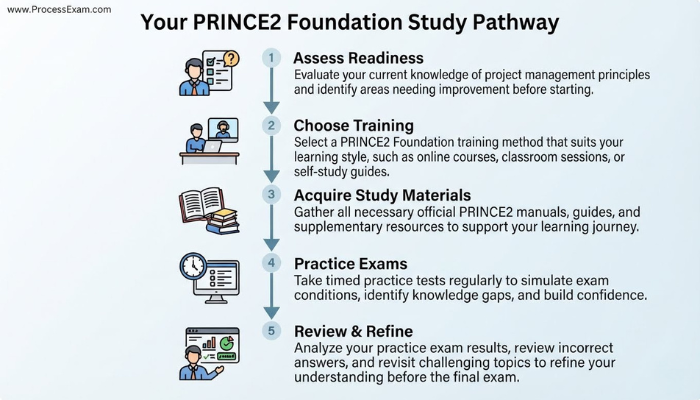
Week 1: principles and roles
Learn the seven principles until you can explain each one with an example from a project you know. Then learn the roles: Executive, Senior User, Senior Supplier, project manager, team manager, project assurance, change authority and project support. For each role, write one sentence on what it decides and one on what it does not decide. Most "who" questions come straight from this list.
Week 2: the practices
Take one practice a day. For each, note its purpose, the management products it uses and the PRINCE2 minimum requirements. Pay special attention to business case (outputs, outcomes, benefits and dis-benefits), issues (the types of issue and how each is handled) and progress (tolerances, the reports that flow up, and exception handling).
Week 3: processes and management products
Now the processes make sense, because you know who is acting and why. Walk through a whole project on paper: starting up, initiating, one delivery stage, a stage boundary and closure. At each step, note which management products are created or updated, such as the project brief, the PID, work packages, highlight reports, end stage reports and the end project report.
Week 4: practice under the clock
This is the week to test yourself. Start with short sets of questions sorted by topic, then move to full 60-question papers in 60 minutes. PeopleCert sells its own PRINCE2 mock exams, and PRINCE2 7 training packages often include sample papers. For extra question volume, our PRINCE2 Foundation practice test follows the Version 7 exam's 60-question, 60-minute format, so each attempt tells you whether you would have reached the 36 correct answers you need. Keep an error log: note the topic of every wrong or guessed answer and go back to the manual for those topics, not to more questions.
Check every source against the edition
Before you trust any book, video or question set, look for the words "themes" and "change theme". If you find them, the material was written for the sixth edition. The underlying ideas are close, but the exam uses the seventh edition's terms, and an answer option that uses the right idea with the old name can still be the wrong option.
Which PRINCE2 terms trip candidates up on exam day?
PRINCE2 Foundation questions often hinge on the difference between two terms that sound interchangeable in ordinary work. These are the pairs worth drilling until the distinction is automatic.
| Often confused | The distinction the exam tests |
|---|---|
| Executive / Senior User | The Executive owns the business case and is ultimately accountable; the Senior User specifies needs and confirms the products deliver the expected benefits. |
| Output / outcome / benefit | An output is the product delivered; an outcome is the result of using it; a benefit is the measurable improvement someone values. |
| Highlight report / exception report | A highlight report is the regular progress update to the board; an exception report goes up only when tolerance is forecast to be exceeded. |
| Tolerance / contingency | Tolerance is the permitted deviation from a target before escalation; contingency is money or time set aside for specific risks. |
| Project assurance / quality assurance | Project assurance works for the project board, checking the project on its behalf; quality assurance is independent of the project and belongs to the wider organisation. |
| Management stage / delivery work | Management stages are the board's decision points; the specialist work inside them can run in its own cycles, such as sprints, that need not line up with stage boundaries. |
| Issue / risk | A risk is uncertain and has not happened yet; an issue has happened, or is a request that needs a decision now. |
A few other habits cost marks:
- Answering from your own company's practice. The exam asks what PRINCE2 says, not what your organisation does. When your experience and the manual disagree, the manual wins.
- Assuming the project manager decides. In PRINCE2 the project manager runs the project day to day, but the board authorises stages, tolerances and closure. Questions that ask who "approves" or "authorises" rarely have the project manager as the answer.
- Treating tailoring as dropping things. Tailoring adapts the practices and processes to the project; the principles are never tailored away.
- Leaving the last ten minutes empty. There is no penalty for a wrong answer, so never leave a question blank. Flag the hard ones, finish a first pass, then return.
Does PRINCE2 Foundation expire, and how do you keep it current?
This is one of the most searched questions about the certificate, and the answer has changed. Older articles, including earlier versions of this one, said the Foundation certificate was valid for life. That is not how PeopleCert presents the Version 7 certification today. PeopleCert's Foundation page, checked in September 2026, states certification renewal every three years, with 60 CPD points needed for renewal.
PeopleCert describes two ways to keep a certification current:
- PeopleCert Membership: log continuing professional development (CPD) points through PeopleCert's membership programme during the three-year period.
- Another course in the same product suite: complete a different course from the same suite and pass its exam before your renewal date. For a Foundation holder, the obvious candidate is PRINCE2 Practitioner.
CPD points can come from the work many project professionals already do: training, reading, webinars, mentoring and applying the method on real projects. The practical advice is to record them as you go rather than trying to reconstruct three years of activity just before the renewal date.
What if you hold an older PRINCE2 certificate? A certificate you earned is still a record that you passed that exam. But employers and clients increasingly ask for the current edition, and question banks and courses now teach Version 7. If your certificate is from the sixth edition or earlier, check PeopleCert's current options before deciding whether to move to Version 7 through Foundation, Practitioner or renewal.
Foundation, Practitioner or PMP: which PRINCE2 route fits your career?
PRINCE2 Foundation is an entry point, and the right next step depends on the work you do and where you do it.
When Foundation alone is enough
If you work on PRINCE2 projects rather than run them, Foundation is often all a role asks for. Project support officers, PMO analysts, project coordinators, team managers and business analysts use it to understand the documents they receive, the reports they write and the decisions they are waiting for. It is also a sensible first qualification for anyone moving into project work from operations, engineering or IT, because it teaches a shared vocabulary quickly.
When to go on to Practitioner
If you manage projects, or want to, Practitioner is the level employers usually mean when they ask for "PRINCE2 qualified". PeopleCert's PRINCE2 Practitioner (Version 7) page describes it as an objective-testing exam of 150 minutes, open book, with 60% needed to pass, and it lists the prerequisites you must hold before your results are released. Foundation is the usual route; check the page for the other qualifications PeopleCert accepts. Practitioner tests application: you are given a scenario and asked how the method should be applied and tailored, which is why most people sit it soon after Foundation while the terms are fresh.
How PRINCE2 compares with PMP
The two are complements rather than rivals. PRINCE2 is a method: it tells you how a project should be directed, managed and delivered, and who is responsible for each part. PMI's PMP certifies experienced project managers against a broader body of practice and requires documented project experience before you can sit it. PRINCE2 Foundation requires no experience at all.
Geography matters as well. PRINCE2 began in UK government and is widely used in the UK, Europe, Australia and many other countries, especially in the public sector and in organisations that work with it. In the United States, PMP is the credential job adverts name most often, although PRINCE2 appears in roles with UK or European links and in organisations that have adopted the method. Look at the job adverts in your own market before choosing: if they say "PRINCE2 Practitioner", the path is clear; if they say "PMP", Foundation is still useful background but should not be your only credential.
Other PeopleCert certifications that pair with it
PeopleCert examines several frameworks that sit well beside PRINCE2, including PRINCE2 Agile for teams that combine the method with agile delivery, and service management qualifications for people whose projects hand over into live operations. You can see the range of PeopleCert certifications we cover if you are planning a longer route.
Whichever way you go, the value of Foundation is the same one the failing project showed at the start: it gives you the questions to ask before a project goes wrong, and the vocabulary to ask them in a way a project board will act on.
Frequently Asked Questions
How do you get PRINCE2 certification?
Start with PeopleCert's PRINCE2 Foundation (Version 7) exam, which has no prerequisites. Prepare through self-study, eLearning or an accredited course, book the online proctored exam, and score at least 60% on the 60 questions. Project managers usually continue to PRINCE2 Practitioner, which tests applying and tailoring the method to a scenario.
Does PRINCE2 Foundation expire?
PeopleCert's Foundation (Version 7) page, checked in September 2026, states certification renewal every three years with 60 CPD points. You can keep it current through PeopleCert Membership by logging CPD, or by passing a different exam from the same product suite, such as PRINCE2 Practitioner, before your renewal date.
How much does the PRINCE2 Foundation exam cost?
The PRINCE2 Foundation exam price is USD 338. PeopleCert and accredited training organisations also sell bundles that add the eBook, eLearning or a mock exam, and local-currency prices can differ, so compare the options on PeopleCert's PRINCE2 Foundation page before you book the exam.
Can you take the PRINCE2 Foundation exam online?
Yes. PeopleCert delivers PRINCE2 Foundation as a web-based exam with an online proctor, so you can sit it at home or at work. Your room, webcam and connection must meet PeopleCert's online proctoring requirements. It is closed book, 60 questions in 60 minutes, in 14 languages.
What is the difference between PRINCE2 Foundation and Practitioner?
Foundation tests whether you know the PRINCE2 method: principles, people, practices, processes and roles. Practitioner tests whether you can apply and tailor it to a scenario. Foundation is closed book with no prerequisites; Practitioner is a 150-minute open-book exam, and PeopleCert requires a recognised prerequisite, usually Foundation.
- Project Management |
- PRINCE2 Foundation Question Bank |
- PRINCE2 Foundation Exam Questions Download |
- PRINCE2 Foundation Test Questions |
- PRINCE2 7 Foundation Simulator |
- PRINCE2 7 Foundation Mock Exam |
- PRINCE2 7 Foundation Certification Cost |
- PRINCE2 7 Foundation Certification Requirements |
- PRINCE2 7 Foundation PDF |
- PeopleCert PRINCE2 7 Foundation Test Questions |
- PeopleCert PRINCE2 7 Foundation Book |
- PeopleCert PRINCE2 7 Foundation Sample Questions


