
How to Get PHR Certification: Eligibility, Cost and Exam Format
Updated on 21 September 2026. What’s new: updated for HRCI's 2024 PHR content outline, with the current 115-question, 120-minute exam format.
You are two years into an HR coordinator job, the PHR keeps turning up on adverts for the role above yours, and you are wondering whether it is too soon. For many coordinators it is not. With a bachelor's degree and two years of professional-level HR work, HRCI's Professional in Human Resources is open to you today. The real question is whether your two years count as professional-level, and that is where this guide starts.
The PHR is HRCI's credential for people who run HR programmes and keep day-to-day operations working, grounded in United States employment law. It is not a qualification for people who have never done HR work, and it is not a leadership credential either. It sits exactly where a coordinator who has started making decisions of their own is heading. Below you will find the degree-and-experience routes, what the whole process costs, what the exam looks like, how HRCI scores it, and a way to prepare that fits someone still early in the profession.
Is two years in HR enough to sit the PHR?
It can be. HRCI sets three routes to eligibility on its PHR certification page, and you only need to meet one of them. Each route trades formal education against time spent in a professional-level HR role:
| Highest education | Professional-level HR experience needed |
|---|---|
| Master's degree or higher | At least one year |
| Bachelor's degree | At least two years |
| No degree requirement | At least four years |
So the coordinator in our opening, holding a bachelor's degree and two years in post, sits exactly on the line of the middle route. A colleague who finished a master's before joining the team would have qualified after twelve months. Someone who came into HR without a degree needs four years, and there is no shortcut around that. The degree does not have to be in human resources, either: HRCI's frequently asked questions confirm that any college degree counts toward the education side, although a business or HR background can make some content areas feel more familiar on the day.
Notice what the table does not ask for. There is no minimum age, no requirement to hold another credential first, and no need to be a member of any association. The whole gate is education plus a count of professional-level months, which is why the definition of professional-level matters more than anything else in the application.
What does HRCI count as professional-level HR work?
This is the part that decides most coordinators' applications. HRCI explains on its page about understanding professional-level experience that a qualifying HR position involves five things:
- using independent judgement and discretion in how you do the work;
- specialised HR knowledge, with some authority to make decisions;
- in-depth work such as gathering, analysing and interpreting data;
- dealing with a broad range of people, including key personnel;
- being individually accountable for results.
HRCI is equally direct about who is unlikely to qualify: people managers whose main job sits in a function other than HR, entry-level HR practitioners such as HR clerks and HR assistants, and people who are interested in moving into HR but have not yet made the move.
Read those two lists against your own diary. A coordinator who schedules interviews that a recruiter has already chosen, files onboarding paperwork and updates records when told to is doing valuable support work, but it is hard to call it independent judgement. A coordinator who screens applicants against criteria they helped set, advises a line manager on how to handle a late-arriving employee, builds the monthly attrition report and explains what it shows, and owns the onboarding programme from start to finish is doing professional-level work, whatever the job title says.
Most real jobs are a mixture, and most careers change shape over the first few years. That is fine. What HRCI needs is time in a role where the professional-level elements are the substance of the job, not an occasional extra. If your first year was mostly administrative and your second year is when the judgement calls started, be honest with yourself that you may have one qualifying year rather than two.
Why an honest count protects you
HRCI audits applications at random. The HRCI certification handbook explains that a selected candidate is told by email within one business day and must then send an audit form, official job descriptions and an educational transcript or diploma, which HRCI reviews within ten business days. An application that cannot be supported is set to ineligible. The practical lesson is to write your application from your job descriptions, not from your ambitions. If the description on file for your role reads like an assistant's, ask your manager whether it still reflects what you actually do before you apply.
If the count comes up short, you have two sensible options. You can wait, and use the time to take on the professional-level work that will make your next application straightforward. Or you can take HRCI's associate-level aPHR, to which the professional-level experience rule does not apply. Readers weighing the PHR against its senior counterpart, the SPHR, will find that choice covered in our side-by-side comparison of the two HRCI credentials.
What does PHR certification cost, from application to renewal?
The headline figure is simple. HRCI charges an application fee of $100 and an exam fee of $395, and its exam fees page lists the PHR total as $495. That covers one application and one attempt at the exam. Where the budget goes wrong is in the smaller charges around it, most of which are avoidable if you know about them in advance.
- No refund after approval. Once HRCI approves your application, withdrawing or simply changing your mind does not bring the money back. Apply when you intend to sit, not as a way of committing yourself to start studying.
- Rescheduling costs money each time. Moving your appointment means paying Pearson VUE's non-refundable rescheduling fee on every change. You must move a test-centre appointment at least two business days ahead, and an online appointment at least one hour before it starts, or every fee is forfeited.
- Changing exam type has its own fee. If you apply for one HRCI exam and then decide another suits you better, you can switch only before booking an appointment, and HRCI charges a $100 change fee plus any price difference.
- Extending your eligibility is paid and one-off. If you cannot test within your eligibility period, HRCI will add 60 calendar days once per application for a fee, provided you ask before the last ten days of the original period.
- Second Chance Insurance is optional. You can pre-buy a retake at the moment you apply, and only then. It cannot be added later. HRCI publishes the current price on its site; decide before you submit.
Two further costs are worth planning for. The first is preparation material, which ranges from free HRCI resources to paid courses and practice banks, so set a figure before you start shopping. The second is keeping the credential. The PHR is valid for three years, and you keep it by earning 60 HR recertification credits across those three years or by sitting the exam again. Much of that credit can come from learning you would do anyway, but it is a real commitment and belongs in the decision.
A final thought for anyone early in their career: ask whether your employer will pay. Plenty of organisations have a training or professional development budget and simply wait to be asked. A short written case that names the credential, the $495 cost and the areas of your job it strengthens is far more likely to get a yes than a verbal request in a corridor.
What is the PHR exam format, and how does HRCI score it?
These are the figures to plan against:
| PHR at a glance | Figure |
|---|---|
| Full exam title | HRCI Professional in Human Resources |
| Code | PHR |
| Awarded by | HRCI |
| Questions | 115 |
| Testing time | 120 Minutes plus 30 minutes administration time |
| Fees | Exam Fee: $395, Application Fee: $100 |
| Pass mark | 500 (on a scale of 100-700) |
Of the 115 questions, HRCI's PHR page states that 90 are scored and 25 are pretest questions. The pretest items are new questions being trialled for future versions of the exam. They are mixed in among the scored ones, they look exactly the same, and they do not affect your result. The practical consequence is small but freeing: when a question seems oddly worded or covers something you have never met, it may well be one of the 25, so answer it as well as you can and move on without letting it shake you.
The 120 minutes are yours for answering. The extra 30 minutes of administration time cover everything else in the appointment, such as checking in, the tutorial and the optional survey at the end, so the appointment in your Pearson VUE confirmation will look longer than the exam itself. With 115 questions in two hours, a useful checkpoint is to be somewhere past question 55 at the one-hour mark. If you are well behind that, you are spending too long on questions that deserve a first instinct and a flag for review.
You can sit the PHR at a Pearson VUE test centre or from home or the office through Pearson VUE's OnVUE online proctoring. Online testing has its own rules about your room, desk and equipment, so read them before choosing it rather than on the morning of the exam.
What a score of 500 means
HRCI reports a scaled score between 100 and 700, and 500 is the pass mark on every version of the PHR. The scale exists because HRCI runs several versions of the exam at once, and one version may turn out slightly harder than another. Converting raw results onto a common scale means that whichever version you draw, the standard you have to meet is the same. It also means 500 is not a percentage, and no fixed number of correct answers can be quoted as the pass line.
At a test centre you receive a results report before you leave, with the formal results online within one or two business days. Online candidates can see their result in their HRCI account within an hour of finishing, with an email from Pearson VUE within 24 to 48 hours. If you pass, HRCI sends details for claiming your digital badge, which is how the credential is certified and verified. If you do not, the report shows your scaled score and how you performed in each content area, which becomes the plan for your next attempt.
Which topics does the PHR exam content outline cover?
Everything on the exam is drawn from HRCI's PHR exam content outline, which took effect in 2024 and is still the version on HRCI's site as of September 2026. It divides the exam into seven functional areas with fixed weightings. The table below adds a third column that the outline does not have: where an early-career HR professional usually starts from in each area.
| Functional area | Weighting | Where a coordinator usually starts |
|---|---|---|
| Business Management | 14% | Usually new: metrics, risk and the business context of HR decisions |
| Workforce Planning and Talent Acquisition | 14% | Often familiar from hiring and onboarding work; the federal hiring law is the gap |
| Learning and Development | 10% | Partly familiar from running training logistics |
| Total Rewards | 15% | Often new unless you have supported payroll or benefits |
| Employee Engagement | 17% | Partly familiar from surveys and reviews; corrective action is the gap |
| Employee and Labor Relations | 20% | Usually the largest gap, and the largest area |
| HR Information Management | 10% | Usually familiar from daily HRIS use |
A few of these deserve more than a line, because they are where early-career candidates tend to lose marks.
Employee and Labor Relations is a fifth of the exam. It asks you to apply United States federal law and organisational policy to health, safety, security and privacy, to interpret the employee handbook and procedures, to handle complaints and investigations through to resolution or escalation, and to support positive relations in both union and non-union workplaces. Many coordinators have seen an investigation from the edge without ever running one, so this is where to spend the most study time.
Employee Engagement is next at 17 percent. It follows the employee lifecycle from hiring through performance management and retention to the exit process, and it includes the harder end of the job: coaching, performance improvement plans, corrective action, involuntary separations and reductions in force. If you have only ever handled the paperwork after these decisions, study the reasoning that comes before them.
Total Rewards and Business Management together make up almost a third of the exam, and both can feel remote from a coordinator's desk. Total Rewards covers compensation, non-monetary rewards, benefit programmes and keeping pay practices compliant with federal law, including pay equity and salary bands. Business Management asks you to read the organisation around HR: stakeholders, risk, culture, and metrics such as time-to-fill and attrition rates used to support a recommendation.
Workforce Planning and Talent Acquisition will feel the most like home to anyone who has supported recruitment, but it opens with applying federal law to hiring, from Title VII and disparate impact to the FLSA and independent contractor status. Learning and Development and HR Information Management, at 10 percent each, round out the outline with training programmes, succession-planning data, HR databases, reporting and data security.
If you want the responsibilities in each area set out as a checklist you can tick off, our topic-by-topic PHR syllabus lists them area by area, alongside the weightings above.
How do you get from eligible to exam day?
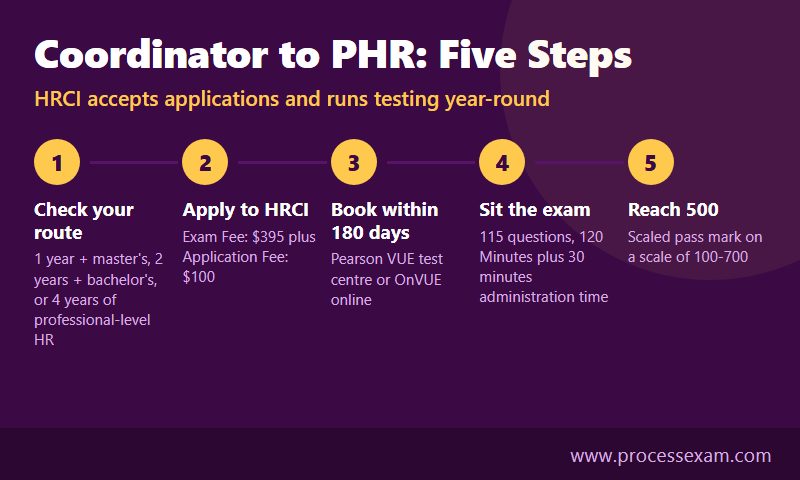
HRCI's process has five stages, and the order matters, because one of them starts a clock you cannot stop.
- Confirm your route. Match your education and professional-level months to one of the three routes, and check that your job descriptions support the claim.
- Apply online. You submit the application and payment through your HRCI account, and decide at this point whether you want Second Chance Insurance. HRCI replies with one of three outcomes: approved, more information needed, or selected for random audit.
- Book within your eligibility period. Approval opens an exam eligibility period of 180 days. Pearson VUE offers dates on a first-come, first-served basis, so HRCI advises booking as soon as you are approved.
- Sit the exam. At a test centre or online, with the 120-minute clock described above.
- Collect your result. A scaled score of 500 or more passes; your digital badge follows.
Is there a testing window or an application deadline?
No. Unlike some HR credentials that run in fixed testing windows, the PHR is available all year. HRCI's help centre FAQ says you can apply year-round for the PHR and its other exams, and its exam fees page says you can apply and test throughout the year. We checked both in September 2026, and neither lists an application deadline.
That sounds like good news, and it is, but it moves the deadline rather than removing it. Your real deadline is the end of your 180-day eligibility period, and you set it yourself on the day HRCI approves you. The most common planning mistake is applying on the first day of study as a way to feel committed, then discovering four months later that the preparation has fallen behind the calendar. A better sequence is to study first, apply when your weakest content area is no longer a blank, and book a date inside the first few weeks of approval while the choice of slots is still wide.
How should a new HR professional prepare for the PHR?
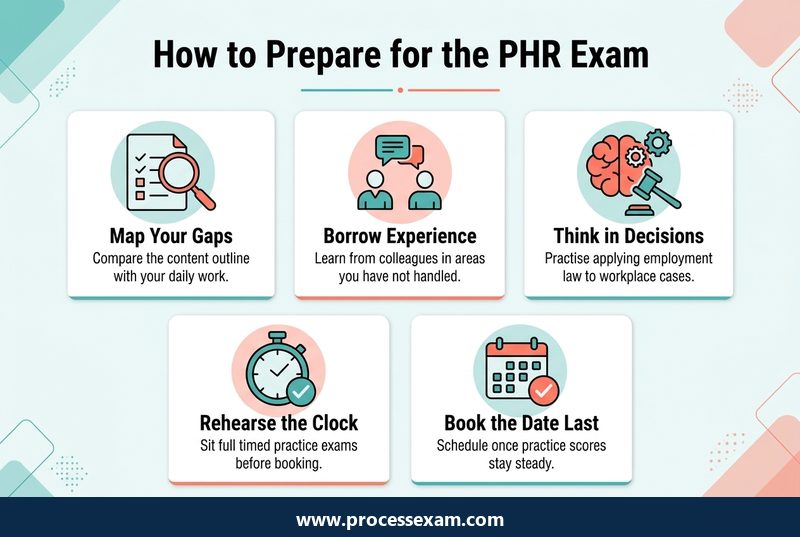
HRCI's handbook makes the point plainly: no two candidates bring the same knowledge, because HR experience and education vary so widely. That is truer early in a career than at any other time. A coordinator from a recruitment-heavy team and one from a payroll-heavy team will find completely different halves of the exam easy. So the first job is not to buy a textbook and start at chapter one. It is to find out which half is yours.
Map your gaps before you study anything
Take the seven functional areas and, for each responsibility the outline lists, give yourself one of three marks: I have done this, I have seen someone do this, or I have never come near it. Be strict. Having heard about a disciplinary hearing in a team meeting is not having done one. The result is a study plan in itself: the "never" rows get most of your time, the "seen" rows get focused reading, and the "done" rows get a quick check that your workplace habit matches the law and good practice, since company custom and the exam's expectations do not always agree.
Borrow the experience you have not had yet
Your gap map will probably show whole areas you have not worked in. The fastest way to make them real is to ask the people who do that work. Spend half an hour with whoever runs payroll or benefits and ask how they would handle a status change or a pay-equity question. Ask an HR business partner to talk you through how they decided on a performance improvement plan. These conversations turn abstract responsibilities into situations, and situations are what the exam describes. They also happen to be how coordinators become the people who are given those responsibilities next.
Learn the law as decisions, not definitions
The PHR is grounded in United States federal law, and the outline names the kinds of rules you will meet: Title VII and disparate impact in hiring, the FLSA and exempt status, OSHA and workers' compensation in safety, and federal law affecting union and non-union workplaces. The questions rarely ask you to recite what a statute says. They describe a situation and ask what an HR professional should do next. So study each law by asking what it stops you from doing, what it obliges you to do, and what a manager is most likely to get wrong about it. HRCI also reminds candidates that they are responsible for the laws in force on the day of their exam, so check that your materials are current.
Rehearse under the real clock
Knowing the material and answering 115 questions in two hours are different skills, and the second only comes from practice. Once your gap map has no blank rows left, sit a full-length, timed PHR mock exam in one go, with no notes and no pausing, and treat the score as a map of where your next two weeks of study should go rather than a forecast of your result. Review every question you got wrong and every one you got right by guessing, write down why the correct answer beats the one you chose, then sit a fresh timed set once those areas are repaired and see whether the gaps have closed.
Choose the exam date from the preparation, not the other way round
There is no standard study period for the PHR, and anyone who quotes one is describing their own background, not yours. Give it as long as your gap map says you need. The only hard limit is the 180-day eligibility period after approval, which is one more reason to delay the application until preparation is well under way.
What happens if you do not pass the PHR the first time?
A first-attempt fail is a setback, not a verdict, and HRCI's rules for retakes are straightforward. Whatever route you take back, there is a cooling-off period of 90 days from the date of the unsuccessful exam before you can book the retake appointment, and you then have an eligibility period of 180 days to sit it.
- With Second Chance Insurance, HRCI sets up the retake for you automatically and emails you when it is ready. There is no new application and no additional fee. You will sit a different version of the same exam, and you cannot switch to a different HRCI exam on the insurance.
- Without it, you apply again and pay all the related fees, as you did the first time.
Use the 90 days well. The results report you receive after an unsuccessful attempt shows your scaled score, so you know how far you were from 500, and how you performed in each content area. HRCI is careful to say this performance information is a study guide rather than an official domain score, but it is the most precise guide you will ever get: go back to your gap map, move the weakest areas to the top, and repeat the timed rehearsal before booking again.
What does the PHR change for someone early in an HR career?
Go back to the coordinator from the opening. If their two years were professional-level, the PHR is available to them now, and the question is no longer "is it too soon?" but "what will it do for me?" The honest answer has three parts.
First, it widens you. Preparing for the PHR forces you through all seven areas of the function, including the ones your current job never touches. Hiring managers weigh precisely that range when they decide whether someone can move from coordinating one process to handling HR generalist work across several.
Second, it makes your knowledge verifiable. A digital badge that anyone can check tells a hiring manager, in one line of a CV or profile, that you have been tested against a published standard in United States employment law and HR operations. For someone without a long track record yet, that independent evidence carries weight.
Third, it builds a habit. The three-year recertification cycle, with its 60 credits, pushes you to keep learning after the exam instead of treating the letters as a finish line.
What the PHR does not do is replace the experience it measures. It will not turn administrative work into professional-level work, and it will not make up for years you have not yet had. The coordinators who get the most from it are the ones who take it at the point where their job has already grown into decisions, and then use the preparation to grow it further.
Frequently Asked Questions
How do you get PHR certification?
Meet one of HRCI's three routes of education plus professional-level HR experience, apply online and pay the $100 application fee and $395 exam fee, then book and sit the 115-question exam within the 180-day eligibility period. A scaled score of 500 or more earns the credential.
What are the PHR eligibility requirements?
You need at least one year in a professional-level HR role with a master's degree or higher, at least two years with a bachelor's degree, or at least four years with no degree requirement. The degree need not be in HR, but clerical or assistant-level HR work generally does not count.
How many questions are on the PHR exam, and how long is it?
The PHR has 115 questions: 90 scored and 25 unscored pretest questions that look identical to the others. You get 120 minutes to answer plus 30 minutes of administration time for check-in and the tutorial, at a Pearson VUE test centre or online through OnVUE.
How much does the PHR certification cost?
HRCI charges an application fee of $100 and an exam fee of $395, a total of $495. Fees are not refunded once an application is approved. Rescheduling through Pearson VUE, changing exam type and extending eligibility all carry extra charges, and Second Chance Insurance is optional.
How hard is the PHR exam?
It is demanding for early-career candidates because it tests all seven HR functional areas and applies United States federal employment law to workplace situations. The pass mark is a scaled 500 on a 100-700 scale, so preparation should target weak content areas rather than a percentage of correct answers.
- HRCI HR Professional Exam Questions |
- HRCI HR Professional Question Bank |
- HRCI HR Professional Questions |
- HRCI HR Professional Study Guide |
- HRCI PHR Quiz |
- PHR Certification |
- PHR Questions |
- PHR Practice Test |
- PHR Study Guide Material |
- PHR Sample Exam |
- HR Professional Certification |
- HRCI HR Professional Book |
- HR Professional Certification Cost |
- HR Professional Certification Requirements |
- HRCI HR Professional Sample Questions |
- PHR Exam Questions Download |
- PHR Test Questions |
- HR Professional PDF |
- HRCI Professional in Human Resources


