
GPHR Certification: Who Needs It and What It Tests

Hiring one person in a country where your employer has no legal entity used to be an exception handled by a lawyer. It now lands in an HR inbox most months. HRCI's Global Professional in Human Resources, the GPHR, is the credential built for the person who has to answer that kind of question. It certifies judgement across borders rather than seniority, costs $495 plus a $100 application fee, and is passed on a scaled score of 500.
This guide sets out who the credential is really aimed at, what separates it from HRCI's domestic and international exams, whether your years of experience qualify you to apply, how the paper is built and scored, and what each of its six functional areas expects you to know.
Which HR jobs actually need the GPHR?
HRCI describes the GPHR as "designed for HR leaders with multinational responsibilities, including global strategy and the development of HR policies and initiatives that support organizational growth". The useful test is not where you live or which passport you carry. It is whether a normal week asks you to make a decision that has to hold good in more than one country at once.
That covers a wider group of people than the phrase "global HR" suggests. A regional HR director with three or four countries in scope clearly qualifies. So does an HR manager sitting at headquarters who signs off policy for subsidiaries, a mobility lead who prices and runs assignments, a business partner in a company that has started hiring engineers in four time zones, and an independent consultant advising a firm on its first overseas office.
Functional Area 01 of HRCI's exam content outline makes the point plainly. It asks candidates to "apply various strategies for operating in countries with minimal headcount" and to describe the role, benefits and limitations of a Professional Employment Organization. Those are not exotic topics any more. They are the mechanics behind every distributed hiring plan drawn up in the last few years, and they are exactly what employers want evidence of before handing someone a multi-country remit.
It is equally worth knowing who should look elsewhere. If your work sits inside one country and that country is the United States, HRCI's domestic credentials test what you actually do. If you are a senior practitioner outside the United States whose scope is a single market, the international senior credential fits better. The GPHR earns its place when the border crossing is the hard part.
What does the GPHR test that the PHR and SPHR never ask about?
The most common misreading is that the GPHR is a harder, more senior version of the SPHR. It is not a rung on a ladder. HRCI files it as a Strategic Certification, the same category as the SPHR, and the difference between the two is the shape of the work rather than the level of it. One assumes a single legal system; the other assumes several, none of which may be the one you trained in.
| Credential | What the exam is really about |
|---|---|
| PHR | Day-to-day HR delivery under United States law, in one operating environment |
| SPHR | Setting HR strategy and policy for a United States organisation |
| SPHRi | Senior HR leadership outside the United States, with local employment law knowledge documented separately |
| GPHR | HR decisions that must work across several countries at once, including mobility, cross-border rewards and global compliance |
Read the GPHR outline beside a domestic one and whole subjects appear that simply are not there in the others. Totalization agreements and double taxation. Host-country versus home-country pay philosophies, and the Big Mac Index as a cost-of-living sense check. Works councils and local unions as parties to a restructuring. The influence of the International Labour Organization, the OECD and the United Nations on what an employer may do. The General Data Protection Regulation as a set of principles you apply, not a headline you have read about. Hofstede and Trompenaars as working models for predicting how a policy will land in a culture that is not your own.
The reverse is also true, and candidates sometimes forget it. The GPHR does not go deep on United States statute. If your reason for certifying is to prove command of federal and state compliance, this is the wrong paper. If your reason is to prove you can move an employee from Manila to Munich without creating a tax problem, a visa problem and a resentful team, it is the right one.
Do you qualify to apply for the GPHR?
HRCI publishes three routes on its GPHR page and you need only one of them. Two years of professional-level HR work will do if you hold a master's degree or higher. Make it three years if your highest qualification is a bachelor's degree, and four years if you hold neither. Checked in September 2026, HRCI sets no separate minimum for time spent specifically on cross-border work, though the exam plainly assumes you have done some.
"Professional-level" is defined in the certification handbook rather than left to interpretation. HRCI looks for the ability to use independent judgement and discretion in your duties, some authority for decision-making, in-depth work such as gathering, analysing and interpreting data, interaction with people at several levels including decision-makers, and individual accountability for results. Administrative HR work, however busy, does not count towards the total.
Two further points save people time. An HR-themed degree is not required, so a finance or languages background does not disqualify you. And the handbook states that HR work experience "does not need to be current or sequential", which matters if you moved out of HR for a spell and came back. You document the experience in the application itself, and HRCI runs random audits, so keep dates and job titles accurate rather than generous.
Once the application is approved, the clock starts. The eligibility period runs for 180 calendar days from the approval date, and the exam must be both scheduled and taken inside it. Miss that, and you reapply and pay the fees again. Testing itself is year-round and first come, first served, so there is no window to wait for.
How is the GPHR exam built, and what does a score of 500 mean?
| Detail | Value |
|---|---|
| Exam name | HRCI Global Professional in Human Resources |
| Exam code | GPHR |
| HRCI category | Strategic Certification |
| Exam fee | Exam Fee: $495 |
| Application fee | Application Fee: $100 |
| Number of questions | 125 |
| Duration | 135 Minutes plus 30 minutes administration time |
| Passing score | 500 (on a scale of 100-700) |
| Delivery | Pearson VUE test centre, or at home or in the office through OnVUE |
| Certification validity | Three years |
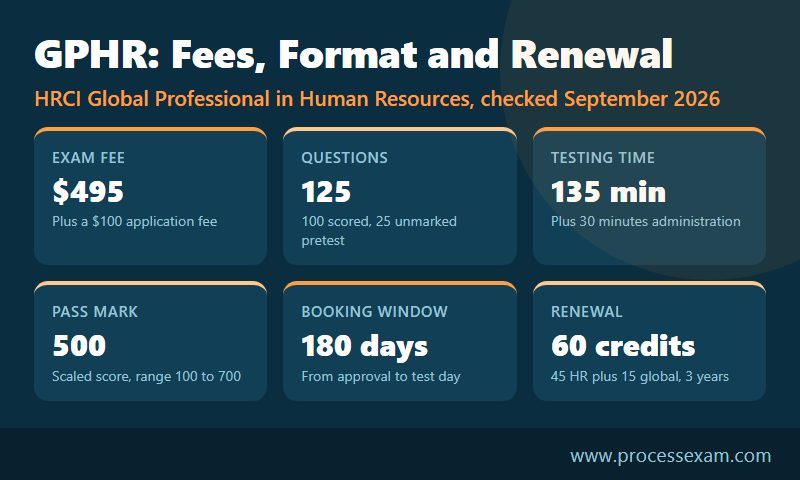
Of those 125 items, HRCI's GPHR page says 100 are scored and 25 are pretest questions being trialled for future papers. Nothing marks them out on screen and they are scattered through the exam, so the only safe approach is to treat every question as if it counts. The 135 minutes is working time; the extra half hour covers check-in and the tutorial, not thinking.
The paper is not uniformly traditional multiple choice. The handbook lists multiple choice with several correct answers, fill in the blank, drag and drop, and scenario sets where a single situation carries a run of linked questions. Items are written at three cognitive levels: recall, applying a familiar principle to a real problem, and synthesis, where you combine elements and think your way through something genuinely complex. The strategic credentials lean towards the last two, which is why memorising definitions tends to disappoint.
Scoring is where candidates most often go wrong before they start. HRCI reports a scaled score from 100 to 700 and sets the pass at 500 on every version of every exam, using equating so that a slightly harder form is not a harder pass. That 500 is not a percentage and cannot be converted into one, so ignore any figure that claims a percentage is the GPHR pass mark. The cut score itself is set by subject matter experts using the modified Angoff method, which asks how a minimally competent candidate would perform on each item.
What is inside the six GPHR functional areas?
The current exam content outline took effect in October 2020 and remains the one HRCI publishes as of September 2026. It splits the exam into six functional areas, and because the weightings differ by a factor of two and a half, they deserve very different shares of your preparation time. Our topic list for this credential breaks the same six areas down point by point.
Strategic Global Human Resources, 25 per cent
The largest area, and the one closest to a seat at the table. It covers aligning HR strategy with a global business strategy, workforce planning against local labour market conditions, restructuring in a global environment, and choosing a delivery model, whether regional centres of excellence, business partnering or something decentralised. It also covers organisation design across time zones, the case for and against outsourcing and shared services, HR metrics such as cost per hire and assignment return on investment, and the HR work inside a merger, acquisition or divestiture.
Global Talent Management, 20 per cent
Sourcing, assessing, developing and keeping people at global scale. Expect questions on build, buy or borrow decisions, culturally relevant assessment, alternate work arrangements including cross-border remote work, the risk of misclassifying contractors, learning programmes that survive translation, and engagement diagnostics. It is also where works councils, local unions and the influence of the ILO, OECD and UN appear, alongside global HR systems, data privacy and workforce analytics that have to reconcile different definitions in different markets.
Global Mobility, 15 per cent
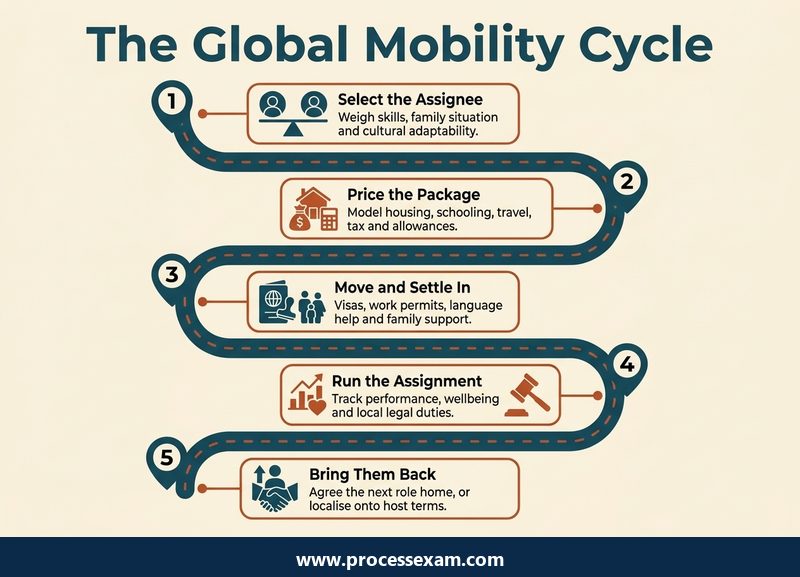
The most distinctive area on the paper. Assignment types from short-term to local-plus; the difference between a parent country national, a host country national and a third country national; expatriation planning, visas and family acclimation; the demographic factors you must weigh when selecting someone for an overseas posting; the incremental cost variables in an assignment budget; country-to-country differences in onboarding and offboarding; repatriation; and what changes when an assignee is localised onto host-country terms.
Workplace Culture, 15 per cent
A small area with outsized influence on the scenario questions. It names Trompenaars and Hofstede directly as models for describing cultural dynamics and for designing HR programmes that fit a global workforce. It also covers diversity and inclusion in settings where the legal, religious and political context varies sharply by country, and corporate social responsibility and ethics programmes, including the US Foreign Corrupt Practices Act and the UK Bribery Act.
Total Rewards, 15 per cent
Pay and benefits that have to satisfy statute in one country and market practice in another. Health and welfare benefits, retirement, payroll, equity compensation and its tax treatment, double taxation and totalization agreements. Expatriate pay philosophies, balance-sheet thinking, and cost-of-living comparisons. Supplemental pay such as per diems, hazard pay and hardship allowances, and the circumstances, from political unrest to climate extremes, that justify them. Finally, defined benefit against defined contribution retirement plans in both statutory and voluntary schemes.
Risk Management and Compliance, 10 per cent
The smallest area, and the one most often left until the last weekend. Physical safety and security for employees abroad, including evacuation planning and kidnap and ransom cover. Control frameworks such as audits, segregation of duties and exception reporting. Global anti-discrimination, anti-bullying and anti-harassment policy. Running an investigation across jurisdictions. And the key principles of GDPR, listed in the outline as lawfulness, fairness and transparency, purpose limitation, data minimisation, accuracy, storage limitation, integrity and accountability.
How do you study for countries you have never worked in?
The honest difficulty of the GPHR is that most candidates have deep experience of two or three markets and almost none of the rest. You cannot fix that by reading country guides, and you do not need to. The exam rewards a repeatable way of reasoning about an unfamiliar market, not a stock of facts about Brazil.
Three habits do most of the work. First, for any decision, ask what is statutory, what is customary and what is negotiable, in that order; the outline uses those three words repeatedly. Second, cost every mobility decision out loud, because Total Rewards and Global Mobility together are 30 per cent of the exam and the questions usually turn on a variable someone forgot. Third, when a scenario involves people from two cultures, name which dimension is in tension before choosing an answer.
A ten-week plan weighted to the outline handles the rest:
- Weeks 1 to 3 – Strategic Global Human Resources. Draw your own organisation's delivery model, then redraw it as a regional centre of excellence and list what breaks.
- Weeks 4 and 5 – Global Talent Management. Work through contractor classification and cross-border remote work until the risk pattern is automatic.
- Weeks 6 and 7 – Global Mobility and Total Rewards together. Build one assignment cost model on paper and run it home-country, then host-country.
- Week 8 – Workplace Culture. Learn the Hofstede and Trompenaars dimensions well enough to apply them, not recite them.
- Week 9 – Risk Management and Compliance, GDPR principles, investigations and security planning.
- Week 10 – Full-length timed attempts only, reviewing wrong answers by functional area rather than by question.
Timed attempts are the part people skip and regret. Sitting 125 mixed items in 135 minutes teaches pacing that no amount of reading will, and reviewing the wrong ones by area shows you where the marks are actually leaking; our GPHR practice exam is built for that last stretch. Pair it with HRCI's own GPHR exam content outline, which lists every responsibility statement the questions are written from.
What happens between booking the exam and holding the credential?
Results arrive at the test centre, or on screen at the end of an OnVUE session. A pass is a scaled score of at least 500. If you do not pass, the report tells you how far short you were and gives a performance level for each functional area; HRCI is careful to say these are a study guide rather than official domain scores, so read them as direction, not as marks.
A failed attempt carries a 90-day cooling-off period before you may schedule again, and you must then test inside the 180-day eligibility period. Unless you bought Second Chance Insurance with the original application, a retake means reapplying and paying the fees again. Second Chance Insurance has to be purchased at the moment you apply and cannot be added later, which is worth deciding on before you submit rather than after a disappointing morning.
Once you hold it, the credential runs for three years. HRCI requires 60 recertification credits in that cycle, and the GPHR has a split the other credentials do not: 45 general HR credits plus 15 specifically global ones. The alternative is retaking the exam. Plan the global 15 early, because they are the ones people scramble for in the final quarter. HRCI's GPHR credential page states the current requirement, and the full rules on applications, testing and retakes sit in its certification policies and procedures handbook.
What does a GPHR change about the roles you can apply for?
The practical value is that it settles an argument you would otherwise have to win by anecdote. Multi-country HR work is hard to evidence on a CV, because the job titles are the same as the domestic ones and the difficulty lives in the detail. Three letters after your name tell a hiring manager that an independent body, accredited by the National Commission for Certifying Agencies, has tested your judgement against a global outline rather than a national one.
It also changes the shape of the conversation internally. HR practitioners who have passed the GPHR tend to report that they are brought into market-entry and restructuring discussions earlier, because someone in the room now assumes they will ask about works councils and totalization before the plan is signed rather than after. That is a modest-sounding shift with real consequences for what the HR function is asked to do.
There are limits worth stating. The GPHR will not substitute for country-specific legal knowledge, and no credential will make an employer overlook a thin track record. Nor is it the right first certification for someone still building professional-level HR experience. What it does well is mark the point at which your career stops being about one labour market and starts being about several, and give you a defensible framework for the decisions that come with that.
If your work already crosses a border most weeks, the paperwork is the easy part: check which of the three eligibility routes you meet, apply, and put the 180-day clock to use.
Frequently Asked Questions
What is GPHR certification?
GPHR stands for Global Professional in Human Resources, a credential awarded by HRCI. It certifies that an HR professional can handle work spanning more than one country, covering global strategy, talent management, mobility, workplace culture, total rewards and cross-border risk. It is valid for three years and is accredited by the National Commission for Certifying Agencies.
How much does the GPHR exam cost?
There are two charges, and HRCI states them as Exam Fee: $495 and Application Fee: $100. Both are payable on a first attempt and the application fee is not refundable. A retake without Second Chance Insurance means reapplying and paying them again, while any preparation material you choose is a separate cost.
What are the eligibility requirements for the GPHR?
One of three combinations qualifies you. Hold a master's degree or higher and you need two years of professional-level HR work; a bachelor's degree and you need three; no degree and you need four. HRCI defines professional-level work as involving independent judgement, some decision-making authority and individual accountability for results.
How many questions are on the GPHR exam and what is the passing score?
The exam has 125 questions with a duration of 135 Minutes plus 30 minutes administration time. HRCI's GPHR page explains that 100 are scored and 25 are pretest items mixed in unmarked. The passing score is 500 (on a scale of 100-700), a scaled score rather than a percentage of questions answered correctly.
How do you keep a GPHR certification current?
The credential lasts three years. HRCI asks for 60 recertification credits in that period, made up of 45 general HR credits and 15 credits in global topics specifically, or you can retake the exam instead. The global 15 are the ones candidates most often leave too late.
- HRCI HR Global Professional Exam Questions |
- HRCI HR Global Professional Question Bank |
- HRCI HR Global Professional Questions |
- HRCI HR Global Professional Study Guide |
- HRCI GPHR Quiz |
- GPHR Certification |
- GPHR Questions |
- GPHR Practice Test |
- GPHR Study Guide Material |
- GPHR Sample Exam |
- HR Global Professional Certification |
- HRCI HR Global Professional Book |
- HR Global Professional Certification Cost |
- HR Global Professional Certification Requirements |
- HRCI HR Global Professional Sample Questions |
- GPHR Exam Questions Download |
- GPHR Test Questions |
- HR Global Professional PDF |
- HRCI Global Professional in Human Resources


