
Is Getting a CAPM Certification Worth It?
Updated on 21 September 2026. What’s new: CAPM fees corrected to $225 and $300, and the PMBOK 6th edition syllabus replaced by PMI's current four-domain outline.
Yes – if you are new to projects. The CAPM pays off for students, graduates, career changers and coordinators who need proof of project skills before anyone will trust them with a project. If you already lead projects and can document the hours, skip it and sit the PMP instead. Everything below is the detail behind that answer: what PMI now tests, what it costs, and how long it really takes.

The Certified Associate in Project Management (CAPM) is the Project Management Institute's entry-level credential. It was built for people who work on projects rather than run them, and for a long time it was treated as a junior version of the PMP that tested the same book of knowledge areas.
That description is out of date. PMI rewrote the exam content outline, and the CAPM now spans three ways of working – predictive, agile and business analysis – instead of one. The eligibility rules changed too. So the honest answer to “is it worth it” depends less on the credential's reputation than on where you are standing right now.
| CAPM exam detail | Value |
|---|---|
| Certification | PMI Certified Associate in Project Management (CAPM) |
| Exam code | CAPM |
| Vendor | PMI |
| Reference standard | PMBOK Guide - Seventh Edition |
| Number of questions | 150 |
| Duration | 180 minutes |
| Exam fee | Member Price USD $225 / Full Price USD $300 |
| Result reported as | Above Target / Target / Below Target / Needs Improvement |
Who is the CAPM worth it for, and who should go straight to the PMP?
The CAPM solves one specific problem: you can do the work, but nothing on paper says so. That problem is real for some people and imaginary for others, which is why the same credential gets called essential by one candidate and a waste of money by the next.
The CAPM is worth it if you recognise yourself here
It earns its keep for students and recent graduates applying for coordinator, analyst and junior delivery roles, where every applicant has a degree and almost none of them has a project credential. It helps career changers – a nurse moving into healthcare programme support, a teacher moving into an education technology rollout – because it translates unrelated experience into vocabulary a hiring manager recognises. It helps people who already do project work under another job title, such as operations, marketing or service delivery staff who run schedules and stakeholders without anyone calling them a project manager. And it helps in organisations where an internal move into the project management office needs a documented reason, not just a manager's goodwill.
Go straight to the PMP if this sounds like you
If you have been leading projects for three or more years and can evidence those months on an application, the CAPM adds almost nothing that the PMP will not add more of. Employers who ask for a credential at that level ask for the PMP by name. Sitting the CAPM first does not shorten the PMP application, does not waive any PMP requirement, and does not count toward it. The only sensible reason to take both is a long gap before you meet the PMP experience rule and a need for something on the CV in the meantime.
Where the honest doubt sits
The CAPM does not manufacture experience. A hiring manager comparing a certified candidate with no delivery history against an uncertified one who has shipped three projects will usually take the second. What the credential does is get the first candidate into the room. Treat it as an entry ticket paired with whatever practical work you can point to – a university project, a volunteer rollout, a process improvement at your current job – rather than as a substitute for one.
What does the CAPM exam actually test now?
This is the part most older articles get wrong, and it is the single biggest change in the credential's history. The exam used to follow the knowledge areas and process groups of one standard. PMI's current exam content outline replaced that with four domains, and two of them cover ground the old CAPM barely touched.
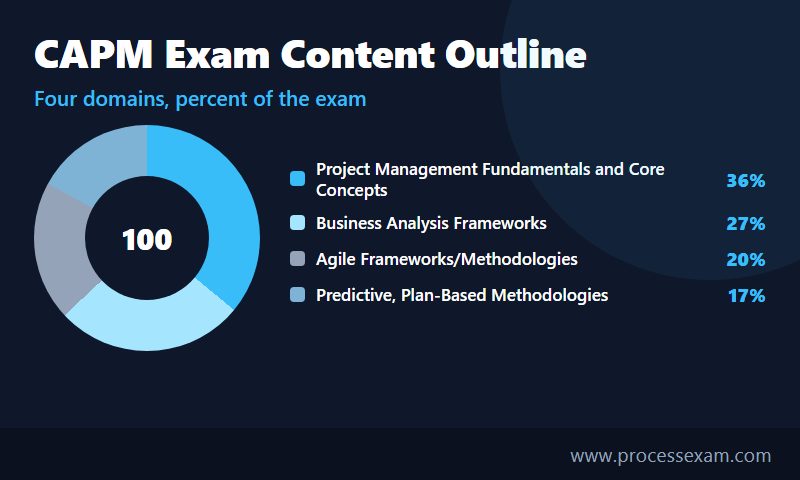
Project Management Fundamentals and Core Concepts – 36%
The largest domain, and the one closest to the old exam. It covers project life cycles and how a life cycle is chosen, the planning essentials of scope, schedule, cost, quality, risk, resources, communication and procurement, the roles and responsibilities around a project, how projects connect to organisational strategy, and structured problem solving. If you have read a general project management text, most of this will feel familiar.
Business Analysis Frameworks – 27%
The surprise for nearly everyone. More than a quarter of the exam is business analysis: what a business analyst does and how that role works alongside the project manager, how stakeholders are identified and communicated with, how requirements are elicited, documented, traced and prioritised, how a product roadmap shapes delivery, and how completed work is validated against what was actually asked for. Candidates who prepare only from project management material walk into this domain cold.
Agile Frameworks and Methodologies – 20%
This domain asks when an adaptive approach fits better than a plan-driven one, how iterations are planned and sized, what the common agile events and artefacts are for, how progress is controlled when scope is deliberately flexible, and how work is executed inside an agile team. You are not being examined as a Scrum practitioner, but you do need to reason about adaptive delivery rather than recite its terminology.
Predictive, Plan-Based Methodologies – 17%
The smallest domain, which tells you how far the credential has moved. It covers when a predictive approach is the right one, schedule development and control, quality and integration planning, and the documentation that keeps a plan-driven project under control.
Read those weightings together and the picture is clear: agile and business analysis account for almost half the paper. Our CAPM certification exam syllabus breaks each domain into its individual tasks, and PMI publishes the authoritative version in its CAPM exam content outline. Study from both, and give the two unfamiliar domains at least as much time as the one you find comfortable.
Do you meet the CAPM eligibility rules, and what changed?
The requirements are now shorter than they used to be, and simpler to explain.
- A secondary degree – a high school diploma, an associate degree or the global equivalent.
- 23 hours of project management education, completed before you sit the exam.
That is the whole list. The older route, which let candidates qualify with 1,500 hours of documented experience on a project team instead of the education hours, no longer exists. PMI withdrew it, which means the education hours are not an alternative any more – they are the requirement. PMI states the current rules on its official CAPM certification page, and that page is the one to check before you pay for anything, because eligibility rules change more often than exam content does.
What counts as the 23 hours
The hours have to be project management education, delivered by a provider that issues some record of completion. PMI's own exam preparation course is written to cover them in one go. So do courses from PMI Authorised Training Partners, accredited university and college modules, and employer training programmes that teach project management rather than a specific internal tool. Keep the certificate or transcript: the application asks you to describe the course, the provider and the hours, and an audit asks you to produce the evidence.
What does not count
Reading a book, watching unstructured videos and on-the-job experience do not count, however much you learned from them. Neither does generic business or leadership training with no project management content. If you are unsure whether a course qualifies, the test PMI applies is whether its contact hours were spent on project management subject matter.
Practical consequence of the change
For students, the change is good news: you no longer need experience you cannot have yet. For experienced practitioners, it is a small irritation – years on project teams now buy you nothing toward CAPM eligibility, so you pay for a course you may not need. That is one more reason for anyone with substantial delivery history to look at the PMP instead, where the same experience is exactly what the application wants.
What does the CAPM really cost, and does PMI membership pay for itself?
There are three numbers in the decision, and most people only look at the first one.
The exam fee
The exam costs USD $225 at the member price and USD $300 at the full price. The gap is USD $75.
The membership arithmetic
PMI membership is a paid annual subscription, and the member discount on the exam covers a meaningful share of it before you count anything else. Membership also gives digital access to PMI's standards, which is the sort of thing you would otherwise buy separately while studying. For a candidate who intends to sit the exam once and never engage with PMI again, the full price is simpler. For anyone who expects to renew the credential, attend chapter events or eventually apply for the PMP, joining first is usually the cheaper order of operations. Work out your own number rather than assuming either way.
The training you have to buy
This is the cost that surprises people, because the 23 education hours are compulsory. Prices vary enormously between providers, and this is where a CAPM budget can double. Before paying, check that the course actually issues a record of the hours and that its content maps onto the four current domains rather than the old knowledge-area structure. A cheap course built for the previous exam is the most expensive mistake available here, because you pay for it twice: once in fees and once in a failed attempt.
The cost nobody budgets for
A resit means paying a re-examination fee and going through the wait again. PMI gives you a fixed eligibility period once your application is approved and allows only a limited number of attempts inside it, so a failure is not simply a matter of rebooking whenever you feel ready. The cheapest version of the CAPM is the one you pass first time, which is an argument for spending on preparation rather than economising on it.
How do you prepare for the CAPM in six to eight weeks?
Most candidates studying around an hour a day need six to eight weeks. Less if you already work on projects and only need to learn the agile and business analysis material; more if every domain is new. The sequence below is built around the weightings rather than around a textbook's chapter order.
Weeks 1 and 2 – fundamentals
Start with the 36% domain, because everything else assumes it. Get comfortable with life cycles and why one is chosen over another, the planning disciplines and how they interact, and who does what on a project. Finish these two weeks able to explain, in your own words, what changes about a project when the approach changes.
Weeks 3 and 4 – business analysis and agile
These are the domains that decide most results, and they deserve the middle of your plan while your attention is best. For business analysis, work through the flow from stakeholder to requirement to validated delivery, and learn to tell elicitation, documentation, traceability and prioritisation apart. For agile, concentrate on judgement rather than vocabulary: when adaptive delivery fits, how an iteration is planned, and how control works without a fixed scope.
Week 5 – predictive methods and the gaps
Cover the 17% domain properly – schedule development and control, quality and integration planning, the documents that keep a plan-driven project honest – then go back to whatever you have been avoiding. There is always something.
Weeks 6 to 8 – timed practice and repair
Now stop reading and start answering. Sit full-length papers under exam conditions, because 150 questions in 180 minutes is a pace as much as a knowledge test, and a domain you know well can still cost you marks if you spend four minutes on each of its questions. After every paper, sort your wrong answers by domain and spend the next session on the worst one. A score that keeps rising on questions you have never seen before is the only readiness signal worth trusting.
When you want a straight answer about where you stand today, sit a full-length CAPM practice test under the real clock and let the domain breakdown tell you which of the four areas is still costing you marks.
Two habits that separate passes from resits
Write down why the wrong options were wrong, not just which option was right. CAPM questions are built from plausible distractors, and recognising the trap is a transferable skill. And keep a single page of notes that grows as you study: the four domains and their weightings, the situations that call for predictive versus adaptive delivery, and the business analysis sequence. That page is your last revision, not the textbook.
What happens on CAPM exam day, and what if you do not pass?
The exam is 150 questions in 180 minutes, delivered either at a test centre or online with remote proctoring. PMI's exam content outline schedules a single 10-minute break after the 75th question, which is worth taking even if you feel fine: the second half is where careless reading costs marks.
Pacing
180 minutes for 150 questions is a little over a minute each, and the questions are not evenly demanding. Scenario questions in the agile and business analysis domains take longer than recall questions in the fundamentals domain. Move quickly through what you know, mark anything that takes more than two minutes, and come back to the marked ones with whatever time you have left. Finishing the first pass with fifteen minutes in hand is a much better position than answering every question perfectly in order and running out of clock.
How the result is reported
PMI does not publish a passing percentage for the CAPM. Your result comes back as Above Target, Target, Below Target or Needs Improvement, and you get one of those ratings for your overall performance and for each domain. PMI also includes unscored pretest questions in the paper, which is part of why a raw percentage would not mean what candidates think it means. The practical reading of this is simple: you cannot calculate a target score, so aim to be comfortably strong across all four domains rather than banking on one to carry the rest.
If the result is not the one you wanted
The domain ratings on your report are genuinely useful, so use them before the disappointment fades. A Below Target in business analysis and a Target in fundamentals tells you exactly where the next fortnight goes. Re-sitting costs a re-examination fee and uses one of the attempts in your eligibility period, so go back only when your practice scores on unseen questions have moved, not when you feel ready.
What does the CAPM do for your career once you have it?
The credential opens a specific set of doors, and it is fair about which ones.
The roles it fits
Project coordinator, project administrator, project support officer, junior business analyst, PMO analyst, operations or service delivery coordinator, and scheduler roles are where the CAPM is recognised on sight. In organisations with a mature project management office, it is often the qualification that lets an internal candidate be considered for the first delivery role at all. Since the outline now includes business analysis, it also reads well on applications for junior analyst work, which was not true of the older version of the exam.
What it signals
To an employer, the CAPM says three things: you can speak the vocabulary a project team uses, you understand both plan-driven and adaptive delivery rather than only one, and you finished something optional and difficult. That last signal is undervalued. Filtering CVs is largely a search for evidence of follow-through.
What it does not do
It does not guarantee a salary increase, it does not make you a project manager, and it does not shorten the road to the PMP. Anyone who tells you it reliably adds a fixed percentage to your pay is guessing. Pay depends on your role, your market and your negotiation far more than on any single credential, and the CAPM's real contribution is getting you considered for the roles that pay differently in the first place.
Keeping it alive
The CAPM is no longer a certificate you re-sit every few years. It runs on PMI's continuing certification requirements: 15 professional development units across a three-year cycle, plus a renewal fee, with the details and the current PDU rules published on PMI's certification maintenance page. Fifteen units over three years is a light obligation, and PMI counts a wide range of learning and volunteering toward it, so this should not be a reason to hesitate – but it is a reason to diarise the cycle date the week you pass.
So, is the CAPM certification worth it for you?
Put the three tests together and the decision usually makes itself.
Test one: do you have experience you can document? If yes, the PMP is the better target and the CAPM is a detour. If no, the CAPM is the credential available to you.
Test two: does your market ask for it? Search the job listings you would actually apply for. If CAPM appears in the desirable section of entry-level project and analyst roles in your country and sector, the answer is settled. If nothing mentions it and everything asks for the PMP, save the money for the PMP application.
Test three: can you afford the whole cost, not just the fee? The exam is USD $225 for members or USD $300 at the full price, and the 23 education hours sit on top. If the total is affordable and the first two tests pointed the same way, take it.
For the reader it was designed for – early in a career, light on documented experience, aiming at a coordinator or analyst role – the CAPM is one of the better value credentials in project management, and the four-domain outline has made it considerably more useful than the version most online articles still describe. For the experienced project manager, it is the wrong exam, and the PMP is waiting.
Frequently Asked Questions
Is CAPM certification worth it?
It is worth it if you have little documented project experience and want an entry-level credential for coordinator, analyst or PMO roles. If you already lead projects and can evidence the hours, the PMP is the better target, because the CAPM neither waives nor shortens any PMP requirement.
What are the CAPM certification requirements?
You need a secondary degree, meaning a high school diploma, an associate degree or the global equivalent, plus 23 hours of project management education completed before the exam. PMI withdrew the older route that allowed 1,500 hours of project team experience instead of the education hours.
How much does the CAPM certification exam cost?
The exam fee is USD $225 at the PMI member price and USD $300 at the full price. Budget separately for the 23 compulsory education hours, which vary widely between providers, and for a re-examination fee if a first attempt does not go your way.
What does the CAPM exam cover?
PMI's exam content outline sets four domains: Project Management Fundamentals and Core Concepts at 36 percent, Business Analysis Frameworks at 27 percent, Agile Frameworks and Methodologies at 20 percent, and Predictive, Plan-Based Methodologies at 17 percent. Agile and business analysis together are almost half the paper.
What is the passing score for the CAPM exam?
PMI does not publish a passing percentage. Results are reported as Above Target, Target, Below Target or Needs Improvement, overall and for each domain. The paper has 150 questions in 180 minutes and includes unscored pretest questions, so a raw percentage would not mean what candidates expect.
- PMI Project Management Associate Exam Questions |
- PMI Project Management Associate Question Bank |
- PMI Project Management Associate Questions |
- PMI Project Management Associate Study Guide |
- PMI CAPM Quiz |
- CAPM Certification |
- CAPM Questions |
- CAPM Practice Test |
- CAPM Study Guide Material |
- CAPM Sample Exam |
- Project Management Associate Certification |
- PMI Project Management Associate Book |
- Project Management Associate Certification Cost |
- Project Management Associate Certification Requirements |
- PMI Project Management Associate Sample Questions |
- CAPM Exam Questions Download |
- CAPM Test Questions |
- Project Management Associate PDF |
- PMI Certified Associate in Project Management


