
DSDM Certification Guide: AgilePM Foundation Cost, Syllabus, Pass Mark
If you last looked at DSDM certification a few years ago, one thing has moved: APMG International's AgilePM scheme is now on AgilePM version 3, which gives Scrum a syllabus topic of its own. The entry exam, AgilePM Foundation, is still 50 multiple-choice questions in 40 minutes, costs USD $386 and needs 60% (30 correct answers) to pass, and the certificate never expires. Most candidates are ready for this recall exam after three to four weeks of steady study.
Version 3 is the current edition on APMG International's AgilePM page, which we checked in September 2026. If a study guide, a course handout or an old forum thread describes an earlier edition, treat the Scrum material in it with caution and rely on the syllabus below instead.
This guide is for project managers, team leaders, business analysts and team members who have been told to "get agile" and want a recognised qualification that goes beyond a two-day workshop. It explains what the exam is, what it covers, how the DSDM ideas turn into questions, how to plan four weeks of study, and where the certificate leads.
What is the DSDM certification, and who is AgilePM Foundation for?
DSDM stands for Dynamic Systems Development Method, an agile approach that began in the 1990s as a way to bring discipline to rapid application development and has since grown into a full project framework. APMG International publishes the AgilePM qualification scheme around it. The scheme has two exam levels that matter to a newcomer: Foundation, which proves you understand the framework, and Practitioner, which proves you can apply it to a scenario. A third exam, Practitioner re-registration, exists for people who hold the higher level and want to keep it current.
What makes AgilePM different from a team-level agile method is that it is written for projects. It assumes there is a sponsor who approved a business case, a budget that somebody watches, a delivery date that matters, and a steering structure above the delivery team. It then shows how to keep all of that while working in short, prioritised increments. That is why it appeals to organisations in government, finance, utilities and large IT departments, where agile delivery has to sit inside an existing governance model rather than replace it.
Who gets the most from Foundation?
- Project managers moving from plan-driven delivery who need the vocabulary and the control mechanisms of an agile project.
- Business analysts and product-minded staff who write, rank and estimate requirements and want a defined way to do it.
- Team leaders and developers working inside a DSDM-style organisation who want to understand the roles around them.
- Scrum practitioners whose employer runs projects, not just products, and who need to see how sprints and timeboxes relate.
There is no entry requirement, so you can sit Foundation without prior certification or a set number of project years. Experience helps you connect the ideas, but the questions test what the framework says, not what you have done.
How much does the exam cost and how is it set out?
The table below gives the figures we hold for the exam. Check the current fee with the exam booking page before you pay, because APMG International and its training partners can change pricing and add delivery charges.
| Item | Detail |
|---|---|
| Exam name | APMG International Agile Project Management - Foundation |
| Exam code | AgilePM Foundation |
| Exam fee | USD $386 |
| Duration | 40 minutes |
| Number of questions | 50 |
| Passing score | 60% |
| Question type | Multiple choice, one correct answer |
| Validity | No expiry for Foundation |
What do the numbers mean in practice?
Fifty questions in 40 minutes leaves about 48 seconds for each one. A pass needs 30 correct answers, so you can afford to miss 20. That is a forgiving margin, but the clock is the real opponent: a question you cannot place in the first 30 seconds should be flagged and revisited rather than argued over. Because the paper tests recall of terms, roles, products and rules, the answer is either in your head or it is not, and long deliberation rarely helps.
How do you book it?
Most people sit Foundation through an accredited training provider, on the last afternoon of a course that typically runs three days. The exam is delivered online, so it can also be taken by self-study candidates who book directly through the APMG International exam booking site. Have a stable connection, a quiet room and valid identification ready, and read the invigilation rules before the day so nothing surprises you at the start. The vendor's overview of the whole scheme, including the training-course model, is on the AgilePM certification page.
Does Foundation expire?
No. APMG International states that the Foundation qualification has no expiry date. Only the Practitioner status has a five-year life and needs re-registration, so Foundation is a one-off cost with no renewal fee to plan for.
What changed in AgilePM version 3, and what does the syllabus cover?
The change most visible to an exam candidate is Scrum. Earlier editions treated it as background reading. Version 3 gives it a syllabus topic of its own, so the roles, events and artefacts of Scrum are now examinable, and you must be able to say which vocabulary belongs to which framework. The rest of the scheme keeps the DSDM core: principles, a phased lifecycle, defined roles, a family of management products and a set of techniques. APMG International also describes version 3 as adding project simulations to the training experience.
The syllabus has ten topics and does not publish a weighting for each, so plan to cover all of them evenly rather than gamble on a favourite. You can compare this list with the AgilePM Foundation syllabus before you start.
| Syllabus topic | What you should be able to do |
|---|---|
| Key Concepts | Define agile terms and separate framework vocabulary from everyday use |
| Scrum Overview | Name Scrum roles, events and artefacts and state where they differ from AgilePM |
| AgilePM Fundamentals | Explain the philosophy, the eight principles and the fixed-time, variable-features approach |
| Individuals and Interactions | Match each role to its accountability and its level in the project |
| Collaboration and Communication | Choose between workshops, modelling, stand-ups and reviews for a given need |
| Project Lifecycle Framework | Order the phases and state the purpose and outputs of each |
| Requirements, Estimating and Prioritisation | Apply MoSCoW, describe requirement levels and recognise estimating methods |
| Planning and Control | Describe timeboxes, plan levels and how progress is tracked |
| Risk Management and the Project Approach | Tailor the approach to a project and handle risk through the lifecycle |
| Governance, Compliance and the AgilePM Products | Identify the products and who owns them at each stage |
Which topics catch people out?
Two of the ten cause the most lost marks. The first is Scrum Overview, because candidates who use Scrum every day assume they know it and then get caught by a question that asks which framework calls something a sprint backlog and which calls it a prioritised requirements list. The second is Governance and the AgilePM products, which is dry list-learning: the names of the management products and the point in the lifecycle where each first appears. Give both extra time.
How do the DSDM principles and lifecycle show up in exam questions?
Exam questions rarely ask you to recite a definition word for word. They give you a short situation and ask which principle, phase, role or product it points to. So the way to learn the material is to attach each item to a situation. The groups below are the ones that generate most of the paper.
The eight principles
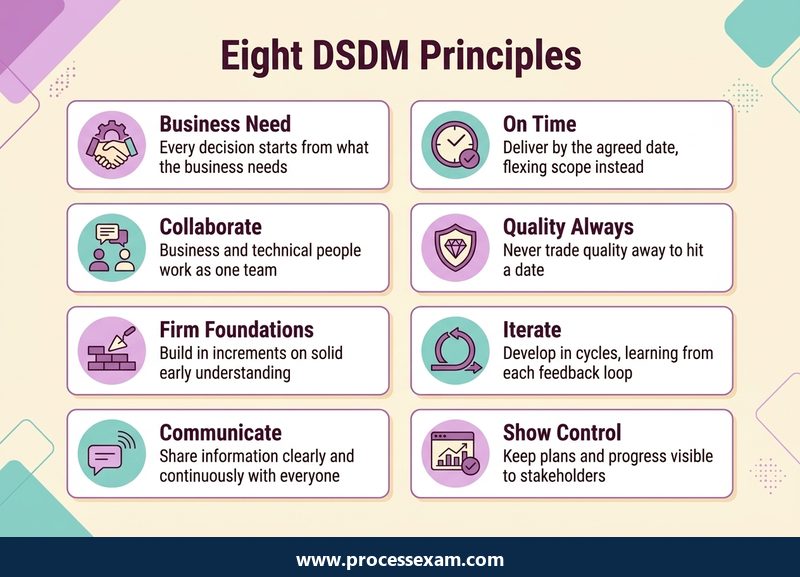
AgilePM rests on eight principles: focus on the business need, deliver on time, collaborate, never compromise quality, build incrementally from firm foundations, develop iteratively, communicate continuously and clearly, and demonstrate control. A useful trick is to learn what each one rules out. "Deliver on time" rules out quietly moving the deadline; "never compromise quality" rules out dropping testing to hit a date; "build incrementally from firm foundations" rules out starting to code before the solution is understood at a high level.
The lifecycle and its phases
The lifecycle has six stages: Pre-Project, Feasibility, Foundations, Evolutionary Development, Deployment and Post-Project. Foundations is where the solution and delivery approach are set up firmly enough to build on, and Evolutionary Development is where the team works through timeboxes to grow the solution. Deployment can happen more than once, because usable increments can be released while later ones are still being built. Post-Project is where benefits are assessed after the team has gone, which is why a question about measuring benefits will not point to Deployment.
Roles and who owns what
Roles sit at three levels. The project level holds the Business Sponsor, Business Visionary, Project Manager and Technical Coordinator. The Solution Development Team holds the Business Ambassador, Business Analyst, Solution Developer, Solution Tester and Team Leader. Around them sit supporting roles such as the Business Advisor, Technical Advisor and Workshop Facilitator. A typical question describes a duty, such as "keeps the solution technically coherent" or "represents the business day to day inside the team", and asks you to name the role. Learn each role as a verb phrase, not a title.
MoSCoW and timeboxing worked through
MoSCoW sorts requirements into Must Have, Should Have, Could Have and Won't Have this time. The guidance is that Must Haves should account for no more than about 60% of the effort estimated for the project, with roughly 20% for Could Haves so there is room to absorb problems without touching the Musts. Suppose a team estimates 100 person-days for everything on the list. Keeping Musts to about 60 days and treating about 20 days of Could Haves as contingency means the project can lose a Could Have when something goes wrong and still deliver everything it promised.
Timeboxing follows the same logic of fixing time and flexing scope. A timebox has a fixed end date, a set of prioritised requirements and a short structure of investigation, refinement and consolidation steps. If work is running late, the answer in AgilePM is to drop the lowest-priority item, not to extend the timebox. That single rule answers a large share of "what should the team do?" questions.
Techniques and products
Expect questions on facilitated workshops, modelling, iterative development, testing throughout and estimating with relative methods such as planning poker. For products, learn the main management documents by stage: the Terms of Reference and Business Case early on, the Feasibility Assessment in Feasibility, the Solution Architecture Definition and Delivery Plan in Foundations, the Timebox Plan during development, and the Project Review Report near the end. Sort them by lifecycle stage rather than alphabetically and the list becomes far easier to hold.
How do you get exam-ready in a month?
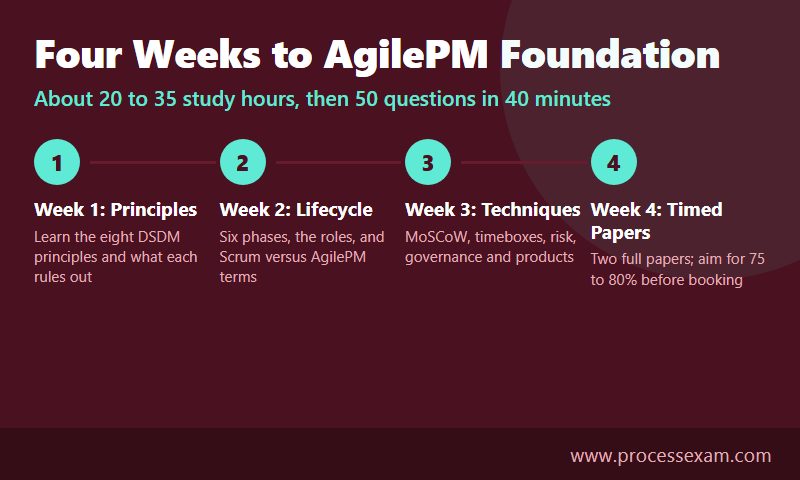
Most candidates with a job to hold down need about 20 to 35 hours in total, and someone who already uses an agile method can manage with fewer. The plan below spreads that across four weeks with about six to eight hours a week. Adjust the hours, but keep the order: learn the shape of the framework first, add the detail second, and only then start timed question work.
| Week | Focus | Finish the week by |
|---|---|---|
| 1 | Key Concepts, AgilePM Fundamentals, the eight principles, fixed time and variable features | Writing the principles from memory and one thing each rules out |
| 2 | Lifecycle phases, roles, Scrum Overview | Drawing the six phases with a purpose beside each, and a two-column Scrum versus AgilePM vocabulary sheet |
| 3 | Requirements, MoSCoW, estimating, planning and control, risk, governance and products | Sorting the management products by phase without notes |
| 4 | Timed question sets, error review, final read of weak topics | Scoring 75 to 80% or more on two full papers |
What should each study session look like?
Read a section, close the book, and write down what you remember before you check. Recall is what the paper tests, and the effort of retrieving an answer does more for memory than a second read. Keep a running sheet of confusable pairs, such as Business Sponsor and Business Visionary, or Solution Tester and Business Ambassador, and revisit it every few days.
When should you start timed questions?
From the start of week three, once you can name the ten topics without a list in front of you. Do half a paper in 20 minutes at first, then a full paper in 40 minutes in the last week. After each set, sort every miss into one of three groups: did not know it, mixed up two terms, or misread the question. Each group needs a different fix. The vendor also publishes sample papers that show the style of the real questions, which is worth doing once early so the format holds no surprises.
Is a training course necessary?
It is the usual route and gives you structure, a tutor for the awkward parts and the exam sitting on the last day. It is not the only route, because the exam can be booked directly. Choose a course if you learn best in a room, or if your employer is paying. Choose self-study if you already work in a DSDM-style organisation and need only the exam framework filled in. Either way, use an APMG International accredited provider so the material follows the current version.
Where do well-prepared candidates still drop marks?
Passing needs 30 of 50, so a few avoidable errors are the difference between a pass and a resit. These are the ones that recur.
- Answering as a Scrum practitioner. In AgilePM the Project Manager and Technical Coordinator exist, the Product Owner does not, and the Business Ambassador is not a Scrum role. When a question uses AgilePM language, answer in it.
- Treating Won't Have as "never". It means not in this timebox or this delivery, and it may return later.
- Extending a timebox to finish the work. The framework flexes scope, not the end date.
- Mixing up who signs off what. Business roles decide priority and acceptance; technical roles decide technical direction. A question that reverses them has a wrong option built in.
- Memorising the lifecycle without its outputs. Knowing the six names is not enough when a question asks which phase produces a given product.
- Running out of clock. With 48 seconds a question, a candidate who spends two minutes on one item has borrowed the time of three others.
- Leaving answers blank. Nothing suggests a penalty for a wrong answer, so always choose one, even if it is a reasoned guess.
What is the best way to handle a question you are unsure of?
Cross out the options that contradict a principle first. AgilePM answers almost always agree with the principles, so an option that lets quality slip, hides control from the business or delays collaboration is usually a distractor. Then choose between what is left and move on.
What does Foundation prove to an employer, and what comes next?
Foundation proves that you know the framework and can talk about a project in its terms, which is valuable when a hiring manager or a client asks for "DSDM or AgilePM experience". It does not prove you can run a project, and APMG International separates that claim into the Practitioner exam. Foundation on its own is a sensible first step if your role touches agile projects and you want a recognised credential without a long commitment.
How does it compare with a Scrum credential?
They answer different questions. A Scrum credential shows you can work in and facilitate a Scrum team. AgilePM shows you understand the project layer above teams: business case, governance, prioritisation across a whole delivery and control by the sponsor. Because version 3 now examines Scrum, the Foundation exam helps you see where the two meet, and many people hold both. If you want an overview of the method itself, the general background on DSDM is a reasonable place to start, though the exam follows the APMG International syllabus, not the encyclopaedia.
Where does Foundation lead?
The natural next step is Practitioner, taken after Foundation, which asks you to apply the framework to a written scenario rather than recall it. Outside the AgilePM scheme, Foundation is a useful base for roles such as agile project manager, delivery lead, business analyst on an agile programme, or team leader in a DSDM organisation. Avoid promising yourself a specific pay rise: it depends on employer, region and experience, and no single figure applies to everyone. What the certificate does reliably is show a shared language and a completed, externally marked exam.
What is a sensible plan for the week of the exam?
Stop learning new material two days before. Spend the last two days on your confusable-pairs sheet and one lighter timed set. On the day, log in early, keep water nearby, and read every question fully before the options, because the negative and the "best" in a question ("which is NOT", "which is the BEST") are where careless marks go.
Book the date once your week-three timed scores are stable, so the exam sits about ten days ahead and works as a deadline rather than a worry. Then write the eight principles on one sheet, the six phases on another, and keep both where you will see them every morning.
Frequently Asked Questions
What is the DSDM certification?
The DSDM certification is the APMG International AgilePM qualification, built on the Dynamic Systems Development Method. Its Foundation level proves you understand the principles, lifecycle, roles and management products of agile project delivery. The Practitioner level tests whether you can apply them to a written scenario.
How many questions are on the AgilePM Foundation exam and what is the pass mark?
The AgilePM Foundation exam has 50 multiple-choice questions to answer in 40 minutes, which leaves about 48 seconds each. The passing score is 60%, so you need 30 correct answers. The exam fee is USD $386, and the qualification has no expiry date.
Are there prerequisites for AgilePM Foundation?
There are no formal prerequisites for the Foundation exam, so you do not need earlier certification or a set number of project years. Experience with projects or with agile methods makes the ideas easier to connect, but the questions test what the framework says rather than your own work history.
How long does it take to prepare for AgilePM Foundation?
Most candidates need about 20 to 35 hours, spread over three to four weeks. Someone who already works in an agile team may need less. Learn the principles, lifecycle and roles first, then add the detail, and begin timed question sets once you can name all ten syllabus topics.
Is AgilePM Foundation enough, or do I need Practitioner?
Foundation is enough to prove you know the framework and its vocabulary, and it can stand alone. Practitioner is a separate, scenario-based exam taken after Foundation to show you can apply AgilePM in practice. Choose it if your role involves running or shaping DSDM-style projects.
- Project Management |
- APMG International Agile Project Management Foundation Test Questions |
- AgilePM Foundation Question Bank |
- AgilePM Foundation Level Simulator |
- AgilePM Foundation Level Mock Exam |
- APMG International Agile Project Management Foundation Book |
- Agile Project Management Foundation Certification Cost |
- Agile Project Management Foundation Certification Requirements |
- APMG International AgilePM Foundation Level Question Bank |
- APMG International AgilePM Foundation Level Book |
- APMG International AgilePM Foundation Level Study Guide |
- AgilePM Foundation Level Certification |
- AgilePM Foundation Level Certification Cost |
- APMG International Agile Project Management Foundation Sample Questions |
- AgilePM Foundation Exam Questions Download |
- AgilePM Foundation Test Questions |
- Agile Project Management Foundation PDF |
- APMG International AgilePM Foundation Level Exam Questions |
- APMG International AgilePM Foundation Level Sample Questions |
- AgilePM Foundation Level |
- AgilePM Foundation Level PDF


