
CQA Practice Test Scores and How to Measure Real Exam Readiness
Updated on 21 September 2026. What’s new: syllabus updated to ASQ's 2026 CQA Body of Knowledge, with current exam fees and scored questions per domain.
A 72 percent on a CQA practice test tells you almost nothing on its own. It is not a prediction of your ASQ result, because the real exam is reported as a scaled 550 out of 750 across 150 scored questions rather than as a percentage. What a practice score is good for is diagnosis: which of the five 2026 Body of Knowledge domains is leaking marks, and how many marks that leak is actually worth.

Most candidates use practice tests as a mood ring. They sit one, see a number, feel encouraged or discouraged, and go back to reading. The number changes nothing about what they study next, which means the test did no work at all. Used properly, a practice test is the only instrument you have for measuring an exam you cannot see, and the measurement is worth far more than the score.
This article treats practice testing as a measurement method rather than as revision. It covers what a score can and cannot tell you, how to run a test so the result is trustworthy, how to convert a domain breakdown into a study decision, how to tell a genuine gain from a memorised question bank, and what evidence should be on the table before you pay the application fee.
What does a CQA practice test score actually measure?
A practice score measures two things at once, and candidates usually confuse them. The first is knowledge coverage: how much of the Body of Knowledge you can retrieve correctly. The second is question-handling: whether you can read a four-option item, spot what it is really asking, and eliminate the two plausible distractors inside your time budget. A single percentage folds both together, which is why it is such a poor guide on its own.
It is also worth being precise about what the percentage is not. ASQ does not report the Certified Quality Auditor exam as a percentage. Results come back as a scaled score with 550 out of 750 as the threshold, and scaled scoring adjusts for how difficult a particular form of the exam turned out to be. There is no published conversion between a practice percentage and a scaled score, so anyone who tells you that 75 percent on a mock equals 550 on the day is guessing. Treat your practice percentage as an internal instrument, calibrated against your own earlier attempts, not against ASQ's scale.
Here are the figures the measurement has to work inside.
| Exam detail | ASQ CQA |
|---|---|
| Certification | ASQ Certified Quality Auditor (CQA) |
| Exam code | CQA |
| Vendor | ASQ |
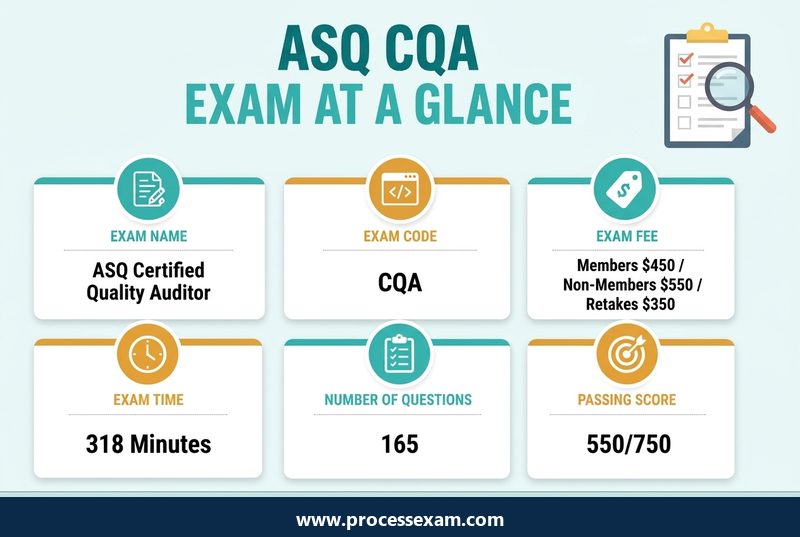
| Number of questions | 165 |
| Duration | Total appointment time - 330 minutes; Exam time - 318 minutes |
| Exam fee (USD) | ASQ members - $450; non-members - $550; retakes - $350 |
| Passing score | 550/750 |
Two of those numbers do most of the damage to unprepared candidates. The 165 questions include 15 unscored pretest items that look exactly like the rest, so roughly one question in eleven that you agonise over is worth nothing. And 318 minutes across 165 questions works out at about one minute fifty-six seconds each, before the case-study material is taken into account. ASQ publishes both facts, along with the current testing windows, on its Certified Quality Auditor certification page.
How do you sit a practice test so the score means anything?
A measurement taken under the wrong conditions is worse than no measurement, because you will act on it. Three conditions decide whether your practice score is informative or decorative.
Time the whole thing, in one sitting
An untimed practice test measures your knowledge with unlimited retrieval time, which is a state you will never be in again. Set the clock to the real exam time and do not stop it for anything. If you cannot spare a full sitting, run half-length tests on a proportional clock instead of stretching a full one across two evenings; a split session hides exactly the fatigue effect you need to see. Most candidates find their accuracy holds for the first ninety minutes and then drifts, and the drift is a finding, not a failure.
Use the same references you will carry in
The CQA is an open-book exam. ASQ allows you to bring your own bound reference materials, which changes the nature of practice testing completely: a mock sat with nothing on the desk measures a different skill from the one being examined. Practise with the exact books, tabs and annotations you intend to bring, and time how long a lookup takes you. Candidates discover two useful things this way. Some references are too slow to be worth opening under a two-minute clock. And a book you have not indexed yourself is close to useless when you are under pressure.
Do not look at an answer until the test is over
Checking answers as you go turns a measurement into a study session. It feels productive and it destroys the data: you cannot tell afterwards which items you would have got right unaided. Finish, then mark, then analyse. The discipline also rehearses the hardest part of exam day, which is leaving a question you are unsure about and moving on.
Log more than right and wrong
Before you mark anything, go back through the paper and label each answer: confident, reasoned, narrowed to two, or guessed. A correct guess is a future wrong answer wearing a disguise, and it is invisible in a raw score. Candidates who keep this label consistently find that their honest score is five to ten points below their reported one, which is precisely the gap that surprises people on the day.
How do you read a CQA score report domain by domain?
Once the test is marked, the percentage has done its job and you can put it away. The useful artefact is the breakdown by Body of Knowledge domain, because that is what tells you where the next two weeks go.
ASQ began testing a revised Body of Knowledge with the April 2026 window, and the weighting moved enough that a study plan built on the older outline now points at the wrong topics. The 150 scored questions are distributed like this.
| Domain | Scored questions | Share of the scored paper |
|---|---|---|
| I. Auditing Fundamentals | 37 | About 25% |
| II. Audit Process | 45 | 30% |
| III. Auditor Competencies | 30 | 20% |
| IV. Audit Program Management and Business Applications | 23 | About 15% |
| V. Quality Tools and Techniques | 15 | 10% |
Now do the arithmetic that most candidates skip. A domain percentage on its own is not a priority; a domain percentage multiplied by that domain's question count is. Scoring 60 percent in Domain II costs you eighteen scored questions. Scoring the same 60 percent in Domain V costs you six. If you spend your next fortnight on statistics because the tools percentage looked ugly, you have optimised the cheapest part of the paper. Rank your weaknesses by marks at stake, not by how bad the percentage looks.
What each domain will show you when it is weak
Domain I, Auditing Fundamentals, carries 37 scored questions and covers audit types, the auditor-auditee relationship, audit purpose and scope, the criteria you audit against, participant roles and professional conduct. It has grown in the current outline, and it now explicitly includes desk audits built from questionnaire-based assessments, hybrid and fully remote audits, and how an audit provides an independent view of cybersecurity and financial risk. Weakness here usually looks like confusion between categories rather than ignorance: second-party and third-party questions answered as though they were the same, or scope and purpose used interchangeably. The repair is a comparison table you write yourself, not another read-through.
Domain II, Audit Process, is the largest block at 45 scored questions and runs in the order a real audit runs, from preparation and planning through performance and evidence collection to reporting, follow-up and closure. Losses here are usually sequencing errors: candidates know every step but not what must be settled before the next one starts. If your breakdown shows Domain II below the rest, write the audit lifecycle out from memory and mark what goes wrong at each stage. It is the highest-value hour in the whole preparation.
Domain III, Auditor Competencies, holds 30 scored questions on auditor characteristics, on-site resource management, conflict resolution, communication and presentation, interviewing technique and team dynamics. It grew in the current outline, which is ASQ stating plainly that these are examinable skills rather than soft extras. Experienced auditors often score worst here, because they answer from personal habit instead of from the documented practice the question is testing. If that is your pattern, the fix is to read every stem asking what the standard expects, not what your last audit did.
Domain IV, Audit Program Management and Business Applications, has 23 scored questions on running an audit programme and on the business and financial impact of audit work. Weakness here tends to come from a narrow job: if you have only ever executed audits, programme-level questions about scheduling, staffing, evaluation and reporting to management will feel abstract. This is the domain where a borrowed handbook chapter genuinely helps.
Domain V, Quality Tools and Techniques, is only 15 scored questions but covers an enormous surface: problem-solving tools, process improvement, basic statistics, process variation, sampling methods, change control and configuration management, verification and validation, and risk tools. Know what each tool is for and how to read one. Do not try to become a statistician for ten percent of the paper. Our breakdown of the five scored domains and their sub-topics lists what sits under each one if you want to turn your weak areas into a checklist.
One more thing the breakdown will not show you: roughly 10 to 15 percent of the exam arrives as case studies, each a short audit scenario with supporting documents provided during the exam. The questions are ordinary four-option items, but they are slower. If your practice platform does not include scenario sets, add them from the sample material yourself, because a timing plan built only on standalone questions will run short.
Why does a memorised question bank inflate your score?
This is the failure mode that ruins practice testing as a measurement, and it is easy to fall into without noticing. Work through the same bank three times and your score will climb steeply. Almost none of that climb is knowledge. You are recognising items, and recognition is a different memory system from the one the exam taxes.
There are three symptoms worth watching for. Your score rises fastest between the second and third attempt at the same set, which is the opposite of how genuine learning curves behave. You answer faster without being able to explain the reasoning any better. And your score on a set of questions you have never seen sits well below your best recorded result.
The test for this is simple and slightly uncomfortable: keep a reserve of fresh questions you have never attempted, and use them for every measurement that matters. Repeated questions are for repair work, not for measurement. If you only have one bank, split it in thirds and quarantine the last third until you think you are ready.
There is a related trap in memorising answers rather than the reason behind them. The CQA question writers work from an outline in which every sub-topic carries a cognitive level, from Understand up to Evaluate and Create. You can see those levels for yourself in ASQ's published 2026 CQA Body of Knowledge. A sub-topic marked Understand can be answered from a memorised definition. A sub-topic marked Evaluate cannot, because the question will hand you a situation and ask you to judge it. A bank-trained candidate passes the first kind and stalls on the second, and the current outline has more of the second kind than the one it replaced.
What should happen between one practice test and the next?
The interval is where the improvement is made; the test only reveals it. A useful cycle has five stages and takes seven to ten days.
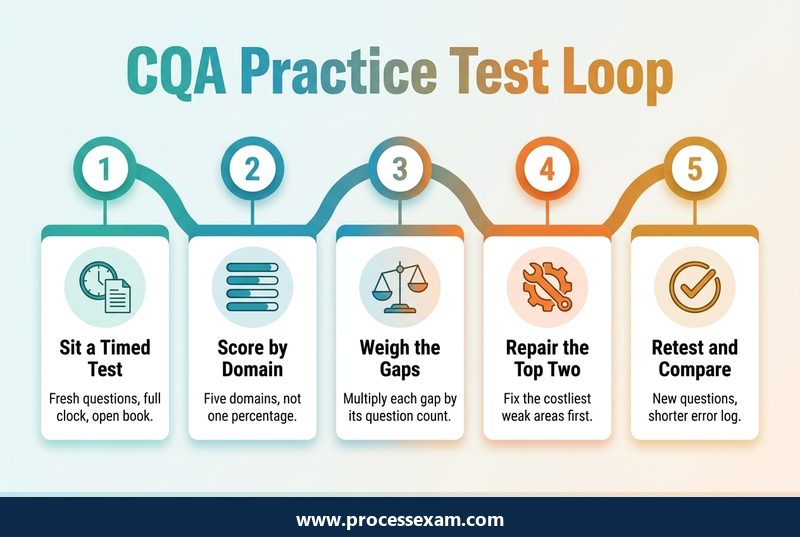
Sit a full timed test on fresh questions. Same clock, same references, no interruptions, no marking until the end.
Score it by domain, not in total. Write the five domain results and multiply each shortfall by that domain's question count so you can see the marks at stake rather than the percentages.
Classify every wrong and every guess. Sort them into four buckets: I never learned this, I mixed two things up, I misread the stem, and I ran out of time. Those four call for four completely different remedies, and treating them all as "revise more" is why some candidates plateau for months.
Repair the top two by marks at stake. Give them focused sessions rather than general reading. A confusion bucket needs a comparison you write yourself. A never-learned bucket needs source material. A misread-stem bucket needs slow, deliberate reading practice on old questions. A timing bucket needs pacing drills, not content.
Retest, and compare the report rather than the score. The question to ask is not whether the number went up but whether the same four buckets refilled. A shrinking error log with a flat score is real progress; a rising score with the same recurring confusions is not.
Keep every report. Three or four of them in sequence form the only honest record you will have of whether your preparation is working, and they make the readiness decision below something you can defend rather than something you feel.
When is your practice score high enough to book the exam?
No practice platform can tell you that you have passed, and any that claims to is overselling. What the evidence can do is make the decision defensible. Four conditions, met together, are a reasonable bar.
- Consistency, not a personal best. Two or three full-length attempts in a row, all on questions you have not seen, landing in the same band. One good score is noise.
- No domain trailing badly. The exam does not require a minimum per domain, but a single weak area big enough to swing thirty or forty scored questions is a risk you can still remove cheaply.
- Time to spare. You finish inside 318 minutes with enough left to revisit the items you flagged, and you have done that on a paper that included scenario-based sets.
- A shrinking guess count. Fewer answers labelled "guessed" attempt after attempt. This one matters more than the headline percentage, because guessed correct answers are the part of your score that will not survive a different question paper.
If you want a realistic reading before you commit, sit a full-length CQA practice exam on the same 165-question clock and compare the domain breakdown with the table above; the distance between your first attempt and your third is the clearest evidence you will get that the method is working.
There is a financial argument for waiting until the evidence is there, too. The exam costs $450 for ASQ members and $550 for non-members, and while ASQ offers a reduced retake rate of $350 for two years after an attempt, a retake still costs a testing window and several more weeks. Application deadlines sit several weeks before each window opens, so the decision to apply is made earlier than most candidates expect. ASQ lists the current windows and deadlines on its certification application page; work backwards from the deadline and make sure your last two practice attempts fall before it, not after.
Which measurement mistakes make candidates misjudge readiness?
Each of these produces a number that looks like evidence and is not.
- Measuring with questions you have already seen. The single biggest source of false confidence, and the easiest to avoid by quarantining a fresh set.
- Taking the first test too late. A test sat in the final week can only frighten you. Sat early, a poor score is information you still have time to act on.
- Treating a domain percentage as a priority. Sixty percent in a 45-question domain and sixty percent in a 15-question domain are not the same problem.
- Practising closed book for an open-book exam. Reference handling is an examinable skill in practice if not on paper, and it is trained only by using your books under the clock.
- Ignoring the guess column. A score that depends on lucky guesses is not reproducible, and the day that matters is not the day to find that out.
- Studying an outdated outline. Weightings changed with the current Body of Knowledge, so material built on the previous outline will send you to the wrong domains.
- Re-reading instead of repairing. Re-reading a chapter you already half-know feels like work and rarely moves a domain score. Targeted repair of a specific confusion does.
What does this measuring habit give you after you pass?
The loop described here is not a study trick invented for certification exams. It is the audit cycle applied to yourself: define the criteria, gather objective evidence, judge the evidence against the criteria, record the findings, act on the ones that matter, then verify that the action worked. Candidates who prepare this way tend to find Domain II easier than they expected, because they have been running the process rather than reading about it.
It also carries past the exam. ASQ certifications are maintained rather than granted once, so the same habit of measuring against a published criterion, recording the gap and closing it keeps a credential current instead of letting it lapse quietly. And in the job itself, the difference between an auditor who reports a finding and one who verifies that the corrective action held is exactly the difference between reading a score and reading a score report.
Start the loop early enough that the first measurement is still useful, keep your questions fresh, rank your gaps by marks rather than by percentages, and let the evidence, not the nerves, decide when you apply.
Frequently Asked Questions
How many questions are on the ASQ CQA exam?
The CQA exam has 165 multiple-choice questions, of which 150 are scored and 15 are unscored pretest items. You cannot tell which is which while you are sitting there, so answer every question with the same care and pace yourself across the whole paper.
What is the passing score for the ASQ CQA exam?
The passing score is 550 out of 750 on ASQ's scaled scale. Because scaling adjusts for the difficulty of the particular exam form, there is no published conversion from a practice-test percentage to a scaled score. Use practice results to compare yourself with yourself.
What does the CQA exam cost, including a retake?
The fee is USD $450 for ASQ members, $550 for non-members and $350 for retakes. Confirm the current amounts and the application deadline for your testing window on ASQ's certification pages before you apply, because deadlines fall weeks before the window opens.
How are the questions split across the 2026 Body of Knowledge?
The 150 scored questions are split across five domains: Auditing Fundamentals 37, Audit Process 45, Auditor Competencies 30, Audit Program Management and Business Applications 23, and Quality Tools and Techniques 15. These weightings apply from the April 2026 testing window.
How many practice tests should a CQA candidate take?
Quality matters more than quantity. Three or four full-length attempts on fresh questions, spaced about a week apart with targeted repair in between, give a more reliable readiness signal than a dozen repeats of one question bank you have started to recognise.
- ASQ Quality Auditor Sample Questions |
- CQA Exam Questions Download |
- CQA Test Questions |
- Quality Auditor PDF |
- ASQ Quality Auditor Book |
- ASQ CQA BOK PDF |
- Quality Auditor Certification Cost |
- Quality Auditor Certification Requirements |
- ASQ Quality Auditor Test Questions |
- CQA Question Bank |
- CQA Body of Knowledge (BOK) |
- Auditing |
- CQA Handbook


