
CPRSA Study Guide: Pega Robotics System Architect Exam
Updated on 23 September 2026. What’s new: the robotics exam is now PEGACPRSAV25 for Pega Robotic Automation R25, with 60 questions in 90 minutes and a 65% pass mark.
Pega rebuilt Robot Studio for its R25 release, and the Certified Pega Robotics System Architect exam moved with it. The current exam is PEGACPRSAV25, written against Pega Robotic Automation R25: 60 questions, 90 minutes, a 65% pass mark and a USD $190 fee per attempt. If you last looked at this credential when Pega wrote it PCRSA and Robot Studio ran inside Microsoft Visual Studio, the study path has changed underneath you.

This guide covers the exam as Pega runs it today, checked in September 2026. It sets out the nine topic areas and how they are weighted, the logistics you need before you book a seat, a four-week plan that fits around a working week, and the errors that quietly cost marks on the day.
What changed for CPRSA candidates when Pega Robotics moved to R25?
Pega Academy still carries two robotics exam pages, and the gap between them explains most of the confusion candidates meet. The older page describes exam code PEGAPCRSA80V1_2019, the Version 8 exam that people sat when Robot Studio was a plug-in hosted inside Microsoft Visual Studio. The page reached from the certifications list describes PEGACPRSAV25, and that one applies to Pega Robotic Automation R25. Notice which acronym each code carries: the retired code spells PCRSA, the current one spells CPRSA. Job adverts, forum threads and older blogs still use the earlier spelling, so both names point at the same career path.
R25 was not a point release. Pega rebuilt Robot Studio as a standalone application with an interface of its own, so the Visual Studio shell that older walkthroughs assume has gone. The release also changed how you inspect your own work: an Automation Overview gives a high-level view of an automation and lets you drill into any part of it, and an Event Explorer lists the events in a project so you can jump straight to the workflow you want to review, modify or debug. Pega sets out the full list in the Pega Robotic Automation R25 release notes.
Three consequences follow for anyone preparing now. Tutorials and screen recordings made before the redesign no longer match what is on your screen, so a video from the Version 8 era will send you hunting for menus that no longer exist. Migration between the old and new versions is a topic in its own right, because solutions built on 19.1 have to be brought forward rather than opened as they are. And the training Pega points candidates at has been rewritten: the Robotics System Architect mission on Pega Academy now runs to twenty modules and roughly twenty-two and a half hours, taught against R25.
One reassurance before you plan around it. Checked in September 2026, the credential sits on Pega Academy's certifications list and its exam page shows no retirement date, so the exam is live and bookable while you study.
Which Pega Robot Studio skills does the CPRSA exam actually test?
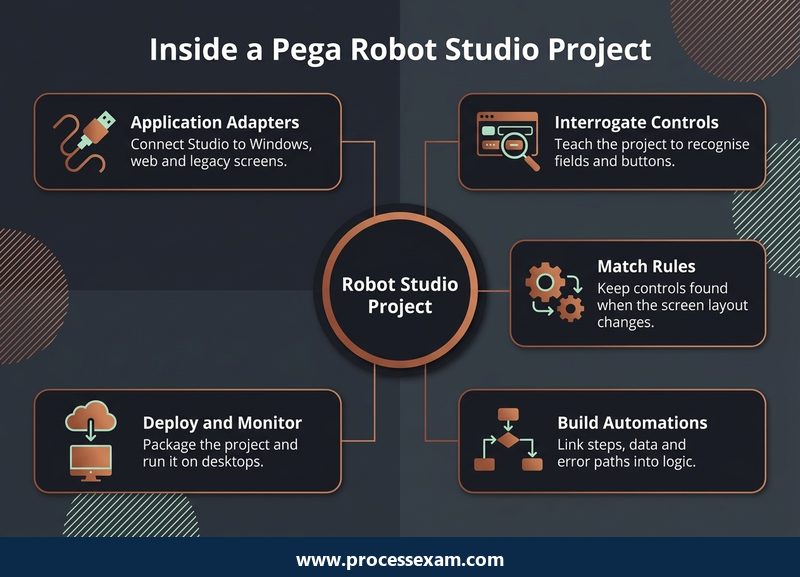
The exam is built around one question asked in many forms: can you make a software robot drive an application reliably? Everything else follows from that. The skills fall into five groups, and it helps to picture them as parts of a single project rather than as a syllabus list.
Connecting Studio to the applications a robot must drive
A robot works by attaching to the software a person would otherwise click through, whether that is a Windows desktop application, a web page or a legacy terminal. Setting up those connections, and knowing which one suits a given application, is the starting point of every project and the first thing the exam probes.
Interrogating and recording what is on screen
Interrogation is how a project learns that a particular box is the account number field and a particular button submits the form. The mission spends several modules on it: basic interrogation, enhanced interrogation options and interrogating a web application each get their own treatment, which tells you how much of the working day it occupies.
Match rules that keep controls found
Screens move. A control that was found by position on Monday can vanish on Tuesday because a column widened or a page loaded differently. Match rules decide which properties identify a control, and choosing them well is the difference between an automation that survives a release and one that breaks overnight.
Building and hardening automations
Automations are the logic that runs between those controls: reading a value, deciding what to do with it, writing it somewhere else, handling the case where the value is missing. The exam separates ordinary automation work from advanced technique and best practice, and it treats debugging as a skill of its own rather than as something you pick up by accident.
Data handling with the toolbox
Between the controls and the logic sits the plumbing: the components that hold, convert and move data while an automation runs. Pega's training gives this its own pair of modules, one on using the toolbox for simple automations and one on data handling, and the exam follows suit. Expect questions in which the right answer is a component you have either used or never heard of, with no middle ground. Text that arrives from a screen as a single string and has to become three fields, a list that must be looped over, a value that has to survive from one step to the next; these are ordinary problems on a real project, and they are ordinary questions on the paper.
Integration and deployment
The last group is what turns a working prototype into something a business can run. Robotic integration covers how automations exchange data with the wider Pega platform and with other systems; deployment covers packaging a project, publishing it and getting it onto the machines where it will run.
How are the nine CPRSA topic areas weighted?
Pega publishes a weighting for every area, and reading it changes how you spend your hours. Three areas alone account for more than half the paper, and one of them is worth more than seven of the others put together.
| Topic area | Share of exam |
|---|---|
| Automation Development | 22% |
| Interrogating and Recording | 17% |
| Advanced Automation and Best Practices | 15% |
| Pega Robotic Integration | 15% |
| Debugging and Diagnostics | 8% |
| Deployment | 8% |
| Applications | 7% |
| Match Rules | 5% |
| Overview and Projects | 3% |
Read from the bottom and the message is just as clear. Overview and Projects is worth three marks in a hundred, so an hour spent memorising project terminology is an hour taken from somewhere that pays four or five times better. Match Rules is worth five, yet it underpins the seventeen that interrogation carries, which is why it is worth studying next to interrogation rather than on its own.
Our topic-by-topic CPRSA syllabus lists the same nine areas with the weightings above, and Pega states them on the Pega Academy CPRSA exam page. Both were showing identical figures when this article was checked in September 2026. If you see a different split quoted anywhere, it belongs to the retired Version 8 paper, which grouped its content differently.
Why does interrogation carry so much of the exam?
Seventeen per cent for interrogation, plus five for match rules, looks generous until you have watched an automation fail in production. Interrogation is where a robotic project touches the real world, and the real world keeps moving.
When you interrogate an application you are telling the project how to recognise its parts. Every control you capture gets a set of properties that identify it later: a name, a class, a position, text that sits beside it. If the properties you rely on are the stable ones, the automation keeps working through redesigns and browser updates. If you accept whatever the interrogation offered first, the automation works on your machine today and fails for a hundred users next month.
That is the reasoning the exam is testing, and it is why the questions are so often scenarios rather than definitions. A typical item describes an automation that worked in testing and fails intermittently in production, then asks what you would change. The answer is usually about which property a match rule keys on, or about interrogating at the right level of the control tree, not about clicking a particular menu.
Web applications add their own layer, which is why the mission treats them separately from Windows applications. Pages render differently, elements are generated dynamically, and a browser extension mediates between Studio and the page. Anyone whose experience is entirely on desktop applications should spend deliberate time here, because the habits do not transfer cleanly.
There is a second reason the area is weighted so heavily. Interrogation is where a robotics project is most often handed to someone who is not a developer. Pega's own training opens with a citizen developer module for exactly that reason, and a system architect is frequently the person who has to review, correct or inherit work captured by a business user. Recognising a fragile capture in somebody else's project, and knowing what to re-interrogate rather than patch, is a different skill from doing it well yourself, and the scenarios test it.
The practical advice is simple. Do not read about interrogation; do it. Interrogate an application you use every day, break it on purpose by changing a window size or a zoom level, and work out which match rule survives. Half an hour of that teaches more than a chapter, and it is the half hour that shows up in your score.
What are the CPRSA exam rules on questions, time, pass mark and fee?
The logistics are straightforward, but they shape how you should practise, so get them clear before you book.
| Exam detail | CPRSA |
|---|---|
| Certification | Certified Pega Robotics System Architect (CPRSA) |
| Exam code | PEGACPRSAV25 |
| Vendor | Pega |
| Applies to | Pega Robotic Automation R25 |
| Number of questions | 60 |
| Duration | 90 minutes |
| Passing score | 65% |
| Exam fee | USD $190 |
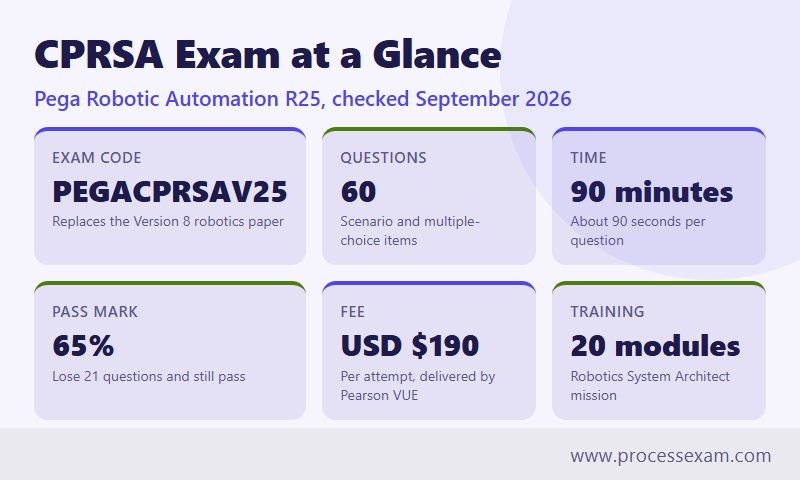
Sixty questions in ninety minutes leaves ninety seconds each, and robotics questions are not one-liners. Several describe a project, a failure and three plausible fixes, and reading one properly takes half your allowance. That maths is the argument for timed practice: not because the questions are hard in isolation, but because a candidate who spends four minutes on the first difficult scenario spends the last ten minutes guessing.
A 65% pass mark means you can lose twenty-one questions and still pass. It also means the two biggest areas can sink you on their own. Get Automation Development and Interrogating and Recording badly wrong and you have lost thirty-nine per cent of the paper before the other seven areas are counted.
Pega's exams are delivered by Pearson VUE, and Pega's certification FAQs put the fee at USD $190 per attempt, which matches the figure on our own exam pages. Book through the Pegasystems programme, confirm the exam code on the booking screen reads PEGACPRSAV25, and check the identification and system requirements before the day rather than on it.
What does a four-week CPRSA preparation plan look like?
This plan assumes you can give the exam five or six hours a week and that you have access to Robot Studio. If robotics is entirely new to you, run each week over two and treat the mission as your spine.
| Week | Focus | What to finish |
|---|---|---|
| 1 | Projects and applications | Work through the overview and application modules; connect Studio to one Windows and one web application of your own |
| 2 | Interrogation and match rules | Interrogate both applications, then deliberately break and repair the match rules until you can predict which ones survive |
| 3 | Automations and debugging | Build an end-to-end automation with data handling and error paths; step through it with the debugging and diagnostic tools |
| 4 | Integration, deployment and timed practice | Publish the project, cover the integration modules, then sit full-length timed papers and review every wrong answer |
Keep a short log as you go. One line per problem you hit, one line for the fix. By week four that log is worth more than any set of notes, because everything in it is something you personally got wrong, which is exactly the material the exam will find.
Week three is the point to measure yourself honestly: a timed run through the CPRSA practice test tells you whether the plan is working while there is still a fortnight to fix whatever it exposes.
Leave the last two days for revision alone. Re-read your log, walk once more through the nine topic areas and confirm you can say in a sentence what each one covers. Do not start a new module, and do not rebuild an automation you already understand.
Where do CPRSA candidates lose the most marks?
The failures follow a pattern, and none of them is about intelligence.
- Studying the wrong version. Material written for the Version 8 exam describes a Robot Studio that no longer exists. Check that anything you rely on names R25 or the current exam code.
- Reading instead of building. Robotics is a practical discipline, and scenario questions reward people who recognise a situation because they have been in it.
- Weighting hours by interest rather than by marks. Deployment is satisfying and worth eight per cent; automation development is fiddly and worth twenty-two.
- Treating match rules as a footnote. They are five per cent as a topic and a hidden factor in far more, because half the failure scenarios in the exam trace back to a control that could not be found.
- Skipping the debugging tools. Candidates who have never used the diagnostic tools in anger cannot answer questions about what those tools would have shown.
- Practising untimed. An untimed practice score flatters you. Ninety minutes with a clock running is a different exam.
- Guessing at the mission. Pega's own training uses the exact vocabulary the questions use, and several answer options differ by one term.
There is one more, harder to name. Candidates who have built automations for years sometimes fail because their habits are their own rather than Pega's. The exam asks what the recommended practice is, not what has worked for you, and where those differ the recommended practice wins.
Which jobs and projects does a CPRSA credential open?
Robotic automation sits where large organisations cannot change their systems quickly enough. A claims team works across four applications that will not be replaced this decade; a bank's onboarding process needs data copied between a mainframe screen and a web portal. Someone has to build the robots that carry that work, and the credential is how employers filter for people who can.
The roles that name it are recognisable: RPA developer, robotics automation developer, Pega robotics consultant, automation engineer inside a centre of excellence. On Pega projects specifically, the credential is often what separates the person who designs the automation estate from the person who maintains it, because the design decisions the exam tests, which controls to key on, where to put error handling, how to package for deployment, are the ones that decide whether an estate of fifty robots is a quiet asset or a weekly emergency.
There is a timing argument too. Robotic automation is often described as a bridge technology, useful only until the underlying systems are replaced, and that description has been repeated for a decade while the bridges kept being built. What has genuinely shifted is the expectation around them: organisations now want automations that are documented, monitored and safe to hand over, rather than scripts that only their author can repair. That expectation is precisely what the advanced practice, debugging and deployment areas of this exam are about, which makes the credential a reasonable proxy for the way the work is actually done now.
It also fits neatly beside Pega's other credentials rather than competing with them. A system architect who adds robotics can carry a project from case design through to the desktop automations that feed it, and that combination is rarer than either qualification on its own.
Whether you sit the exam next month or next quarter, work from the current version, build more than you read, and measure yourself against the clock before you book. The nine areas above are the whole of it, and none of them is beyond a working architect who gives them four honest weeks.
Frequently Asked Questions
What is the CPRSA exam code?
The current exam code is PEGACPRSAV25, and it applies to Pega Robotic Automation R25. An older robotics exam used the code PEGAPCRSA80V1_2019 for the Version 8 release. Confirm the code shown on the booking screen matches PEGACPRSAV25 before you pay for a seat.
Is PCRSA the same as CPRSA?
They name the same career path. Pega's older exam code spells the acronym PCRSA, while the current code and the certification name spell it CPRSA, short for Certified Pega Robotics System Architect. Older job adverts and articles still use PCRSA, so treat the two as one credential.
How many questions are on the CPRSA exam, and what is the passing score?
The exam has 60 questions with a 90-minute limit and a passing score of 65%. That is roughly 90 seconds per question, and many items are scenarios rather than single-line questions, so practise against a clock rather than working through question banks at your own pace.
How much does the CPRSA exam cost and where do you book it?
The exam fee is USD $190 per attempt. Pega exams are delivered through Pearson VUE, and Pega's certification FAQs quote the same $190 figure for exams taken that way. Check the current price and any voucher options on Pega Academy before you register for a date.
Do you need Pega training before taking the CPRSA exam?
Pega does not gate the exam behind a purchase, but it points candidates at the Robotics System Architect mission on Pega Academy, which runs to about twenty-two and a half hours across twenty modules taught against R25. Hands-on time in Robot Studio matters more than any single course.
- System Architect |
- Pega Robotics System Architect Test Questions |
- Pega Robotics System Architect Book |
- Robotics System Architect Certification Cost |
- Robotics System Architect Certification Requirements |
- Pega Robotics System Architect Sample Questions |
- Robotics System Architect PDF |
- CPRSA Question Bank |
- CPRSA Exam Questions Download |
- CPRSA Test Questions |
- PEGACPRSAV25 Mock Exam |
- PEGACPRSAV25 Simulator |
- PEGACPRSAV25 |
- PEGACPRSAV25 PDF |
- PEGACPRSAV25 Certification |
- PEGACPRSAV25 Certification Cost |
- PEGACPRSAV25 Certification Requirements |
- PEGACPRSAV25 Exam Questions |
- PEGACPRSAV25 Sample Questions |
- PEGACPRSAV25 Book |
- PEGACPRSAV25 Question Bank |
- PEGACPRSAV25 Study Guide


