
CPOA Exam: A Study Method Built on IIBA's Guide
Priya, a business analyst moving into a product owner role, has two things open on her desk: a list of generic exam tips and IIBA's Guide to Product Ownership Analysis. The tips say to build a timetable and make flashcards. The Guide says what the exam is actually about. To prepare for the CPOA exam, read the Guide against the seven knowledge-area weights, turn each area into recall cues, and test yourself on why wrong answers are wrong.

That is a change from the way this page used to advise candidates. Generic tips still help with discipline, but they say nothing about where the marks sit. The method below does. It suits a candidate who has a few weeks, a copy of the Guide and no wish to read every page with equal attention. If you searched for how to take the CPOA exam, the logistics are covered near the end; most of what follows is how to study.
Why do general study tips fall short for the IIBA CPOA exam?
Advice such as organising a schedule, using visual aids, revising regularly and asking mentors is sound, and none of it is wrong. It is incomplete, because it treats every exam as the same kind of object. The IIBA Certificate in Product Ownership Analysis is not. IIBA's handbook describes a competency-based paper of multiple-choice, knowledge-based questions, built on seven named knowledge areas with a published share of questions each. A study plan that ignores that structure spreads effort by habit, not by the blueprint.
There is a second gap. A tip such as "practise active recall" does not tell you what to recall. The exam syllabus does: each knowledge area is divided into competencies, and each competency carries a proficiency wording such as General Awareness or Practical Knowledge. Those two phrases tell you how deep to go. General Awareness means you recognise the idea and can pick it out of a scenario; Practical Knowledge means you can follow the rule it describes. Neither asks you to have run a product for years, and neither is satisfied by reading once and hoping.
The Guide itself is the natural spine of preparation. IIBA's handbook names the Guide to Product Ownership Analysis as a self-directed study resource and says the PDF is free for IIBA members. If you are not a member, check IIBA's store for how it is supplied before you build your plan around it. One naming warning: ServiceNow sells an unrelated exam that shares the acronym, so everything here concerns the IIBA certificate, whose figures are below.
| Exam detail | IIBA CPOA |
|---|---|
| Certification | IIBA Certificate in Product Ownership Analysis (CPOA) |
| Exam code | CPOA |
| Certifying body | IIBA |
| Category | Specialized Business Analysis |
| Number of questions | 60 |
| Duration | 90 minutes |
| Exam fee | Member - $250, Non-Member - $405 |
| Retake fee | Member - $195, Non-Member - $350 |
| Result | Pass or Fail |
Read the table once and note the last row. With no numeric pass mark to aim at, the sensible target is not a score but coverage: every knowledge area understood well enough that no question in it is a surprise.
How do you read the seven knowledge areas against their exam weight?
IIBA's handbook gives the blueprint in one short list. The lightest area, Apply Foundational Concepts, takes 10 percent of the questions. The other six, namely Cultivate Customer Intimacy, Engage the Whole Team, Make an Impact, Deliver Often, Learn Fast and Obsess About Value, take 15 percent each. Applied to 60 questions, that is about six questions from the foundations and about nine from each other area. The arithmetic matters for one reason: no area is small enough to skip, and none is large enough to rescue a weak spot elsewhere.
A reading budget is the simplest way to put that into practice. The table below is this article's own planning device, not an IIBA figure. It assumes twenty hours of first-pass reading and lets time follow weight: two hours for the lightest area and three for each of the others. Treat the hours as a starting allocation and move them after your first self-test, because weight tells you what the exam asks and not what you find hard.
| Knowledge area | Exam weight | Reading hours if time follows weight | Question to carry into the first pass |
|---|---|---|---|
| Apply Foundational Concepts | 10% | 2 | Which roles and artefacts exist, and who owns each? |
| Cultivate Customer Intimacy | 15% | 3 | How do I learn what a customer needs, not what they say? |
| Engage the Whole Team | 15% | 3 | What does the team share, and who sits around it? |
| Make an Impact | 15% | 3 | Who is the product for, and why should anyone back it? |
| Deliver Often | 15% | 3 | What is built first, and how is it checked? |
| Learn Fast | 15% | 3 | What gets measured or assessed, and what does it change? |
| Obsess About Value | 15% | 3 | Is this still worth doing, and can we do it better? |
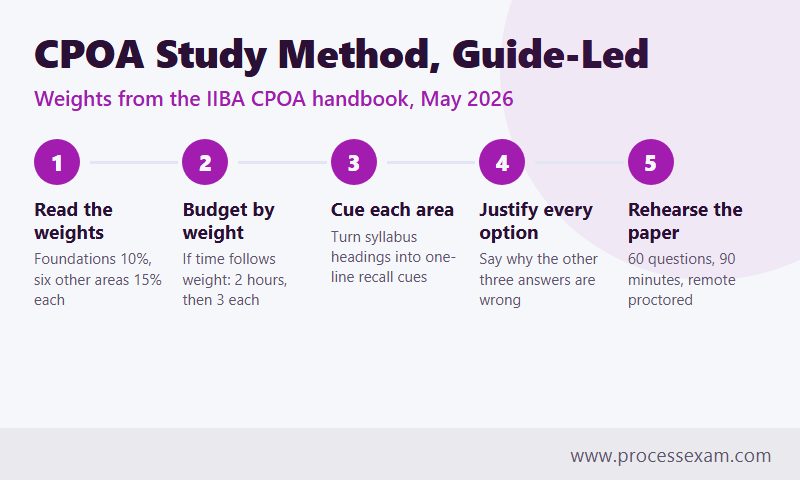
Write the carry-in question at the top of a fresh page for each area before you open the Guide. Reading with a question in hand is the cheapest improvement on passive study, and it forces you to notice when a section answers a different question from the one you expected. Those mismatches are where wrong answers on exam day come from: you recognise a term and attach the meaning you use at work, not the meaning the Guide gives it.
Which recall cues can you pull from each knowledge area?
A recall cue is one line you can say from memory that reopens a whole section. Build them from the competency headings in the exam syllabus, which every candidate can see, instead of from your own notes. Each area has two groups of three headings. Learn the six headings in order, then write one short line per heading using the pattern verb, object, reason. The cue lines below show the grouping for each area; write your own sentences in your own words, because a line you wrote is one you can reconstruct.
Foundations: three artefacts and the lifecycle around them
The headings run Define Key Product Disciplines, Align Products to Strategy and Align Artefacts, then Structure the Work, Drive Success and Expand Product Owner Role. The cue is a chain: disciplines, strategy, artefacts, team, success, role. The syllabus mentions a roles and permissions matrix, with a RACI as the example, so make sure you can say what such a matrix settles. A good self-prompt is to sketch a product lifecycle from conception to retirement and mark where product management, product ownership and product marketing each act.
Customer Intimacy: from getting personal to integrating what you learn
Here the headings are Get Personal, Build Empathy and Engage in Observation, followed by Validate Problems and Integrate Learnings. Notice the direction of travel: closeness first, evidence second, then the learning has to go somewhere. Your cue can be a single sentence that begins with a person and ends with a changed decision. Test it by taking your last real customer conversation and labelling which heading each part of it belonged to.
Whole Team: a shared view, then the people around it
Share Vision, Collective Responsibility and Align Product make up the first group, and Provide Psychological Safety, Analyze Stakeholder and Engage Stakeholder the second. Read the first group as what the team holds in common and the second as how it treats people. The self-prompt is to list five stakeholders you deal with and say whether you have analysed them or merely emailed them, since the syllabus separates the two verbs.
Making an Impact: who, fit and promise, then strategy, initiatives and support
The first triplet is Target Customers, Assess Product-Market Fit and Define Value Proposition. The second is Define Product Strategy, Integrate Across Initiatives and Cultivate Organizational Support. A cue that works is to say the first group aloud as a pitch to a customer and the second as a pitch to a sponsor. If you cannot make the second pitch without repeating the first, you have not separated them yet.
Deliver Often: an outer loop of releases and an inner loop of iterations
Manage Product Backlog, Minimal Viable Product Builds and Plan Releases sit above Plan Iteration, Build Product Features and Validate Product Features. Picture two loops, the larger one governing what ships and the smaller one governing each build cycle. When a scenario question mentions a small first version, the cue tells you to look at the outer loop; when it mentions checking a feature, look at the inner one.
Learn Fast: three subjects crossed with two verbs
The headings form a tidy grid. Measure Strategy, Measure Product and Measure Delivery sit beside Assess Strategy, Assess Market and Assess Delivery. Draw the grid from memory, three columns by two rows, and write one example in each cell. The grid is the cue, and it also exposes a trap: the Assess headings here overlap in wording with the headings in the value area, so keep the subject, not the verb, as your anchor.
Obsess About Value: three alignment checks, then three ways to improve
Assess Strategic Alignment, Assess Market Alignment and Assess Financial Viability ask whether the work deserves to continue. Assess Capability, Optimize Process and Leverage Technology ask how to do it better. State the split as a question and an answer: should we, then how. Because this is the last area many candidates study, schedule it earlier in your reading than feels natural, or give it a second pass at the end.
How do you test yourself when every answer has to be justified?
The CPOA paper is multiple choice, and at this level the wrong options are usually things a sensible product owner might actually do. That changes what self-testing should look like. Recognising the right answer is not enough; you need to know why the other three fail, because the reason is what transfers to a new scenario. Four short habits build that skill without any question bank at all.
First, cover and recite. Hide your cue sheet and write the six headings of one area from memory, then check. Second, rewrite a heading as a scenario: take Plan Releases and invent two sentences about a team that has to choose what ships first. Third, write four options for it, one right and three plausible, and for each wrong option name the exact idea it misapplies. Fourth, teach it aloud to an imaginary colleague for a few minutes; wherever you hesitate, that heading goes back on the list.
Keep an error log with one line per miss: the knowledge area, the heading, and whether the slip was a vocabulary slip or a reasoning slip. After a few sessions the log will disagree with the weights in a useful way, because the area you find hardest may not be the one you budgeted most for. Move hours toward the log, within reason, since every area still carries at least ten percent of the paper.
When the cue sheets feel solid, run them against unfamiliar wording in the IIBA CPOA practice exam and note which knowledge area each unfamiliar question came from, the same way you sort your own scenarios. Fresh phrasing is the real test, since a cue that only works on the sentences you wrote has not yet become knowledge. Searches for CPOA practice questions often lead to dumps sites, which teach memorised answers and nothing about reasoning; avoid them.
Which job belongs to which week of preparation?
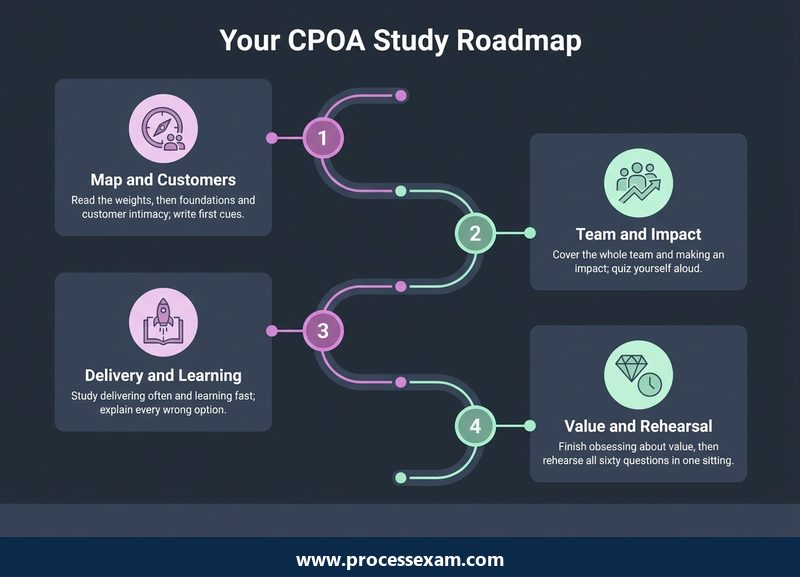
Instead of a timetable that divides the syllabus into equal slices, give each week one job and one pair of areas. The example below follows the twenty-hour reading budget and adds review each week, for about five to seven hours per week in total. If you have longer, stretch the same pattern; if you have less, keep the order and shorten the sessions, not the areas.
Week one: map the paper and learn the people
Read the handbook's exam structure and blueprint, set up your error log, then read Apply Foundational Concepts and Cultivate Customer Intimacy. These two are the vocabulary of everything later, and they total five reading hours on the budget. End the week by reciting both areas' cues from a blank page.
Week two: the team and the impact
Cover Engage the Whole Team and Make an Impact, six hours between them. Because these areas are about people and positioning, the best test is describing them using a real project of yours. Add your first rewritten scenarios and four-option drills, and revisit week one's cues for a short stretch each day.
Week three: the rhythm of building and learning
Deliver Often and Learn Fast form a pair: one is about what ships, the other about what you find out. Study them side by side and draw the two-loop sketch and the three-by-two grid from memory. Spend the last session mixing questions from weeks one to three, so that you practise telling the areas apart rather than studying them in order.
Week four: value, then rehearsal
Give Obsess About Value its three hours early in the week, then stop reading and start rehearsing. Sit a mixed set of all sixty questions in one sitting with the clock set to ninety minutes, mark your position at the halfway point of the clock, and log every miss. A day later, do a lighter review of only the log. The day before the exam is for rest and for the remote-proctoring checks, not for new material.
IIBA's handbook says candidates taking the exam online must photograph their photo ID during check-in and points to a separate guide to online proctored exams for technical set-up. Read that guide during week four, not on exam morning, and test your equipment while there is still time to fix a problem.
How does the method change with your background?
If you already work as a product owner
Your risk is answering from your employer's habits instead of the Guide's. Spend your first-pass time comparing what you do with each competency heading, and treat every difference as a flag. You may be able to compress the schedule, but do not skip the foundations: the vocabulary check is where experienced people lose the easiest questions.
If you are a business analyst
Elicitation, stakeholders and value will feel familiar, which makes them the dangerous areas, because familiarity breeds skimming. The newer ground for many analysts is the product viewpoint: backlogs, minimal builds, releases and measuring outcomes. Give that ground your extra hours, and use the grid and two-loop sketches to anchor it.
If you are changing careers
Add time, not shortcuts. Stretch the plan across six weeks with the foundations spread over the first two, and read the glossary-style sections slowly. Lean hard on the four-option drill, because it forces you to learn why practices exist, which is what a person with no product experience most needs.
What does the exam cost, and when does the six-month clock start?
Budget Member - $250 or Non-Member - $405 for the first sitting, and Member - $195 or Non-Member - $350 if you need a retake. IIBA's handbook says there is a fee for each attempt, that rewrite fees are not part of the first payment, and that you can ask for a refund within 30 days of IIBA receiving payment. Prices change, so confirm them on IIBA's certification page before you pay.
The clock matters more than the price. The handbook gives you half a year, counted from the day IIBA receives payment, to both book and sit the paper. That makes the order of work a planning decision: pay when your first two weeks are done and you know the plan is holding, not before you have looked at the Guide. Paying first and studying later turns slack into pressure. Paying once you have built cue sheets gives you a deadline that is long enough to leave room for a retake if the first attempt goes badly.
Taking the exam is straightforward once you have booked: it is delivered online with remote proctoring, so you need a quiet room, a working machine and your identification ready. For the wording of each rule, rely on IIBA's own handbook and its CPOA certification page. The CPOA syllabus lists every competency heading used in this method, which makes it a handy map before you start.
The method is deliberately small: seven areas, a budget that follows their weights, cue sheets, a habit of justifying answers, and one job per week. None of it needs special tools, and all of it can be checked against IIBA's own blueprint. Start by writing the carry-in question for the first area, and the rest of the plan builds from there.
Frequently Asked Questions
How do I take the CPOA exam?
You buy the exam from IIBA, then schedule and sit it within six months of IIBA receiving payment, according to IIBA's handbook. The paper has 60 multiple-choice questions, lasts 90 minutes and is delivered online with remote proctoring. Have your photo ID ready for check-in and read IIBA's online-proctoring guide before the day.
What is the best way to study for the CPOA exam?
Read IIBA's Guide to Product Ownership Analysis one knowledge area at a time, giving each time in proportion to its weight. Turn the syllabus headings into one-line recall cues, test yourself by explaining why the wrong options fail, and keep an error log by area. Rehearse all 60 questions under the 90-minute clock before you sit.
Which knowledge areas carry the most weight on the CPOA exam?
None dominates. Foundations weigh 10 percent, while each remaining area, Cultivate Customer Intimacy, Engage the Whole Team, Make an Impact, Deliver Often, Learn Fast and Obsess About Value, weighs 15 percent. On 60 questions that is about six from the foundations and nine from each other area.
Is there a free study guide for the CPOA exam?
IIBA's handbook lists the Guide to Product Ownership Analysis PDF as a study resource and says it is free for IIBA members. Premium members also get digital access resources, and members can use IIBA's KnowledgeHub. If you are not a member, check IIBA's store for how the Guide is supplied.
Is the CPOA the same as the ServiceNow CPOA exam?
No, they are different credentials. IIBA's CPOA is the Certificate in Product Ownership Analysis for product owners and business analysts, with 60 questions in 90 minutes. ServiceNow uses the same letters for a different credential about owning a ServiceNow platform. Syllabus, fee and format differ, so check the vendor name before you buy study material.
- IIBA Product Ownership Analysis Exam Questions |
- IIBA Product Ownership Analysis Question Bank |
- IIBA Product Ownership Analysis Questions |
- IIBA Product Ownership Analysis Study Guide |
- IIBA CPOA Quiz |
- CPOA Certification |
- CPOA Questions |
- CPOA Practice Test |
- CPOA Study Guide Material |
- CPOA Sample Exam |
- Product Ownership Analysis Certification |
- IIBA Certificate in Product Ownership Analysis |
- IIBA Product Ownership Analysis Book |
- Product Ownership Analysis Certification Cost |
- Product Ownership Analysis Certification Requirements |
- IIBA Product Ownership Analysis Sample Questions |
- CPOA Exam Questions Download |
- CPOA Test Questions |
- Product Ownership Analysis PDF


