
ASQ CPGP Exam Guide: GMP Domains, Format and Study Plan
A deviation opens on the production floor at 02:10. A tablet press has drifted outside its validated compression range, half a batch is already in the tote, and the shift lead needs a decision before the next campaign is dispensed. Who signs? Which records prove what happened? Does the fix count as a change that has to be reported? The ASQ Certified Pharmaceutical GMP Professional exam is built out of moments exactly like that one.
The CPGP is not a recall-the-definition credential. ASQ writes most of its questions at the applied end of Bloom's revised taxonomy, so the paper hands you a situation and asks what a competent GMP professional would do next. That is why candidates who have run investigations, hosted inspectors or released batches tend to find the exam fair, while candidates who have only read about GMP find it relentless.
This guide walks through what ASQ expects before you apply, how the paper is built, what each of the eight Body of Knowledge areas carries, how to use the open-book rules properly, and a ten-week plan that gets you there.
Why does the CPGP exam read like a shift on the production floor?
ASQ's Body of Knowledge for this credential covers compliance with good manufacturing practices as regulated and guided by national and international agencies for the pharmaceutical industry. It spans finished human and veterinary drugs and biologics, combination devices, the component raw materials behind them including active pharmaceutical ingredients and excipients, and packaging and labeling operations. That scope is deliberately wide, because a GMP professional is rarely allowed to specialise.
Each topic in the published CPGP Body of Knowledge carries a cognitive level in brackets at the end of its subtext, and that level tells you the highest complexity at which the topic can be tested. Reading those brackets is the single most useful hour of preparation you will spend. A topic marked Understand can be revised from notes. A topic marked Analyze, Evaluate or Create cannot.
Work through the document and the pattern becomes obvious. Change control is split into pre-change analysis at Analyze, change implementation at Create and post-change analysis at Analyze. Investigations and CAPA sit at Evaluate, with CAPA feedback and trending at Create. Audit processes and audit follow-up are both Evaluate. In-process and finished goods inspection criteria are at Create. These are not topics you recall; they are topics you exercise.
That shapes the questions. A typical CPGP item describes a situation with more detail than you strictly need, offers four options that are all plausible to someone who has never had to defend a decision, and rewards the one that a regulator and a quality unit would both accept. The distractors are usually actions that are technically possible but skip a required step, invent an authority the quality unit does not have, or solve the symptom rather than the cause.
Who the credential is written for
The CPGP suits people who already carry GMP responsibility rather than people hoping to enter the industry. Quality assurance and quality control staff who review and release batches. Validation and qualification engineers. Regulatory affairs professionals who assess post-marketing changes. Manufacturing supervisors in sterile and nonsterile operations. Auditors and compliance specialists who host inspections. Contract manufacturing oversight staff who manage quality agreements on someone else's site.
If your daily work includes writing or approving deviations, judging whether a change needs a filing, arguing with a supplier about a certificate of analysis, or explaining a data integrity gap to an inspector, the exam is largely describing your job back to you.
Do you meet ASQ's experience bar for the CPGP?
This is where a number of people stop, and it is worth checking before you plan anything else. ASQ requires five years of on-the-job experience in one or more areas of the Certified Pharmaceutical GMP Body of Knowledge. Three of those five years must have been spent in a role ASQ describes as a decision-making position, and the experience has to come from full-time paid work.
The detail that surprises candidates is what ASQ does not offer here. On several of its credentials a degree shortens the experience requirement. On this one it does not: ASQ states plainly on its official CPGP certification page that there are no education waivers for this exam. A pharmacy or chemistry degree helps you pass; it does not help you qualify.
"Decision-making position" is the phrase worth thinking hardest about. It does not mean line management. It means work where your judgement carried consequence without someone above you re-deciding it: approving a deviation closure, signing a batch disposition, accepting or rejecting a supplier, deciding that a laboratory result was assignable, setting a validation acceptance criterion. If your experience is genuinely of that kind, describe it in those terms on the application rather than by job title.
How is the CPGP exam built, and what does it cost to sit?
The CPGP is a long paper. ASQ offers it as a computer-delivered exam and as a paper-and-pencil exam, and the two differ in length. The computer-delivered version carries 165 multiple-choice questions, of which 150 are scored and 15 are unscored pretest items seeded among them. The paper version carries 150 questions. Either way you cannot tell a pretest question from a scored one, so every item gets the same attention.
The other defining feature is that the CPGP is open book. You may bring reference material, and ASQ's condition is that all reference materials must remain bound. That rule does more to shape sensible preparation than any other single fact about this exam, and it gets its own section below.
| Exam detail | ASQ CPGP |
|---|---|
| Certification | ASQ Certified Pharmaceutical GMP Professional (CPGP) |
| Exam code | CPGP |
| Certification body | ASQ |
| Category | Auditing |
| Number of questions | 165 |
| Duration (minutes) | Total appointment time- 270 Exam Time - 258 |
| Exam fee (USD) | ASQ MEMBERS - $450 NON-MEMBERS - $550 RETAKES - $350 |
| Passing score | 550/750 |
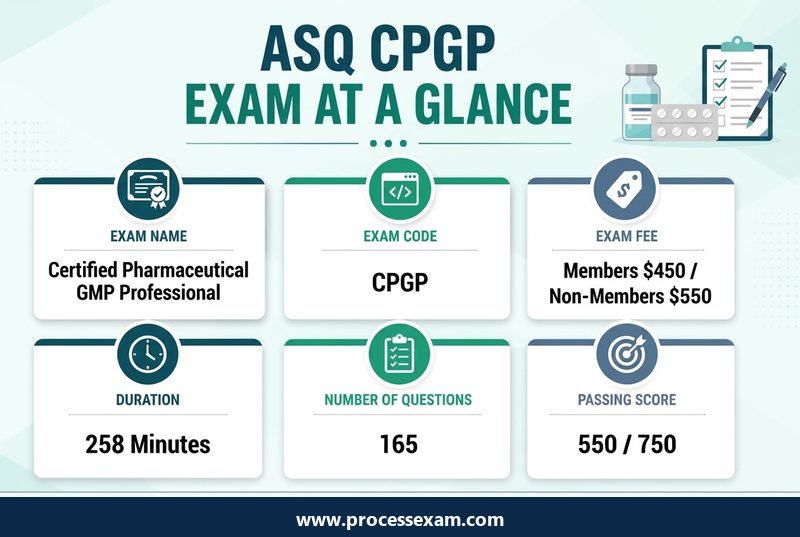
Read those figures together, because they interact. The total appointment time is 270 minutes and the exam time inside it is 258 minutes; the difference is the administrative wrapper around the paper, not extra thinking time. Against 165 questions, 258 minutes works out at roughly 1 minute 34 seconds per question. That sounds generous until you meet a scenario that runs to a full screen and a reference you want to check.
The score is reported on a scaled basis: 550 out of 750. A scaled score is not a percentage of questions answered correctly, and there is no published conversion between the two, so do not try to reverse-engineer how many items you can afford to miss. Treat every question as one you intend to get right, and use practice scores as a trend rather than a prediction.
On fees, ASQ prices the exam at USD $450 for ASQ members, $550 for non-members and $350 for retakes. The $100 gap between the member and non-member fee is close to the cost of membership itself, which is why many candidates join before they register rather than after. Applications and scheduling both run through ASQ's certification application pages, and exam windows are published there well in advance.
Which eight domains carry the 150 scored questions?
The Body of Knowledge divides the 150 scored questions across eight areas, and the split is public. Knowing it stops you from spending four weeks on the area you enjoy and four days on the area that carries the most marks. Our CPGP exam syllabus breakdown lays the same structure out topic by topic if you want it alongside the ASQ document.
| # | Body of Knowledge area | Questions |
|---|---|---|
| I | Regulatory Agency Governance | 17 |
| II | Quality Systems | 26 |
| III | Laboratory Systems | 20 |
| IV | Infrastructure: Facilities, Utilities, and Equipment | 17 |
| V | Materials and Supply Chain Management | 17 |
| VI | Sterile and Nonsterile Manufacturing Systems | 22 |
| VII | Filling, Packaging, and Labeling | 18 |
| VIII | Product Development and Technology Transfer | 13 |
I. Regulatory Agency Governance (17 questions)
This area asks you to place a requirement in the right framework. It covers the acts, statutes and directives that apply to pharmaceuticals, and the interpretation of the regulations and guidances published or administered by the bodies ASQ names in the Body of Knowledge: the Pharmaceutical Inspection Convention and Pharmaceutical Inspection Co-operation Scheme, the International Conference on Harmonization, the World Health Organization, the European Medicines Agency, the Food and Drug Administration, Health Canada, USDA 9CFR and other national regulators and international standards.
It then moves to mutual recognition agreements, which govern product registration, import and export of raw material or finished product, and the sharing of inspection findings. Inspections themselves are examinable: pre-approval, system-based, for-cause and licence renewal inspections, their typical frequency, and how to prepare for and host both in-person and remote evaluations including record requests and digital reporting.
Enforcement actions come next, with warning letters, consent decrees, licence withdrawals, product seizure and import alerts named explicitly. Regulatory agency reporting covers post-marketing changes and how they are assessed for impact to choose a reporting method, global reporting requirements such as supplements, field alerts, biological product deviation reports, adverse events, recalls, annual reports and variations to dossiers, and product surveillance including risk evaluation and mitigation strategies and pharmacovigilance. The area closes on four documents worth knowing cold: the Site Master File, Validation Master Plan, Drug Master File and Site Reference File.
II. Quality Systems (26 questions)
The heaviest area on the paper, and the one where the cognitive levels climb highest. It opens on the quality management system itself, with ASQ pointing at ICH Q7, ICH Q10 and EU GMP among other guidances for the requirements around development, operation and management review for suitability and effectiveness. Quality unit management follows: the Qualified Person and Management Representative roles, batch release and disposition for investigational and commercial product, and the requirement that the quality unit be independent of operations.
Risk management is tested at Apply against ICH Q9 and ICH Q12, and the Body of Knowledge also names the Quality Management Maturity assessment programme as a way of judging how effective a quality system actually is. Training and personnel qualification covers needs analysis, proof of proficiency with documented evidence and periodic reassessment, training effectiveness testing, and the supervisor's responsibility for ensuring staff are trained for the work they do.
Then come the engine-room topics. Change control across pre-change impact assessment, implementation against a plan, and post-change analysis for new risk. Investigations and CAPA across trigger events, immediate and corrective and preventive action, and CAPA trending used to modify the quality system. Audits and self-inspections across schedules, audit types, remote and on-site conduct, evidence of completion and verification that corrective actions worked.
Documents and records management is where data integrity lives: the GMP document system from corporate standards down to test instructions, record review against the ALCOA attributes of attributable, legible, contemporaneous, original and accurate together with PIC/S data integrity guidance, and regulatory record retention requirements. The area finishes with product complaints and adverse events, periodic product assessment comparing the US annual product review with the European product quality review, and a long treatment of supplier and contractor quality: supplier quality systems, controls over selection and procurement, supplier evaluation and certification, quality agreements and the management of outsourced manufacturing, development and testing.
III. Laboratory Systems (20 questions)
Laboratory Systems begins with compendia, and specifically the difference between required and informational chapters, and how the United States Pharmacopoeia, European Pharmacopoeia and Japanese Pharmacopoeia differ in what they demand for marketing authorisation. You review compendial methods for suitability in your own laboratory, and check test methods, qualification, validation and verification against the relevant chapters.
Laboratory investigations of atypical results is the area candidates underestimate. You need procedures for investigating biological, microbiological and chemical data and unknowns, and you need to interpret out-of-specification and out-of-trend data well enough to decide the outcome of the laboratory phase and whether a wider investigation is triggered. That topic is set at Evaluate for a reason.
The rest of the area is instrument management including identification, classification, qualification, calibration and preventive maintenance; specifications for raw materials, intermediates, packaging components, labels and finished products, and when specifications must be revised; record-keeping and data integrity in acquisition systems, audit trail review for error, falsification and fraud, and certificate of analysis review; sample, reagent, solution and standard handling, labelling and storage; stability programmes covering release versus stability-indicating tests, trend review against expiry dating and the handling of a stability-point failure; and the requirements for reserve samples and retains.
IV. Infrastructure: Facilities, Utilities, and Equipment (17 questions)
Facilities questions turn on size, construction and location of buildings, control system placement, and the separation requirements that prevent cross-contamination, with antibiotics, hormones and toxins called out by name. Lighting, ventilation and drainage in manufacturing and storage areas are examinable, as is facilities change control.
Utilities is dense. Water supply system design gets specific: dechlorination, reverse osmosis, deionisation and distillation as unit operations, delivery lines, back-flow and back-siphonage prevention, drainage, and the right water grade for the processing step, whether potable, purified or water for injection. Compressed air and gas systems cover storage, flow regulation, filtration, venting and purging. Utility design for production steps such as washing, sterilising and depyrogenation is tested, along with utilities change control.
Equipment covers location, design, construction, installation and maintenance; layout that minimises error and supports cleaning; cleaning, maintenance and sanitisation procedures; the need for and methodology of product-contact cleaning validation and the differences between single-use, multi-use and dedicated equipment; and equipment change control. Qualification and validation is a single high-value topic covering factory and site acceptance testing and design, installation, operational and performance qualification before process validation. The area also takes in maintenance and metrology, general cleaning, sanitisation, pest control and sterilisation, automated and computerised systems including open versus closed systems, configuration control and security requirements for on-site, multi-site and cloud-based systems, and business continuity and disaster recovery planning.
V. Materials and Supply Chain Management (17 questions)
This area follows material from the gate to disposal. Receipt covers how incoming raw materials, bulk chemicals, components and labelling are received, labelled and stored, and what to do about damaged material, material from unapproved suppliers and missing documentation. Inventory control covers transaction documentation, status changes, allocation and stop shipments for quality holds.
Sampling covers representative plans and sample sizes, the sampling environment and utensils appropriate to the material, and the cleaning and monitoring of both. Storage, identification and rotation covers environmental suitability, label content, stock rotation by first-in first-out and first-expired first-out, the distinction between retest and expiration dates, and the sources of mix-up together with the controls that reduce them, including segregation, lot control and special handling for similarly named materials.
Shipping and distribution brings in temperature-sensitive requirements, tertiary packaging and monitoring devices, shipping report analysis against good distribution practice, and supply chain security through tamper-evident seals, manifests, document verification, barcoding, radio frequency identification and serialisation. Traceability and sourcing covers incoming materials through finished drugs, biological agent requirements for bovine and transmissible spongiform encephalopathy, and pedigree and sourcing for active pharmaceutical ingredients, biological starting materials and excipients. The area ends with salvaged and returned goods and destruction.
VI. Sterile and Nonsterile Manufacturing Systems (22 questions)
The second-heaviest area. It opens on master and completed batch records: the required elements including issuance, yields, critical step verification, processing instructions and hold times, and the requirements for execution, review and disposition. Production operations then differentiate human drugs, veterinary drugs and biologics, continuous versus batch manufacturing, utility requirements across sterile and nonsterile production and across solid, semisolid, liquid, cream, ointment and combination products, and the operations requiring gowning, sanitisation and hygiene.
In-process controls cover test selection at each step, monitoring of critical process parameters, process capability including the calculation of Cp and Cpk, and assessment of specification limits against registration or compendial requirements. That Cp and Cpk topic is worth flagging: it is one of the few places in this exam where you may need to compute something rather than judge it.
Critical unit processes are the heart of the area: sterilisation and sterilising filtration, aseptic filling, depyrogenation, lyophilisation and other drying, tablet granulation and compression, terminal sterilisation and emulsification, together with the validation studies behind them including media fill process simulations, re-evaluation and revalidation criteria, and environmental monitoring requirements and tools for viable and nonviable particulates, pressure differentials, temperature and humidity. Contamination and cross-contamination sources and mitigation close out the main body, followed by the distinction between reprocessing and reworking and the storage and segregation of those materials.
VII. Filling, Packaging, and Labeling (18 questions)
Filling operations cover procedures that preserve identity, strength and purity across liquids, powders, ointments, tablets, capsules and suspensions, the controls needed for different filling equipment, contamination controls at every stage, approval of staged materials and status labelling throughout. Environmental monitoring during production is tested through active air sampling, settling plates, swab sampling, nonviable particle counting and contact plates for surfaces and people.
Inspection is examined twice over. In-process and finished goods inspection covers seal tests, torque testing and bottle rejection systems, qualification and challenge of vision and detection systems, defect characterisation and equipment failure detection. Product inspection covers the training and reproducibility of staff performing manual and semi-automatic inspection, the requirement for periodic eye examinations and documented breaks, and validation of automated inspection.
Packaging and labelling controls make up the rest, and they are detailed: content protection procedures, equipment qualification and maintenance, line clearance, quality check criteria, cut-label and splice procedures, one hundred per cent inspection of hand-applied labels, packaging process controls, contamination controls and tamper-evident and child-proof requirements. Labelling adds print quality and durability, whether a label change needs regulatory notification and approval, label reconciliation and investigation of discrepancies, control of unused batch-coded labels, offline printing, roll label splicing, gang printing, secure storage and destruction, and access control over labels, package inserts and printed cartons.
VIII. Product Development and Technology Transfer (13 questions)
The smallest area, and the one most often skipped by candidates whose careers sit in commercial manufacturing. It covers quality by design: identifying critical quality attributes for products and critical process parameters for processes, the concept of design space across the product lifecycle, and process analytical technology tools including multivariate data analysis, process analysers and endpoint controls.
Phase-appropriate GMP requirements follow, applying the right level of GMP across the product lifecycle, recognising the requirements attached to development phases including method qualification and validation and comparability protocols, the GMP requirements for combination drug-device and drug-delivery products, and the production and packaging of clinical trials material and investigational medicinal products. The area closes on raw material and packaging selection studies, new product development reports covering stability, material compatibility and method development, and scale-up and technology transfer including manufacturing site change, analytical laboratory site change, inter-site comparison of results, and the ranging, capability, in-process control, hold time and shipping studies that make a transfer succeed.
How do you make an open-book exam work instead of against you?
Most candidates hear open book and relax. That is the trap. An open-book exam with 165 questions and 258 minutes punishes anyone who plans to look things up, because a single unplanned search can cost three or four questions' worth of time. The reference set is there to confirm, not to teach.
ASQ's rule is that all reference materials must remain bound, which rules out loose printouts, ring-punched pages and anything you could rearrange at the desk. Confirm the current conditions on ASQ's own exam page before you build anything, because delivery conditions differ between the computer-delivered and paper versions.
Build a reference set you can hit in fifteen seconds
The useful test is not what is in your reference set but how fast you can reach a given item. Aim for this:
- One primary handbook, tabbed by Body of Knowledge area. Eight tabs, labelled I to VIII in ASQ's own order, so a question about labelling reconciliation sends you straight to tab VII.
- A single bound personal summary. Definitions you keep confusing, the reprocessing versus reworking distinction, retest versus expiration dates, release versus stability-indicating tests, DQ/IQ/OQ/PQ sequence, the water grades and where each is used.
- Formulas on one page. Cp and Cpk, written out with a worked example rather than symbols alone.
- Nothing you have not used during practice. A book you have never opened under time pressure is dead weight.
Then practise with the set. Take timed question sets with the reference beside you and make a rule: if you cannot land on the answer within fifteen seconds of opening a book, close it, answer on judgement, flag the question and move on. Candidates who learn that discipline in week eight do not lose twenty minutes to it on exam day.
How should you build a ten-week CPGP study plan?
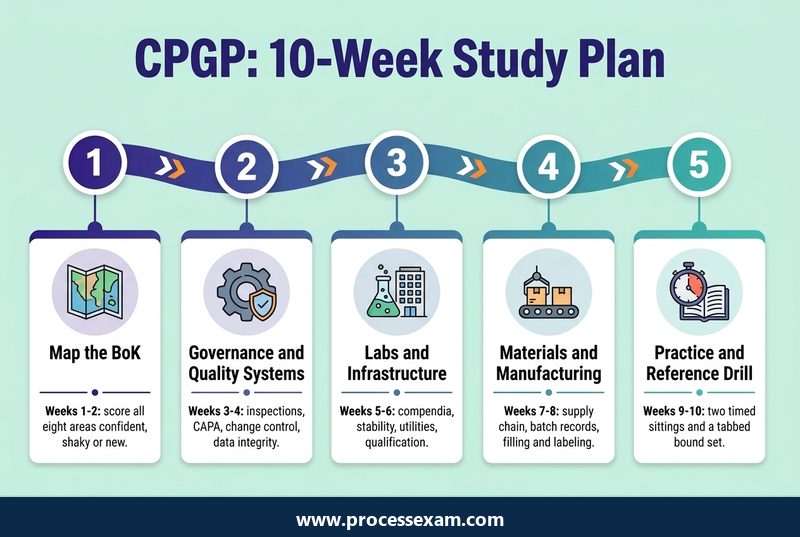
Ten weeks at six to eight hours a week suits someone already working in pharmaceutical quality. If your experience is concentrated in one or two areas, stretch it to fourteen weeks and put the extra time where your gaps are, not where your confidence is.
| Weeks | Focus | What you should finish with |
|---|---|---|
| 1-2 | Map the Body of Knowledge | All eight areas read once, every topic scored confident / shaky / new, and the cognitive level noted beside each |
| 3-4 | Governance and Quality Systems | Inspection and enforcement types, reporting routes, QMS structure, change control, CAPA, audits, data integrity and supplier management |
| 5-6 | Laboratory and Infrastructure | Compendia, atypical result investigations, stability, specifications, utilities and water grades, qualification and validation sequence |
| 7-8 | Materials, Manufacturing, Packaging | Supply chain controls, batch records, critical unit processes, environmental monitoring, filling, labelling and reconciliation |
| 9 | Development and technology transfer | Quality by design, phase-appropriate GMP, clinical trial material, scale-up and site transfer studies |
| 10 | Timed practice and reference drill | Two full-length timed sittings, a reviewed error log, and a bound reference set you can navigate without thinking |
Two habits make the difference inside that plan. Keep an error log from week three, recording not the question but the reason you got it wrong: misread scope, missed a required step, confused two terms, ran out of time. Review the reasons rather than the questions, because the same reason repeats across unrelated topics.
The second habit is to rehearse under real conditions early. A 258-minute paper is a physical event as much as an intellectual one, and nobody discovers their concentration curve by doing twenty questions at a time. When you reach week nine, put a full-length CPGP practice test in the diary for a Saturday morning, sit it straight through with only your bound references, and treat the score as a diagnostic rather than a verdict. The areas that collapse in hour three are the ones to rebuild in week ten.
Where do CPGP candidates lose the most marks?
The failure patterns on this exam are consistent, and every one of them is a preparation decision rather than a knowledge gap.
- Studying the job instead of the Body of Knowledge. Deep experience in sterile manufacturing is worth 22 questions. It is worth nothing on the 26 questions in Quality Systems or the 20 in Laboratory Systems if you never opened those areas.
- Ignoring the cognitive levels. Candidates revise Evaluate-level topics from bullet-point notes and then meet a question that asks them to judge between two defensible positions.
- Treating open book as a substitute for preparation. The reference set saves you on five questions. It cannot carry you through 165.
- Answering as the person you are rather than the role the question describes. Many items put you in the quality unit. The right answer is the one the quality unit is empowered to make, not the one production would prefer.
- Fixing symptoms in investigation questions. If an option corrects the batch but never reaches root cause or impact assessment, it is almost always a distractor.
- Skipping Product Development and Technology Transfer. Thirteen questions is roughly nine per cent of the scored paper, and it is the cheapest area to secure because its topics sit mostly at Understand and Apply.
- Assuming a percentage pass mark. The result is scaled at 550 out of 750, and guessing at an equivalent percentage leads people to relax at exactly the wrong point.
- Leaving the experience check to the end. Five years, three of them in a decision-making position, no education waivers. Confirm it before you buy anything.
What does exam day look like, and what happens after you pass?
Plan the day around the clock rather than the content. The appointment runs 270 minutes in total with 258 minutes of exam time inside it, so arrive expecting the best part of four and a half hours in the chair.
Pacing across 258 minutes
Work in three blocks of roughly 55 questions and check the clock only at the end of each. A comfortable first block leaves you 170 minutes or more for the remaining 110 questions. Flag anything that needs a reference check or a second reading and move on; the first pass should be about banking the questions you know. Reserve the last 25 minutes for flagged items and a sweep for unanswered ones, because an unanswered question scores nothing while a considered guess between two remaining options scores something often enough to matter.
Read the final sentence of a long scenario first. GMP questions bury the actual ask under process detail, and knowing whether you are being asked for the immediate action, the root cause, the responsible party or the reporting route tells you which half of the scenario to read carefully.
The week before
Stop adding material. Re-read your error log by reason rather than by topic, walk your reference set until every tab is muscle memory, and confirm the practical arrangements: exam window, delivery mode, identification requirements and what you are permitted to bring. Sleep matters more on a 258-minute paper than on a 90-minute one.
Holding the credential afterwards
The CPGP is one of the ASQ credentials that has to be maintained. ASQ's recertification requirements ask holders to obtain 18 recertification units within a three-year recertification period, or to retake the exam at the end of that period. Applications can be submitted up to six months before or 60 days after the recertification date; after the grace period the route is by exam, and a certification that is not renewed by exam within a year of its recertification date expires.
In practice this is easy to satisfy if you record units as you earn them rather than in the last month: training you deliver or attend, audits you conduct, professional membership, relevant project work and conference participation all contribute. Candidates who let it drift are the ones who end up sitting 165 questions again.
What the credential changes
Inside a pharmaceutical quality organisation the CPGP does three specific things. It gives an external, examined basis for the judgement calls you already make, which matters in front of auditors and in front of a contract partner's quality unit. It signals breadth at a point in a career where most people have gone deep in one area, which is what moves a specialist toward quality management or a multi-site compliance role. And it is recognised by the same regulated employers and contract manufacturers who take ASQ's auditing and quality credentials seriously, because it is built from the regulations and guidances they are inspected against.
None of that happens because of a line on a profile. It happens because the preparation forces you to learn the seven areas of GMP that your current role never touches, and those are exactly the areas where the next job will test you.
Frequently Asked Questions
How many questions are on the ASQ CPGP exam?
The computer-delivered CPGP exam has 165 multiple-choice questions, of which 150 are scored and 15 are unscored pretest items. The paper-and-pencil version has 150 questions. You cannot identify the pretest items while sitting the exam, so treat every question as if it counts.
What does the CPGP exam cost?
ASQ prices the CPGP at USD $450 for ASQ members, $550 for non-members and $350 for retakes. The $100 member discount is close to the cost of membership itself, which is why many candidates join before registering rather than after they receive a result.
What is the passing score for the CPGP?
The CPGP passing score is 550 out of 750 on a scaled basis. A scaled score is not a percentage of questions answered correctly and ASQ publishes no conversion between the two, so use practice results as a trend rather than as a predicted pass mark.
What experience do you need to sit the CPGP exam?
ASQ requires five years of on-the-job experience in one or more areas of the Body of Knowledge, three of which must be in a decision-making position. The work must be full-time and paid, and ASQ offers no education waivers for this particular exam.
Is the CPGP exam open book?
Yes. ASQ allows reference material, with the condition that all reference materials remain bound. Loose printouts are not permitted. Build a tabbed set you have already used during timed practice, because searching unfamiliar references during the exam costs more time than it saves.
- Auditing |
- ASQ Pharmaceutical GMP Professional Test Questions |
- CPGP Question Bank |
- CPGP Body of Knowledge (BOK) |
- Pharmaceutical GMP Professional Simulator |
- Pharmaceutical GMP Professional Mock Exam |
- ASQ Pharmaceutical GMP Professional Book |
- ASQ CPGP BOK PDF |
- Pharmaceutical GMP Professional Certification Cost |
- Pharmaceutical GMP Professional Certification Requirements |
- ASQ Pharmaceutical GMP Professional Sample Questions |
- CPGP Exam Questions Download |
- CPGP Test Questions |
- Pharmaceutical GMP Professional PDF |
- CPGP Handbook


