
CPBA Certification: What Changed and What the Pega Exam Covers Now
Updated on 8 October 2026. What’s new: the exam now follows Pega Platform '25 (code PEGACPBA25V1), with Pega GenAI worth 10% and Insights worth 5% of the topic list
Yes, the CPBA exam has changed, and older study notes still describe a topic list that no longer exists. The paper now follows Pega Platform '25 (code PEGACPBA25V1): It stays at 50 questions, 90 minutes and a 65% pass mark, but Pega GenAI is now a tested topic, Insights is a separate block, and case management still leads the weighting.

Has Pega retired or replaced the Business Architect exam?
No. Pega Academy's page for the Certified Pega Business Architect exam, read in October 2026, lists the paper as applying to Pega Platform '25, carries the exam code PEGACPBA25V1 and shows no retirement date. That is the same version our product page covers, so a guide that still talks about a 2025 refresh as if it were upcoming is out of date.
What did change is the content. The vendor describes the certification as testing your ability to take part in the design and construction of Pega applications in App Studio by working from business objectives and requirements. Two topic lines in the current list will be new to anyone who studied from an older outline: Pega GenAI (10%) and Insights (5%). An earlier topic list that many blogs still reproduce had separate lines for Pega Express and for Reporting, and neither appears on the current page. Pega's own Business Architect mission carries a note that the Pega Express methodology is being replaced by the Blueprint Delivered methodology, which helps explain why Blueprint now sits inside the exam while Pega Express does not.
The exam at a glance
| Item | Current detail |
|---|---|
| Exam name | Certified Pega Business Architect (CPBA) |
| Exam code | CPBA (Pega's code: PEGACPBA25V1) |
| Applies to | Pega Platform '25 (CPBA Version 25) |
| Number of questions | 50 |
| Duration | 90 minutes |
| Passing score | 65% |
| Exam fee | USD $190 |
| Delivery | Pearson VUE, at a test centre or online proctored |
| Languages | English, German, Spanish, French, Japanese, Portuguese-Brazilian |
You can confirm every line on the official Pega Academy exam page, and you should do so before you book, because Pega moves its exams to a new platform version from time to time. If the page you open shows a different code, you are looking at a different version of the paper and the weights in this guide will not apply.
What stayed the same
The format did not move. Fifty questions in 90 minutes is under two minutes for each one, which is generous for a paper whose verbs are mostly "describe", "identify" and "configure". The pass mark of 65% is the figure older guides quoted too. The audience is also the same: the Business Architect is the person who sits between the business team and the developers, designing what gets built in App Studio rather than writing the underlying rules by hand.
Where do the marks sit now that GenAI and Insights are on the list?
Seven topics share the paper, and two of them, case management and application development, hold 55% of it between them. The weights below come from the exam page on Pega Academy. They describe the share of the exam, so a topic with a small percentage still produces a few questions you cannot afford to leave blank.
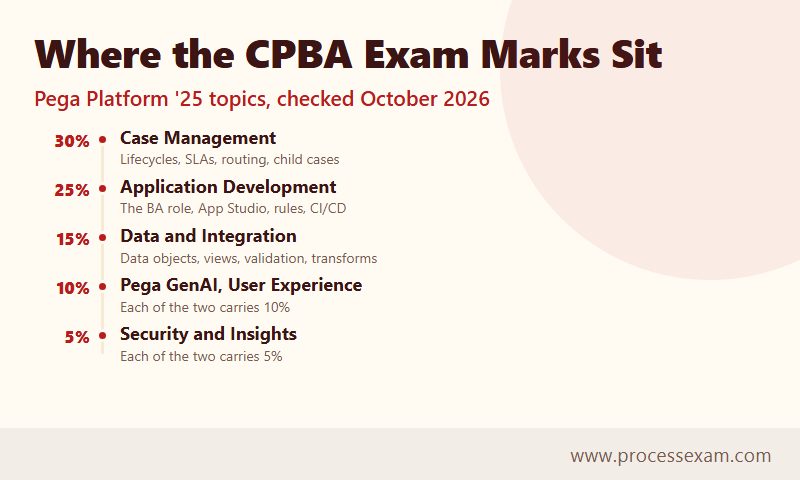
| Topic | Share of the exam | What it tests in one line |
|---|---|---|
| Case Management | 30% | Designing case lifecycles and controlling how work moves |
| Application Development | 25% | The Business Architect role and how Pega applications are built and delivered |
| Data and Integration | 15% | Data objects, relationships, validation and transforms |
| Pega GenAI | 10% | Blueprint, Autopilot, Knowledge Buddy, Connect Rules, agents and tools |
| User Experience | 10% | Views, portals and form behaviour |
| Security | 5% | Personas, operators, access groups, authorization and authentication |
| Insights | 5% | Tables, charts, columns, filters and sorting |
The full topic-by-topic wording is on our CPBA syllabus page, which shows the same seven topics as Pega's own page.
Reading the weights as a time budget
If the paper follows the percentages closely, case management alone is about 15 of the 50 questions, and application development is a little over a dozen. Those two topics are also where preparation pays off fastest, because case management is hands-on and repeatable, and application development is mostly recall of terms and roles. Data and integration comes next with roughly seven or eight questions, and the other four topics share the rest.
A sensible split of study hours follows the weights, with a small bonus for anything that is new. GenAI and Insights are the topics where even experienced Pega users are most likely to have gaps, because neither existed in the form the exam now describes when many people first learned the platform. Give each of them a few focused hours even though they are small, and you remove the questions that are hardest to guess.
Why a small topic can still decide the result
With a 65% pass mark, you can miss roughly a third of the paper. That sounds comfortable until you notice how the misses cluster. A candidate who is strong on case lifecycles but ignores security, user experience and Insights has written off about a fifth of the questions before sitting down, and then has to be nearly perfect everywhere else. Spreading effort across all seven topics is the safer plan than polishing the biggest two.
What does the new GenAI topic expect a Business Architect to explain?
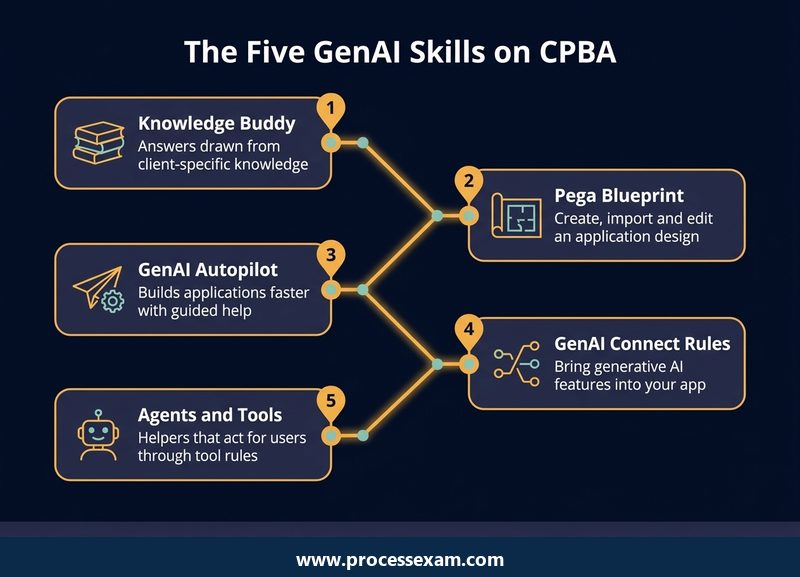
The GenAI block is worth 10% and is written entirely in the language of understanding: describe, analyze, explain. Nothing in the official wording asks you to write code. You are expected to know what each capability is for, who benefits from it and when you would choose it, the way a business architect would argue for it in a design workshop.
Knowledge Buddy
The exam wants you to describe how Pega GenAI Knowledge Buddy provides client-specific contextual knowledge and support. In plain terms, the question is how an assistant can answer from an organisation's own material instead of from general knowledge, so that a caseworker gets help that fits the company's policies. Expect scenario wording such as "a service team wants answers based on its own documents; which capability fits?"
Pega Blueprint
Blueprint is the most concrete item on the list because the objective names three actions: create, import and modify a Blueprint. It is the route for turning an application design into something you can bring into Pega Platform. Pega Academy teaches it through a module on Blueprint for Business Architects plus two short challenges, one on creating a Blueprint and one on importing it into the platform. Candidates who skip those challenges often cannot answer a question about what happens after the design is imported.
GenAI Autopilot
Here the verb is analyze: you should be able to say what role Autopilot plays in developing applications faster. Think about where time goes in building an application and where guided assistance removes manual steps, and be ready to explain the benefit without overselling it.
GenAI Connect Rules
This objective is about integration: you explain how to bring generative AI features into your own application by using Connect Rules. The test is whether you recognise Connect Rules as the mechanism for linking a process to a generative AI service, not whether you can configure one from memory.
Agents and Tool Rules
The last objective asks how GenAI agents and Tool Rules benefit application users. Learn the relationship in one sentence, an agent acts on a user's behalf and uses tools that you define, and then practise stating the user benefit rather than the mechanism.
A good way to revise this block is to take each of the five items and write one sentence that starts with the business problem, for example "a support team keeps answering the same policy questions", and finishes with the capability you would pick. If you can do that for all five without looking, the GenAI questions are largely covered.
Do case management and application development still decide the result?
For most candidates, yes. Together they carry 55% of the exam, and both are the areas where the Business Architect's day-to-day work shows up most directly.
Case management at 30%
The official objectives read like a tour of a working application. You design a case lifecycle, set case statuses and add instructions to tasks. You add a service level agreement and configure urgency, goals, deadlines and passed deadlines. You route assignments to users, work groups and work queues, and you can route using business logic. You identify duplicate cases, add optional actions, automate workflow decisions with conditions, pause and resume processing with wait steps, skip a stage or a process, configure child cases and decide when to use automation shapes.
The easiest way to hold this together is to picture one request, say a refund claim, and follow it from submission to closure. The claim starts a case. The lifecycle splits the work into stages such as intake, review and payout. A service level agreement sets a goal for how soon the review should finish and a deadline after which the work is late, and urgency rises as time passes. The review assignment goes to a work queue, but a high-value claim routes to a named approver through a condition. A wait step pauses the case until a customer replies. A duplicate check stops the same claim being filed twice, and a child case handles a related investigation without blocking the parent. Each of those sentences maps to one or two objectives, so telling the story out loud is real revision.
Application development at 25%
This topic mixes role knowledge, platform concepts and delivery tools. You describe the role and skills of a Pega Business Architect, identify the stakeholders on a Pega project and weigh the benefits of building digital solutions on Pega Platform. You explain how the Situational Layer Cake, prescriptive design, studio interoperability and the Reuse Library support modular enterprise reuse, and you can state the benefits of Pega's Center-out business architecture. Accessibility features, the value of building in App Studio, the roles of workspaces and branches, and the part played by rules, rulesets, classes and records are all listed. So are Pega's CI/CD pipeline and Deployment Manager, collaboration tools, and the way Agile Studio, the Developer Assistant and Agile Workbench support and track development.
Most of this is vocabulary with a reason behind it. When a question asks why a team would layer an application, the answer is reuse without copying, and when it asks what a branch is for, the answer is isolating a team's changes until they are ready to merge. Because the verbs are "describe" and "explain", a candidate who has read the Academy material twice and can paraphrase each term in a sentence collects most of these marks.
How much time do data, user experience, security and Insights really deserve?
Together these four topics add up to 35% of the paper, which is more than case management alone. They are quicker to learn, so they are where an efficient plan wins.
Data and Integration, 15%
You configure data objects, data relationships and data records, capture and present data using fields, field types and views, and create calculated values. You validate data with rules based on business logic, and you manipulate application data by setting default property values and configuring data transforms. The recurring trap is confusing where a value lives with how it is shown: a field type decides how data is captured, a view decides where it appears, and a data transform decides what it starts as. Build one small data object with a relationship to another and you will answer most of these questions from experience.
User Experience, 10%
The user experience objectives are short: group fields to create views, add and remove fields in views, configure user interface elements and portal content, and set form appearance, visibility and controls. Pega Academy teaches these through Constellation, the UI architecture its mission describes, so practise in that environment rather than relying on screenshots of older interfaces.
Security, 5%
Two ideas carry this topic. First, how personas, operators and access groups relate: a persona describes a kind of user, an operator is an individual account, and an access group decides what that operator can do. Second, the difference between authorization and authentication. Authentication asks who you are, authorization asks what you may do once the system knows. Both are easy to learn in an evening, and both are classic multiple-choice material.
Insights, 5%
The newest small topic asks you to describe the benefits of using Insights, create visualizations with tables and charts, and use columns, filters and sorting. If you have only ever used older reporting screens, spend an hour building a table with a filter and a chart in the current tool so that the wording of the options feels familiar on exam day.
What should you study from Pega Academy as Pega Express gives way to Blueprint Delivered?
Start with the Business Architect mission on Pega Academy. It is the vendor's own route into this exam: required modules on the role of a Business Architect, Pega GenAI Blueprint, Pega positioning and the Pega Express overview, followed by modules on case life cycle design, data modelling, displaying data in Constellation, assigning and completing work, and controlling case workflow. Many modules come with a hands-on challenge, and the exam topics line up with those challenges closely enough that finishing them covers most of the case management, data and user experience objectives.
One adjustment is needed. The mission still carries a Pega Express overview module, and the page notes that the Pega Express methodology is being replaced by Blueprint Delivered. The current exam list no longer names Pega Express as a topic, so read that module for context rather than memorising it, and use the saved time on the GenAI and Insights material instead.
A three-pass way to prepare
Rather than counting weeks, work in passes, and move on only when a pass is done.
- Learn. Go through the mission modules in the order Pega gives, and keep a one-page glossary of terms you could not explain aloud on first reading.
- Build. Do every challenge, then rebuild one small application yourself without the instructions: a case with three stages, an SLA, a routed assignment, a data object and a view.
- Test. Sit full-length papers against the clock, review each wrong or guessed answer against the objective it came from, and loop back to the weakest topic.
For the third pass, a timed CPBA practice exam tells you quickly whether you are guessing on the GenAI, security and Insights questions, which is exactly where self-assessment usually flatters candidates.
What a good practice score looks like
Aim to score comfortably above the pass mark on papers you have not seen before, not on repeats. A repeat score measures memory of the answers, and a first-sitting score measures the skill. If your first-sitting results swing widely from one paper to the next, a topic is still weak, and the topic breakdown in your review tells you which one.
What does the exam cost, and how is it delivered?
The exam fee is USD $190. Pearson VUE proctors the exam, so you create an account on the Pearson VUE page for Pega, register for the exam there and pay at booking. Pega Academy lists two delivery options: you can either travel to a test centre or sit the paper from home or the office, where a proctor watches through your webcam and the room must be quiet and free of interruptions.
The paper is offered in English, German, Spanish, French, Japanese and Portuguese-Brazilian, and Pega Academy shows a retirement date of "N/A" for this version, which means none is announced. Discount offers, retake terms and rescheduling windows are set by Pega and Pearson VUE and can change, so read them on the booking pages on the day you pay. They are left out here because they sit on pages that change.
Checks before exam day
- Confirm the exam you book reads Certified Pega Business Architect and the code PEGACPBA25V1.
- If you choose online delivery, test your webcam, microphone and room before the appointment rather than during it.
- Decide your pacing in advance: with 50 questions in 90 minutes you have roughly 1.8 minutes each, so flag a question after two minutes and move on.
- Read each scenario question for the business need first and the Pega feature second; the correct option is usually the one that meets the need with the least extra work.
Is CPBA still worth taking now that Blueprint can draft an application design?
Pega describes the Business Architect as the liaison between the business function and the technical development team, who makes sure the solution reflects the business's needs. That job does not disappear when a tool drafts the first version of an application design. Someone still has to judge whether the design is right: whether the lifecycle matches how work really moves, whether the SLA is realistic, whether the data model captures what the business needs. The CPBA topics are the vocabulary for that judgement, and the new GenAI and Insights topics are Pega's signal that Business Architects are now expected to work with those tools.
What the credential shows an employer
It shows that you can talk about a Pega application with developers and with business stakeholders and mean the same thing. Pega Academy marks the exam as beginner level and lists the Business Architect as one of its roles, alongside System Architect, Decisioning Architect, Robotics System Architect and Solution Designer. If you later move towards building the rules yourself, the System Architect role is the neighbouring path, and the case, data and user experience knowledge from CPBA carries straight over.
A note on salary claims
Older articles on this exam quote a fixed salary range for certified architects. It is left out here: a figure without a published survey behind it is not a reason to take an exam, and pay varies widely with country, employer and experience. If pay is your reason, look at current job listings for the role in your own market.
Who gains most
Business analysts, product owners and consultants who already work with Pega teams gain the most, because the certificate turns informal knowledge into a checked standard. Newcomers gain a structured path, since the Academy mission and the exam topics follow the same list. Existing developers gain the least, but the GenAI and Insights topics are a quick way to confirm they are current.
Frequently Asked Questions
What is CPBA certification?
CPBA stands for Certified Pega Business Architect. It is Pega's certification for people who take part in designing and building Pega applications in App Studio from business objectives and requirements. The current paper follows Pega Platform '25 and carries the exam code PEGACPBA25V1.
How many questions are on the CPBA exam and what is the pass mark?
The CPBA exam has 50 questions and lasts 90 minutes, and the passing score is 65%. That gives you a little under two minutes for each question, so most candidates have time to flag a difficult scenario question and return to it before the clock runs out.
How much does the CPBA exam cost?
The CPBA exam fee is USD $190. Pega delivers the exam through Pearson VUE, so you pay when you register on the Pearson VUE site. Pega and Pearson VUE set any discounts, retake terms and rescheduling rules, so check their booking pages before you pay.
Which topics are on the current CPBA exam?
Seven topics: case management 30%, application development 25%, data and integration 15%, Pega GenAI 10%, user experience 10%, security 5% and Insights 5%. GenAI and Insights are the newer lines, and the exam page on Pega Academy lists the objectives under each one.
Has Pega retired or replaced the CPBA exam?
No. In October 2026 the Pega Academy exam page still listed the Certified Pega Business Architect exam for Pega Platform '25 with no retirement date. The syllabus changed, with GenAI and Insights now included, but the certification, its name and its format remain current.
- Pega Business Architect Test Questions |
- Pega Business Architect Book |
- Business Architect Certification Cost |
- Business Architect Certification Requirements |
- Pega Business Architect Sample Questions |
- Business Architect PDF |
- CPBA Question Bank |
- CPBA Exam Questions Download |
- CPBA Test Questions |
- PEGACPBA25V1 Mock Exam |
- PEGACPBA25V1 Simulator |
- PEGACPBA25V1 Certification |
- PEGACPBA25V1 Certification Cost |
- PEGACPBA25V1 Certification Requirements |
- PEGACPBA25V1 |
- PEGACPBA25V1 PDF |
- PEGACPBA25V1 Book |
- PEGACPBA25V1 Question Bank |
- PEGACPBA25V1 Study Guide |
- PEGACPBA25V1 Exam Questions |
- PEGACPBA25V1 Sample Questions


