
CP APMP Exam: How to Prepare for and Pass the APMP Practitioner
It is Tuesday afternoon, the submission portal closes on Thursday, and three sections of the response still have no owner. What a bid manager does in the next hour is exactly what the CP APMP certification tests. APMP's Practitioner exam gives you one bid scenario and 80 questions in 150 minutes, and asks you to judge what should happen next. You pass it by applying the APMP Body of Knowledge to that scenario, not by reciting it.
CP APMP is the set of letters you add after your name once you pass the APMP Practitioner-Level Certification. It sits one step above the Foundation level (CF APMP) and one step below the Professional level (CPP APMP). Foundation asks whether you know the vocabulary of bid and proposal work. Practitioner asks whether you can use it well when a real opportunity is going wrong, with an incomplete capture plan, a late kick-off and a team spread across three offices.
This guide covers what the credential proves, who is allowed to sit it, how the exam paper is built, what each of the four competency areas really asks, a six-week preparation plan, and how you keep the credential once you have it. Every exam detail below comes either from our exam data or from APMP's own certification pages, checked in September 2026.
What does the CP APMP certification actually prove?
Go back to that unowned-sections problem for a moment. A candidate who only knows definitions will say "assign the sections". A practitioner asks different questions first. Is the gap caused by a missing content plan, so nobody knew the sections existed? Is it a resourcing problem the capture manager should have raised at the bid/no-bid gate? Should the bid manager write one section personally, escalate another to a senior sponsor, and trim the third to the compliance minimum? APMP designed the Practitioner exam to reward that kind of judgement.
APMP describes the purpose of the level as validating real-world mastery of industry best practice and the ability to assemble and manage teams that communicate a consistent winning strategy. In practice the credential says three things about you to an employer:
- You can plan a bid, not just contribute to one. Schedules, reviews, risk and production are all tested from the manager's seat.
- You can diagnose. Half of every syllabus area is about spotting whether something in the scenario was done appropriately or inappropriately, and why.
- You work to a shared method. The APMP Body of Knowledge gives teams a common language, which matters when bid staff move between companies, sectors and countries.
Here are the exam facts in one table:
| Exam detail | CP APMP |
|---|---|
| Exam name | APMP Practitioner-Level Certification |
| Exam code | CP APMP |
| Vendor | APMP |
| Category | Bid/Proposal |
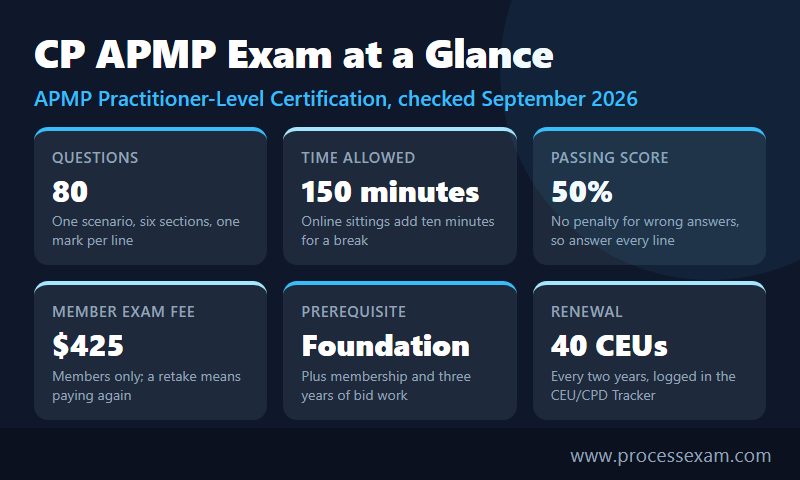
| Number of questions | 80 |
| Duration | 150 minutes |
| Exam fee | APMP Members: $425 |
| Passing score | 50% |
Who can sit the APMP Practitioner exam, and what does it cost?
The Practitioner level has three entry conditions, all stated in APMP's Practitioner OTE Preparation Guide. If you cannot tick all three, you are not ready to book.
Hold the Foundation certification first
You must already be certified at the Foundation level. Unlike the Capture Practitioner route, which does not require Foundation, the bid and proposal Practitioner exam builds directly on it. APMP also asks candidates to make sure their Foundation continuing-education record is up to date before they sit the Practitioner paper, so check your tracker before you pay.
Be an APMP member in good standing
The exam is priced for members only, and membership is not a one-off step. APMP requires Practitioner holders to keep their membership current to keep the credential, so budget for renewal year after year, not only for the exam.
Have at least three years' experience
APMP asks for at least three years in the capture, sales, bid or proposal field. The questions assume you have lived through reviews, compliance matrices and last-minute changes, so experience is less a paperwork rule than a practical one.
Cost, booking and retakes
The fee in our exam data is APMP Members: $425. APMP prices in US dollars and points candidates to APMG, the independent examining body that runs the platform, for other payment currencies. You can book in two ways: through an APMP Accredited Training Organization, where the exam is often part of a course, or on your own through the APMG public booking portal. APMP's certification FAQ states that you have one year from registration, or from receiving a voucher, to take the exam. If you do not pass, you pay the fee again, but APMP sets no waiting period, so you can re-sit as soon as your weak areas are fixed. The current conditions are always listed on APMP's Practitioner certification page.
How is the CP APMP exam paper built?
Knowing the structure of the paper removes much of the stress on the day. APMP calls it an Objective Testing Exam, and it has three parts.
- The scenario. One document describes a customer, the business reason for the opportunity, its objectives, the bidding organizations, their history with the customer and how each intends to position itself. Everything else in the paper refers back to it.
- The questions. Six sections, each called a "question", each tied to one syllabus area named at its start. Every question splits into parts (A, B, C), each part has between three and six question lines, and every line earns one mark. That is where the total of 80 comes from.
- The answer pages. One page per question. Unless a line says otherwise, it has exactly one correct answer, and giving two answers voids that line.
The four question styles
APMP uses four formats, and each rewards a slightly different habit:
- Classic multiple choice. Pick one from three or four options, often framed as "is this approach suitable, and why?"
- Matching. Link items in one list to items in a second list, where an option can be used once, more than once or not at all.
- Multiple response. Choose exactly two of five options. Both must be right to earn the mark, and any other number of answers voids the line.
- Assertion-reason. Judge two statements, decide whether each is true, and if both are, decide whether the reason actually explains the assertion.
Difficulty and time
The paper tests at learning levels 3 (apply) and 4 (analyze) of Bloom's taxonomy, with APMP stating a range of 35 to 45 marks at each level. You have 150 minutes, and APMP extends online sittings by ten minutes so that you can take a break. Wrong answers cost nothing, so a blank line is a mark thrown away. Our exam data puts the passing score at 50%.
Open book, but restricted since September 2026
Older guides described the Practitioner exam as open book with unrestricted materials. From 1 September 2026, APMP changed that. The exam is now open book with restricted materials: you may use the APMP Industry Glossary of Terms, APMP study and preparation guides, the APMP Body of Knowledge and your own notes, whether handwritten, printed or saved on your device. Any AI tool is banned during the exam, and so is pasting exam material into one; breaking the rule can void your result or cost you the certification. During the exam, notes can only go on a wipe-clean board. APMP's certification FAQs carry the full wording.
What do the four APMP competency areas ask of you?
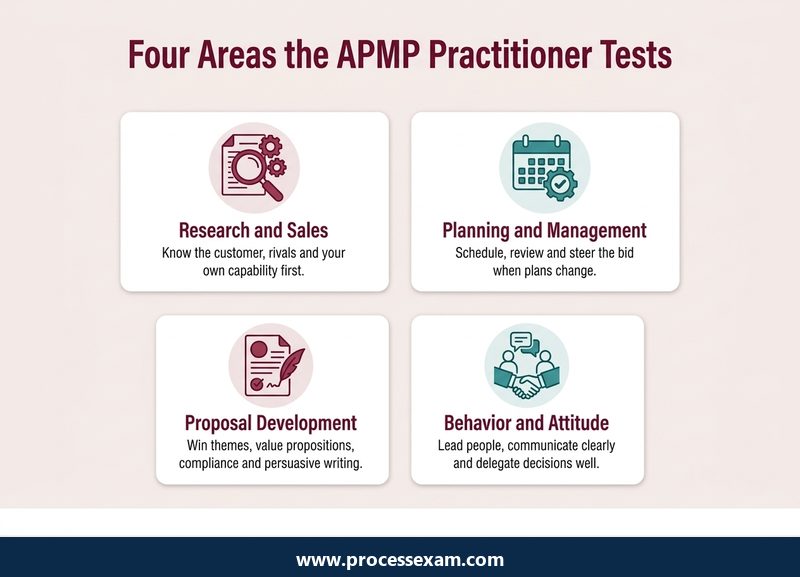
The bid and proposal Practitioner syllabus has four competency areas. For each one, APMP lists two kinds of skill: applying and adapting the competency to the scenario, and telling appropriate from inappropriate use of it. Expect both kinds in every area. Our CP APMP sample questions give a feel for how the areas turn into scenario lines.
Information Research, Management and Sales Orientation (IMSO)
This area is about what the bid team knows before it writes anything. You must identify the information an opportunity plan needs and plan how to gather it about the customer, the competition and your own capability in the time available. You also need to see where the sales process connects with the business development lifecycle. Diagnostic lines ask whether the opportunity plan actually drives the proposal strategy, whether a win strategy was built and adapted as things changed, and whether the right people were talking to internal clients and external customers.
Planning and Management (PLM)
This is the bid manager's home ground. You build a proposal schedule that covers resourcing, metrics, activities, reviews, the customer's timescales and a cost estimate. You choose the right review roles, manage risk to both the proposal and the solution, decide what goes into a progress report (schedule changes, resource changes, open issues), plan production time and document formats, run a virtual team and capture lessons learned. The three unowned sections from our opening sit squarely here: the exam wants to know whether the schedule adapted to the change and whether the escalation went to the right person.
Development (DV)
Development is the widest area. It runs from the first qualification decision to the finished pages: establishing an early price-to-win target, building a quantified value proposition, choosing teaming partners with a Bidder Comparison Matrix and SWOT, finding positive and negative discriminators, and writing a customer-focused executive summary. It also covers the kick-off meeting and its inputs, content planning, the compliance matrix, persuasive writing and graphics with action captions. Many candidates lose marks here by choosing the answer that sounds most polished instead of the one that is most compliant.
Behavior and Attitude (BA)
The last area tests how you lead people under pressure: choosing communication styles and media, reading what a stakeholder really needs, checking the quality of processes and taking corrective action, building strategic relationships and a working team, and making and delegating decisions. The scenario often hides these issues inside a planning problem, for example a subject matter expert who keeps missing deadlines because nobody agreed the escalation path.
How should you prepare for CP APMP over six weeks?
APMP does not publish a study guide for the Practitioner level. It publishes a preparation guide that maps every syllabus line to the Body of Knowledge chapters behind it, and it offers a sample paper. Those two documents, plus your own bid experience, are the core of any sensible plan. The six weeks below assume three to five hours a week alongside a full-time job.
| Week | Focus | Finish by the end of the week |
|---|---|---|
| 1 | Orientation | Read the preparation guide end to end, complete its checklist, confirm membership and Foundation CEUs, and take the APMP sample paper cold to get a baseline |
| 2 | IMSO | Opportunity and capture plans, customer and competitor analysis, win strategy, how sales methods fit the lifecycle |
| 3 | PLM | Scheduling, review management, internal and external risk, production, virtual teams, lessons learned |
| 4 | DV | Gate decisions, price to win, value propositions, teaming tools, executive summaries, content plans, compliance matrix, graphics |
| 5 | BA and mixed practice | Communication, quality, decisions and delegation; then timed scenario sets that mix all four areas |
| 6 | Rehearsal | A full timed run under exam rules, error review by syllabus area, a short personal notes file you are allowed to bring |
Start from the preparation guide, not a summary
APMP's Practitioner OTE Preparation Guide (version 4.4) is short, and its cross-reference tables are the closest thing to an official reading list. Work through them line by line and tick off each Body of Knowledge chapter. Version 4.4, dated September 2026, is the one that carries the new restricted-materials rule, so make sure you have it rather than an older copy.
Use the sample paper twice
APMG hosts the APMP sample papers on its sample exam portal; choose "APMP Practitioner" from the list. Take it once in week one without preparing and once in week six under timed conditions. The gap between the two scores is the best measure you will get of whether your plan worked. Open the scenario PDF first, as you would in the real exam, and use the "Additional Information" tab where a question refers to it.
Turn your own bids into practice
For every chapter you read, pick a bid you worked on and ask what the Body of Knowledge says should have happened compared with what did. Write two lines on each. This builds the analyze-level skill that so many marks depend on, and it gives you ready-made examples for the Behavior and Attitude area, which is hard to study from text alone.
Prepare the notes you are allowed to use
Because personal notes are permitted, a well-organized notes file is a real advantage. Keep it short: one page per competency area, the roles and who owns what at each gate, the kick-off inputs, the review types and their purpose, and the assertion-reason method. Long notes slow you down; APMP itself says the questions are not designed around looking things up.
Once the Body of Knowledge work is done, a timed CP APMP practice test is the quickest way to check whether you can hold the scenario in your head across six question sections and still finish inside 150 minutes.
How do you work a scenario question under time pressure?
APMP's own timing guidance is a good starting point: spend the first ten to fifteen minutes reading the scenario and getting used to the layout, give each of the six questions about twenty minutes, and keep fifteen to twenty minutes in reserve for questions that come with additional information.
Read the scenario like a bid review
Do not skim. Note the customer's objectives, each bidder's history with the customer, and the stated positioning. Most wrong answers contradict one of those three facts. A thirty-second margin note such as "incumbent weak on delivery" often decides several lines later.
Handle each style on purpose
- Classic: decide whether the action in the stem is appropriate before looking at the options, then find the option that gives the right reason.
- Matching: answer each row on its own; do not assume options are used only once.
- Multiple response: check that you have marked exactly two. Marking three voids the line.
- Assertion-reason: judge the assertion, then the reason, as separate true-or-false calls. Only when both are true do you ask whether the reason explains the assertion.
Watch the small words
APMP warns about negative phrasing ("which does NOT describe") and judgement phrasing ("the BEST" or "MOST correct"). In both cases more than one option may look reasonable. Choose the one that follows the Body of Knowledge, even if your own company does it differently.
Which mistakes cost CP APMP candidates the most marks?
- Answering from company habit. Your organization may run reviews differently. The exam rewards APMP best practice as the Body of Knowledge describes it.
- Leaning on the book during the exam. Open book is a safety net, not a strategy. Candidates who look up every line run out of time in the fifth and sixth questions.
- Ignoring the new materials rule. Since September 2026 only APMP's own materials and personal notes are allowed, and AI tools are banned outright. Bringing anything else is a risk to your result.
- Skipping Foundation housekeeping. An out-of-date Foundation CEU record or lapsed membership can hold up your booking.
- Studying Development only. It is the biggest area, but Planning and Management and Behavior and Attitude carry their own questions, and they are where experienced writers often slip.
- Leaving lines blank. There is no negative marking, so an educated guess always beats an empty line.
How do you keep CP APMP, and is it worth the effort?
The credential lasts as long as you maintain it. APMP requires Practitioner holders to earn and log 40 CEUs/CPDs every two years in the CEU/CPD Tracker on their member profile and to stay an APMP member. When you reach 40, the credential renews for another two years and the count resets. Foundation holders need 20 in the same period, so moving up to Practitioner doubles the commitment.
Earning the units is not hard for anyone active in the profession. APMP gives one unit per hour of educational session at its conferences and chapter events, one per hour of accredited training, one per APMP webinar and two for each micro-certification you pass. Volunteering, mentoring, judging awards, presenting and writing about Body of Knowledge topics also count, within set limits. The full table is on APMP's maintaining certification page. Keep evidence for activities outside APMP, because records are audited at random.
What the credential does for a career
In bid and proposal work, CP APMP is the level that separates contributors from managers. It is often listed in bid manager and proposal manager job descriptions, it gives a hiring manager independent proof that you can run a process and not only write for one, and it opens the path to the Professional level. It also has a quieter benefit: the preparation forces you to compare your own bid habits with a published standard, and most candidates find at least one review or scheduling habit they change on their next live bid.
Go back to Thursday's deadline one last time. A CP APMP holder handles those three sections by checking the content plan, re-planning the schedule, escalating one gap to the sponsor and keeping the rest of the team on track. If that is the kind of manager you want to be, the Practitioner exam is a fair and practical way to prove it.
Frequently Asked Questions
What is the CP APMP certification?
CP APMP is the post-nominal for APMP's Practitioner-Level Certification in bid and proposal management. It sits above Foundation (CF APMP) and below Professional (CPP APMP), and it shows you can apply APMP best practice to a realistic bid scenario and judge whether actions taken in that scenario were appropriate.
How many questions are on the APMP Practitioner exam and how long is it?
The CP APMP exam has 80 questions, one mark each, to answer in 150 minutes, and the passing score is 50%. The questions are grouped into six sections, all based on one bid scenario. APMP adds ten minutes to online sittings so that candidates can take a break.
Do I need the APMP Foundation certification before CP APMP?
Yes. To earn the Practitioner certification you must already hold the Foundation certification, be an APMP member in good standing and have at least three years' experience in capture, sales, bid or proposal work. APMP also asks that your Foundation continuing-education record is current before you sit.
How much does the CP APMP exam cost?
The fee is APMP Members: $425, since the exam is open to members only. Remember to budget for membership itself, which you must keep to hold the credential. If you fail, the fee is payable again, but APMP sets no waiting period before a re-sit.
How do you maintain the CP APMP certification?
You must earn and log 40 CEUs/CPDs every two years in the CEU/CPD Tracker on your APMP profile and keep your APMP membership active. Conferences, chapter events, accredited training, webinars, micro-certifications, volunteering and writing on Body of Knowledge topics all earn units.
- Practitioner Certification Cost |
- Practitioner Certification Requirements |
- Practitioner PDF |
- APMP Practitioner Test Questions |
- CP APMP Body of Knowledge (BOK) |
- Practitioner Simulator |
- APMP Practitioner Book |
- APMP Practitioner Sample Questions |
- CP APMP Test Questions |
- Bid/Proposal |
- APMP CP APMP BOK PDF |
- CP APMP Exam Questions Download |
- CP APMP Question Bank |
- Practitioner Mock Exam


