
Free vs Paid PMP Mock Exams: Which Do You Need?
Updated on 12 October 2026. What’s new: now reflects PMI's July 2026 outline: 180 questions in 240 minutes, with People 33%, Process 41% and Business Environment 26%
Mostly no. Free PMP mock exams are good enough to show you where you stand, but the exam itself is 180 questions in 240 minutes, and few free sets let you rehearse that length, the case-study section or the pacing. Use free mocks to find weak areas early, then pay for full-length sittings only once you can check each one against PMI’s current outline.
That answer changes with your situation, your budget and how long you have, so this guide goes through who can get by on free material, what a paid mock really adds, how to test any mock against PMI’s July 2026 Exam Content Outline, and how many to sit before exam day.
Which PMP candidates can get by on free mock exams alone?
A small group can. The rest of the field gets the most from a mix, and the deciding factor is rarely money. It is how much of the exam’s behaviour is already familiar to you: long sittings, scenario reading, and choosing the best of four plausible answers.
| Your situation | Are free mocks enough? | What to add |
|---|---|---|
| You sat a long professional exam in the last two years and have run projects for a decade | Often, yes, if the free sets follow the current outline | One full-length sitting under the clock, free or paid, before booking |
| You manage projects well but have not sat a timed exam since university | Rarely | Two or three full-length sittings, so the stamina and pacing are practised rather than guessed |
| Your work is mostly agile, or mostly predictive, and the other half is unfamiliar | No, free sets tend to lean one way | Sets that mix predictive, agile and hybrid scenarios, with explanations |
| You are retaking after a result below target | No | Mocks that report results by domain, so you can see exactly where the first attempt slipped |
| You have a tight budget and several months | Yes, for the first half of your preparation | Save the paid sitting for the final fortnight |
Read the table as a starting point, not a verdict. The question to ask yourself is whether a free set can tell you something you do not already know. Early on, almost any honest set can: you will discover that you are weak on, say, stakeholder engagement or on how governance works in your sponsor’s organisation. Later, a set that cannot reproduce the real exam’s length and structure cannot tell you whether you are ready, however good its individual questions are.
Money matters in one respect only. The exam fee comes to Member Price: USD $425 or Full Price: USD $675, and a further attempt means paying again. Spending a modest amount on a proper rehearsal is cheap protection against that, but only if the rehearsal is a good one, which is why most of this guide is about telling good from poor rather than free from paid.
What do free PMP mocks do well, and where do they run out?
Free mocks are strongest in the first half of your preparation and weakest in the last two weeks. The reasons are practical rather than moral: someone has to pay for a large, carefully written, regularly updated set of scenario questions, and when nobody is paying directly, the set is usually shorter, older or lighter on explanation.
What free mocks are good for
- A first diagnostic. A short set taken cold shows which domain to start with, and costs you nothing but an hour.
- Warming up the habit. Ten questions a day on a commute or lunch break keep the vocabulary alive between longer study sessions.
- Sampling a provider. A free set is a fair test of a provider’s style. If its explanations are thin or its answers contradict each other, you have learned that before paying.
- Topic checks. After reading about risk or stakeholder engagement, a handful of questions on that topic tell you whether it stuck.
Where free sets usually stop
- Length. Many are a short quiz rather than a sitting. You cannot learn whether you tire at question 120 from a 20-question set.
- No clock, no breaks. Without a timer there is no pacing practice, and without the two scheduled breaks there is no rehearsal of the exam’s rhythm.
- Uneven coverage. A free set may repeat favourite topics such as earned value and critical path while leaving out governance, compliance or benefits realisation, which sit in the Business Environment domain.
- Dated assumptions. A set written for an earlier outline will weight Process far more heavily and Business Environment far less than the exam you are about to sit.
- Thin explanations. A key letter with no reasoning teaches you to memorise. The exam rewards judgement, so the reasoning is where the learning is.
- Gates and upsells. Some free sets are a doorway to a sales sequence, which is fine as long as you know it.
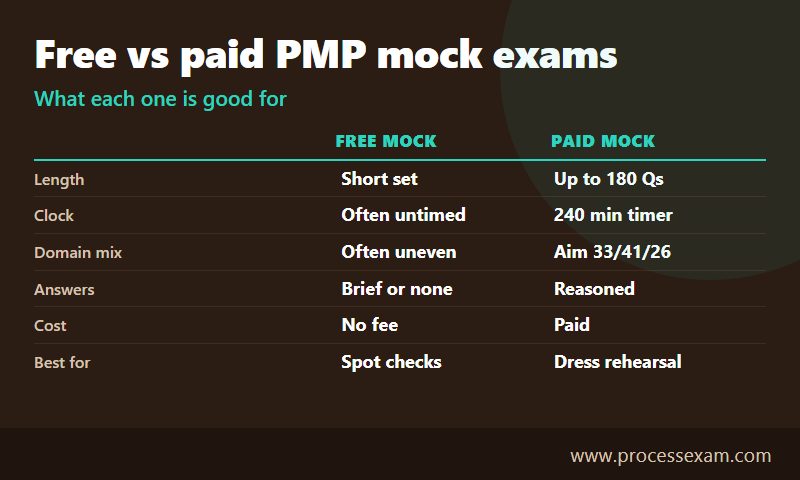
The comparison above is a pattern, not a rule. A well-made free set will beat a careless paid one, and a paid set can be as shallow as any free one. That is why the sections below give you tests you can run yourself, which do not depend on the price tag.
What does paying for a mock exam buy you, and what does it not?
A paid mock is worth the money when it gives you three things a free set cannot: a full sitting, a reasoned answer for every option, and a score broken down by domain. Price alone guarantees none of them.
What a good paid mock adds
- A full-length sitting. A set built for 180 questions lets you practise concentration over a four-hour exam, including the transition between the case-study section and the independent questions.
- Several different forms. More than one full set means you can sit a second mock weeks later without simply remembering the answers.
- Explanations for wrong options as well as the right one. On a best-answer exam, knowing why three plausible answers fail is half the skill.
- Results by domain and task. A single percentage tells you little. A split between People, Process and Business Environment tells you where the next study hour should go.
- Updates. A provider with paying customers has a reason to revise questions when PMI changes the outline, as it did in July 2026.
What paying does not guarantee
- Accuracy. A paid set can still contain a wrong key. Be suspicious when the explanation for the “correct” answer argues against itself.
- Realism. A harder-than-real set can shake your confidence for no reason, and an easier one can inflate it. Treat your score on any single provider as relative to that provider.
- Real exam content. Be wary of any set that claims to hold actual exam questions. It trains recall rather than judgement, and PMI’s outline states that it investigates credible reports of exam misconduct. Good mocks are original questions written to the outline.
One more point on value. Compare what you would pay against the cost of a postponed or repeated attempt, not against a free alternative. If a good rehearsal moves your booking by two weeks in the right direction, it has paid for itself many times over compared with an exam fee of USD $425 or USD $675.
Where do PMI’s own free and paid resources fit in?
PMI publishes a small amount of free material and sells a larger paid set, and both are worth knowing about because they are the closest thing to the exam writer’s own voice.
On the free side, PMI offers the exam content outline itself, a short sample-question document and, according to its shop, a free introduction to its authorised on-demand exam preparation. The sample document is a single page holding three sample questions with the correct answers marked. It is useful for seeing the flavour of the wording, but three questions cannot diagnose anything, and it says nothing about the scenario-heavy form of the July 2026 exam.
On the paid side, PMI sells PMI Study Hall Essentials as a subscription, along with an exam-preparation course and instructor-led courses through authorised training partners. If you want practice material written by the body that writes the exam, this is where to look. Check the current price and what each tier includes on PMI’s own pages, because they vary by region and change over time, and this guide does not quote them.
Alongside those, there is a middle layer of shorter free practice from independent sources, such as a short set of PMP sample questions you can try without paying. A set like this is best used as the diagnostic described above: take it cold, note which domain trips you, and use the explanations to find your next topic rather than to judge your readiness.
How do you judge any mock against PMI’s July 2026 outline?
Judge it against six points taken straight from the outline. Each can be checked in about twenty minutes by reading a provider’s description and attempting a few questions, and none depends on whether the set is free.
| What PMI sets | Current figure | What a good mock should do about it |
|---|---|---|
| Exam code and fee | PMP; Member Price: USD $425, Full Price: USD $675 | Not applicable, but a provider quoting a different fee has not looked at PMI’s page recently |
| Questions | 180, of which 170 are scored and 10 are unscored pretest items | Offer a full set of 180, and tell you to treat every item as if it counts |
| Time | 240 minutes, with two 10-minute breaks | Run a 240-minute clock and let you rehearse the breaks |
| Domain weighting | People 33%, Process 41%, Business Environment 26% | Show a mix close to those shares, not a heavy tilt towards Process |
| Question types | Multiple choice, multiple response, case or scenario, graphic-based, matching, enhanced matching, point and click | Include scenario sets and graphic questions, not only single short items |
| Result | Reported as Above Target, Target, Below Target or Needs Improvement | Avoid promising a pass mark that PMI does not publish |
The six checks in plain terms
Does it match the current domain split? The outline gives the share of items on the exam: People 33%, Process 41% and Business Environment 26%. Count or ask. If a provider cannot say how its questions divide across domains, assume it does not know.
Is a full set really 180 questions? A smaller “full mock” may be fine for a sitting on a train, but it is not the exam. Only a set of the real length shows whether your concentration holds.
Does it use the real clock? The outline gives 240 minutes for 180 questions, an average of 80 seconds each. A mock that does not time you cannot tell you whether you can hold that pace.
Are there scenario sets and graphic questions? The outline lists case or scenario questions and graphic-based questions as new types, in which you read a situation, a chart or a diagram and then answer. If every mock question is a two-line stem, you are preparing for an older exam.
Are the explanations about reasoning? Open the explanation of a question you got right. If it only restates the answer, look elsewhere. A good one says why the best choice fits this situation and why each other option fails.
Does it cover every task? The outline sets out twenty-six tasks across the three domains and states that each exam includes questions on all tasks within each domain. A mock that never touches governance, ethics or benefits realisation is missing a part of the exam, however many questions it holds.
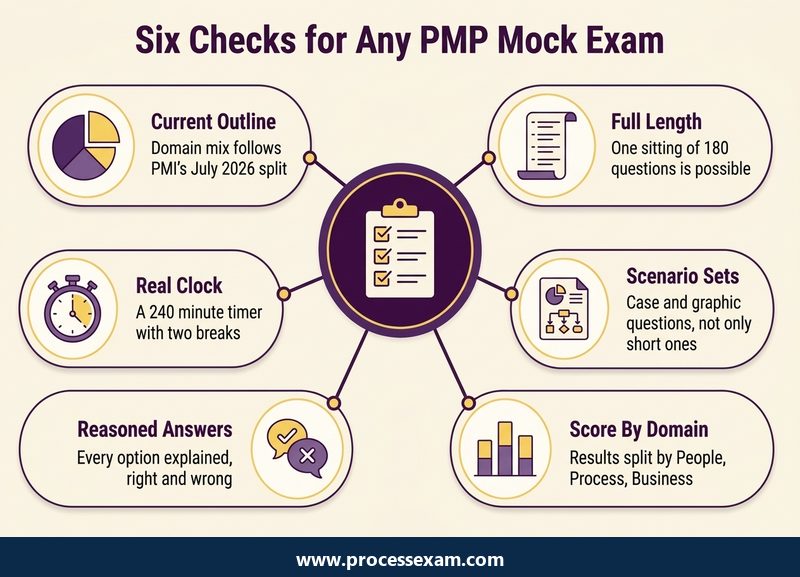
A set that passes five of the six is usually usable. A set that fails the domain split and the scenario check is probably built for an older exam and is worth using only for general warm-up questions. For the full domain-by-domain wording, read PMI’s outline directly rather than any summary, ours included.
How many PMP mock exams should you sit, and when?
Sit one short diagnostic at the start, topic sets as you study, and a small number of full-length mocks in the last few weeks, spaced far enough apart that you can act on each result. The count matters less than how much you learn from each sitting.
A sensible pattern, which is mine and not a PMI rule, is to treat mocks as three different tools rather than one:
| Stage | Type of mock | What to do with the result |
|---|---|---|
| Before you study | Short free diagnostic, untimed or loosely timed | Rank the three domains by your own weakness and decide where to begin |
| During study | Topic sets of 10 to 30 questions after each topic | Fix the gaps while the material is fresh, and keep an error log |
| About halfway | First full-length sitting, under the clock | Find out how you pace, and spot the weakest domain with real data |
| The last three or four weeks | Two or three full-length sittings, a week or so apart | Each one should be followed by days of targeted study, not another sitting |
| The last week | Light review of the error log; at most a short set | Protect energy and confidence, do not chase a higher score |
Why spacing beats volume
A full sitting takes four hours and a proper review often takes longer. A candidate who sits one mock every day for a week gets seven scores and almost no learning, because there was no time to understand any of them. A candidate who sits one a week and spends the days between on the weak tasks gets better at each step. If you only have time for two full sittings, make them two, a week apart, rather than six squeezed together.
Do not run out of fresh mocks
Memorising answers to the same set is the most common way to get an inflated score. Hold back at least one full-length mock until the final stretch and do not look at it beforehand. If you are using several providers, rotate them so that you are not seeing the same scenarios twice.
The full-length sittings in that schedule are where a paid set earns its place. ProcessExam’s PMP mock exam is there for those rehearsals, once the free material has shown you which domain to work on first.
How should you read a mock score when PMI publishes no pass mark?
Treat a mock score as a thermometer, not a gate. PMI reports the real result as one of four bands: Above Target, Target, Below Target or Needs Improvement. It does not publish a pass percentage, so any provider that names a magic percentage as the safe score is guessing.
Three habits turn a number into information:
- Compare a provider only with itself. A high score on one provider and a lower one on another says little, because the sets differ in difficulty and in how closely they follow the outline.
- Look at the trend and the weakest domain, not the best score. Three full-length sittings that are steady or rising, with no domain far below the others, say more than one good day.
- Keep an error log. After each mock, sort every miss into one of five causes: you did not know the concept, you misread what was asked, you changed a right answer, you ran short of time, or you did not recognise the format. The second, third and fourth are habits you can fix without learning anything new.
What about the unscored questions?
Ten of the 180 questions on the real exam are pretest items that do not count, and nothing marks them out. A mock cannot reproduce that, so do not try to guess which items are scored. Answer every question as though it counts, and when you meet an odd one that does not fit the outline, mark it, make your best choice and move on.
When is it time to book?
Book once your recent full-length scores are stable, your error log shows no domain with an obvious hole, and your pacing is comfortable inside the 240 minutes. If one of those is not true, a further week of targeted work usually costs less than a second attempt at the exam fee.
What should a full-length mock rehearse besides the questions?
It should rehearse the day itself. The exam has a structure and a rhythm that are easy to get wrong the first time, and a full mock is the only safe place to find out.
- The case-study section first. The outline places a break after the case-study section, so the scenario-based block sits at the start of the sitting. Practise reading a long scenario with its graphs and answering the series of questions that follows.
- The two 10-minute breaks. The first comes after the case-study section and the second about midway through the independent questions. Once you review your answers and start a break, you cannot return to the section before it, so finish and check each part before you stand up.
- Pacing at about 80 seconds a question. That is the average over 180 questions in 240 minutes. Decide in advance when you will flag a question and move on, and practise doing it.
- Multiple-response and matching items. These take longer than single-choice items. Know how you will handle them under pressure.
- Delivery mode. Enhanced matching and point-and-click items appear only in the test-centre version of the exam, while case or scenario and graphic-based items appear in every mode. Sit your mock on the same kind of screen you will use on the day.
- Food, water, sleep and the commute or the room. Practise the physical side once: a full sitting at the hour of your booking tells you whether you need a snack, a stand-up stretch or a quieter room.
What if a mock goes badly?
A poor first full-length score is information, not a verdict. Sort the misses with the error log, fix the two biggest causes, wait a week and sit the next one. The outline allows up to three attempts at the real exam within one year of eligibility, but you do not need to spend an attempt to find out where you are weak. That is what the mocks are for.
Frequently Asked Questions
Are free PMP mock exams enough to pass?
For some candidates, yes, but most do better with a mix. Free mocks suit early diagnosis and topic checks. The real exam is 180 questions in 240 minutes, so at least one or two full-length, timed sittings in your final weeks, free or paid, are worth having before you book.
How many PMP mock exams should I take before the real exam?
There is no PMI-set number. A workable pattern is one short diagnostic, topic sets while you study, a first full-length sitting about halfway, then two or three full sittings a week apart in the last few weeks. Each full sitting needs days of targeted review afterwards.
How do I know if a PMP mock exam is up to date?
Check it against PMI's July 2026 Exam Content Outline. The domains should be People 33%, Process 41% and Business Environment 26%, a full set should hold 180 questions, and there should be case-based and graphic questions. A provider unable to state its domain split probably has not updated.
What score on a PMP mock exam means I am ready?
No mock score guarantees a result, because PMI reports Above Target, Target, Below Target or Needs Improvement rather than a pass mark. Look for steady or rising scores across several full-length sittings with no domain far behind the others, and compare each provider only with itself.
How long is the PMP exam and how many questions does it have?
The PMP exam has 180 questions, of which 170 are scored and 10 are unscored pretest items, with 240 minutes allowed. There are two 10-minute breaks. The fee is Member Price: USD $425 or Full Price: USD $675, and results come as performance bands rather than a percentage.
- PMP Certification |
- PMI Project Management Exam Questions |
- PMI Project Management Question Bank |
- PMI Project Management Questions |
- PMI Project Management Study Guide |
- PMI PMP Quiz |
- PMP Questions |
- PMP Practice Test |
- PMP Study Guide Material |
- PMP Sample Exam |
- Project Management Certification |
- PMI Project Management Book |
- Project Management Certification Cost |
- Project Management Certification Requirements |
- PMI Project Management Sample Questions |
- PMP Exam Questions Download |
- PMP Test Questions |
- Project Management PDF |
- PMI Project Management Professional


