
CMQ/OE Certification Benefits: From Running Audits to Shaping Strategy
Updated on 22 September 2026. What’s new: updated for ASQ's 2026 CMQ/OE Body of Knowledge, tested since the July 2026 window, with current exam fees.
You can run every audit on the calendar and still learn about next year's strategy after it has been signed. The ASQ Certified Manager of Quality/Organizational Excellence (CMQ/OE) is built to close that gap. Its real benefit is not a line on a CV. It is tested proof, across seven management domains, that you can argue budgets, risk, suppliers and people in the language a leadership team already uses, and that is what gets quality invited in when decisions are made.

This article treats benefits in the practical sense: what the credential changes in how senior people read your work, who is allowed to apply, what the exam asks under ASQ's 2026 Body of Knowledge, and how to prepare while still doing the job. One clarification first, because the two are often mixed up. CMQ/OE is not the Certified Construction Quality Manager (CCQM), which ASQ aims at construction projects. CMQ/OE is ASQ's general management and leadership credential for quality professionals in any sector, from a ten-person service firm to a multinational manufacturer.
Why is the quality manager so often missing when strategy gets decided?
Picture a business with a well-run quality function. Internal audits happen on schedule, nonconformances are closed on time, and the certification body leaves satisfied. Yet when the leadership team sets next year's priorities, the quality manager is not in the room. The plan arrives afterwards, usually carrying a target that quality will have to absorb: a faster launch date, a cheaper supplier, a hiring freeze in inspection.
The cause is rarely competence. It is vocabulary. Strategy discussions run on cash flow, risk appetite, market position and people capacity. Audit findings and control charts are evidence, but they are evidence written in a dialect most executives do not read fluently. A quality manager who can only report conformance gets treated as a function to be informed, not a colleague to be consulted.
ASQ shaped the CMQ/OE around that problem. The credential grew out of ASQ's older Certified Quality Manager program. When ASQ's Quality Management Division surveyed certified quality managers and other experts, the results showed that the job had widened well beyond running a quality system, and the ASQ Certification Board approved a broader program under the new name. The Body of Knowledge that came out of it spends as much effort on strategic planning, finance, projects, supplier risk and training as on quality tools.
ASQ pictures the holder as someone who leads improvement work that may be regional or global, builds customer and supplier relationships, supports the rollout of strategy and helps design the measures that show whether an organization is getting better. That scope is the point. The exam does not ask whether you can conduct an audit; other ASQ credentials cover that. It asks whether you can judge what an audit result means for the business and make the case for the response.
What are the real benefits of CMQ/OE certification?
Older articles on this subject promise pay rises, job security and instant prestige. Those claims are hard to prove and easy to oversell. The benefits below are narrower and more useful, because each one comes directly from what the exam makes you practise.
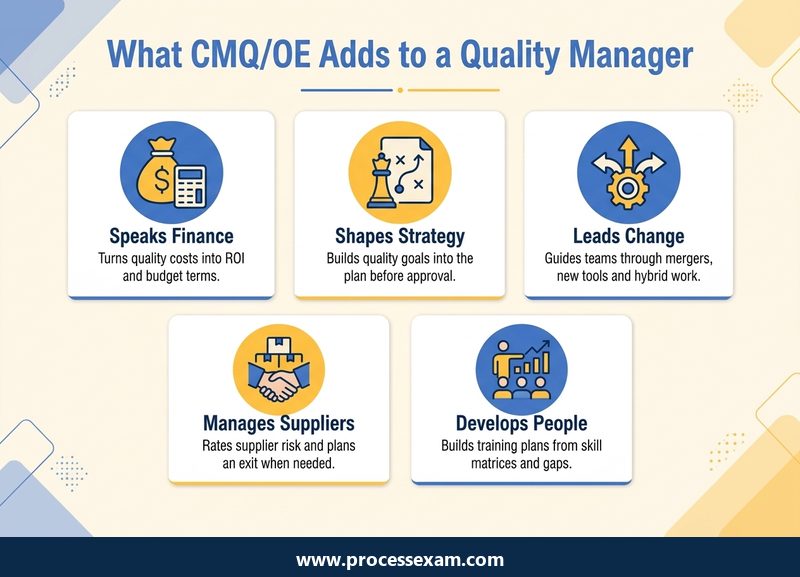
You learn to put quality in financial terms
The Management Elements and Methods domain expects you to read income statements and balance sheets, work with product and service cost structures, manage budgets and use return on investment, return on assets, net present value, internal rate of return and portfolio analysis to judge a project's risk, feasibility and priority. Add the cost of quality categories from the tools domain (prevention, appraisal, internal failure and external failure) and you can present a quality proposal the way a finance director expects to see any other investment case, with a cost, a payback and a risk.
You take part in strategy instead of receiving it
The strategic planning domain covers mission, vision and values, SWOT and PESTLE analysis, market forces, stakeholder analysis, internal capability, legal and industry factors, and the effect of technology such as automation, Quality 4.0, cloud computing, artificial intelligence and cybersecurity. It then turns to deployment: tactical plans that are specific, measurable, attainable, relevant and time-bound, resources that are actually in place, and performance measures tied to strategic goals. A manager who has worked through this can comment on a draft plan before it is approved, which is exactly when a quality objective is cheapest to build in.
You lead change and people with a method
The leadership domain goes well beyond motivation. It covers organizational design, change management including the effect of mergers and acquisitions on quality culture, negotiation, empowerment, team development and conflict, plus an expanded section on governance, ethics and compliance that includes the ASQ Code of Ethics, confidentiality agreements and the protection of intellectual property. Training and Development closes the loop with needs analysis, skill matrices, adult learning and checking whether training changed anything on the job.
You handle suppliers and customers as business risks
Supply chain topics ask you to select and classify suppliers, assess supplier risk, audit and develop suppliers, run certification programs and, new in the 2026 edition, evaluate exit strategies for suppliers who keep missing requirements. Customer topics cover segmentation, the voice of the customer through quality function deployment, loyalty and the financial effect of losing an account. Both domains reward the manager who can put a number on a relationship rather than describe it.
The credential is independently accredited
According to ASQ, the ANSI National Accreditation Board (ANAB) accredits the CMQ/OE program against ISO 17024, the international standard for bodies that certify people. For an employer, that means an independent body has checked how the exam is developed, delivered and maintained, which is a fair basis for trusting the letters after your name. Because the credential must be renewed every three years, it also signals that the holder has kept learning since the day of the exam.
How much experience does ASQ want before you can apply?
This is where applicants most often misread the rules, so it is worth slowing down. ASQ asks for ten years of full-time, paid work in one or more of the areas the CMQ/OE Body of Knowledge covers. At least five of those years have to be in what ASQ calls a decision-making position.
A decision-making position is not the same thing as a management title. In ASQ's terms it means you had the authority to define, carry out or control a project or process, and you answered for how it turned out. A senior engineer who owned a process change from design through to results may well qualify; someone with a manager's title but no real say over outcomes may struggle to support the claim. Describe your roles on the application in those terms: what you decided, what you controlled and what you were held accountable for.
Education shortens the ten years, but only once. You claim a single waiver, the one that matches your highest qualification:
- A diploma from a technical or trade school takes off one year.
- An associate degree takes off two years.
- A bachelor's degree takes off four years.
- A master's degree or doctorate takes off five years.
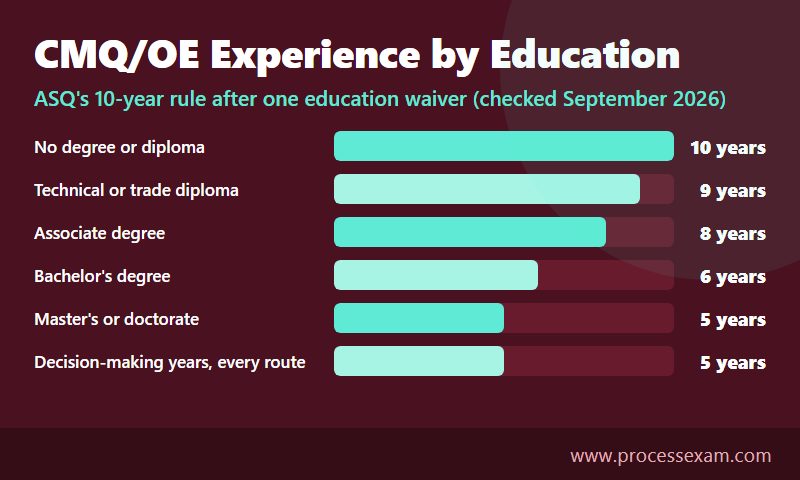
Notice what the waiver leaves alone: the five decision-making years. A candidate with a master's degree needs five years of experience in total, and every one of them must be a decision-making year. That is one reason the CMQ/OE usually comes later in a career than ASQ's associate-level and technician-level credentials.
Two further rules help some applicants. Holders of ASQ's quality auditor, reliability engineer, software quality engineer or quality engineer credentials can reuse the experience that got them through that application, provided the ten-year minimum is still met. And if ASQ reviews your application and decides you are not eligible, you get the fee back less a processing charge, so it pays to test your work history against the decision-making definition before you submit anything.
How is the CMQ/OE exam delivered, scored and priced?
These are the exam facts as ProcessExam records them for the CMQ/OE:
| Exam detail | CMQ/OE |
|---|---|
| Exam name | ASQ Certified Manager of Quality/Organizational Excellence |
| Exam code | CMQ/OE |
| Vendor | ASQ |
| Number of questions | 180 |
| Exam duration | Total appointment time - 270 minutes Exam time - 258 minutes |
| Passing score | 550/750 |
| Exam fee | ASQ MEMBERS - $485 NON-MEMBERS - $585 RETAKES - $385 |
| Format | Multiple choice, open book |
| Body of Knowledge | 2026 edition, tested from the July 2026 window |
On the computer-based exam you answer 180 multiple-choice questions, in English. Of those, 165 are scored and 15 are unscored, and nothing on screen tells you which is which, so treat every question as live. The appointment lasts four and a half hours, and the exam clock gives you 4 hours and 18 minutes of it. Divided evenly, 258 minutes across 180 questions leaves about 86 seconds for each one, which is comfortable for recall items and tight for the long scenarios this exam is known for.
A paper-based version is still offered in certain locations. It carries only the scored multiple-choice items, runs four hours and is available in English and in Mandarin. Most candidates, though, sit the computer version with ASQ's testing partner, Prometric.
Open book, on ASQ's terms
Every ASQ exam is open book, and the CMQ/OE is no exception. You bring your own references; nothing is supplied. ASQ also says that its CMQ/OE Handbook, written as a companion to the Body of Knowledge, can be used during the exam. Read the reference and calculator policies on ASQ's CMQ/OE certification page before you pack, so that nothing you rely on is refused at the test centre.
Results and retakes
Computer-based candidates see a pass or fail on screen the moment they submit. A confirming email follows a few business days later, and a separate message explains how to claim the digital certificate and badge. Pilot exams on a new Body of Knowledge are the exception: ASQ said results from the July 2026 pilot, the first sitting on the 2026 edition, would take four to six weeks. A candidate who falls short receives a performance summary by email, and for two years after that attempt you can reapply at the reduced retake fee shown in the table. ASQ does not publish a CMQ/OE pass rate on its certification page, so be wary of any figure that circulates without a source.
Testing windows and deadlines
ASQ runs the computer-based CMQ/OE in month-long windows rather than all year, and each window has its own application deadline. When this article was checked in September 2026, ASQ listed the following:
- September 1 - 30, 2026: the window running now. Its application deadline, August 10, 2026, has already passed.
- November 1 - 30, 2026: applications close October 12, 2026.
- January 1 - 31, 2027: applications close December 7, 2026.
Dates move, so confirm them on ASQ's exam dates and deadlines page before you plan your study backwards from one. Once you apply, ASQ reviews an online application in one to two business days (paper forms take longer), then sends an eligibility email explaining how to book a seat with Prometric inside the window you chose. On the day, bring one valid government-issued photo ID that carries a signature and shows the same name as your application.
What changed when ASQ moved to the 2026 Body of Knowledge?
ASQ has tested a new CMQ/OE Body of Knowledge since the July 2026 window, so anyone booking a seat from here on should study the 2026 edition. Prep books and question sets written before this year may still be organized around the 2019 edition, and that matters more than it first appears.
ASQ's own BoK map explains that the job analysis behind the update found most 2019 topics still relevant, so this is a rebalancing rather than a rewrite. The seven domain names have not changed. What has moved is the number of scored questions each domain receives:
| Domain | 2019 BoK | 2026 BoK | Change |
|---|---|---|---|
| I. Leadership | 28 | 28 | 0 |
| II. Strategic Plan Development and Deployment | 22 | 23 | +1 |
| III. Management Elements and Methods | 31 | 26 | -5 |
| IV. Quality Management Tools | 30 | 31 | +1 |
| V. Customer-Focused Organizations | 21 | 22 | +1 |
| VI. Supply Chain Management | 17 | 19 | +2 |
| VII. Training and Development | 16 | 16 | 0 |
| Total scored | 165 | 165 | 0 |
Management Elements and Methods gave up five questions: two went to supply chain and one each to strategy, tools and customers. The content changes matter more than the counts:
- Leadership now names engagement, mergers and acquisitions and hybrid work groups, and its governance section gains two new topics, compliance and confidentiality, next to the Code of Ethics.
- Strategic planning adds PESTLE analysis, artificial intelligence, cybersecurity and trade association standards, and drops machine learning as a named item.
- Management elements adds emotional intelligence, international risk standards and virtual or hybrid communication, and removes performance excellence models.
- Quality tools drops Kepner-Tregoe and adds is/is-not analysis, SIPOC, 8D, CAPA, A3, total productive maintenance and a process reliability measure.
- Customers adds contractual and customer requirements, suppliers adds exit strategies, and training adds skill matrices.
ASQ publishes both the 2026 CMQ/OE Body of Knowledge and a BoK map that compares the two editions line by line. Read the map once, early. It tells you which chapters of an older study guide you can still trust and which topics you will have to find elsewhere.
What does each of the seven domains expect a manager to handle?
The Body of Knowledge tags every topic with the highest thinking level it can be tested at, from Remember up to Create, based on the revised Bloom's taxonomy. The CMQ/OE sits high on that scale. Many topics are tested at Evaluate or Create, so questions ask you to judge a plan or design a response, not recall a definition. Our sub-topic list for all seven domains sets out each area in full; the notes below explain what each domain is really probing.
I. Leadership (28 questions)
Organizational designs such as matrix, flat and parallel structures; the different roles of leaders and managers; change management; negotiation, influence and Socratic questioning; empowerment and job design; team types, stages and roles; and the governance, ethics and compliance topics above. Expect scenarios in which a team has stalled or a change is being resisted, and you must choose the leadership response that suits the stage the team has reached.
II. Strategic Plan Development and Deployment (23 questions)
Planning models, the business environment (risk, market forces, stakeholders, technology, internal capability, legal and industry factors) and deployment. The deployment half is where experienced managers drop marks. Questions test whether a tactical plan is genuinely measurable and time-bound, whether the resources behind it really exist, and whether the chosen measures would reveal progress against the strategy or merely activity.
III. Management Elements and Methods (26 questions)
The broadest domain: management principles and theories, how functions depend on one another, human resources, finance, risk and knowledge management, communication across cultures, time zones and virtual teams, project management with critical path, PERT, Gantt charts and work breakdown structures, the quality system itself, and quality models from ISO 9000-based standards and TQM to the thinking of Shewhart, Deming, Juran, Crosby, Feigenbaum and Ishikawa. It lost five questions in 2026 but remains one of the three largest domains.
IV. Quality Management Tools (31 questions)
Now the largest domain. It spans the classic seven quality tools, affinity and tree diagrams with the other planning tools, improvement methods including root cause analysis, PDCA, DMAIC, SIPOC, 8D, CAPA, A3 and FMEA, creativity techniques, cost of quality, process management with lean tools and the theory of constraints, and measurement: basic statistics, sampling, measurement systems analysis, trends, common and special cause variation, capability indices and reliability terms. The statistics are applied rather than deep, and ASQ notes that reliability calculations are not tested, but you must be able to read a control chart or a capability result and decide what a manager should do next.
V. Customer-Focused Organizations (22 questions)
Internal and external customers, segmentation, qualitative feedback such as verbatim comments and focus groups, quality function deployment, systems for capturing satisfaction and loyalty, customer value analysis, service principles, and managing several customers whose demands conflict. Questions often ask which customer group a decision will hurt, and what that loss would cost.
VI. Supply Chain Management (19 questions)
Supplier selection and approval, supplier risk, communication routines, performance metrics, audits and improvement, certification and partnerships, exit strategies, and logistics topics such as ship-to-stock, just-in-time delivery and incoming inspection. With two extra questions, this domain grew more than any other in the 2026 edition.
VII. Training and Development (16 questions)
Training plans tied to strategy, needs analysis using surveys, performance reviews, regulatory guidance, skill matrices and gap analysis, materials designed for adult learners, delivery methods, mentoring and coaching, and evaluation of whether training actually changed behaviour or results.
How can a working manager fit CMQ/OE preparation around the day job?
Most CMQ/OE candidates are senior, busy and out of the habit of sitting exams. The plan below assumes about fourteen weeks and a few focused sessions each week. Stretch it if an entire domain is new to you, and pick your testing window before you start, so the plan has a fixed end date.
Weeks 1-2: map your experience against the domains
Read the 2026 Body of Knowledge line by line and mark each topic as work you do, work you have watched others do, or work you have only read about. Most managers find one or two whole domains in the third group, often finance, supply chain or training. Those become the centre of the plan, however uncomfortable that feels.
Weeks 3-9: study the weakest domains first, as decisions
Work through the domains in order of weakness, not in BoK order. For each topic, write a short note on the decision a manager would make with it: when a matrix structure beats a functional one, when net present value is a better guide than payback, when to exit a supplier rather than develop it. Scenario questions reward that framing far more than definitions, and the notes become part of your reference kit.
Weeks 10-11: build a reference kit you can search fast
Because the exam is open book, your references matter, but only if you can find things quickly. Tab the CMQ/OE Handbook or your main text by domain, and keep a one-page index of formulas, tool-selection rules and the decision notes from the earlier weeks. A reference you have to hunt through during the exam costs minutes you do not have.
Weeks 12-14: timed runs and targeted review
Sit at least two full-length mocks under the real timing, with your reference kit and nothing else on the desk. A full-length CMQ/OE practice exam on ProcessExam follows that length and time limit, so you can check your pacing and see which domains still leak marks before your window opens. After each run, sort every miss by domain and by cause: did not know it, misread the scenario, or ran short of time. Only the first cause is fixed by more reading.
Where experienced managers lose marks
- Answering from their own company's habits. The exam wants the best response in principle, which may differ from how your organization actually works.
- Skipping the numbers. Finance, cost of quality and basic statistics look minor beside leadership topics, but they surface in several domains.
- Studying the 2019 edition. Older material misses the governance topics and the newer improvement tools, and it overweights Management Elements and Methods.
- Treating open book as a safety net. Without tabs and an index, looking things up eats the time the scenario questions need.
- Applying too late. Applications close roughly three weeks before each window opens. Miss one and your study peak lands about two months before your seat.
What does the certification do for you after the exam?
Passing gives you the credential; using it is a separate task. The managers who get the most from the CMQ/OE put its vocabulary to work straight away. They bring a cost of quality estimate to the budget round, ask for a stakeholder analysis before a reorganization, or propose a supplier exit plan in business terms rather than as a quality complaint. That is how the seat at the strategy table is actually won, and senior leaders notice it in a way they never notice a certificate on a wall.
Roles where the CMQ/OE fits naturally include quality manager, quality director, operational excellence or continuous improvement lead, supplier quality manager, and consultants who advise leadership teams on quality systems. It also pairs well with ASQ's auditing and engineering credentials: those show that you can do the technical work, and the CMQ/OE shows that you can direct it. This article quotes no salary figures, because the honest answer depends on sector, country and role. If pay is part of your decision, look for a current salary survey that separates certified from uncertified quality managers.
Keeping the credential current
The CMQ/OE is not a lifetime certification. ASQ requires it to be renewed every three years, either by logging recertification activity in ASQ's online journal or by taking the exam again. Activity falls into three categories: professional development, employment, and a newer giving-back category that credits volunteering and mentoring. ASQ's recertification page sets out the timeline, the fees and how to synchronize several ASQ certifications onto one date. Because employment itself is a qualifying category, much of the credit can come from work you already do, which is one more reason to treat the CMQ/OE as a habit rather than a finish line.
Frequently Asked Questions
What does CMQ/OE stand for?
CMQ/OE stands for Certified Manager of Quality/Organizational Excellence, a credential awarded by ASQ. It grew out of ASQ's older Certified Quality Manager program and covers leadership, strategy, management methods, quality tools, customers, suppliers and training. It is meant for people who lead quality and improvement work rather than those who carry out inspections.
What experience do you need for the ASQ CMQ/OE?
You need ten years of full-time, paid work in areas the CMQ/OE Body of Knowledge covers, and five of those years must involve real authority over projects or processes. One education waiver can shorten the total, from one year for a trade diploma up to five for a master's or doctorate, but never the five decision-making years.
How much does the CMQ/OE exam cost?
ASQ lists three CMQ/OE fees: ASQ MEMBERS - $485, NON-MEMBERS - $585 and RETAKES - $385. The retake rate is available for two years after an unsuccessful attempt. If ASQ finds an application ineligible, it refunds the fee minus a processing charge, so check the experience rules carefully before you pay.
How many questions are on the CMQ/OE exam, and what is the passing score?
The computer-based CMQ/OE has 180 multiple-choice questions, 165 of them scored, with an exam time of 258 minutes inside a longer appointment. The passing score is 550/750, a scaled score rather than a percentage of correct answers. The exam is open book, and results appear on screen as soon as you submit.
What is the ASQ CMQ/OE pass rate?
ASQ does not publish a pass rate on its CMQ/OE certification page, and figures quoted elsewhere rarely name a source. A more useful measure is your own readiness: steady results on timed, full-length mock exams across all seven domains, plus a tabbed reference kit you can search quickly during the open-book exam.
- ASQ Manager of Quality/Organizational Excellence Sample Questions |
- CMQ/OE Exam Questions Download |
- CMQ/OE Test Questions |
- Manager of Quality/Organizational Excellence PDF |
- ASQ Manager of Quality/Organizational Excellence Book |
- ASQ CMQ/OE BOK PDF |
- Manager of Quality/Organizational Excellence Certification Cost |
- Manager of Quality/Organizational Excellence Certification Requirements |
- ASQ Manager of Quality/Organizational Excellence Test Questions |
- CMQ/OE Body of Knowledge (BOK) |
- CMQ/OE Question Bank |
- Manager of Quality/Organizational Excellence Simulator |
- Manager of Quality/Organizational Excellence Mock Exam |
- CMQ/OE Handbook


