
CIS-SPM Exam Prep: Why Dumps Risk Your Certification
Updated on 23 September 2026. What’s new: the exam details now follow the Strategic Portfolio Management blueprint: 60 questions in 90 minutes for USD $450, across nine weighted domains
Dumps and practice questions are not two versions of one product, so there is no fair comparison to make. A dump circulates copied live exam content, and the ServiceNow certification terms you accept before booking treat that content as confidential – a credential earned against them can be withdrawn. This guide works from what ServiceNow publishes about CIS-SPM: 60 questions, 90 minutes, USD $450, and a result given only as Pass or Fail.

What does a CIS-SPM dump actually put at risk?
Start with what you are buying when you buy leaked questions, because the marketing never describes it accurately. Somebody sat the CIS-SPM exam, memorised or captured items, and resold them. Everything that follows – the price, the "verified" label, the promise of a 24-hour pass – rests on that single act. ProcessExam does not link to such material and will not tell you where to find it. What is worth your time is understanding the three separate costs a candidate takes on by going near it.
The credential itself is the first thing at stake
Scheduling a ServiceNow exam is not a simple checkout. Before a seat is released you are asked to read and accept ServiceNow’s certification policies, and those policies are the contract under which your result is issued. They cover the confidentiality of exam content and the conduct expected of a candidate. A pass produced by material that breaches them is not a pass that ServiceNow is obliged to keep on your record. Read the terms on ServiceNow University at the point where you schedule, rather than clicking through them, because they describe exactly this situation.
The asymmetry is what makes this a bad trade. The dump costs a few dollars and saves a few weeks. The credential costs USD $450 plus the months of platform work that make it believable on a CV, and it is the thing an employer or a ServiceNow partner checks. Putting the second at risk to shorten the first is not a shortcut; it is a wager with the odds set against you.
Proctoring and item analysis are designed to catch this
ServiceNow delivers its mainline exams through Pearson VUE, in test centres and under online proctoring. Proctoring is the visible half: an identity check, a room scan, a watched session. The half candidates forget is statistical. Certification bodies compare how populations of candidates answer individual items, and an item whose answer pattern suddenly changes – everybody getting a hard question right, in the same short time – is a flagged item. Flagged items get retired and rewritten, and the results attached to them get reviewed. This is routine maintenance of an exam bank, not a conspiracy theory, and it is the reason a dump decays quickly.
The content is usually wrong by the time you read it
ServiceNow ships family releases twice a year, and Strategic Portfolio Management moves with them. Workspaces are redesigned, fields are renamed, planning features are added. A leaked answer key captures one moment in that cycle and then rots. Candidates who rely on one discover the problem in the worst possible place: a question that looks familiar, with an answer that was correct two releases ago. Because the result comes back as Pass or Fail with no breakdown, they also cannot tell which of their assumptions failed them.
And the job is still there on Monday
CIS-SPM exists because organisations hand real implementations to the people who hold it. If you pass without being able to configure a demand workflow, set a resource plan against a project, or explain why a cost plan is not rolling up, the gap shows in your first sprint. A credential that gets you into a role you cannot do is worse than no credential, because the failure happens in public and with a client watching.
Which CIS-SPM figures are fixed, and which does ServiceNow keep to itself?
Some parts of this exam are published plainly, and some are deliberately not. Knowing which is which stops you chasing numbers that do not exist – the pass mark being the one candidates waste most time on.
| Item | CIS-SPM |
|---|---|
| Full name | ServiceNow Certified Implementation Specialist - Strategic Portfolio Management |
| Exam code | CIS-SPM |
| Questions | 60 |
| Duration | 90 minutes |
| Exam fee | USD $450 |
| Result | Pass / Fail |
| Delivery | Pearson VUE, test centre or online proctored |
| Vendor | ServiceNow |
Sixty questions inside ninety minutes averages out at a minute and a half apiece. A straight recall item will not need that long; a scenario setting out a portfolio, its funding model and three demands competing for the same people will need more. Clear the short ones quickly so the long ones keep the slack.
There is no published pass percentage, and that is deliberate
ServiceNow reports the outcome as Pass or Fail. No percentage, no per-domain score, no list of what you missed. Candidates read that as secrecy; it is closer to statistics. Exam forms are equated so that a slightly harder set of items does not punish the candidate who drew it, which means the raw number of correct answers needed is not a constant that could honestly be printed. The practical consequence for you is that "what score do I need?" is the wrong question. The right one is "can I handle every domain under time?"
Retakes exist, but the gap between attempts grows
A failed mainline exam is not the end of the road. ServiceNow allows a retake, and publishes a waiting period that lengthens with each further attempt, so a second failure costs considerably more time than the first. Check the current rule and any fee on ServiceNow University before you book rather than relying on a figure quoted in a forum, because this is one of the policies the vendor revises. Treat the waiting period as the real penalty for sitting the exam before you are ready.
Where do the 60 CIS-SPM questions come from?
ServiceNow publishes a mainline exam blueprint for this credential, and it is the only map of the exam that carries the vendor’s name. The CIS-SPM exam blueprint sits inside ServiceNow University, and the full document opens once you sign in with a ServiceNow account, so there is a step between you and it. The domain list and weightings below are the ones reproduced on our CIS-SPM syllabus page, which mirrors that blueprint; treat the vendor’s own copy as the authority and check it after every family release.
| Blueprint domain | Share of the exam |
|---|---|
| Project Management | 30% |
| Resource Management | 23% |
| Idea and Demand | 18% |
| SPM Financials | 10% |
| Portfolio Planning Workspace | 8% |
| Timecard Management | 5% |
| SPM Implementation Overview | 2% |
| SPM Platform Analytics and Dashboards | 2% |
| SPM Better Together | 2% |
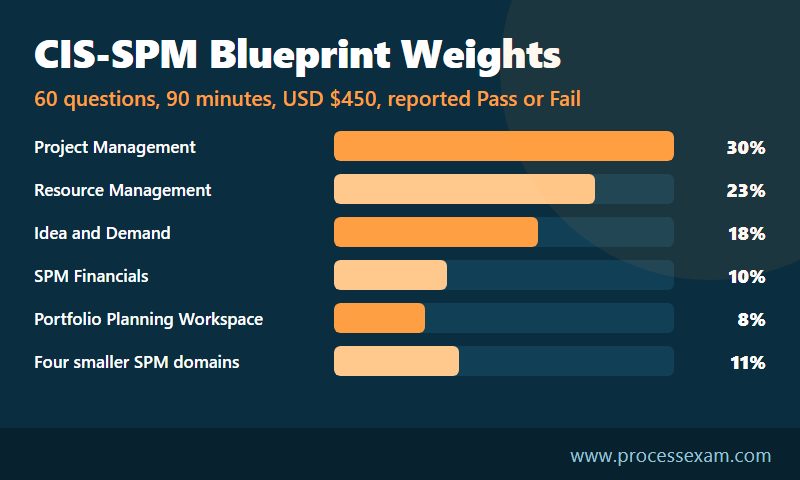
Read that shape before you read any study guide. Three domains – project delivery, resourcing, and the intake of ideas and demands – account for roughly seven questions in every ten. The four small areas at the bottom share about a tenth of the paper between them, which is one or two questions each: worth an evening, never worth a week. A candidate who spends equal time on nine domains has already mismanaged the highest-weighted skill the exam tests, which is prioritisation.
What do the three heaviest SPM domains expect you to configure?
Weighting tells you where to look; it does not tell you what the questions want. Across these three areas the pattern is consistent: you are shown a situation an implementation consultant meets, and asked which configuration produces the outcome the customer described.
Project Management, at 30%
The largest block covers the delivery record itself – projects, tasks, phases, dependencies and the way a schedule is calculated rather than typed. Expect to reason about planned versus actual dates, the effect of a task relationship on everything downstream, percentage complete and how it is derived, baselines taken before a change, and the difference between the waterfall project record and an agile delivery tracked in the same instance. Status reporting sits here too: what a project status report pulls together, who writes it, and why an overdue task and a red status are not automatically the same statement.
Resource Management, at 23%
This is the domain that separates candidates who have run an SPM project from those who have only read about one. Resource plans move through requested, confirmed and allocated states, and every state means something different to a resource manager looking at capacity. Be ready for soft bookings against hard ones, group versus named-person requests, the availability calculation behind a capacity chart, what happens to a plan when a project’s dates shift, and how allocations and timecards reconcile at the end of a week. If one area deserves hands-on time rather than reading, it is this one.
Idea and Demand, at 18%
Work arrives before it becomes a project. Ideas are submitted and assessed, demands are created, qualified, scored and either approved into a project or closed. Questions here probe the states in that lifecycle, the assessment and scoring that rank one demand above another, the roles allowed to move a demand forward, and the handover where an approved demand becomes a project record with its data intact. Understanding this flow end to end also explains half of what the Portfolio Planning Workspace shows you.
And the rest, briefly
SPM Financials asks about cost plans, budgets, forecasts and rollups from task to project to portfolio. The Portfolio Planning Workspace asks what a planner can do inside it – compare scenarios, shift funding, see the effect on a roadmap. Timecard Management covers entry, submission, approval and where recorded time surfaces afterwards. The three 2% domains cover the shape of an SPM implementation, the analytics and dashboards that report on it, and how SPM works alongside neighbouring ServiceNow products. Cover them once, properly, and move on.
Which CIS-SPM study materials does ServiceNow publish itself?
Everything in this section is free or already paid for, comes from the vendor, and is current by definition. That combination is what a dump pretends to offer and cannot.
- The exam blueprint. Domains, weightings and the objectives underneath them. It is the syllabus the item writers work from, and it changes when the product does.
- The credential path. ServiceNow sets out the sequence of courses and prerequisites it expects behind this exam, starting with platform fundamentals and ending with the Strategic Portfolio Management implementation course. Work the published CIS-SPM credential path in order; the later material assumes the earlier.
- The product documentation. ServiceNow’s docs describe every table, field and workflow the exam can ask about, release by release. When a practice question and your memory disagree, the docs settle it.
- A practice instance. Nothing else teaches resource plans. Configure a demand, promote it, staff it, book time against it and watch the numbers move.
- The ServiceNow community. Implementation threads show how other people solved the problems the exam describes, which is closer to the exam’s style than any list of facts.
One honest caveat about the vendor material: most of it lives behind a ServiceNow University sign-in, and some courses are paid or tied to a partner or customer account. That friction is exactly what the dump sites exploit. The answer is to start the account early, not to go around it.
How do you turn the blueprint into a study plan you can defend?
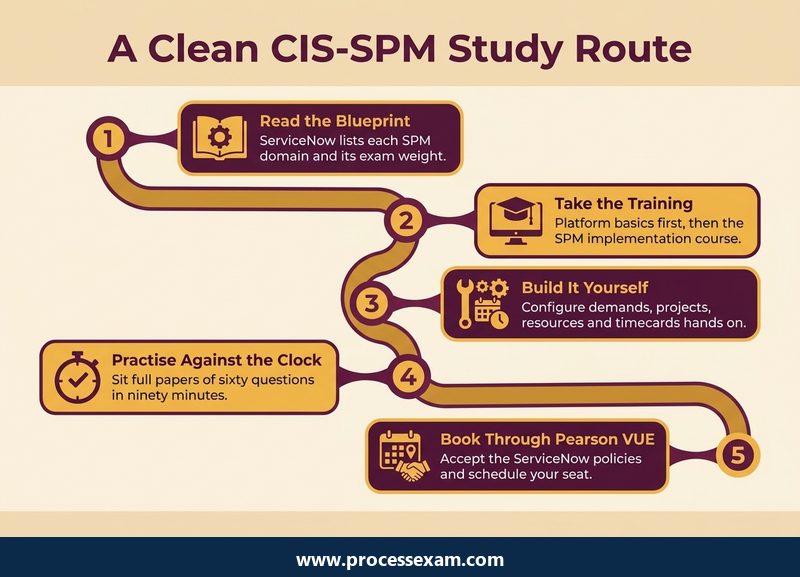
A plan is defensible when you can point at each week and say which blueprint domain it served and what you built during it. Six weeks at eight hours a week suits someone already administering ServiceNow; double the calendar if SPM is new to you.
Weeks one and two: intake and delivery
Take Idea and Demand first, because it is where work enters the system, then move straight into Project Management. Build as you read: submit an idea, assess it, qualify a demand, approve it into a project, then plan that project with real tasks and dependencies. By the end of week two you should be able to change one task’s duration and predict what happens to the finish date before you press save.
Weeks three and four: resourcing and money
Give Resource Management a full fortnight, and spend it inside an instance rather than a textbook. Create a resource plan, request a group, confirm it, allocate a named person, then shift the project dates and see what breaks. Add cost plans and budgets on top so you can trace a number from a task up to a portfolio. This is the block that most often decides a result.
Week five: workspaces, timecards and the small domains
Work through the Portfolio Planning Workspace as a planner would, run a week of timecards from entry to approval, then clear the three 2% domains in a single sitting. Keep a running list of anything you had to look up; that list is your revision sheet for week six.
Week six: timed papers and the gaps they expose
Stop learning new material. Sit full-length papers under exam conditions, mark them, and send every wrong answer back to the documentation or the instance rather than to the answer key. Two clean runs at pace, with the same mistakes not reappearing, is a better readiness signal than any score you could quote.
How do you know you are ready when the result is only Pass or Fail?
With no percentage to aim at, readiness has to be measured on your own evidence. Four signals are worth trusting, and none of them is a number somebody sold you.
- Coverage. You can name all nine blueprint domains and say, in a sentence each, what a question from them would look like.
- Repair, not recall. When you get a practice item wrong you can explain the correct answer from the product, not from having seen the item before.
- Pace. You finish sixty questions inside ninety minutes with time left to revisit the flagged ones, not exactly on the bell.
- Stability. Your last two timed runs agree with each other. One good run is variance; two is a trend.
Question practice earns its place in that list when it is built to the published blueprint and explains every answer – which is the whole difference between practice and a leaked key. If you want a timed bank to run week six against, our CIS-SPM mock exam is written to the current domain weightings and gives an explanation with each question.
One more habit worth keeping: write down, before each timed run, which two domains you expect to be weakest. Being right about your own weak spots is itself a readiness signal, and being wrong about them tells you more than the score does.
What does the CIS-SPM credential prove once you hold it?
Implementation Specialist credentials are read by two audiences, and they read them differently. A ServiceNow partner counts them, because certified staff sit behind the partner programme and the engagements it unlocks. A customer reads yours as a promise that the consultant in the room has configured demand intake and resource plans before, and will not be learning on their budget.
That is why the route matters as much as the result here. Strategic Portfolio Management work is judged by whether the portfolio a client is funding actually reflects the projects being delivered, whether capacity numbers are believed by the resource managers who own them, and whether the roadmap in the planning workspace survives contact with a re-prioritisation. None of that is answerable from memorised items. A candidate who built the flows during preparation walks in with the answers; a candidate who bought them walks in with a certificate and a problem.
Keep the credential useful after you pass. ServiceNow ties certification maintenance to its release cycle, so check your ServiceNow University record for what is due and when rather than assuming a credential is permanent. Each maintenance cycle is also a cheap way to stay current on a product that changes twice a year – which, in the end, is the same reason dumps fail and hands-on preparation does not.
Frequently Asked Questions
Are CIS-SPM dumps safe to use for exam preparation?
No. Dumps circulate copied live exam content, which the ServiceNow certification policies you accept before booking treat as confidential. A result obtained that way can be withdrawn, and the material is usually out of date within a release or two because Strategic Portfolio Management changes with every ServiceNow family release.
How many questions are on the CIS-SPM exam, and how long do you get?
The CIS-SPM exam has 60 questions and a 90-minute time limit, which works out at about ninety seconds per item. Scenario questions that describe a portfolio, a funding model and competing demands take longer, so build a habit of clearing the short recall items quickly.
What is the passing score for the CIS-SPM exam?
ServiceNow does not publish one. The result is reported as Pass or Fail, with no percentage and no per-domain breakdown. Exam forms are equated for difficulty, so a fixed number of correct answers would not be meaningful. Judge readiness on timed practice across every blueprint domain instead.
How much does the CIS-SPM exam cost?
The exam fee is USD $450. ServiceNow can change pricing or issue vouchers through its training and partner programmes, so confirm the figure on ServiceNow University when you schedule. The fee covers one attempt at the 60-question exam, delivered through Pearson VUE at a test centre or online.
Which CIS-SPM domain carries the most weight?
Project Management is the heaviest at 30%, followed by Resource Management at 23% and Idea and Demand at 18%. Those three cover roughly seven questions in every ten, so they deserve most of your study time and most of your hands-on configuration practice in an instance.
- ServiceNow Strategic Portfolio Mgmt Implementation Specialist Test Questions |
- CIS-SPM Question Bank |
- ServiceNow Strategic Portfolio Mgmt Implementation Specialist Book |
- Strategic Portfolio Mgmt Implementation Specialist Certification Cost |
- Strategic Portfolio Mgmt Implementation Specialist Certification Requirements |
- ServiceNow Strategic Portfolio Mgmt Implementation Specialist Sample Questions |
- CIS-SPM Exam Questions Download |
- CIS-SPM Test Questions |
- Strategic Portfolio Mgmt Implementation Specialist PDF |
- Technology |
- CIS-Strategic Portfolio Mgmt Certification |
- CIS-Strategic Portfolio Mgmt Certification Cost |
- ServiceNow CIS-Strategic Portfolio Mgmt Book |
- ServiceNow CIS-Strategic Portfolio Mgmt Question Bank |
- ServiceNow CIS-Strategic Portfolio Mgmt Study Guide |
- CIS-Strategic Portfolio Mgmt |
- CIS-Strategic Portfolio Mgmt PDF |
- ServiceNow CIS-Strategic Portfolio Mgmt Exam Questions |
- ServiceNow CIS-Strategic Portfolio Mgmt Sample Questions


