
ASQ Certified Food Safety and Quality Auditor (CFSQA): Cost, Exam and Eligibility
The ASQ Certified Food Safety and Quality Auditor (CFSQA) is a five-year-experience credential for people who audit HACCP-based food safety systems. The exam has 145 multiple-choice questions, runs 258 minutes, costs $550 ($450 for ASQ members) and needs 550 out of 750 to pass. This guide covers eligibility, the exam day, the fees, the weights and a study plan; our CFSQA practice exam is there for timed drills.
Everything below was checked against ASQ's own CFSQA page and its Body of Knowledge document in September 2026. Where ASQ gives a date, the date is quoted with the month it was read, so you can see how fresh it is.
Is the CFSQA the right credential for your food safety job?
ASQ describes the CFSQA holder as someone who can audit a food safety and HACCP-based system: examine it, question it, evaluate it and report on where it is adequate and where it falls short. That is an auditor's credential, not a food scientist's or a plant operator's. If your working day is spent checking whether someone else's system does what it claims, it fits. If you mostly run a line, it will feel like a stretch.
ASQ lists the job functions it has in mind: consultant, food quality auditor, food safety auditor, HACCP auditor, quality assurance manager and quality assurance supervisor. The same page names food manufacturing, processing and distribution as the home ground, and mentions HACCP coordinators and regulatory compliance officers among the people who should consider it. Three quick tests help you decide.
- Do you already judge evidence? The exam keeps asking you to decide whether a record, an observation or a control is good enough, not to recite what a term means.
- Do you touch HACCP? Seven principles, prerequisite programmes and corrective action run through more than a third of the paper.
- Can you show the experience? ASQ reviews your application before you may sit, so the next section matters before anything else.
A note on the name: the credential used to be called the Certified HACCP Auditor (CHA). ASQ's own fact sheet still mentions the earlier name, and the ASQ web address still ends in "haccp-auditor". If an older job advert asks for a CHA, the CFSQA is the current ASQ credential in that line.
Do you qualify to apply, and how do the experience years add up?
ASQ asks for five years of paid, full-time, on-the-job experience in one or more areas covered by the CFSQA Body of Knowledge. One of those years has to be spent in what ASQ terms a decision-making post: you set, ran or controlled a process or project and were accountable for how it turned out. The title does not have to include "manager" or "supervisor"; a senior auditor who signs off findings can qualify.
A degree from an accepted college, university or technical school shortens the five years. Only one waiver can be claimed, and ASQ's page sets them as follows.
| Education you hold | Years waived | Experience still needed |
|---|---|---|
| Technical or trade school diploma | 1 | 4 years |
| Associate degree | 1 | 4 years |
| Bachelor's degree | 3 | 2 years |
| Master's or doctorate | 4 | 1 year |
The decision-making year is not waived by any degree, so a master's holder still needs one year of that kind. Degrees earned outside the United States have to be equivalent to a US degree. ASQ also says that if it finds you do not meet the requirements, it refunds your fee minus a processing charge of $130, so it is worth reading the requirement text on ASQ's CFSQA page before you pay.
How to describe your experience so it is easy to approve
Write each role in terms of the Body of Knowledge, not your job title. "Led the internal audit programme for a dairy plant, including HACCP plan verification and supplier audits" maps to several sections at once. "Quality technician" on its own does not. Keep dates, employer names and a supervisor who can confirm the work; a clear form matters because online applications take ASQ one to two working days to review and paper ones three to five, and unclear ones draw a hold message.
What does the CFSQA exam look like on test day?
The exam is delivered mainly on computer at Prometric test centres, with a paper-based option in scheduled sessions. It is offered in English only. Here are the exam's core numbers, which agree with ASQ's page.
| Item | CFSQA detail |
|---|---|
| Exam | ASQ Certified Food Safety and Quality Auditor (CFSQA) |
| Questions | 145 (computer-based) |
| Exam time | 258 minutes |
| Full seat booking | 270 minutes |
| Passing score | 550/750 |
| Fee, ASQ members | $450 |
| Fee, non-members | $550 |
| Retake fee | $350 |
Of the 145 computer-based questions, 135 are scored and 10 are unscored. ASQ does not tell you which are which, so treat every question as live. That is 258 minutes for 145 items, roughly 1.8 minutes each, a comfortable pace if you know where to look things up. The paper version is different: 135 questions in four hours, with no unscored items.
Open book means a bound binder, not loose notes
The CFSQA is an open-book paper, yet the rules on what you may bring are tight. Notes count as reference material, and they must stay bound throughout: stitched or glued spines, or pages held in a cover by ring binders, spiral binders, brads or screw posts. Stapling pages by hand does not pass inspection, and sticky notes count only as index tabs put on before you enter the centre. Blank writing tablets and slide or wheel charts are prohibited. A basic scientific calculator is built into the computer exam, and a silent, battery-powered calculator without programmable memory is accepted if you prefer your own.
Test-centre rules that cost people fees
- Arrive 30 minutes before your appointment. Late arrivals are refused entry and lose the exam fee.
- Bring one valid government photo ID with a signature, and make sure the name matches your application exactly.
- Your bag and phone go into a locker; you keep only your ID and locker key.
- Changing an appointment costs $130 and must be done at least five days ahead. A no-show forfeits the application fee.
What will you actually pay, and which testing window can you still catch?
The first attempt costs $550, or $450 if you are an ASQ member, because ASQ takes $100 off the initial fee for members. A retake costs $350. The retake rate is available for two years from your previous attempt, so a fail followed by a quick, focused second try is cheaper than waiting and re-applying at full price.
Whether membership pays for itself is simple arithmetic: it saves $100 on the exam, so it makes sense only if the membership fee, which you should confirm on ASQ's site, is lower than the discount or you value its other benefits anyway. Budget also for a reference handbook and any practice tests, and for the $130 rescheduling fee if there is a real chance your work calendar will move.
Windows checked in September 2026
| Computer-based window | Application deadline |
|---|---|
| 1 to 30 September 2026 | Passed |
| 1 to 30 November 2026 | 12 October 2026 |
| 1 to 31 January 2027 | 7 December 2026 |
| 1 to 31 March 2027 | 8 February 2027 |
You apply first, wait for ASQ approval, then receive an eligibility email and book a specific day inside the window with the testing provider. If you choose paper, you get a seating letter around two weeks before instead. With an October 12 deadline for November, most people reading this in autumn are better served aiming at the January window, which leaves time for a proper study plan. Dates change, so confirm them on the ASQ page before you commit.
How are the 135 scored questions divided across the Body of Knowledge?
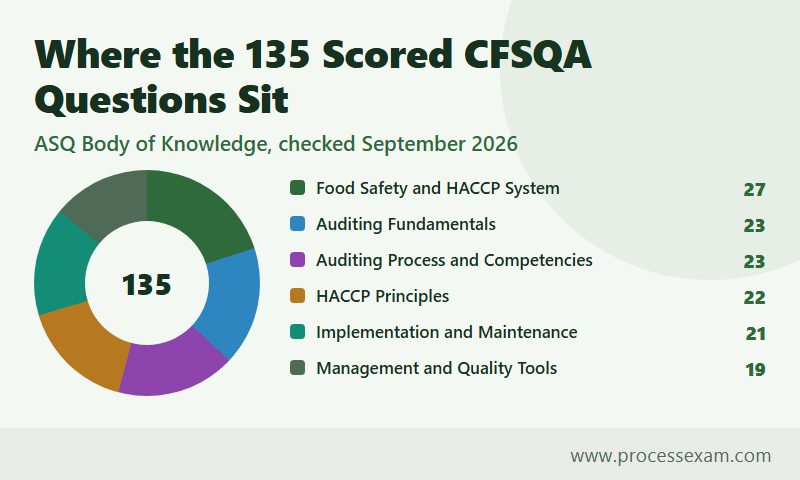
ASQ's Body of Knowledge document is dated 2020 (item B1103). It splits the 135 scored questions across seven sections. Each entry also carries the highest thinking level at which it can be tested, from Remember and Understand through Apply and Analyze to Evaluate. Our CFSQA syllabus page lists the same topics if you want them in one place. In September 2026 ASQ's page still links this Body of Knowledge, and we found no announcement of a replacement.
| Section | Scored questions | Share of 135 |
|---|---|---|
| I. Food Safety and HACCP System | 27 | 20% |
| II. Food Safety and HACCP Management | 9 | 7% |
| III. HACCP Principles | 22 | 16% |
| IV. Implementation and Maintenance | 21 | 16% |
| V. Auditing Fundamentals | 23 | 17% |
| VI. Auditing Process and Auditor Competencies | 23 | 17% |
| VII. Quality Tools and Techniques | 10 | 7% |
Read the table as two halves. Sections I to IV, worth 79 questions, are about the food safety system itself. Sections V and VI, worth 46, are about the craft of auditing it. Only 10 questions test statistics and quality tools, and 9 cover management responsibility and preliminary tasks. The chart below folds those last two together so that the donut stays readable.
Section I: the system and its prerequisites
The largest section starts with terminology: deviation, validation, verification, food safety culture, food quality plan, and bodies such as Codex Alimentarius and the National Advisory Committee on Microbiological Criteria for Foods. It then moves into prerequisite programmes, tested at the Analyze level. Expect good manufacturing, agricultural and laboratory practice, sanitation procedures, chemical control, training, calibration, pest management, foreign material control, maintenance, waste, supplier qualification and distribution. Traceability and recall, crisis management, food defence, environmental monitoring and food fraud follow, and the section closes with preventive controls: process controls, supply chain controls and allergen control.
Sections II to IV: from planning to a living plan
Section II covers the preliminary tasks for building a plan (team, product description, intended use, flow diagram), the scope of the system against quality, risk and GFSI-type schemes, and management responsibility. Section III walks the seven principles: hazard analysis, critical control points, critical limits, monitoring, corrective action, verification, and records. Section IV asks how a plan is piloted, validated, reassessed using complaints, recalls and deviations, and maintained. Because the exam is written for auditors, ask of each principle "what would I look for as evidence?" rather than "how do I design this?".
Sections V and VI: the auditing craft
Auditing Fundamentals covers the difference between assurance and control, why audits are done, first-, second- and third-party audits, criteria such as standards, contracts and regulations, roles on an audit, and ethics, liability and due care. Section VI follows the audit from planning to closure: pre-audit documents, tracing strategies, opening and exit meetings, working papers, objective evidence, classifying nonconformances, reporting, corrective action follow-up, records retention, and the interpersonal skills of interviewing, conflict handling and team facilitation. It ends with two Remember-level lists you can memorise: the regulations (FSMA, FDA 21 CFR 117 and 507, the Foreign Supplier Verification Program and USDA rules) and the certification schemes (SQF, FSSC 22000, BRC, Primus, Global G.A.P., IFS and others).
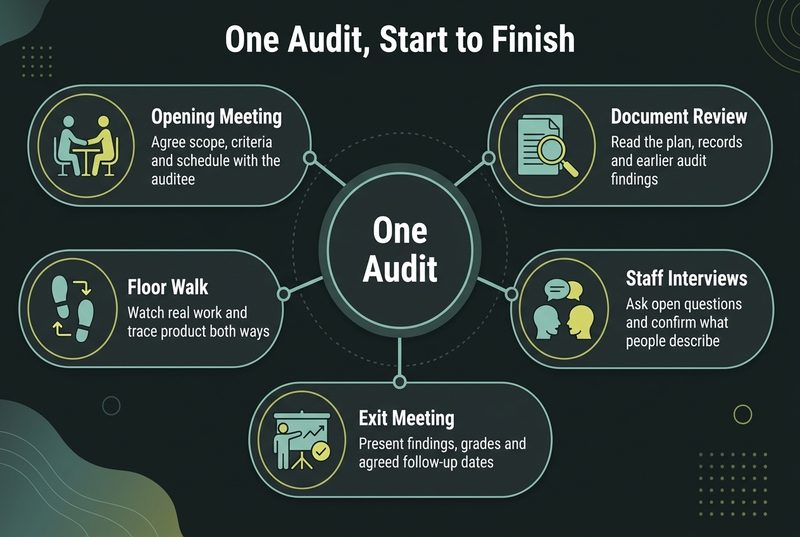
The graphic above follows one audit through the sequence that Section VI tests, so it doubles as a memory aid for the order of events.
Section VII: the small statistics block
The seven basic quality tools, mean, median, mode, standard deviation, sampling, and the qualitative versus quantitative split are tested at Apply or Analyze level. Statistical process control is tested only at the Understand level and process capability (Cp and Cpk) only at Remember, and ASQ notes that neither requires calculations. Ten questions is a small share, but they are the easiest marks to secure with a short revision block.
How should you split your study weeks and reference binder?
Most candidates who already audit need six to eight weeks alongside work; those coming from production or lab roles may want ten. The plan below assumes about six hours a week and is a suggestion, not an ASQ recommendation.
- Week 1: read the Body of Knowledge line by line. Mark every topic as strong, shaky or new. Note the cognitive level, because a topic tested at Analyze needs more than a definition.
- Weeks 2 and 3: the food safety system. Cover Sections I and II. Build a one-page table of the prerequisite programmes with an example audit question for each.
- Week 4: the seven principles. For each principle write what a compliant record looks like and what a red flag looks like.
- Week 5: implementation and auditing fundamentals. Sections IV and V, including party types and audit criteria.
- Week 6: the audit process. Sit down with a real or imagined audit and tag every step to a Section VI topic.
- Week 7: quality tools and regulations lists. Short flash-card drills for the Remember-level lists.
- Week 8: timed papers. Two full-length attempts of 145 questions in 258 minutes, then review every wrong and every guessed answer.
Building the binder
ASQ's page lists the CFSQA Handbook and Quality Audits for Improved Performance among the exam references, and the fact sheet names the Certified HACCP Auditor Handbook. Whatever you choose, index it: tab the seven sections, add a one-page glossary of the Section I terms, and a list of the regulations and schemes from Section VI. The binder is a lookup aid for facts. It cannot replace judgement on a scenario question, so if you find yourself searching it for more than a minute, flag the question and return.
Practice that matches the exam
Practice questions are most useful when they test judgement, not recall. Timed sets that mimic the exam, with explanations for every answer, help you build the pacing you will need for 145 questions. After each set, sort your misses into three piles: content you did not know, content you knew but misread, and questions where the binder cost you time. Each pile has a different fix.
What catches out candidates who already work in food safety?
- Answering as the operator instead of the auditor. A question may describe a plant problem, but the correct option is usually about evidence, verification or reporting, not the fix itself.
- Treating open book as a safety net. A 258-minute window sounds generous, but repeated lookups add up quickly. Use the binder for terms and lists only.
- Skipping the "boring" sections. Sections II and VII total only 19 scored questions, yet they are where experienced auditors most often lose easy marks because they never studied them formally.
- Confusing similar words. Validation versus verification, control point versus critical control point, operating limit versus critical limit, observation versus nonconformance. The exam separates them deliberately.
- Leaving the paperwork late. A missing ID match, a binder with a loose staple, or a late arrival can end the day before a question is read.
A practical habit: when you review a practice question, restate the correct answer in one sentence beginning "An auditor would confirm this by...". If you cannot finish that sentence, you have only memorised the answer.
What happens after you pass, and how long does the credential last?
Computer-based candidates see the result on screen as soon as they submit. A confirmation email follows within three to five business days, and ASQ sends a separate email explaining how to claim a digital certificate and badge through the Accredible platform. Paper results arrive a little later. A failed attempt brings an emailed breakdown of how you did, handy when you plan the retake.
ASQ's fact sheet says the credential requires recertification every three years, and its recertification page sets the rules, so check that page rather than relying on a summary. Keep a simple log from the day you pass: audits performed, training taken, articles or talks given. It is far easier than reconstructing three years of activity later.
The credential itself does not create a job, but it gives an employer external proof that your audit judgement was tested against a published Body of Knowledge. It also pairs well with the third-party scheme knowledge the exam covers, because many auditors work against SQF, BRC or FSSC 22000 requirements every week. For the full set of policies, including the candidate handbook, see ASQ's certification candidate handbook, and for the exact scope of each topic read ASQ's Body of Knowledge document.
Frequently Asked Questions
How much does the ASQ CFSQA exam cost?
The first attempt costs $550, or $450 for ASQ members, because members save $100 on the initial fee. A retake costs $350 and is available at that reduced rate for two years after your previous attempt. Rescheduling a booked appointment adds a $130 charge.
How many questions are on the CFSQA exam and how long is it?
The computer-based exam has 145 multiple-choice questions, of which 135 are scored and 10 are unscored. Exam time is 258 minutes and the total appointment is 270 minutes. The paper-based option has 135 questions in four hours. Both are offered in English only.
What is the passing score for the CFSQA?
The passing score is 550 out of 750. Computer-based candidates see the result on screen straight after submitting, and ASQ confirms it by email within three to five business days. Failing candidates receive a summary of performance that shows where to focus before a retake.
What experience do you need for the CFSQA?
You need five years of paid, full-time experience in Body of Knowledge areas, with at least one year in a decision-making role. A diploma or associate degree waives one year, a bachelor's degree three years and a master's or doctorate four years. Only one waiver can be claimed.
Is the CFSQA exam open book?
Yes. Every ASQ exam is open book, but reference material and notes must stay bound, by stitching, glue, or ring or spiral binders. Hand-stapled pages and loose notes are refused at inspection. Sticky notes work as index tabs only if they are already stuck on before you walk in.
- Auditing |
- ASQ Food Safety and Quality Auditor Test Questions |
- CFSQA Question Bank |
- CFSQA Body of Knowledge (BOK) |
- ASQ Food Safety and Quality Auditor Book |
- ASQ CFSQA BOK PDF |
- Food Safety and Quality Auditor Certification Cost |
- Food Safety and Quality Auditor Certification Requirements |
- ASQ Food Safety and Quality Auditor Sample Questions |
- CFSQA Exam Questions Download |
- CFSQA Test Questions |
- Food Safety and Quality Auditor PDF |
- CFSQA Handbook


