
Certified Calibration Technician Salary and Career Path
Updated on 23 September 2026. What’s new: the CCT exam fees are corrected to ASQ's current $360 for members, $460 for non-members and $260 for a retake
Calibration sits in the middle of the technician pay range rather than the top of it. The United States Bureau of Labor Statistics puts the median wage for calibration technologists and technicians at $67,820 a year, or $32.61 an hour, in its May 2025 figures, spread across roughly 17,000 jobs. What lifts an individual above that median is the size of the work you are trusted with, and the ASQ Certified Calibration Technician credential is the usual way of proving you can be trusted with more of it.
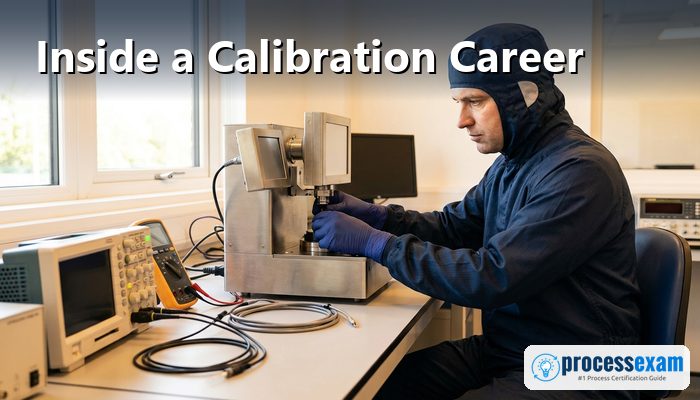
How much do calibration technicians earn, and what actually moves the number?
The wage figures above come from the Bureau of Labor Statistics occupational profile for calibration technologists and technicians, which is drawn from its national employer wage survey rather than from self-reported job-board entries. Alongside the median it records typical entry-level education as an associate degree, growth of 5 percent between 2025 and 2035 - faster than the average across all occupations - and about 1,500 openings a year over that decade, most of them replacing people who retire or move into engineering roles.
Read those numbers honestly. They describe an occupation, not a credential. No public survey separates the pay of certified technicians from uncertified ones in a way you could quote in a salary discussion, so treat certification as leverage rather than as an automatic percentage. It gives your manager an external benchmark for a grade increase, it gets your name past screening filters that list ASQ credentials, and it removes the argument that your skill is only local knowledge of one site's instruments.
Four things push earnings up inside the same job title. The first is regulatory weight: a technician whose certificates support medical device release or aerospace airworthiness carries more risk than one calibrating shop gauges, and is paid accordingly. The second is scope - running a written procedure is a lower grade than deciding calibration intervals, building uncertainty budgets and choosing which standard may be substituted for another. The third is accreditation. In a laboratory working to ISO/IEC 17025, the people who can sign results and defend them to an assessor are a smaller group than the people who can take readings. The fourth is inconvenience: field service, shutdown work, cleanroom gowning and night shifts all pay premiums, because the instruments cannot be brought to you.
Which industries hire calibration technicians, and what is the work like inside them?
Every industry that has to prove a measurement was right hires this skill, but the daily shape of the job changes a lot between them.
- Pharmaceutical and medical device manufacturers - heavily documented work, where a late calibration can quarantine a batch and where your records are read by auditors long after you have forgotten the instrument.
- Aerospace, defence and nuclear - torque, pressure, dimensional and electrical standards with tight tolerances, often with security clearance and long traceability chains.
- Automotive and general manufacturing - high instrument counts, gauge studies, and pressure to keep production running while equipment is off the line.
- Electronics and semiconductor - time, frequency, voltage and resistance work at resolutions where the environment itself is a variable.
- Independent calibration laboratories - the widest variety of equipment, customer-facing certificates, and the most exposure to accreditation assessments.
- Energy, utilities and process plants - flow, level, temperature and analytical instruments, much of it field work in difficult access.
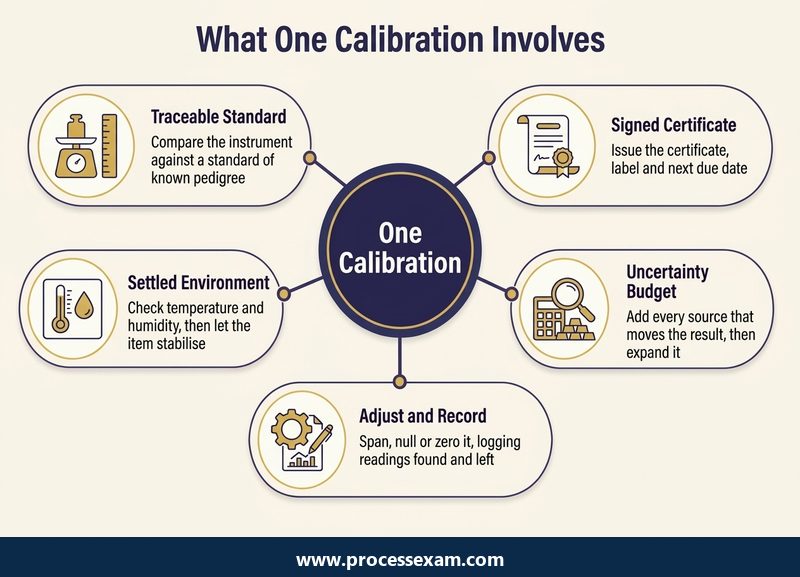
The rhythm of a shift is similar everywhere. You pull the next instrument from the due list, check that the room is inside its temperature and humidity limits, let the item settle, and compare it against a standard whose own traceability you can show. If it is out, you adjust it by spanning, nulling, zeroing or linearising, and you record what it read both before and after, because the as-found reading is the piece of evidence that tells a quality engineer whether anything measured with it since the last calibration is suspect. Then comes the paperwork that pays your wages: the certificate, the label, the interval decision, and - when something has failed badly - the notification that starts an impact assessment.
Which career moves open up once you can prove the skill?
ASQ's own description of a calibration department lists the roles that sit around the bench: laboratory manager, technical manager, scheduler, quality manager and technician. That list is a fair map of where people go next.
Moving up inside the laboratory
The first step is usually senior or lead technician - the person who writes and revises procedures, sets calibration intervals from history rather than habit, and trains new starters. From there the path splits. Technical management suits people who enjoy the measurement science: defending uncertainty budgets, running interlaboratory comparisons, approving substitutions. Laboratory or quality management suits people who enjoy the system: scheduling, overdue lists, document control, corrective action and the assessment visit.
Moving sideways into better-paid specialisms
Instrument manufacturers hire experienced technicians as field service and applications engineers, where travel pays a premium. Supplier quality teams want people who can walk into a vendor's laboratory and tell whether its certificates mean anything. Internal audit teams want someone who understands ISO/IEC 17025 from the inside. And in regulated plants, validation and metrology engineering roles open to technicians who have shown they can handle uncertainty maths and write a defensible report.
What each move asks you to add
Calibration skill alone rarely gets you the next job. Supervisory roles ask for scheduling and people management, audit roles ask for questioning technique and standards knowledge, and engineering roles ask for statistics beyond the exam. The certificate proves the technical base; the promotion usually depends on the layer you build on top of it.
Does your experience qualify you for the CCT, and what will it cost?
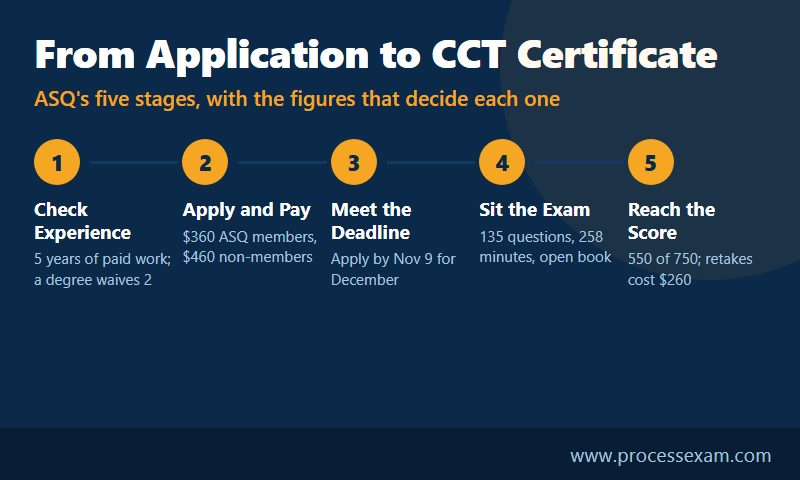
ASQ asks for five years of full-time, paid work in one or more areas of the calibration technician body of knowledge. Unpaid, voluntary or purely academic work does not count towards it. Formal study shortens that requirement by two years, whether the qualification is a trade, military or technical school diploma or a university degree at any level, and only one such waiver may be claimed. A technician holding any one of them therefore needs three years on the bench rather than five.
The fees are set by ASQ and published on the certification page. Membership is the cheapest way to sit the exam, and a second attempt is charged at a reduced rate for two years after your previous one.
| Exam detail | Value |
|---|---|
| Exam name | ASQ Certified Calibration Technician |
| Exam code | CCT |
| Exam fee | ASQ MEMBERS - $360; NON-MEMBERS - $460; RETAKES - $260 |
| Number of questions | 135 |
| Exam duration | Exam time 258 minutes, total appointment time 270 minutes |
| Passing score | 550/750 |
| Question format | Multiple choice, open book, English only |
Two smaller charges are worth knowing before you commit. If ASQ reviews your application and decides you do not meet the requirements, the refund comes back minus a processing fee of $130. Changing an exam appointment also costs $130 and has to be done at least five days ahead; simply not turning up forfeits what you paid. Budget for the reference books as well - the ones you are allowed to carry into the exam are not cheap, and they are the difference between looking something up in seconds and losing three minutes you needed elsewhere.
When is the next testing window, and how do you get a seat in it?
ASQ does not test all year round. Computer-delivered exams run inside fixed monthly windows, and each window closes to applications weeks before it opens. These are the dates published on ASQ's calendar, checked September 2026.
| Testing window | Application deadline | Position in September 2026 |
|---|---|---|
| October 1 - 31, 2026 | September 14, 2026 | Deadline already passed; no longer open to new applications |
| December 1 - 31, 2026 | November 9, 2026 | The next window you can still apply for |
| February 1 - 28, 2027 | January 11, 2027 | Open |
Dates move, so confirm them against ASQ's exam dates and deadlines page before you plan around them. The sequence itself is stable. You apply online, and ASQ reviews the application in one to two business days for online submissions, or three to five for a paper one. An approval or a hold comes back by email; a hold simply means the reviewer wants more detail about your experience. Once approved, an eligibility message follows within a day or two containing the instructions for booking with the testing provider, and you then choose a date and a test centre inside the window you applied for. Candidates sitting a paper or translated version are told their seat in a letter about two weeks before the date instead.
Book early in the window rather than late. An appointment in the first week leaves you the rest of the month to reschedule if illness or a work emergency lands on the day, and it means a disappointing result is followed by months of preparation rather than a scramble.
What is the shape of the CCT paper, and what score do you need?
Candidates sitting the computer version answer 135 multiple-choice questions in one part. Only 125 of them count; the remaining 10 are trial items ASQ is evaluating for future papers, and nothing on screen marks which is which, so give every question the same care. Exam time is 258 minutes inside a total appointment of 270 minutes, which works out at about one minute and fifty seconds per question - enough time to think, not enough to research more than a handful of answers from scratch. A paper version also exists, at 125 questions in four hours. The result is reported on a scaled range, and you need 550 out of 750 to pass.
Every ASQ exam is open book, and the rules about what you may bring are strict: references have to be permanently bound, hand-stapled notes are refused at the door, and sticky tabs must already be in place when you arrive. A basic scientific calculator appears on screen, and any silent, non-programmable hand-held one is allowed as well, which rules out graphing models. Computer-delivered candidates see their outcome as soon as they submit, with written confirmation in three to five business days.
The current syllabus is the 2024 body of knowledge, first tested in the December 2024 window and still the live version in September 2026. Its five areas carry fixed question counts, which makes study planning unusually straightforward.
| Body of knowledge area | Scored questions | What it asks of you |
|---|---|---|
| I. General Metrology | 30 | The seven base SI units, derived units and multipliers, fundamental constants, common measurands from torque to viscosity, traceability, and when one class of standard may stand in for another |
| II. Measurement Systems | 26 | Direct, indirect, ratio, transfer and substitution methods; repeatability, reproducibility, bias, linearity and stability; specification wording; error sources; measurement assurance programmes |
| III. Calibration Systems | 28 | Procedures and adjustment methods, industry regulation and which rule takes precedence, environmental control, scheduling and overdue work, software validation, records and formal reports |
| IV. Measurement Uncertainty and Applied Math | 25 | Guard-banding, false accept and false reject, TUR and TAR, type A and type B components, coverage factors, root sum square, conversions, ratios, significant figures and angular units |
| V. Quality Systems and Standards | 16 | Quality system components, the seven basic tools, audit types, corrective action for out-of-tolerance findings, ethics, occupational safety, and the standards that govern laboratories |
The published body of knowledge also marks each topic with a cognitive level, and that detail is worth more than the topic list. Substitution of standards is set at Evaluate, error sources and measurement methods at Evaluate as well, and several calibration systems topics at Analyze. Those are not definition questions. They give you a situation and ask what you would do about it. Our ASQ calibration technician syllabus page lays the same structure out topic by topic if you want to tick items off as you cover them.
How do you prepare for an open-book exam built on uncertainty maths?
Ten weeks of steady evening study suits most working technicians. Weight it by the question counts rather than by what you enjoy.
- Weeks 1 and 2 - metrology foundations. Base and derived units, multipliers, constants and the traceability chain. Write out the hierarchy from national standard to your working gauge, then find where your own laboratory sits in it.
- Weeks 3 and 4 - measurement systems. Drill the vocabulary until bias, linearity, repeatability and reproducibility are instant, and learn specification wording cold: percent of reading, percent of full scale, percent of range, counts and floor terms trap people who have only ever read one manufacturer's datasheets.
- Weeks 5 and 6 - calibration systems. Procedures, adjustment methods, environmental limits, interval setting, records, certificates and the difference between verification and validation.
- Weeks 7 and 8 - uncertainty and applied maths. The heaviest stretch, and the one to protect from interruptions. Build three uncertainty budgets from your own bench, combine them by root sum square, expand with a coverage factor, and state the result properly.
- Weeks 9 and 10 - quality systems and timed practice. Audits, corrective action, the standards, then full-length timed sittings with the books you intend to carry.
Work the maths by hand, not by spreadsheet. A worked example makes the point: if a pressure gauge has a tolerance of plus or minus 1.0 psi and your calibration process has an expanded uncertainty of 0.20 psi, the test uncertainty ratio is 5 to 1, comfortably past the 4 to 1 rule of thumb many procedures set. Halve the tolerance to plus or minus 0.5 psi and the same process gives 2.5 to 1, and now guard-banding and the risk of a false accept become real decisions rather than exam vocabulary. Practising that arithmetic under time pressure is what separates candidates who finish from candidates who run out of minutes in the last section.
Treat the open book as a filing problem. Tab your references by body of knowledge area before the day, mark the conversion tables and the uncertainty formulas you always forget, and accept that anything you have to hunt for has already cost you the question. When you want realistic timed practice, our CCT practice exam runs on the same question count and clock as the real sitting, which is the fastest way to find out whether your tabs are in the right places.
Which parts of the exam do working technicians underestimate?
Experience helps on this exam, but it also creates blind spots.
- Treating open book as a safety net. The clock, not the content, fails most candidates. If you look up more than one question in ten you will not finish.
- Skipping the quality systems area. Sixteen questions on audits, corrective action, ethics, safety and the standards look minor next to thirty on metrology, yet bench technicians routinely lose most of them. They are also the cheapest marks to buy with study time.
- Assuming your site's practice is the correct answer. Questions on regulation ask which requirement takes precedence in general, not what your quality manual happens to say.
- Vocabulary drift. ASQ writes the exam in terms of IM&TE - inspection, measurement and test equipment - rather than the local abbreviation your industry uses, and specification terms have exact meanings that everyday speech blurs.
- Stopping at the definition. Topics set at Analyze and Evaluate ask you to choose between standards, diagnose an error source or judge a substitution, so revise by working through situations rather than by rereading lists.
- Leaving uncertainty until last. Twenty-five questions depend on a skill that takes weeks to become comfortable, and it is the one area nobody improvises on exam day.
Calibration rewards people who are careful on purpose. The pay reflects responsibility more than years served, and the fastest way to be handed responsibility is to show that your judgement - on intervals, on substitutions, on when a result should be reported as out of tolerance - has been measured against a national standard of practice. That is what the certificate says about you, and it is why it tends to be the technicians who already do the thinking who see the biggest change after passing.
Frequently Asked Questions
How much does a certified calibration technician make?
The Bureau of Labor Statistics reports a median wage of $67,820 a year, or $32.61 an hour, for calibration technologists and technicians in its May 2025 figures. Pay above that median usually reflects regulated industries, accredited laboratory work, field service travel, and responsibility for intervals and uncertainty budgets rather than length of service.
How do you become a certified calibration technician?
You need five years of full-time, paid work in areas of ASQ's calibration technician body of knowledge, reduced by two years if you hold a trade diploma or a degree. You then apply before a testing window deadline, book a seat once ASQ approves you, and pass the 135-question exam.
What does a calibration technician do?
A calibration technician checks measuring and test equipment against traceable standards, adjusts what has drifted, and records the readings found before and after. The role also covers environmental checks, calibration intervals, certificates and labels, and raising out-of-tolerance findings so affected products can be reviewed.
How much does the ASQ CCT exam cost?
ASQ charges $360 for members and $460 for non-members, with retakes at $260 for two years after a previous attempt. Separate charges apply if you change your appointment or if your application is declined, so read the fee notes before you submit anything.
What is the passing score for the CCT exam?
You need 550 out of 750 on ASQ's scaled score. The exam contains 135 multiple-choice questions, of which 125 count towards that score and 10 are unscored trial items, and you have 258 minutes of exam time inside a 270-minute appointment to answer them.
- ASQ Calibration Technician Test Questions |
- CCT Question Bank |
- CCT Body of Knowledge (BOK) |
- ASQ Certified Calibration Technician |
- Calibration Technician Simulator |
- Calibration Technician Mock Exam |
- ASQ Calibration Technician Book |
- ASQ CCT BOK PDF |
- Calibration Technician Certification Cost |
- Calibration Technician Certification Requirements |
- ASQ Certified Calibration Technician Calibration Technician Certification |
- ASQ Calibration Technician Sample Questions |
- CCT Exam Questions Download |
- CCT Test Questions |
- Calibration Technician PDF |
- CCT Handbook


