
Best HR Certifications by Career Stage: 8 SHRM and HRCI Credentials
Updated on 21 September 2026. What’s new: SHRM-CP corrected to 134 questions, with current fees and exam formats for every HRCI and SHRM credential listed.
The right HR certification depends far less on which body awards it than on where you are standing in your career today. Someone two years into a coordinator role and someone who signs off a restructuring across three countries are not choosing between the same credentials at all. This guide maps the eight SHRM and HRCI credentials onto the stage each one was built for, with the exam fee, question count and testing time for every one of them.

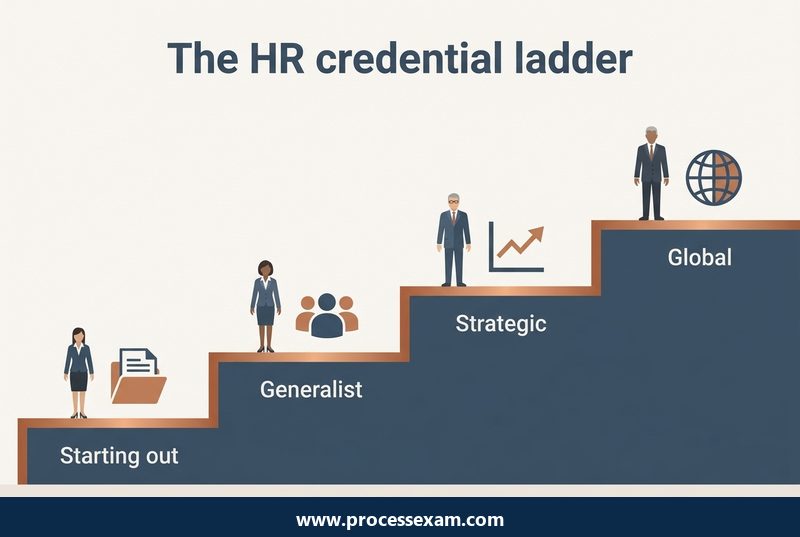
Eight credentials sounds like a crowded field, but it is really two ladders standing next to each other. HRCI runs the longer one, with a rung for people who have barely started and rungs for people who set policy for a whole organisation. SHRM runs a short one: two credentials, both aimed at people already doing HR work, split by whether you carry out decisions or make them. Once you know which rung you are reaching for, the shortlist usually comes down to two names, and often to one.
Why does your career stage decide the credential, not the brand?
Ask an HR community which certification to take and the replies split into camps, as though SHRM and HRCI were rival football clubs. That framing helps nobody, because the two bodies are not really competing for the same candidate at every level. They are competing at exactly two points on the ladder and leaving the rest of it to each other.
The clearest evidence sits in the job adverts themselves. Employers rarely ask for one body by name. They ask for "PHR or SHRM-CP preferred" for a generalist role, and "SPHR or SHRM-SCP" for a manager or director role. Those pairings are not accidents. Each pair sits at the same height on its own ladder, which is why a recruiter treats them as interchangeable, and why choosing by brand loyalty rather than by level is the one mistake that actually costs you something.
The second reason is eligibility. Both bodies gate their higher credentials behind combinations of education and professional experience, and they publish those combinations on each credential's own page. Sitting an exam a level above your experience is not just harder; the questions assume a vantage point you have not had yet. Strategic exams describe a board conversation, a workforce plan or a merger and ask what you would do next. If nobody has ever asked you those questions at work, you are guessing, and guessing is expensive at these fees.
So the useful question is not "SHRM or HRCI". It is "what does my week actually look like?" If you spend it answering employee queries, running onboarding and keeping records straight, you are at the operational level. If you spend it deciding what the HR function will do next year and defending that plan to people who control budgets, you are at the strategic level. If you have not started yet, there is exactly one credential built for you, and only one body offers it.
What do the eight HR credentials cost, and how long is each exam?
Here is the whole field in one place, so you can see the ladders next to each other before reading about any single credential.
| Credential | Body | Exam fee | Questions | Testing time | Passing score |
|---|---|---|---|---|---|
| aPHR | HRCI | Exam Fee: $300, Application Fee: $100 | 90 | 105 minutes plus 30 minutes administration time | 500 (on a scale of 100-700) |
| PHR | HRCI | Exam Fee: $395, Application Fee: $100 | 115 | 120 minutes plus 30 minutes administration time | 500 (on a scale of 100-700) |
| PHRi | HRCI | Exam Fee: $395, Application Fee: $100 | 115 | 135 minutes plus 30 minutes administration time | 500 (on a scale of 100-700) |
| SPHR | HRCI | Exam Fee: $495, Application Fee: $100 | 140 | 150 minutes plus 30 minutes administration time | 500 (on a scale of 100-700) |
| SPHRi | HRCI | Exam Fee: $495, Application Fee: $100 | 140 | 165 minutes plus 30 minutes administration time | 500 (on a scale of 100-700) |
| GPHR | HRCI | Exam Fee: $495, Application Fee: $100 | 125 | 135 minutes plus 30 minutes administration time | 500 (on a scale of 100-700) |
| SHRM-CP | SHRM | Member - $399, Non-member - $499 | 134 | 220 minutes | Pass / Fail (200 Scaled Score) |
| SHRM-SCP | SHRM | Member - $399, Non-member - $499 | 134 | 220 minutes | Pass / Fail (200 Scaled Score) |
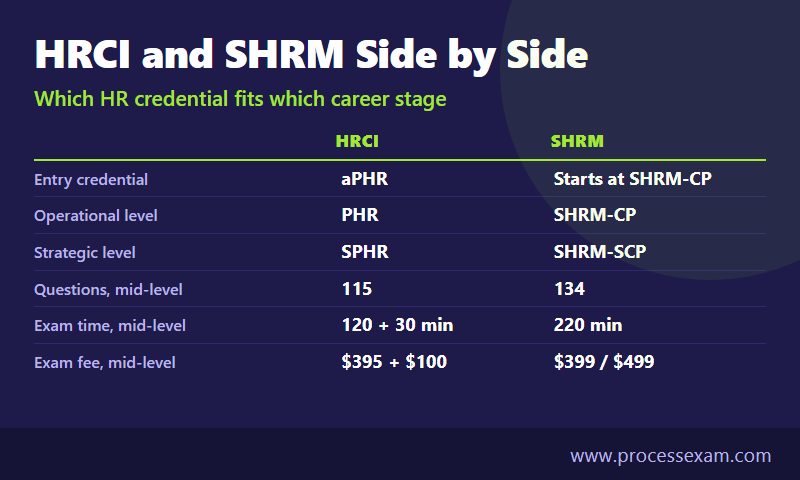
Three things in that table are worth pausing on, because they change what a credential actually costs you.
First, the two bodies price differently. Every HRCI credential carries a separate application fee of $100 on top of the exam fee, so the real outlay for PHR is $495 and for SPHR, SPHRi or GPHR it is $595. SHRM prices by membership instead, and charges the same for both of its credentials: $399 for members and $499 for non-members, whether you sit SHRM-CP or SHRM-SCP. Compare the totals rather than the headline numbers and the two ladders turn out to be priced almost identically at each rung.
Second, HRCI quotes testing time as the exam clock plus a separate block of administration time, while SHRM quotes a single 220-minute appointment. Read the HRCI figures as two numbers, not one: 120 minutes of answering plus 30 minutes of check-in, tutorial and survey for PHR, and so on down the column.
Third, the scoring conventions differ and cannot be compared directly. HRCI reports a scaled score with 500 as the pass mark on a 100 to 700 scale. SHRM reports Pass or Fail against a 200 scaled score. Neither is a percentage, so "what percentage do I need" has no answer at either body, and any figure quoted as one is somebody's estimate.
Which credential fits your first two years in HR?
If you are an HR coordinator, an HR administrator, a recruiter moving into generalist work, a line manager who has picked up people responsibilities, or a graduate aiming at HR, there is one credential designed for you and it belongs to HRCI. SHRM's ladder starts higher up.
The aPHR is HRCI's entry credential: 90 questions, 105 minutes of testing time plus 30 minutes of administration, an exam fee of $300 and an application fee of $100. It is the shortest and cheapest exam of the eight, and that is the point. It is built to prove that you understand how the HR function works before you have years of decisions behind you.
What makes aPHR genuinely useful at this stage is not the letters. It is that preparing for it forces you across the whole function rather than the corner of it you happen to work in. A recruiter who studies for it finally learns how compensation structures are built; a payroll administrator learns why employee relations cases are documented the way they are. That breadth is exactly what an employer is testing for when they promote someone from a specialist seat into a generalist one.
The trap at this stage is ambition. Every year, people two years into HR look at the PHR or SHRM-CP and decide to skip a rung, reasoning that a bigger credential is a bigger signal. It usually is not, because both of those exams gate on experience and both assume you have already handled the situations they describe. The signal that actually works early on is a credential you passed, not one you were eligible to sit. HRCI sets out what the aPHR covers and who it is for on its official aPHR certification page.
Which credential fits an HR generalist three to six years in?
This is the crowded rung, and it is the only place on the ladder where SHRM and HRCI compete head to head. You are here if you run processes rather than design them: you handle employee relations cases, manage a recruitment cycle end to end, administer benefits, apply the policy rather than write it, and escalate the genuinely novel problems upward.
The HRCI option is the PHR: 115 questions, 120 minutes of testing time plus 30 minutes of administration, $395 plus the $100 application fee. It is anchored in United States employment law and in the operational, tactical side of HR. If your work involves federal and state compliance, that anchoring is a feature, and it is the single biggest reason to prefer PHR over its alternatives.
The SHRM option is the SHRM-CP: 134 questions in a 220-minute appointment, $399 for members and $499 for non-members. It is built around a competency model rather than a body of law, which is why it travels better across borders and why it mixes situational questions in with knowledge questions. SHRM describes the credential and its eligibility routes on its official SHRM-CP page, and we cover both SHRM credentials, their syllabus breakdowns and their practice material on our SHRM certification pages.
There is a third option here that many people miss. The PHRi is HRCI's international edition of the PHR: the same 115 questions and the same $395 plus $100 fee, but 135 minutes of testing time instead of 120, and no United States employment law in it. If you work in HR outside the United States and your employer has never once cited a federal statute at you, PHRi is the honest fit, and choosing PHR instead means studying a legal framework you will never apply.
How to decide between the three? Ask what a hard day at work is made of. If it is a compliance question, take the PHR. If it is a judgement call with no clean precedent, take the SHRM-CP, because its situational items are built from exactly those. If it is either of those but in Dubai, Singapore or Nairobi, take the PHRi. HRCI's official PHR certification page lists the eligibility combinations for the United States credential.
Which credential fits a manager or director who sets HR strategy?
The strategic rung is for people whose decisions cost money and change the shape of the organisation. You are here if you own an HR budget, sit in on workforce planning, advise executives rather than report to them, and answer for outcomes rather than for tasks completed.
HRCI's SPHR is the longest exam of the eight on the answering clock: 140 questions in 150 minutes plus 30 minutes of administration, at $495 plus the $100 application fee. Its centre of gravity is planning, policy design and the business consequences of HR decisions, rather than the execution of them.
SHRM's SHRM-SCP uses the same 134-question, 220-minute format as the SHRM-CP, and is priced identically at $399 for members and $499 for non-members. What changes is the vantage point the questions take. The same competencies appear, but the situations are now about leading a function, influencing executives and setting direction. SHRM sets out the credential's scope on its official SHRM-SCP page.
The SPHRi completes the rung for senior HR professionals outside the United States: 140 questions like the SPHR, the same $495 plus $100, and the most generous clock of the eight at 165 minutes plus 30 minutes of administration. It is the strategic credential with the US-law layer removed, which makes it the natural next step for anyone who took the PHRi.
One warning about this rung. Senior candidates often prepare the way they prepared for their operational exam, which is to say by memorising. It does not work here. HRCI's official SPHR certification page describes a credential about judgement, and both bodies write strategic items where several answers are defensible and only one is best. Preparation at this level means reasoning through scenarios and being able to say why the runner-up option is worse, not recalling definitions faster.
Which credential fits HR work that crosses borders?
Three of the eight carry an international dimension, and they are not interchangeable, which is where a lot of money gets wasted.
GPHR: global HR as the subject itself
The GPHR is 125 questions, 135 minutes of testing time plus 30 minutes of administration, $495 plus the $100 application fee. It is not a translated version of anything. It is a credential about global HR practice: international assignments and mobility, building HR strategy across several jurisdictions, and running a function where employment norms change with the country. Take it when managing across borders is your actual job, not when you simply happen to live abroad. HRCI's official GPHR certification page sets out the scope.
PHRi and SPHRi: the same ladder without US law
PHRi and SPHRi are the international editions of PHR and SPHR. The level is identical, the question counts are identical at 115 and 140, and the fees are identical. What is removed is the United States legal framework, and what is added is time: PHRi gives 135 minutes against the PHR's 120, and SPHRi gives 165 against the SPHR's 150. Both are aimed at HR professionals practising outside the United States.
SHRM-CP and SHRM-SCP: one exam everywhere
SHRM does not split its credentials by geography. The SHRM-CP and SHRM-SCP are the same 134-question exams wherever you sit them, because a competency model does not need a jurisdiction. For an HR professional who moves countries every few years, that single-format design is a real advantage over choosing between a domestic and an international edition.
The rule of thumb is simple enough to write in one line. If your work is inside the United States, take the domestic credential. If it is outside, take the international edition or a SHRM credential. If your work is about the crossing itself, take the GPHR.
How differently do SHRM and HRCI test you?
The two bodies ask different kinds of questions, and the arithmetic in the facts table shows it before you read a single sample item.
Divide testing time by question count and the pattern is immediate. HRCI's exams give you between 1.04 and 1.18 minutes per question: 120 minutes for 115 PHR questions, 150 for 140 SPHR questions, 135 for 125 GPHR questions, 105 for 90 aPHR questions. SHRM's two exams give 220 minutes for 134 questions, which is roughly 1.64 minutes each, more than half a minute longer than any HRCI paper.
That gap is the design talking. Half of the SHRM exams are situational judgement items, which describe a workplace scenario and ask what you would do; you cannot read one, let alone answer it, in a minute. HRCI's items lean toward knowledge and application, which are quicker to read and quicker to settle. Neither approach is easier. They fail different people.
What this means in practice is that the two exams punish different weaknesses:
- HRCI punishes shallow coverage. With about a minute per question and a wide content outline, gaps show up as questions you simply cannot answer. Recovery time is not there.
- SHRM punishes indecision. The extra time is spent reading scenarios where two options both look professional. Candidates who cannot commit to the better one run out of clock in the last third.
- Scores are reported differently. HRCI gives a scaled score against a 500 pass mark on a 100 to 700 scale, so you learn how close you were. SHRM reports Pass or Fail against a 200 scaled score.
- Preparation should differ accordingly. For an HRCI exam, drill breadth and pace. For a SHRM exam, work through scenarios out loud and justify why the option you rejected was weaker.
Neither body recertifies you for life. Both run recertification on a fixed cycle through professional development activity or a retake, and both publish the current credit totals and cycle length on the credential pages linked above. Factor that into the decision, because a credential you cannot realistically maintain is a credential you will lose.
Where should you start if you are still weighing two of them?
By this point most readers are down to a pair: aPHR or PHR, PHR or SHRM-CP, SPHR or SHRM-SCP, PHR or PHRi. Three questions usually settle it.
- How many years of HR decisions are behind you? Under two, take the aPHR. Roughly three to six spent running processes, take an operational credential. More than that spent setting direction, take a strategic one. Check the eligibility combinations on the credential's own page before you pay anything.
- Does United States employment law govern your work? If yes, the domestic HRCI credential rewards what you already know. If no, take the international edition or a SHRM credential, and do not pay to learn a legal framework you will never use.
- Do you execute decisions or make them? This separates PHR from SPHR and SHRM-CP from SHRM-SCP more reliably than any job title does. Answer it honestly: a manager in title who spends the week executing is an operational candidate.
Once the pair has become one name, the next step is not more reading. It is finding out what you do not know while there is still time to fix it. Sit a full-length timed test at your chosen level before you book anything: you will learn more from the questions you get wrong in one evening than from another fortnight of rereading. You can work through timed question sets for every credential on this page from our HRCI exam pages, and repeat the same test a fortnight later to see whether the gap has actually closed.
A last word on the thing nobody puts in a comparison table. These eight credentials differ in fee, length and legal scope, but they do not differ much in what earns the letters: a few months of disciplined study and an honest reading of your own level. The candidates who struggle are almost never the ones who chose the wrong body. They are the ones who chose the wrong rung.
Frequently Asked Questions
Which HR certification should you get first?
If you have under two years of HR experience, the aPHR is the only credential of the eight built for that stage. It has 90 questions, 105 minutes of testing time plus 30 minutes of administration, and costs $300 plus a $100 application fee. SHRM's ladder starts one rung higher.
What is the difference between HRCI and SHRM certification?
HRCI runs a six-rung ladder anchored in employment law, with domestic and international editions, and reports a scaled score against a 500 pass mark. SHRM runs two competency-based credentials, identical worldwide, half situational judgement items, 134 questions in 220 minutes, reported as Pass or Fail.
How much do the HR certifications cost?
HRCI charges an exam fee plus a $100 application fee: $300 for aPHR, $395 for PHR and PHRi, and $495 for SPHR, SPHRi and GPHR. SHRM charges the same for both of its credentials: $399 for members and $499 for non-members, for SHRM-CP and SHRM-SCP alike.
Which HR certification suits a senior HR professional?
The strategic rung holds three: SPHR with 140 questions in 150 minutes, SPHRi with 140 questions in 165 minutes, and SHRM-SCP with 134 questions in 220 minutes. Choose SPHR inside the United States, SPHRi outside it, and SHRM-SCP if competency-based situational questions suit you better.
Which HR certification works outside the United States?
PHRi and SPHRi are the international editions of PHR and SPHR, with the same question counts and fees but no United States employment law. GPHR covers global HR practice itself across 125 questions. SHRM-CP and SHRM-SCP are identical everywhere, so geography does not change them.
- HRCI HR Professional Exam Questions |
- HRCI HR Professional Question Bank |
- HRCI HR Professional Questions |
- HRCI HR Professional Study Guide |
- HRCI PHR Quiz |
- PHR Certification |
- PHR Questions |
- PHR Practice Test |
- PHR Study Guide Material |
- PHR Sample Exam |
- HR Professional Certification |
- HRCI HR Professional Book |
- HR Professional Certification Cost |
- HR Professional Certification Requirements |
- HRCI HR Professional Sample Questions |
- PHR Exam Questions Download |
- PHR Test Questions |
- HR Professional PDF |
- HRCI Professional in Human Resources


