
ASQ CSQP Certification Guide: Eligibility, Fees and Body of Knowledge
Updated on 3 October 2026. What’s new: eligibility corrected to eight years of experience, three in a decision-making role, with education waiving one to five years.
If you spend your days deciding which suppliers earn a purchase order and chasing the ones whose parts arrive wrong, the ASQ Certified Supplier Quality Professional (CSQP) was written for your job. You need eight years of experience in supplier quality, three of them in a decision-making role, and then one open-book exam of 165 questions in 270 minutes, where 550 out of 750 passes.

This guide covers who qualifies once education waivers are counted, what the exam costs for members and non-members, how the 2023 Body of Knowledge splits its 150 scored questions across seven domains, and how to organise ten weeks of study. It also explains how to use the reference books ASQ lets you carry in, which is the part of this exam most candidates plan badly. Details were checked against ASQ's CSQP page in October 2026.
Is the CSQP the right credential for a supplier quality career?
The CSQP suits people who own the relationship between a company and the businesses that supply it: supplier quality engineers who have grown into managers, procurement or sourcing leads who carry quality targets, supply chain quality managers, and consultants who audit and develop suppliers for several clients. It is the ASQ credential that treats the supplier, rather than your own plant, as the thing being managed.
That sets it apart from the credentials people confuse it with. A Certified Quality Auditor proves you can run an audit against a standard. A Certified Quality Engineer proves you can control quality inside a process you own. The CSQP covers some of both, but its centre of gravity is different: strategy, risk, qualification of new suppliers and parts, performance monitoring, corrective action with a supplier, and the relationship management that holds it together. If your calendar is full of scorecards, corrective action requests, source inspections and negotiations over a quality agreement, the content will feel familiar.
It is less suitable if your work is inspection or process control on your own line. Those roles fit the quality technician, quality inspector or quality engineer credentials better, and the experience requirement here is demanding enough that you should be sure of the fit before you apply.
What the credential changes at work
Employers in automotive, aerospace, medical devices, electronics and food all depend on suppliers for parts that decide whether their own product passes. A CSQP after your name tells a hiring manager that you have been tested on the full supplier lifecycle, from the make-or-buy decision to exit strategy, and that you know how to protect the company from counterfeit parts, weak contracts and fragile supply chains. It will not replace experience, and the eight-year rule makes sure of that. What it does is turn years of practical judgment into something a stranger can verify.
Do you meet the experience and decision-making rule?
The application needs eight years of hands-on work in supplier quality, with three of them spent in a role where you decide rather than recommend. ASQ describes such a role as one with authority to define, execute or control projects, and with responsibility for how they turn out. A title alone does not settle it: a senior analyst who chooses which suppliers go onto a probation plan and signs off the improvement plan may qualify, while a manager who only forwards decisions made elsewhere may not.
Education reduces the eight years, but never the three years of decision-making. ASQ lets you subtract a fixed number of years for each qualification: one year for a technical or trade diploma, two for an associate degree, four for a bachelor's degree and five for a master's or doctorate. The graphic below shows what is left to prove after each one.
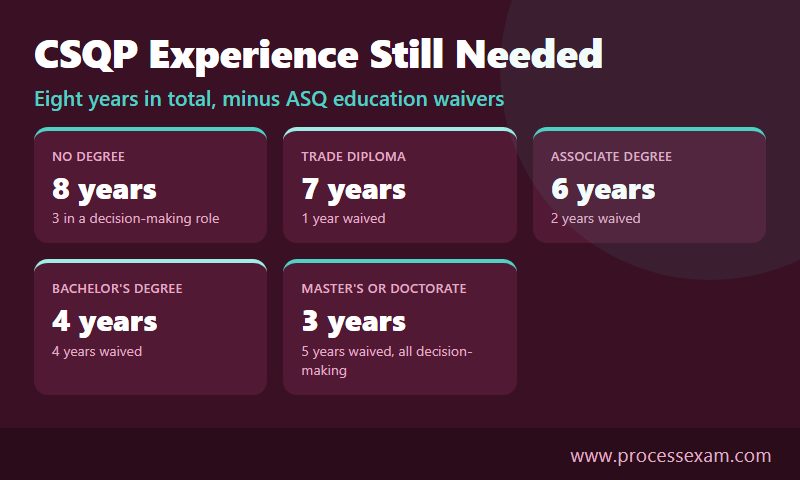
Two practical points follow from the arithmetic. First, even the highest degree leaves three years on the table, and all three have to be decision-making years, so a degree cannot stand in for authority at work. Second, experience can come from any of the areas in the Body of Knowledge, not only a job titled supplier quality, so purchasing, supplier development and audit years can all count if the work matches. Keep a short record of each role, the dates, and the decisions you owned. ASQ asks you to describe your experience on the application, and a clear summary written before you apply is easier than reconstructing it later.
Always read the current rules on ASQ's CSQP certification page before you apply, because eligibility wording is the part of an exam page that changes most often.
How much does the CSQP cost, and when can you sit it?
The fee depends on whether you hold an ASQ membership when you apply, and the numbers below are the ones ASQ listed for the exam at the time of writing.
| Exam detail | CSQP |
|---|---|
| Full name | ASQ Certified Supplier Quality Professional |
| Exam code | CSQP |
| Fee | ASQ members $450, non-members $550 |
| Retake fee | $350 |
| Questions | 165 |
| Duration | 270 minutes |
| Passing score | 550/750 |
| Body of Knowledge | 2023 version |
Membership saves $100 on the first attempt, so if you were already thinking of joining ASQ for the journals and local section, join before you apply and do the sum. A second attempt within two years of the first is available at the reduced retake rate. The fee covers the exam and not your reference books, which you buy separately.
Computer-based or paper
ASQ offers the exam on computer at a testing centre, in English only, and your result appears when you submit. The computer version has 165 questions in four and a half hours, of which 150 are scored and 15 are unscored questions that ASQ is trialling for later exams. You cannot tell which are which, so treat all 165 as real. A paper-based version also exists, with 150 questions in four hours, offered through ASQ's seating-letter process. The two share one Body of Knowledge, so choose on convenience: most candidates prefer the computer option for the instant result and the flexible booking.
Testing windows and deadlines
ASQ runs computer-based testing in monthly windows with an application deadline roughly three weeks before each one. The September 2026 window has already closed. As ASQ listed them in October 2026, the next three are the November window, which runs from 1 to 30 November 2026 with an application deadline of 12 October; January 2027, with a deadline of 7 December; and March 2027, with a deadline of 8 February. If the November deadline is too close for your preparation, plan for January and let the date drive the study schedule below. Apply through ASQ's application page.
How are the 150 scored questions spread across the seven domains?
The 2023 Body of Knowledge has seven domains, and the question counts are published, so you can plan your time by weight rather than by guesswork. The percentages below are the share of the 150 scored questions.
| Domain | Questions | Share |
|---|---|---|
| I. Supplier Strategy | 20 | 13% |
| II. Risk Management | 19 | 13% |
| III. Supplier Selection and Part Qualification | 27 | 18% |
| IV. Supplier Performance Monitoring and Improvement | 29 | 19% |
| V. Supplier Quality Management | 26 | 17% |
| VI. Relationship Management | 16 | 11% |
| VII. Business Governance, Ethics and Compliance | 13 | 9% |
Two things stand out. The three middle domains, selection and part qualification, performance monitoring and improvement, and supplier quality management, hold 82 of the 150 questions, which is more than half of the exam. And the smallest domain, governance and ethics, is still 13 questions, enough to decide a close result if you skip it as the easy one.
The Body of Knowledge also tells you how hard each topic is tested, using the revised Bloom's taxonomy from Remember up to Create. Most topics here sit at Evaluate, Analyze or Create. That means the exam rarely asks you to define a term; it gives a supplier situation and asks you to judge, rank or design a response. Studying vocabulary alone prepares you for the minority of questions.
What does each domain expect you to do with a supplier?
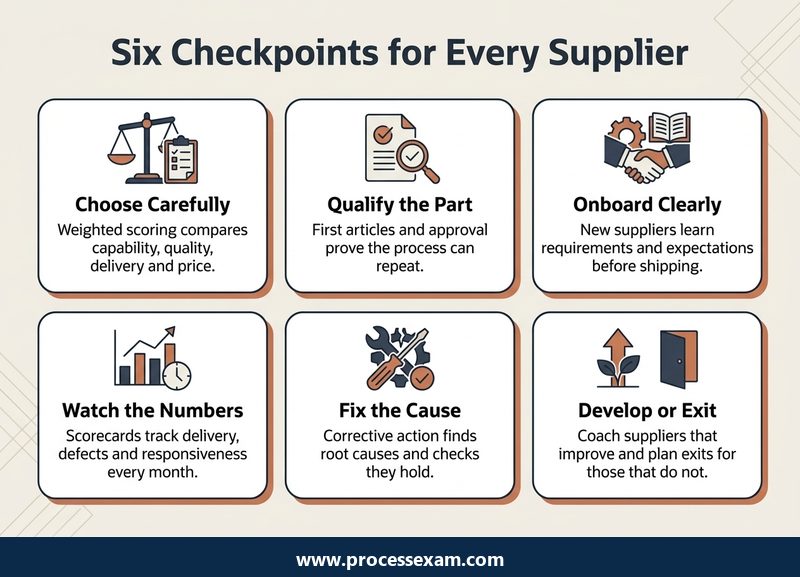
Read the Body of Knowledge from the supplier's side: a supplier is chosen, qualified, monitored, corrected and developed, and each step has a domain. The graphic shows six checkpoints in order, and the notes below cover what the exam tests in each domain.
Supplier Strategy (20 questions)
This domain starts with the supply chain vision and mission, then moves to the supplier lifecycle: selecting and qualifying suppliers, building a performance monitoring system with exit strategies, and setting up a classification system that runs from non-approved through conditionally approved, approved, preferred and certified to partnership and disqualified. It also covers supply chain cost analysis (cost reduction, rationalising the supply base, make or buy decisions using SWOT and historical performance) and the contract side: terms and conditions, supplier agreements, and quality agreements.
The top-level skill is Create, so expect questions such as which classification fits a supplier with good delivery but an open corrective action, or which clause belongs in a quality agreement rather than a commercial contract.
Risk Management (19 questions)
Here you build a risk-based approach to the supply base: business continuity, contingency planning and resilience; a mitigation plan that predicts and controls risk; strategies for preventing counterfeit parts, including supply chain mapping; and a way to categorise supplier risk with models such as the Kraljic portfolio matrix, which sorts purchased items into non-critical, leverage, bottleneck and strategic. Analysis uses decision analysis, FMEA, fault tree analysis and process audits, and mitigation is verified with PDCA, lean and product audits.
A typical question gives you a sole-source part with a long lead time and asks which quadrant it belongs in, and what that implies for the plan.
Supplier Selection and Part Qualification (27 questions)
The largest planning domain starts with requirements: design reviews and internal requirements, including sub-tier suppliers and manufacturability. Then it compares existing suppliers on capability, capacity, quality, delivery, price and lead time, and assesses new ones with self-assessments, audits, financial analysis and quality function deployment, plus a check of third-party certification. Selection uses weighted decision matrices, which you should be able to calculate by hand.
For example, suppose price counts 30 percent, quality 40 percent and delivery 30 percent, and three suppliers are scored from 1 to 5. Supplier A scores 4, 3 and 5, giving 3.9. Supplier B scores 3, 5 and 4, giving 4.1. Supplier C scores 5, 2 and 3, giving 3.2. B wins on the weighted total although A is cheaper and faster, because the weight on quality outweighs the other two. The numbers are illustrative, but questions of this shape are common.
Part and process qualification then covers reading a drawing (views, title blocks, dimensioning, tolerancing and GD&T symbols), planning a qualification with first article inspection, MSA, process flow diagrams, FMEA, control plans, CTQ characteristics and capability studies, understanding the production part approval process (PPAP), and validating results through a certificate of compliance, a certificate of analysis and a production readiness review.
Supplier Performance Monitoring and Improvement (29 questions)
This is the heaviest domain. It covers the metrics you define and watch, such as quality, delivery, cost and responsiveness, and the reports you build from them: scorecards, dashboards, warranty and field return analysis, defect rates. It then asks about lean tools applied at the supplier, including 5S, kaizen, value stream mapping, SMED, kanban, takt time, error-proofing and the eight wastes.
Know the difference between on-time delivery and on-time in full delivery. Take 200 order lines in a month, of which 184 arrive on time and 172 arrive on time and complete. On-time delivery is 92 percent, but on-time in full is 86 percent, and the second number is the one a production planner feels.
The domain also deals with nonconforming product: segregating it, deciding whether it needs a material review board, and assessing the risk. And it covers supplier corrective and preventive action: root cause tools such as cause and effect diagrams, Pareto analysis, the five whys, fault tree analysis and design of experiments, then working with the supplier on corrective action, updating the FMEA and control plan, and using SPC and 8D. Questions at Evaluate level ask you to judge whether a supplier's root cause analysis is robust enough to close the request.
Supplier Quality Management (26 questions)
Five topics fall under monitoring: supplier audits (planning, the initial audit, periodic reevaluation, and virtual, on-site and desktop methods), audit reporting and follow-up, communication techniques including recalls and change requests, supplier development and remediation, and basic project management. The domain adds teams (the forming to adjourning stages, team roles, and evaluating training) and compliance with regulations and standards such as RoHS and ISO, plus categorising suppliers by risk and performance. For your reading plan, the CSQP exam syllabus on our site lays the topics out in the same order as the Body of Knowledge.
Relationship Management (16 questions)
This domain deals with the human side. Onboarding means orienting a new supplier on your vision, requirements and the criticality of what it delivers. Communication covers oral, written and presentation techniques, working across cultures, and the effect of diversity, equity and inclusion on an organisation, then reporting with the seven classic quality tools. Leadership and collaboration includes coaching, influencing without authority, negotiation, conflict resolution and a RACI matrix to fix roles.
Business Governance, Ethics and Compliance (13 questions)
The smallest domain covers the ASQ Code of Ethics, including conflicts of interest, then compliance (confidentiality, bribery), sustainability and environmental, social and governance factors, and confidentiality practice: non-disclosure, quality and change notification agreements, protecting intellectual property, and reporting activity that could be illegal. Most of it is tested at Apply or Understand, so these are marks you can win with a few hours of focused reading. The full wording of every topic is in ASQ's 2023 CSQP Body of Knowledge.
Can you really bring books into the exam, and how should you use them?
Yes. ASQ says all its exams are open book, with one condition: whatever you bring, notes of any kind included, has to be bound when you arrive and stay bound until you leave. Loose sheets and flashcards do not qualify; a bound handbook with your own tabs and a bound notebook of your own notes do. Check the exact wording on ASQ's page before test day, because testing centres apply it strictly.
The mistake is treating the books as a substitute for knowing the material. With 165 questions in 270 minutes you have about 98 seconds for each one. A candidate who has to look up every answer runs out of time; a candidate who has to look up one answer in six finishes with an hour to spare. Use the books as a safety net, not a plan.
How to prepare the reference set
Choose one main text and tab it by domain, not by chapter. ASQ Quality Press publishes a CSQP handbook and a study guide, and either can serve as the spine. Mark the pages for formulas and tools you use rarely: weighted decision matrices, sampling plans, control chart constants, the PPAP elements, the 8D steps, the Kraljic quadrants. Then write your own bound notebook of one-page summaries per domain, with the three or four items you personally forget. Writing the summary teaches more than reading the textbook did.
Build an index as you study, a list of terms with the page where each appears. During practice tests, use the index only when you cannot answer in under a minute, and count how often that happens. That count is your honest readiness score.
How should you spread ten weeks of study across the seven domains?
The weights suggest the shape: more weeks for the middle domains, fewer for the smaller ones, and a full week of timed practice at the end. The plan assumes six to eight hours a week alongside a job, and that you already work in the field. If supplier quality is new to you in some domains, stretch each block.
| Weeks | Focus | What to finish |
|---|---|---|
| 1 | Orientation and set-up | Read the 2023 Body of Knowledge once, tab the handbook, take a short diagnostic to find weak domains |
| 2 | Supplier Strategy | Classification system, make or buy, quality agreements versus contracts |
| 3 | Risk Management | Kraljic matrix, FMEA and fault trees, counterfeit prevention, continuity planning |
| 4-5 | Selection and Part Qualification | Decision matrices by hand, GD&T symbols, qualification plan, PPAP, CoC and CoA |
| 6-7 | Performance Monitoring and Improvement | Metrics, OTD versus OTIF, lean tools, MRB, root cause tools, 8D and SPC |
| 8 | Supplier Quality Management | Audit stages and types, supplier development, teams, regulatory compliance |
| 9 | Relationship, Governance and Ethics | Communication, RACI, negotiation, Code of Ethics, confidentiality, ESG |
| 10 | Timed practice and revision | Two complete timed attempts under exam conditions, a log of each miss, last look at the index |
In each week, read the domain, work its problems by hand, and then answer questions on it at the Body of Knowledge's own level of difficulty: scenarios that ask you to evaluate, not definitions. When a mock exam is the next step, a CSQP practice exam run with the clock on shows you how your book use and pacing hold up across 165 questions.
Find your weak spots by domain, not by total score
A single percentage hides the problem. After each practice test, tally misses by domain. A candidate with a respectable overall score who misses half of the Supplier Performance questions is in more trouble than the total suggests, because that domain is the heaviest. Repeat the tally across attempts and fix whatever domain keeps topping it.
Learn from the shape of the wrong answers
Most distractors on a Create or Evaluate question are things a supplier quality professional really might do, such as issuing a corrective action when the right move was to contain the product first. When you miss a question, write down why the right answer should come before the one you picked. The pattern that emerges, containment before cause, risk before price, evidence before opinion, is worth more than any list of facts.
The last three days
Stop adding material. Reread your bound notebook, check that every tab is still in place, and confirm your test centre, arrival time and identification. A short walk and a night of sleep beat a late session on the Kraljic matrix.
Once you have passed, how does the CSQP stay valid?
A computer-based result appears as soon as you submit. A passing result starts a three-year certification cycle. ASQ asks you to keep the credential current either by earning 18 recertification units within the three years or by retaking the exam at the end of the period. The journal route has a fee that differs for members and non-members, and ASQ allows a 60-day grace period before it asks you to recertify by exam instead. Current rules and fees are on ASQ's recertification page.
Recertification units come from the work you already do: continuing education, presentations, publishing, committee and volunteer work, and professional development. If you keep a running list of dates and hours, the journal route costs an afternoon rather than a second exam.
Where the credential leads
For most holders the CSQP supports a move into a role with wider authority, such as supplier quality manager, director of supplier development, or the quality lead of a supply chain organisation, and it gives consultants something concrete to put in front of a client. It also gives you a shared vocabulary with procurement and legal teams, which is useful when you negotiate a quality agreement. Treat it as evidence that backs up your track record, not a replacement for it.
If you are weighing it against a different route, compare what each one tests rather than which is more famous. The CSQP is the credential that asks you to build a classification system, write the risk plan for a supply base and defend a supplier decision from the contract through to exit.
Frequently Asked Questions
How much does the ASQ CSQP exam cost?
The first attempt costs $450 for ASQ members and $550 for non-members, so membership saves $100. A retake costs $350 and is available at that reduced rate for two years after your previous attempt. Reference books are bought separately and are not included in the exam fee.
What experience do you need for the CSQP?
ASQ asks for eight years of on-the-job experience in supplier quality, with at least three years in a decision-making position. Education reduces the total: one year for a trade diploma, two for an associate degree, four for a bachelor's degree and five for a master's or doctorate.
How many questions are on the CSQP exam and what is the passing score?
The computer-based CSQP has 165 questions in 270 minutes, of which 150 are scored and 15 are unscored. A scaled score of 550 out of 750 passes. The paper option has 150 questions in four hours, and both are based on the same 2023 Body of Knowledge.
Is the CSQP an open-book exam?
Yes. ASQ exams are open book, but reference materials and any notes must be bound and must stay bound during the exam. A tabbed handbook and a bound notebook of your own summaries are allowed; loose sheets are not. Check ASQ's current wording before test day.
How do you keep the CSQP after passing?
Certification runs in three-year cycles. You keep it by earning 18 recertification units within the cycle, or by retaking the exam at the end. The journal route has a member and non-member fee, and ASQ allows a 60-day grace period before exam recertification is required.
- Management |
- CSQP Question Bank |
- CSQP Body of Knowledge (BOK) |
- ASQ CSQP BOK PDF |
- CSQP Exam Questions Download |
- CSQP Test Questions |
- ASQ Supplier Quality Professional Test Questions |
- Supplier Quality Professional Simulator |
- Supplier Quality Professional Mock Exam |
- ASQ Supplier Quality Professional Book |
- Supplier Quality Professional Certification Cost |
- Supplier Quality Professional Certification Requirements |
- ASQ Supplier Quality Professional Sample Questions |
- Supplier Quality Professional PDF |
- CSQP Handbook


