
ASCM CPIM Certification: Planning Skills That Prevent Stockouts
Updated on 21 September 2026. What’s new: updated for CPIM version 9.0, with the current single-exam format, fees and nine content areas.
On Monday the sales team reports a stockout on the product customers want most. On Thursday the warehouse manager asks where to put another pallet of a product nobody has ordered in months. Both problems come from the same place: a plan that did not connect demand, supply and inventory. The ASCM CPIM (Certified in Planning and Inventory Management) credential tests exactly that connection, in one 150-question exam of three and a half hours.

ASCM, the Association for Supply Chain Management, is the body formerly known as APICS, and it still uses that older name as the brand on its certifications, so a search for the old name leads to the same credential described here. This article covers what the exam looks like after the version 9.0 update, what each of the nine content areas asks, what it costs, how to prepare and what the credential does for a planning career. All exam details were checked against ASCM's own pages in September 2026.
What is the ASCM CPIM certification, and who is it for?
CPIM certifies the people who decide what gets made, bought, stored and shipped, and when. ASCM describes the program as an international standard for assessing planning and inventory skills, and it has run for more than fifty years. The subject matter covers demand and supply planning, material and capacity requirements, sales and operations planning, inventory control, detailed scheduling, distribution, quality and continuous improvement.
The credential fits anyone whose decisions move inventory. Typical candidates include:
- Demand and supply planners who build forecasts and translate them into supply plans.
- Master schedulers and material planners who run the master production schedule and material requirements planning.
- Inventory analysts and controllers who set stocking policies, safety stock and cycle counting programs.
- Production schedulers and plant managers who turn plans into daily sequences on the shop floor.
- Buyers and procurement specialists who manage external suppliers and their lead times.
- ERP analysts and consultants who configure the planning systems that all of the above depend on.
ASCM does not set a formal experience requirement to sit the exam. It does, however, state plainly in the exam content manual that it assumes candidates already have experience or knowledge of basic planning and inventory methods before they start studying. Newcomers can pass, but they should budget more time for the fundamentals.
The key exam facts, in one place:
| Exam detail | ASCM CPIM |
|---|---|
| Credential | Certified in Planning and Inventory Management (CPIM) |
| Exam code | CPIM |
| Vendor | ASCM |
| Current version | V 9.0 |
| Number of questions | 150 |
| Duration | 210 minutes |
| Exam fee | USD $1,265 |
| Passing score | 300 / 350 |
| Delivery | Pearson VUE test centers and OnVUE online proctoring |
How is the CPIM exam structured now that it is a single exam?
The most common piece of outdated advice about CPIM is that you need to pass two exams. That was true of earlier versions, which split the content into Part 1 and Part 2. The current program uses one comprehensive exam. ASCM's product page puts it simply: pass one exam covering nine modules of content within 3.5 hours. Some older pages that still circulate online, including archived CPIM 7 material, describe the two-part route, so check the version on anything you study from.
Questions and timing
The exam has 150 multiple-choice questions and a 210-minute time limit. Twenty of the 150 are pretest questions that ASCM is trialling for future forms. They do not count toward your score, and they are not marked, so you have to answer every question as if it counts. Each question asks you to pick the best of four options, or to complete a calculation from the information given. Budget about 80 seconds per question and you will finish with time to review flagged items.
Scoring
CPIM uses a scaled score from 200 to 350. Scores from 300 to 350 pass; 200 to 299 fail. The scale is there so that results mean the same thing across different exam forms that vary slightly in difficulty. Only correct answers earn marks. A wrong answer costs nothing extra and an empty one earns nothing either, so a considered guess always beats a gap. Your score report also shows diagnostic results by content area, which is valuable if you need a retake.
Where you sit it
You sit it on a computer, booked through Pearson VUE, and can choose between a test center and a remotely proctored OnVUE session at home. If you choose online delivery, run the system check well before exam day and plan for a quiet, cleared room.
What do the nine CPIM content areas cover, and how much does each weigh?
Version 9.0 organises the exam into nine content areas, one more than the previous version. The 2024 job task analysis, based on a survey of more than 1,800 supply chain professionals, split the old supply domain into internal and external supply sources and widened the scope to take in more technology and sustainability content. The chart shows how ASCM weights each area.
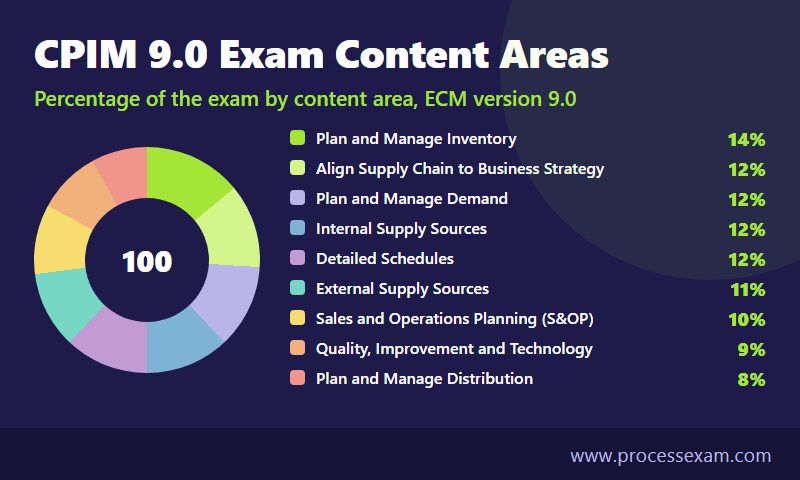
The weightings are fairly flat. Inventory leads at 14%, five areas sit at 11% or 12%, and even the smallest, distribution, is 8%. There is no area you can safely skip. The full sub-topic list for every area is laid out on our module-by-module CPIM topic breakdown, and ASCM's CPIM Exam Content Manual, version 9.0 is the authoritative source for what can be tested.
1. Align the supply chain to support the business strategy (12%)
This area asks whether you understand why the plan exists. It covers order winners and qualifiers, competitive analysis tools such as the five-force model and SWOT, and the push-pull boundary: make-to-stock, assemble-to-order, configure-to-order, make-to-order and engineer-to-order. It also covers process choices along the product-process matrix, facility layouts, financial and operational KPIs such as the cash-to-cash cycle and order fill rate, supply chain risk and business continuity, and sustainability goals including the triple bottom line.
2. Conduct sales and operations planning (10%)
S&OP is where the monthly argument between sales, operations and finance is supposed to end in one agreed plan. Expect questions on product families and aggregation levels, the steps of the S&OP process, evaluating aggregate demand and supply plans, strategic buffers, and reconciling volume and mix against financial targets such as margin and cost of goods sold. You should know when to adjust supply (overtime, outsourcing, temporary suppliers) and when to adjust demand (lead time changes, demand shaping, substitution).
3. Plan and manage demand (12%)
Forecasting sits here, alongside customer segmentation, marketing promotions and product life cycles. You need both qualitative techniques, such as the Delphi method and panel consensus, and quantitative ones: moving averages, weighted moving averages, exponential smoothing, time series decomposition and regression. Forecast error metrics carry real weight, including bias, mean absolute deviation, mean absolute percent error and tracking signals, as does the bullwhip effect and how collaboration reduces it.
4. Plan and manage internal supply sources (12%)
This is the classic planning engine: the master production schedule, rough-cut capacity planning, material requirements planning and the final assembly schedule. You should be able to work an MRP time-phased record from gross requirements through projected available balance to planned order releases, calculate available-to-promise, and explain time fences. Product costing methods, cost of quality and responding to supply disruptions also sit in this area.
5. Plan and manage external supply sources (11%)
New as a separate area in version 9.0, this covers supplier selection and sourcing strategies (sole, single and multisource, nearshore, offshore and reshore), supplier relationship management and scorecards, contract terms, procurement methods such as blanket orders, consignment and vendor-managed inventory, and logistics choices such as cross-docking and full versus less-than-truckload. Managing supplier disruptions and buffers closes the area.
6. Plan and manage inventory (14%)
The heaviest area, and the one most directly tied to the opening example. It covers inventory types and classifications, ABC segmentation, replenishment methods (reorder point, periodic review, min-max, two-bin and kanban), lot sizing including economic order quantity and period order quantity, safety stock and days of supply, carrying and ordering costs, valuation methods such as FIFO and LIFO, cycle counting and inventory accuracy, traceability, and returns managed through the waste hierarchy and reverse logistics.
7. Plan, manage and execute detailed schedules (12%)
Here the plan meets the shop floor. Topics include the elements of lead time (queue, setup, run, wait and move), calculating load, capacity types, finite and infinite loading, sequencing and dispatching rules, input/output control, bottleneck management with theory of constraints, takt time, and releasing and closing work orders.
8. Plan and manage distribution (8%)
Distribution covers network design trade-offs, location-specific forecasts, replenishment parameters for stock keeping units, distribution requirements planning, distribution KPIs, and managing backlog and backorders against service and cost goals.
9. Manage quality, continuous improvement and technology (9%)
The final area pulls in the basic and new seven quality tools, lean concepts and tools such as value stream mapping, SMED and 5S, structured problem solving through PDCA and DMAIC, statistical process control charts, and the selection and use of planning technology, including emerging tools such as artificial intelligence and machine learning.
How does CPIM planning prevent a stockout and excess stock in the same week?
The opening scenario is not bad luck. It is what happens when each planning step runs on its own assumptions. CPIM treats planning as one chain, and the exam repeatedly tests whether you can see where the chain broke.
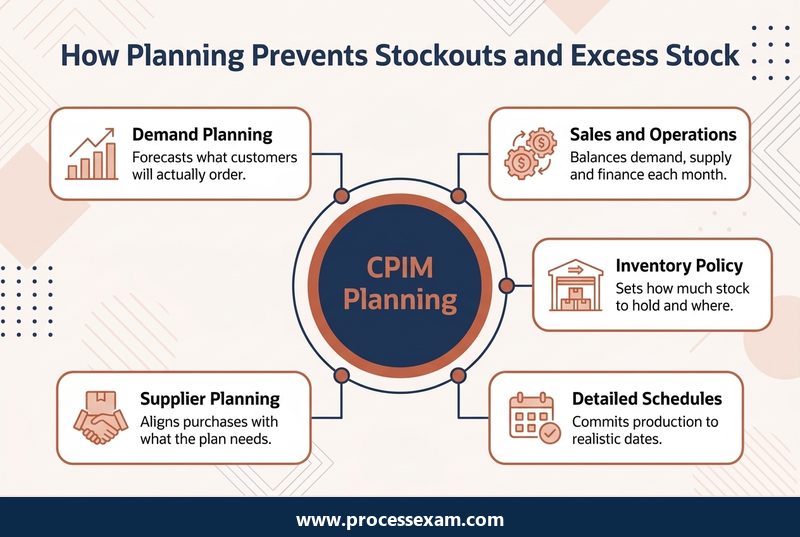
Where the chain usually breaks
- Forecast without error tracking. The fast mover's forecast had been under actual demand for months, but nobody watched the tracking signal, so the bias kept feeding the plan.
- S&OP at the wrong level. The plan balanced total volume for the product family but never reconciled mix, so the family looked healthy while one item ran dry and another piled up.
- Stale planning parameters. Lot sizes and safety stock were set years earlier and never reviewed as demand shifted.
- A master schedule changed inside the time fence. Last-minute changes forced expediting on one item and left components for another sitting idle.
A worked example of the kind CPIM expects
The figures below are an illustration, not exam data. Suppose an item sells an average of 40 units a day and the supplier lead time is 5 days. Demand during the lead time is 40 multiplied by 5, which is 200 units. If you hold 60 units of safety stock to cover variation, the reorder point is 200 plus 60, or 260 units. When stock falls to 260, you order.
Now suppose the item's real demand has risen to 55 units a day while the forecast still says 40. Lead time demand is now 275 units, more than the whole reorder point, so a stockout arrives before the replenishment does. Meanwhile a slow item still planned at its old rate keeps triggering orders it does not need. The CPIM answer is not a bigger buffer everywhere. It is to track forecast error, review the parameters, reclassify items with ABC analysis, and let S&OP reconcile mix as well as volume. Being able to reason through a case like this, and to do the arithmetic quickly, is exactly what the calculation questions check.
What does the CPIM certification cost, and what changed with version 9.0?
The exam fee in our figures is USD $1,265. On ASCM's CPIM page, $1,265 is the price for members who hold the certification upgrade; nonmembers and members without that upgrade pay $1,755. ASCM lists the Annual Membership and Certification Upgrade at an extra $199. The learning system carries the same two prices, and a bundle of learning system, exam and a second-chance exam costs $2,275, or $3,175 without the upgrade. These prices were checked in September 2026 and change from time to time, so confirm them before you buy.
The version 9.0 timeline
ASCM's CPIM 2025/2026 FAQ sets out how the change happened:
- 4 November 2025: the updated exam content manual became available.
- 3 February 2026: the updated learning systems and bundles went on sale.
- 31 May 2026: the last day to sit the previous version of the exam.
- 1 June 2026: the first day of the version 9.0 exam. Only one version is ever live, so everyone testing from this date sits the new one.
Rules worth knowing before you buy
A bundle includes an authorization to test that must be used within twelve months, and an expired authorization cannot be extended. The second-chance exam comes only with a bundle, and conditions apply. If you fail, there is a mandatory 14-day wait before a retake. Candidates who still have the previous learning system can ask ASCM for a free digital copy of the updated one if their exam is scheduled after 1 June 2026.
How should you prepare for the CPIM exam?
Plan around the weightings, not around the chapters you enjoy. Most working planners are strong in the one or two areas they do every day and weak in the rest, and the flat weighting punishes that. Candidates who already plan for a living usually need around ten weeks, giving the syllabus a steady block of hours each week; newcomers to planning should allow longer.
| Weeks | Focus | What to finish |
|---|---|---|
| 1 | Baseline | Read the content outline in the exam content manual; try ASCM's short quiz; note your weakest areas |
| 2–3 | Strategy, S&OP and demand | Push-pull boundary, KPIs, S&OP steps, forecasting methods and error metrics |
| 4–5 | Internal and external supply | Master scheduling, rough-cut capacity, MRP records, ATP, supplier selection and procurement methods |
| 6–7 | Inventory and detailed schedules | Safety stock, reorder point, EOQ, ABC, cycle counting, loading, sequencing and theory of constraints |
| 8 | Distribution, quality and technology | DRP, network trade-offs, lean tools, SPC charts, planning systems |
| 9–10 | Practice and review | Two full timed practice exams, an error log by content area, targeted review of the weakest two areas |
Learn the language before the techniques
CPIM questions use the standard terminology of the ASCM Supply Chain Dictionary. Many companies use their own words for the same thing, and the exam content manual itself notes that "sales and operations planning" and "production planning", or "master production schedule" and "master schedule", may appear for the same concept. Build a glossary as you go. A surprising number of wrong answers come from a term that means something slightly different in your own company.
Practise the arithmetic until it is automatic
MRP records, available-to-promise, reorder points, safety stock, economic order quantity, forecast error and capacity load all turn up as calculation questions. Work each one by hand several times. On exam day you want to spend your time reading the scenario, not remembering the formula.
Use the free material first
ASCM offers a five-question CPIM knowledge quiz and a free 30-day trial of the learning system's first module, Supply Chains and Strategy. The exam content manual also ends with ten sample questions and explained answers. Together they show you the question style before you commit money to a study method.
Rehearse the full three and a half hours
Reading 150 scenario questions is tiring, and accuracy tends to drop in the final hour. Before exam day, you should know how your concentration holds up at question 120. Sitting a timed CPIM mock exam at full length shows where that happens and which content areas still leak marks, so the last two weeks go to the right topics.
Which mistakes cost CPIM candidates the pass mark?
The same errors appear again and again, and nearly all of them are avoidable.
- Studying from old materials. Guides built for the two-part exam or the eight-area version miss the external supply area and the expanded technology and sustainability content.
- Relying on your job. Experience helps, but your company's way of running MRP or S&OP may differ from ASCM's definitions. The exam marks ASCM's answer, not your plant's.
- Skipping the small areas. Distribution, quality and S&OP are the three lightest areas, yet together they make up 27% of the exam.
- Avoiding calculations. Candidates who guess on arithmetic questions give away the most predictable marks on the paper.
- Leaving questions blank. A blank scores the same as a wrong answer, so always choose something.
- Pacing badly. Spending four minutes on one scenario early on usually means rushing the last twenty questions. Flag it and move on.
- Booking too late. An authorization to test has an expiry date. Book once your practice scores are stable, and leave room for a possible retake inside the window.
What is the CPIM certification worth for your career, and how do you keep it?
Planning and inventory decisions have a direct line to working capital and customer service, which is why employers look for people who can show they understand the whole chain. CPIM is one of the most widely recognised credentials for that work, and it gives you a shared vocabulary with planners, buyers and managers in other companies and countries.
How it helps in practice
- Moving from execution to planning. Buyers, schedulers and warehouse leads use CPIM to show they can handle the planning roles above them.
- Leading S&OP. The credential covers the cross-functional process that many organisations still struggle to run well.
- Working with ERP systems. Understanding what MRP and master scheduling are meant to do makes it much easier to configure and trust the system.
- Building toward broader credentials. Many CPIM holders go on to ASCM's CSCP, which takes an end-to-end supply chain view, or CLTD for logistics and distribution.
Keeping the credential active
CPIM is maintained on a five-year cycle. To keep it active, you collect and submit 75 professional development maintenance points in each five-year period, or 100 points if you hold the CPIM Fellow (CPIM-F) designation, which requires an active CPIM. Miss the reporting deadline and the credential lapses, which is why it pays to record each activity when it happens instead of rebuilding five years of evidence in the final month.
A planner who can explain why the fast mover ran out and the slow mover piled up, and fix both in the next planning cycle, is worth a great deal to any operation. That is the skill CPIM sets out to prove.
Frequently Asked Questions
Is APICS CPIM the same as ASCM CPIM?
Yes. APICS was the association's former name; it is now ASCM, the Association for Supply Chain Management. ASCM still uses the APICS brand on its certifications, so both names refer to the same credential, the same exam and the same awarding body. Only the association's name changed.
Is the CPIM still a two-part exam?
No. Earlier versions split CPIM into Part 1 and Part 2, but the current program uses one comprehensive exam. You sit a single exam of 150 questions in 210 minutes covering all nine content areas. Treat any study guide that still describes two exams as out of date.
How many questions are on the CPIM exam, and what is the passing score?
The CPIM exam has 150 multiple-choice questions, 20 of them unscored pretest items, and a time limit of 210 minutes. Results use a scaled score from 200 to 350, and 300 or above is a pass. There is no penalty for wrong answers, so answer every question.
How much does the CPIM exam cost?
The CPIM exam fee is USD $1,265 for ASCM members with the certification upgrade. ASCM lists $1,755 for nonmembers and members without the upgrade, which costs an extra $199 a year. Bundles with the learning system and a second-chance exam cost more. Check current prices on ASCM's site before buying.
How long does the CPIM certification last?
CPIM runs on a five-year maintenance cycle. To keep it active, you submit 75 professional development maintenance points every five years, or 100 points as a CPIM Fellow. Points come from education, industry work and professional activities. If you miss the deadline, the certification lapses and is no longer recognised.
- Supply Chain Management |
- ASCM APICS Certified Planning and Inventory Management Test Questions |
- CPIM Question Bank |
- CPIM Body of Knowledge (BOK) |
- APICS CPIM Simulator |
- APICS CPIM Mock Exam |
- ASCM APICS Certified Planning and Inventory Management Book |
- ASCM CPIM BOK PDF |
- APICS Certified Planning and Inventory Management Certification Cost |
- APICS Certified Planning and Inventory Management Certification Requirements |
- ASCM APICS CPIM Question Bank |
- ASCM APICS CPIM Book |
- ASCM APICS CPIM Study Guide |
- APICS CPIM Certification |
- APICS CPIM Certification Cost |
- APICS CPIM Certification Requirements |
- ASCM APICS Certified Planning and Inventory Management Sample Questions |
- CPIM Exam Questions Download |
- CPIM Test Questions |
- APICS Certified Planning and Inventory Management PDF |
- ASCM APICS CPIM Exam Questions |
- ASCM APICS CPIM Sample Questions |
- APICS CPIM |
- APICS CPIM PDF


