
APMP Graphics Micro-Certification (GR-M APMP): Cost, Format and Prep
Yes, you can sit the APMP Graphics micro-certification without being a designer. It is a 30-question multiple-choice paper in 30 minutes, you need 20 correct (67%) to pass, and the exam fee is $165 for APMP members or $300 for nonmembers. It tests whether you can judge and plan proposal graphics, not whether you can draw them.
The credential goes by GR-M APMP and sits among a family of short APMP micro-certifications for proposal people who want one skill proved rather than a whole career ladder. Searches for it are rare and specific: "certification graphics", cost, requirements. This guide answers those in order, then adds what a candidate needs beyond the numbers, which is a way to spend the thirty minutes and a sensible two weeks of preparation.
Do you need to be a designer to sit the APMP Graphics micro-certification?
No. APMG, the body that delivers APMP exams, aims the Graphics micro-certification at proposal managers, and its own wording is about what graphics do: impactful proposal graphic design increases a proposal's clarity and persuasive power. The questions are multiple choice, so there is no drawing task and no software to open. What you are asked, in effect, is whether you would make the right call when a graphic is needed, chosen, built or reviewed.
That matters because the people who order graphics in a bid are rarely the people who make them. A proposal manager decides which of the twelve things in a technical volume deserves a diagram. A coordinator briefs the illustrator and approves the result. A subject-matter expert sketches a block diagram on a whiteboard and hopes someone turns it into something an evaluator can read in ten seconds. Each of those roles makes graphics decisions without touching a design tool, and each can sit this exam on experience alone.
Who gets the most from it
- Proposal managers and coordinators who brief graphics teams and want a shared vocabulary with them.
- Writers and capture staff who draw first drafts of figures and want those drafts to survive review.
- Designers who joined proposals from marketing and need to show they understand evaluator behaviour, compliance pressure and bid schedules, not only layout.
- Consultants and freelancers who sell proposal support and want a recognised line on a profile.
Who should look elsewhere first
If you are brand new to proposals and do not yet know how a bid is organised, a broader APMP certification gives you the ground to stand on, and the Graphics paper will make more sense afterwards. APMG's micro-certification page lists no prerequisites, so nothing stops you from starting here, but a paper that asks how design fits the proposal process is easier when you have lived through a proposal process.
It is also worth being honest about the size of the credential. A micro-certification proves one skill area. It does not stand in for practitioner-level proposal management, and no hiring manager will read it that way. What it does well is give a clean, checkable signal on a topic that is otherwise judged by portfolio and opinion.
How does a 30-minute, open-book sitting run from login to result?
It is short, it is multiple choice and, according to the badge description APMG issues, it is open book. The pass mark is 20 out of 30. That is two thirds, written as 67%, and it means ten wrong answers still pass. APMG says the questions are based on the APMP Body of Knowledge, a resource that requires APMP membership to read.
| Detail | GR-M APMP |
|---|---|
| Full name | APMP Graphics Micro-Certification |
| Exam code | GR-M APMP |
| Exam fee | APMP Members: $165; Nonmembers: $300 |
| Duration | 30 minutes |
| Questions | 30 multiple choice |
| Passing score | 67% (20 of 30) |
| Book rules | Open book |
| Language | English only |
| Delivery | Online, with a proctor watching by webcam, microphone and desktop |
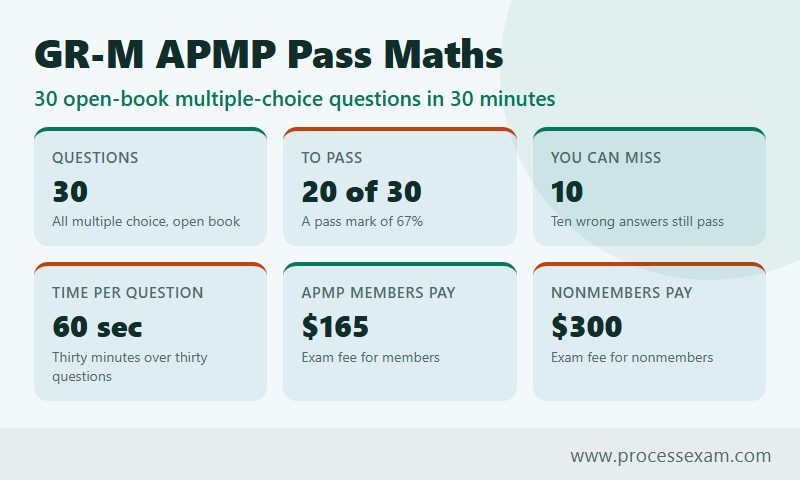
The graphic above turns those figures into the arithmetic that actually shapes your thirty minutes: sixty seconds a question on average, and a margin of ten misses.
How the exam is delivered
APMG offers the exam online through its Candidate Portal, available at any hour, so there is no test centre to travel to and no fixed sitting date to wait for. A proctor monitors the session by webcam, microphone and desktop, which means a quiet room, a working camera and a clear desk are part of the preparation. Check the system requirements on APMG's pages before booking, because the one thing worth avoiding is a technical fault during a paper that only lasts half an hour.
All APMP micro-certification exams are written in English. There are two routes to the exam. You can take training with an Accredited Training Organization, in person, virtually or as self-paced e-learning. Or you can self-study: buy the APMP study guide and an exam from APMG and book when ready. Either route ends in the same thirty questions.
What happens after the result
Sitting the exam is worth 2 CEUs towards APMP's continuing-education scheme, according to APMG. If you disagree with a result, APMG states that appeals must be submitted within six months of the exam date, so keep your confirmation email. Retake rules and any waiting period are not set out on the pages we read, so check the terms in the Candidate Portal before you plan a second attempt.
What does GR-M APMP cost, and does membership pay for itself on one exam?
The fee depends on whether you are an APMP member. APMP Members pay $165 and nonmembers pay $300, so the nonmember fee is nearly double the member fee. APMG sets these figures, so confirm the current amount when you book.
| Cost item | APMP member | Nonmember |
|---|---|---|
| GR-M APMP exam fee | $165 | $300 |
| Fee relative to members | Baseline | Nearly double |
| Body of Knowledge access | Included with membership | Membership required |
| Training course (optional) | Set by each training provider | Set by each training provider |
The honest way to decide is to weigh the saving against APMP's current membership fee, which is on its site and which we have not quoted here because it can change. The comparison has a second half that people forget: the Body of Knowledge, which the questions are based on, is a members' resource. A nonmember who wants to study from the source either joins or studies from the study guide and the free sample exam.
Where the money tends to go
- The exam fee, paid once to APMG.
- Study material, if you take the self-study route: the APMP study guide and any practice you buy.
- Training, if you prefer a taught course. Prices vary by provider, so ask for the exam fee to be listed separately from the course fee.
- Your time, which for a thirty-question paper is a few evenings, not a quarter.
If your employer pays for APMP membership, ask whether the exam fee can come out of a training budget. It is a smaller request than a full certification course, and an easier one to approve.
Which eight areas does the Graphics paper draw on?
APMG's listing says the certification demonstrates understanding of eight areas, and the table below sets them out with what each tends to mean in practice. APMG does not publish a percentage weighting for them on the pages we read, so treat the eight as roughly equal until the study guide tells you otherwise. The same list sits behind the GR-M APMP exam syllabus page if you want to tick items off.
| Area | What it asks you to be able to do |
|---|---|
| What motivates your audience | Read an evaluator: what they must score, what they skim, what makes a figure worth a second look |
| How design and designers fit the proposal process | Know when graphics are briefed, drafted, reviewed and locked, and who owns each step |
| When and how to create graphics, and evaluate them objectively | Decide that a graphic is needed, then judge a finished one against criteria rather than taste |
| Types of proposal graphics | Match a message to a form: process, structure, comparison, timeline, data |
| Design principles and techniques | Apply hierarchy, contrast, alignment, colour and type so a figure reads quickly |
| Industry best practices for impactful graphics | Use habits that persuade: a headline caption, one idea per figure, callouts that carry the benefit |
| Tools and emerging technology | Know what software and newer tools can do for speed and consistency, and where they need a human check |
| When and where to flex design principles | Bend a rule on purpose, with a reason, without breaking readability or compliance |
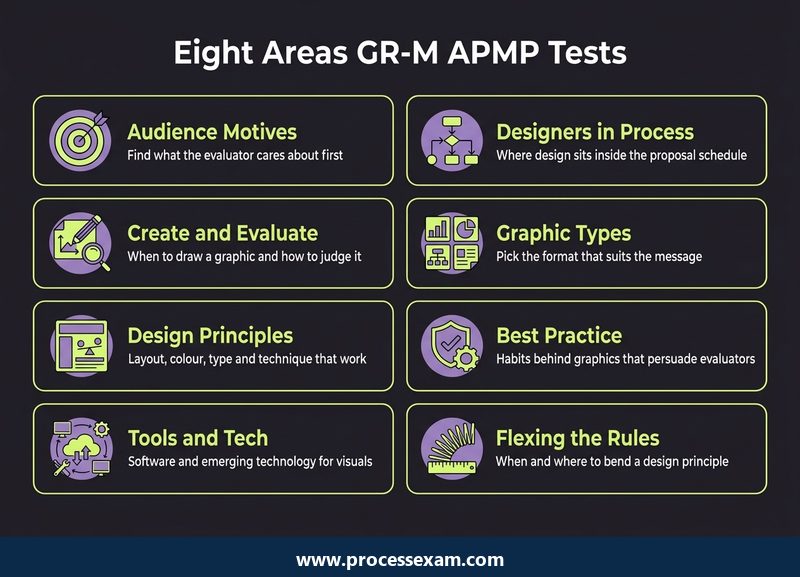
Reading the table as a candidate
Three of the eight are about people and process, not pixels: the audience, the place of design in the schedule, and the judgement of finished work. Candidates who are strong designers sometimes underprepare for those because the work feels obvious. The questions are not about what you would do alone at a desk. They are about what a proposal team should do when the deadline is close and a diagram is late.
A worked scenario to test yourself on
Imagine a technical volume with a process figure of fourteen small boxes joined by crossing arrows, and a reviewer comment that says "unclear". There are several moves: cut the figure to the five steps that matter, group the rest, add a caption that states the point, and check that the colours still work in greyscale. Notice that the sequence mixes audience (what does the evaluator need?), type (is a process figure the right form?), principles (hierarchy, spacing) and best practice (a caption that sells). Most real questions combine two areas, so it pays to study the eight as one toolkit.
That scenario is our own illustration, not an exam item. It is useful because it shows how a topic list becomes a decision under time pressure.
How do you work an open-book paper without losing the clock?
Open book makes the exam more forgiving of memory and much less forgiving of time. Thirty minutes over thirty questions leaves sixty seconds each, and any look-up costs more than a minute if your notes are not organised. Treat the reference material as a tool for the few questions you cannot reason out, not as a crutch for all of them.
A pacing plan that fits the numbers
Suppose you answer the questions you are sure of in about thirty seconds each. If twenty of them are like that, you spend ten minutes and bank most of the pass mark early. That leaves twenty minutes for ten harder questions, two minutes each, which is enough to find a page and read a paragraph. This is a plan, not a rule, but the arithmetic is the point: the pass mark allows ten misses, so you never need to win every look-up.
- First pass: answer what you know, flag anything that needs a look-up, and never spend more than ninety seconds stuck.
- Second pass: work the flagged questions in order, using your index or contents list rather than scrolling.
- Last two minutes: answer every remaining question. A blank cannot score.
Build the book before the exam, not during it
Whatever you are allowed to have open, organise it by the eight areas above. Keep a one-page list of graphic types with the situations that call for each, another of design principles with a one-line meaning, and a third of where design activities sit in a typical proposal timeline. If your notes are digital, make sure you can search them quickly and that the file opens without a login prompt. APMG sets the rules about what material is allowed, so read them in the Candidate Portal and do not assume.
Reading the stem
Open-book questions are not about recall of a definition, so the wording does the work. Look for the audience in the stem, because a decision that suits an engineer reader can be wrong for a procurement officer. Look for the constraint: page limit, deadline, black-and-white print, accessibility. Then look for the verb. "Evaluate" asks for a criterion, "choose" asks for a form, "improve" asks for the smallest change that fixes the problem.
What belongs in the fortnight before you book the sitting?
Two weeks is enough for a thirty-question paper if you already work around proposals, and a third week helps if you do not. The aim is to know the eight areas well enough to answer most items in thirty seconds and to find the rest quickly. Start by taking APMP's free sample exam, which APMG describes as marked automatically, and sit it cold to see your starting point.
| Days | Focus | Output |
|---|---|---|
| 1-2 | Cold run of the free sample exam; read APMG's description of the eight areas | A list of your weakest areas |
| 3-5 | Audience, process and evaluation, the people-side areas | A one-page note on who decides what and when |
| 6-8 | Graphic types and design principles | A table of forms against messages |
| 9-10 | Best practice, tools and flexing the rules | A list of rules you may bend, with the reason each time |
| 11-12 | Two timed runs of thirty questions in thirty minutes, notes open | A count of look-ups and where they were wasted |
| 13 | Fix the weak areas and tidy the notes for search | A book you can use in seconds |
| 14 | Light review and a system check for the proctored session | A rested candidate and a working camera |
For the timed runs, a GR-M APMP practice exam lets you rehearse the thirty-minute rhythm before you spend the APMG fee, and the free sample exam from APMG shows you its own style. Use both, in that order if you are short of time.
Study from your own proposals
The best practice material is lying in your document library. Pull three figures from past bids, one that won praise, one that was cut and one that nobody remembers, and evaluate each against the eight areas. What was the audience trying to find? Was the form right for the message? Would the figure have survived a greyscale print? Doing this on your own work builds the objective habit the paper rewards and it is a better use of an hour than rereading definitions.
What to skip
You do not need to learn software shortcuts for this paper, and you do not need a portfolio. Resist the pull of design tutorials about gradients and fonts that have nothing to do with proposals. If a resource does not help you decide when, why and which graphic, it is probably aimed at a different exam.
For the primary sources, read APMP's own Graphics micro-certification page and APMG's APMP micro-certification page, which set out the delivery, language and resource details, and try the sample papers area APMG runs for a look at its question style.
Is the Graphics badge worth having once you are back at your desk?
It gives you a documented, scoped skill and some bargaining power in a conversation about who owns graphics decisions. It does not promote you, and nothing here suggests it raises pay. We have not found a salary survey that separates micro-certification holders, so we make no salary claim.
What it can plausibly change
- Authority in review. A comment such as "this figure needs a headline caption" is easier to defend when you can point to a recognised standard.
- Hand-offs with designers. A shared vocabulary of forms, hierarchy and evaluation criteria shortens briefs and reduces rework.
- A line on your profile. It signals continuing development to a recruiter who sees many generic proposal titles.
- A stepping stone. Because APMG offers other micro-certifications alongside it, including executive summaries, bid and proposal writing, win themes, price to win, AI and strategic response management, Graphics can be one of several short credentials you stack.
What it leaves unchanged
Your portfolio still matters if you design, your win record still matters if you manage, and your ability to hold a team together near a deadline still matters most. A micro-certification supports those things and does not replace them. Plan on using the knowledge within the next proposal, not on waiting for a title to change.
Keeping it current
APMG's pages list no CEU or CPD requirement to keep the certification valid, and the exam itself is worth 2 CEUs. Even so, graphics practice moves with tools and with what evaluators expect, so a yearly review of your own style guide is better insurance than any renewal rule. If APMP updates the Body of Knowledge or the paper, check the APMG pages before you take a sitting based on older notes.
Frequently Asked Questions
How many questions are on the APMP Graphics micro-certification and what is the pass mark?
GR-M APMP has 30 multiple-choice questions to answer in 30 minutes. The pass mark is 20 out of 30, which is 67%, so ten wrong answers still pass. APMG's badge description also says the exam is open book, which changes how you manage the clock.
How much does the GR-M APMP exam cost?
The exam fee is $165 for APMP members and $300 for nonmembers, so nonmembers pay nearly double. Training courses, the APMP study guide and membership are separate costs, and APMG sets the fees, so check the current amount in the Candidate Portal when you book.
Is the APMP Graphics micro-certification exam open book?
Yes. APMG's badge description calls it an open-book exam lasting 30 minutes. It is taken online with a proctor watching by webcam, microphone and desktop, and in English only. Read APMG's rules on which materials you may keep open before the session starts.
Do you need a prerequisite to take GR-M APMP?
No prerequisite is listed. APMG's micro-certification page states no experience is required for the programme, and you do not need an earlier APMP certification. The questions are based on the APMP Body of Knowledge, which requires APMP membership to access, so nonmembers lean on the study guide and sample exam.
Does the APMP Graphics micro-certification expire?
APMG's page lists no CEU or CPD requirement to keep the micro-certification valid, and it does not give an expiry date. Sitting the exam is worth 2 CEUs. Because rules can change, confirm the current terms with APMG before relying on that for a job application.
- GR-M APMP Question Bank |
- APMP GR-M APMP BOK PDF |
- GR-M APMP Exam Questions Download |
- GR-M APMP Test Questions |
- APMP Graphics Book |
- Graphics Certification Cost |
- Graphics Certification Requirements |
- APMP Graphics Sample Questions |
- Graphics PDF |
- APMP Graphics Test Questions |
- GR-M APMP Body of Knowledge (BOK) |
- Graphics Simulator |
- Graphics Mock Exam


