
aPHR Study Plan: Split Your Time by Functional Area Weight

Study hours are the one thing you control, and the aPHR outline tells you how to spend them. HRCI weights Compliance and Risk Management at 25% and Learning and Development at 15%, so a flat split across five areas wastes time. Score yourself area by area, spend hours in proportion to weight and weakness, and aim for 500 on HRCI's scaled range of 100 to 700.
What does each aPHR functional area test, and how much is it worth?
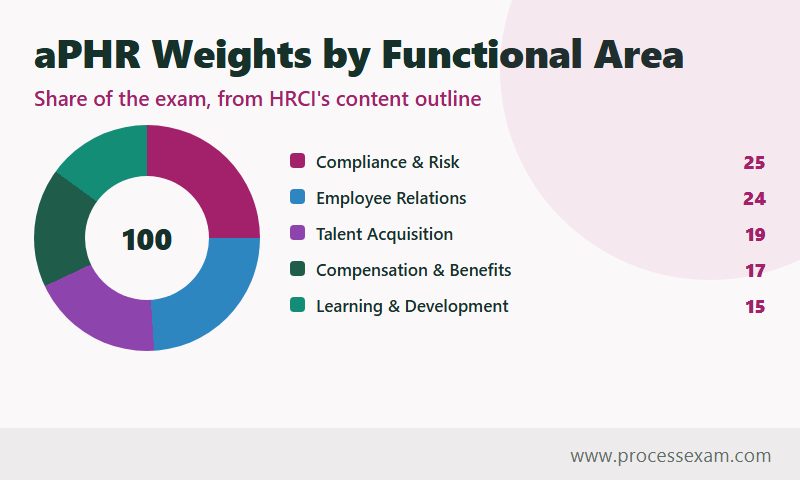
HRCI's aPHR page lists five functional areas, and HRCI's aPHR Exam Content Outline breaks each one into numbered knowledge statements. The weights below come from that outline. The right-hand column is simple arithmetic of ours, not an HRCI figure: the exam has 65 scored questions, and HRCI does not publish how many fall in each area, so treat "about" as a guide to proportion, not a promise.
| Functional area | Weight | Knowledge statements | About how many of 65 scored questions |
|---|---|---|---|
| Compliance and Risk Management | 25% | 6 | 16 |
| Employee Relations | 24% | 6 | 16 |
| Talent Acquisition | 19% | 5 | 12 |
| Compensation and Benefits | 17% | 5 | 11 |
| Learning and Development | 15% | 5 | 10 |
Two features of that table shape a study plan. First, the top two areas hold 49% of the exam between them, so roughly half of the scored paper rests on two of the five areas. Second, the statement counts are close to equal, which means a statement in Compliance (25% over six statements, or about 4.2 points each) carries more weight than one in Learning and Development (15% over five, or 3.0 points each). That assumes every statement is weighted equally, which HRCI does not state, but it is a fair way to decide where an hour of revision pays most.
The level of the questions matters too
HRCI's page on how its exams are structured says that only its practice-based exams, the PHR, SPHR, GPHR, PHRca, PHRi and SPHRi, include application and synthesis-level items. The aPHR is not on that list. Its items sit at the knowledge and comprehension level, which HRCI describes as recalling factual material such as definitions. In plain terms, you are more likely to be asked which law covers a situation, or what a term means, than to untangle a long case. Study to recognise and distinguish terms, not to build elaborate arguments. HRCI sets this out on its How the Exams are Structured page, which is worth reading before you decide how to revise.
What each area asks you to know
- Compliance and Risk Management. Six statements that map the law onto the rest of HR: hiring and non-discrimination, union settings, pay and benefits rules, safety and privacy, risk steps such as business continuity, and restructuring events such as mergers or downsizing. It is a list-heavy area, so most of the work is matching a statute to the situation it governs.
- Employee Relations. Six statements that run from mission, vision and values statements through HR policies and HRIS, engagement techniques, the employee lifecycle, complaint handling and diversity work. The same area also contains performance appraisal methods and their biases, so expect questions on how a rating scale can mislead.
- Talent Acquisition. Five statements following a hire from identifying a staffing need to the signed onboarding paperwork, with recruiting data such as cost-per-hire and time-to-fill at the end.
- Compensation and Benefits. Five statements on pay structures, health plans, fringe benefits, retirement plans and the contents of a wage statement. It is the area with the most vocabulary a newcomer has never met.
- Learning and Development. Five statements on orientation, instructional design, training formats, change management and how training is tracked. It is the smallest area, and the one with the fewest facts to memorise.
The aPHR syllabus page on this site walks through the same outline in plain language, if you would like a second view of each statement before you start.
How should you split your study hours across the five areas?
Start from the weights, then bend the plan toward the areas you know least. Suppose you have 60 hours. The numbers below are an example of the method, not a recommendation from HRCI, and your own total will differ.
| Area | Hours at pure weight (of 60) | Who should add hours | Who can trim |
|---|---|---|---|
| Compliance and Risk Management | 15 | Anyone who has never worked with employment statutes | People with payroll, legal or safety experience |
| Employee Relations | 14 | Those who avoided disciplinary or complaint work | Team leaders who run reviews and investigations already |
| Talent Acquisition | 11 | People who never wrote a job description or measured a vacancy | Recruiters and coordinators |
| Compensation and Benefits | 10 | Anyone whose work never touched payroll or benefits enrolment | Payroll and benefits staff |
| Learning and Development | 9 | People who have been trained but never designed training | Trainers and teachers |
The hours add up to 59, which leaves one spare hour for the final review. Now bend them. A payroll clerk may take three hours from Compensation and Benefits and give them to Compliance. A teacher moving into HR may do the opposite and trim Learning and Development to six hours, then spend the difference on Compliance. A good rule is to move no more than a quarter of any area's hours at the start, and to let your first set of results decide the rest. The weights are fixed, but your gaps are not.
Why weight alone is not enough
A heavy area you already know can wait; a light area you know nothing about cannot be left at zero. Fifteen percent of the exam is still about ten of the scored questions, and with the pass mark set on the total score, a blank area makes the other four do all the work. The aim is balance, tilted toward weight.
Hours per sitting
Short, frequent sittings beat long ones for this material, because much of it is vocabulary and law names that fade without repetition. One area per sitting, then a few questions on the previous area, keeps earlier material from slipping.
In what order should the five areas go across the weeks?
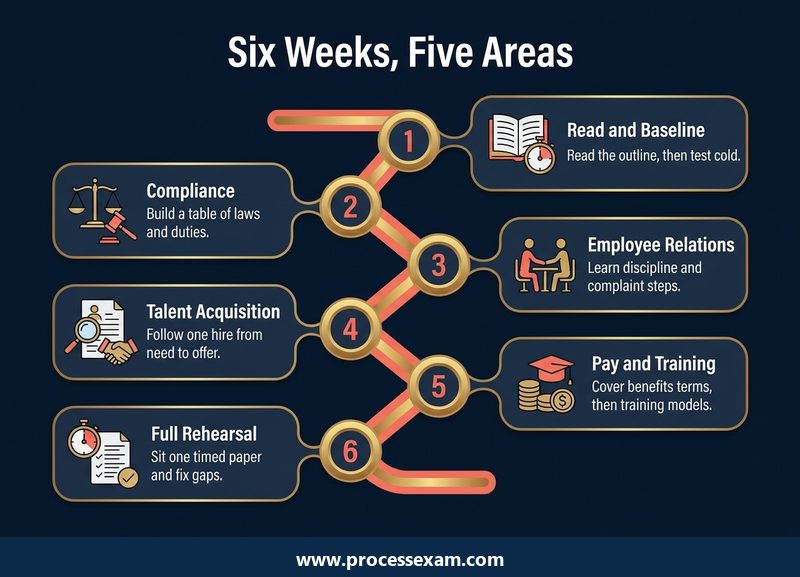
Order matters less than coverage, but there is a logical path through the outline. Compliance goes first because its laws reappear inside the other four areas: a hiring question can be about non-discrimination, a pay question about wage-and-hour rules, a complaint question about retaliation. Learning the laws early makes the rest read more clearly.
A six-week route
- Week 1: read the outline and take a cold baseline. Read HRCI's outline end to end, then answer a first set of questions without notes. The baseline is not a verdict; it is the map for the weeks ahead.
- Week 2: Compliance and Risk Management. Build a one-page table of each law, whom it protects and what it requires of the employer. Repeat it from memory at the end of the week.
- Week 3: Employee Relations. Pair each concept with a workplace situation: a stay interview, an engagement survey, a complaint, a separation. Practise the order of steps in progressive discipline and in an investigation.
- Week 4: Talent Acquisition. Follow one imaginary hire from workforce planning to the offer letter, writing down each document produced on the way. Calculate cost-per-hire and time-to-fill once by hand so the terms stick.
- Week 5: Compensation and Benefits, then Learning and Development. Use two-thirds of the week on pay and benefits terms and the rest on training models. Flashcards suit this week best.
- Week 6: mixed review and one full rehearsal. Take a complete paper under the real clock, review every miss, and spend the final days on the two or three weakest statements.
If you have more than six weeks, stretch the weeks for Compliance and Employee Relations first. If you have fewer, keep the order but cut the baseline to a short check of your three weakest areas.
How do you find your weak areas from your own scores?
A single percentage hides what you most need to see. Record each question you miss against its functional area and, where you can tell, its knowledge statement number from HRCI's outline. Then add a one-word cause: unknown if you had never met the term, mixed if you confused two similar terms, misread if you knew it and skipped a word in the question. Each cause has a different fix. Unknown means study, mixed means build a comparison table, misread means slow down at the start of each question.
Weigh the gaps, not just the scores
A low score in a light area matters less than a moderate one in a heavy area. Multiply each area's weight by the share you missed to get its weighted loss. The figures below are invented to show the method; they are not real results.
| Area | Weight | Answered correctly (example) | Weighted loss |
|---|---|---|---|
| Compliance and Risk Management | 25% | 55% | 11.3 points |
| Compensation and Benefits | 17% | 60% | 6.8 points |
| Employee Relations | 24% | 80% | 4.8 points |
| Talent Acquisition | 19% | 75% | 4.8 points |
| Learning and Development | 15% | 85% | 2.3 points |
In this example the reader's lowest score is Compliance, and so is the biggest loss, but the next priority is Compensation and Benefits, not Employee Relations, even though Employee Relations is heavier. A flat 80% in a 24% area costs less than a 60% in a 17% area. That is the reason to weigh gaps rather than read raw scores.
Do not read a practice percentage as a scaled score
The example above adds up to about 70% correct, but that figure cannot be turned into a result on HRCI's scale. HRCI scales every exam to a range of 100 to 700 with a pass mark of 500, and it says its pass mark takes account of the difficulty of the particular exam form. A practice paper is an indicator of readiness, not a prediction of a scaled number. Use it to compare yourself with yourself over several sittings.
When your results show the same two areas lagging after a week of revision, a timed run through the aPHR practice exam gives you a fresh set of questions to check them against.
What a good pattern looks like
- No area stays far behind the others from one sitting to the next.
- Your "unknown" misses fall each week while "misread" misses stay low.
- The heavy areas, Compliance and Employee Relations, sit at or above your average, not below it.
- You finish a full paper with time left to check flagged items.
These are rules of thumb of ours, not HRCI criteria. Treat them as a checklist for deciding when to book, and no more.
How does HRCI's results report show you where you stand?
HRCI explains its report on the page called Understanding Your Results Report. The first section states Pass or Did Not Pass. If you did not pass, the next sections give the range of possible scores, the passing score and your score, which will fall between 100 and 499. HRCI adds that the closer your number is to 500, the closer you were to passing. The pass decision comes from the total score, not from any single area.
The functional area chart
Both a Pass and a Did Not Pass report include a chart of your performance in each functional area, shown as shaded bars: the fuller the shading, the more items you answered correctly in that area. HRCI states that this performance information is not an official domain score and should not be interpreted as one. It is meant as a guide to what to study next if you test again. That makes the chart useful for exactly the job this article describes, finding the area to work on, but it does not change the result.
If the result falls short
Per HRCI's report page and handbook, a candidate who does not pass and has not bought Second Chance Insurance may reapply straight away but must wait 90 calendar days between attempts, and the earliest test day is day 91. Once the application is approved, you have 180 calendar days to schedule and take the exam, and you cannot sit the same exam more than three times in a consecutive 365-day period. All eligibility rules and fees apply again. Use the area chart to rebuild your plan around the shortest bars, since that is the purpose HRCI gives it.
What the pass rate tells you
HRCI's pass-rate page lists 71% for the aPHR as of 31 December 2025, and its exam statistics page says 2,145 people tested for the aPHR in 2025. Most candidates pass. That helps put the exam in proportion, but it does not tell you how prepared the average candidate was, so keep working from your own results rather than from the headline rate. Both figures are on HRCI's pass rates page.
What should your exam week and exam day look like?
The facts first, from the table below. The exam is computer-based, delivered at a Pearson VUE test centre or through online proctoring from home or office, according to HRCI's aPHR page.
| Item | aPHR |
|---|---|
| Awarding body | HRCI |
| Exam fee | $300 |
| Application fee | $100 |
| Questions | 90 (65 scored plus 25 pretest) |
| Exam time | 105 minutes plus 30 minutes administration time |
| Passing score | 500 on a scale of 100-700 |
| Experience required | None |
The week before
Stop learning new material two days out. Spend those days on your one-page law table, your comparison tables and the list of misses from your last full paper. Check the name on your booking against your identification: HRCI's handbook says the first and last name on your ID must exactly match the name on your application, and that a candidate without valid ID cannot test and forfeits the fees. It also sets deadlines for cancelling, so read the section in the HRCI certification handbook before you book, not after.
Arrival and set-up
The handbook asks test-centre candidates to arrive early, and says arriving more than a quarter of an hour late may mean being refused entry and losing the fee. For online proctoring you cannot cancel inside the last hour before the session. Whichever format you choose, give yourself a margin, because the handbook treats a missed slot as a forfeited fee.
Pacing the clock
Ninety questions in 105 minutes works out to a little under seventy seconds each, by simple division. Nothing on HRCI's pages says which of the 90 are the 25 unscored pretest items, so treat every one as if it counts. A sensible checkpoint is to have answered about half the questions when half the clock has gone. Because the aPHR sits at the knowledge and comprehension level, a question you can answer by recall should take well under that average, and the time you save belongs to the scenario-style items and multi-part items.
Item types to expect
HRCI lists traditional multiple choice with four, or sometimes three, options, multiple response items that tell you how many answers to give, fill in the blank where you enter a numeral, drag and drop, and scenario items that present an HR situation followed by several questions. There is no partial credit: for items with several parts, every part must be right. Select the best answer, which HRCI defines as the one a panel of HR subject matter experts would agree on. Some options are distractors written to look right, so read all of them before you choose.
Laws on the day
HRCI's outline warns that candidates are responsible for knowing the HR laws and regulations in effect at the time of their exam. In the last week, check that your law table matches current rules, particularly for any statute that has recently changed.
How will you know you are ready to book the exam?
Use a simple readiness test with four parts. Your last two full papers should show no area far below the rest. Your misses should be mostly slips in reading, not gaps in knowledge. You should be able to explain each of the six Compliance statements and six Employee Relations statements aloud without notes. And you should have a booked window that leaves a few days between your last paper and the exam. If one part fails, delay by a week and rework that part; HRCI gives you 180 days from approval, so a short delay rarely costs anything except the time itself.
The most common mistake is treating the passing mark as a percentage target and stopping once a practice paper reaches it. The pass mark on the real exam is 500 on the scaled range, set by HRCI, and the form you get may be easier or harder than your practice papers. Aim for comfortable, balanced scores across all five areas, not a minimum.
When you are ready, apply through HRCI, pay the $100 application fee and the $300 exam fee, and book a slot. From there, the plan is in your hands: five areas, weighted hours, honest results, and a calm morning.
Frequently Asked Questions
How should I study for the aPHR exam?
Study by HRCI's five functional areas, in proportion to their weights: Compliance and Risk Management 25%, Employee Relations 24%, Talent Acquisition 19%, Compensation and Benefits 17% and Learning and Development 15%. Take a baseline set of questions first, then give extra hours to the areas where weighted gaps are largest.
What is the aPHR pass rate?
HRCI's pass-rate page lists 71% for the aPHR as of 31 December 2025. HRCI's statistics page says 2,145 people tested for the aPHR during 2025. The rate describes all candidates, so it cannot tell you how prepared you are; your own results across the five areas are a better guide.
Which aPHR functional area carries the most weight?
Compliance and Risk Management carries the most weight at 25%, with Employee Relations close behind at 24%. Together they account for 49% of the exam. Learning and Development is the lightest at 15%. HRCI publishes these weights in its aPHR exam content outline, and they apply to the scored questions.
What is the passing score for the aPHR?
HRCI reports results on a scaled range of 100 to 700, and the passing score is 500. It is not a percentage of questions answered correctly. The exam has 90 questions, of which 65 are scored and 25 are pretest, and the pass decision rests on the total score, not on any single area.
Can you retake the aPHR if you fail?
Yes. According to HRCI, you may reapply straight away, but you must wait 90 calendar days between attempts without Second Chance Insurance, and you cannot sit the same exam more than three times in 365 days. Eligibility rules and fees apply again, and you then have 180 days after approval to test.
- HRCI HR Associate Professional Exam Questions |
- HRCI HR Associate Professional Question Bank |
- HRCI HR Associate Professional Questions |
- HRCI HR Associate Professional Study Guide |
- HRCI aPHR Quiz |
- aPHR Certification |
- aPHR Questions |
- aPHR Practice Test |
- aPHR Study Guide Material |
- aPHR Sample Exam |
- HR Associate Professional Certification |
- HRCI HR Associate Professional Book |
- HR Associate Professional Certification Cost |
- HR Associate Professional Certification Requirements |
- HRCI HR Associate Professional Sample Questions |
- aPHR Exam Questions Download |
- aPHR Test Questions |
- HR Associate Professional PDF |
- HRCI Associate Professional in Human Resources


