
TOGAF 9 Part 2 (OG0-092): Cost, Format and How to Pass
You passed the closed-book paper last month, the TOGAF 9 Foundation certificate is in your inbox, and now the booking page offers OG0-092: eight long scenarios, each with four tempting answers, and a copy of the standard waiting behind a Reference button. The Open Group sets the paper at 90 minutes, scores it out of 40 points, and passes you on 24. That is a different game from Part 1, and this guide covers how the points work, the fee, the syllabus and a way to prepare.

Everything below was read from The Open Group's own TOGAF examinations datasheet, its retail fee schedule applicable from 1 February 2026 and its TOGAF certification portfolio FAQ, all checked in October 2026. Where a figure comes from somewhere else, the text says so.
What does the Part 2 sitting actually look like?
The paper is built from eight scenarios, each a short business story followed by a question and several candidate answers. The Open Group calls the format scenario based, complex multiple choice. You get 90 minutes for all eight, and an English-language electronic copy of the TOGAF 9 Standard is built into the exam software. Hard-copy books are not allowed in the room, because the test centre keeps a clean desk and supplies the reference material on screen instead. The standard opens when you click the Reference button inside the exam.
| Detail | OG0-092 |
|---|---|
| Exam name | The Open Group TOGAF 9 Part 2 |
| Body of knowledge | TOGAF 9.2 |
| Scenario count | 8 |
| Duration | 90 minutes |
| Passing score | 60% |
| Exam fee | USD $375 |
| Qualification earned | TOGAF 9 Certified (Level 2) |
Two details trip up first-time candidates. First, the 60% is not 60% of eight questions. It is 60% of 40 points, which the datasheet states as 24 or more points out of a maximum of 40. Second, the open book does not make the paper easier to finish. It makes it easier to look up a fact and harder to finish, because the standard is long and the clock is not.
The paper is delivered at authorised test centres and, as an alternative, through Pearson VUE's remote online proctoring, and it is supervised in both cases. If you would rather use a test centre for an open-book paper, it is a fair choice: a second screen and a stable connection are one thing fewer to worry about when the whole result depends on eight answers.
Who may book it
The Open Group lists the prerequisite as TOGAF 9 Foundation, or a pass of the Part 1 exam on the same day at the same test centre. That second route is the reason some candidates sit both papers back to back. If you already hold the Foundation certificate you can book Part 2 alone, on whichever date suits you. Passing Part 2 awards TOGAF 9 Certified, the Level 2 qualification, and the portfolio FAQ states that TOGAF 9 certificates do not expire.
How do 5, 3, 1 and 0 points add up to a pass?
Part 1 gives one point for each right answer. Part 2 does not. Every scenario question is marked on a gradient: the best answer earns 5 points, the second-best answer 3, the third-best answer 1, and the distractor 0. Eight questions at 5 points apiece give the maximum of 40, and 24 is the bar. So the exam does not ask whether you picked the single right option. It asks how close to the best answer your choice was, over eight attempts.
That changes how a pass is built. The table shows five ways a candidate could land on, or miss, the 24-point line. The point totals are arithmetic on The Open Group's published scoring rule; the patterns themselves are illustrations, not data from real candidates.
| Pattern across eight scenarios | Points | Result |
|---|---|---|
| Second-best answer every time | 24 | Pass, exactly on the line |
| Five best answers and three distractors | 25 | Pass |
| Four best, one second-best, one third-best, two distractors | 24 | Pass |
| Seven second-best answers and one third-best | 22 | Fail |
| Third-best answer every time | 8 | Fail |
Read the first row twice. A candidate who never finds the best answer but always lands on the runner-up passes by the thinnest margin possible, and one who slips to third-best on a single question falls under the line. A pass therefore comes from consistent, defensible judgement, with a few scenarios where you spot the best answer outright to build a cushion. It does not come from memorising one right answer per question.
What this means for how you read the options
Because partial credit exists, an option that is imperfect can still be worth 3 points. Do not freeze when two answers both look reasonable. Rank them: which one leaves the architecture team better placed against the framework's own logic? The one that respects the phase you are in, keeps the stakeholders informed and ties the work back to requirements usually outranks the one that jumps ahead. A distractor, by contrast, tends to break that logic outright, by skipping a phase, ignoring governance or solving a problem the question did not ask about.
Here is an invented example, written for this guide and not taken from the exam. A regional retailer has bought a smaller chain and now runs two loyalty systems. The architecture team has finished the target business architecture and is deciding what to do next. One option proposes picking the preferred vendor products straight away. A second proposes defining the data and application architectures that serve the target business view. A third proposes a communications campaign. A fourth proposes freezing change until a full governance review is complete. The defensible best answer follows the ADM sequence into the information systems phase; the vendor shortcut jumps to technology; the campaign is useful but not the next step; the freeze is the distractor. Notice that a candidate who ranks sensibly collects points even without perfect certainty.
What does Part 2 cost, and is a retake charged again?
The Open Group's retail fee schedule, applicable from 1 February 2026, lists the TOGAF 9 Part 2 exam at a booking fee of USD $375 when you book directly with Pearson VUE and pay by card, and a retail voucher fee of USD $400 if you buy through The Open Group's shop with an approved voucher account. Exams are priced in US dollars, and the schedule warns that taxes and local currency conversions can change what you pay in some countries.
The same schedule prices the Part 1 paper (OG0-091) at the same booking fee, so working through both papers separately costs twice the figure above. The combined Part 1 and Part 2 paper, OG0-093, has its own line in the schedule and is the cheaper route if you have not yet sat Part 1.
The study material is a separate cost. The usual reading companion is the TOGAF 9 Certified Study Guide, 4th Edition, which is sold through The Open Group's shop. If an accredited training course is on your list, the datasheet notes that the exam is included in the course fee, with a voucher issued for the test centre.
On retakes, The Open Group's certification FAQ carries a one-month retake policy for failed exams, and it publishes separate sections on retake rules and retake fees. The retake fee is not printed in the schedule above, so confirm it with Pearson VUE when you book instead of assuming it equals the first attempt.
Which parts of TOGAF 9.2 do the scenarios lean on?
The Level 2 body of knowledge is wide: the portfolio FAQ puts it at 26 learning units and 108 learning outcomes. The OG0-092 syllabus topic list groups them under the Architecture Development Method, its techniques and the structures around it. The six clusters below are a way of organising that list for revision, not The Open Group's own headings.
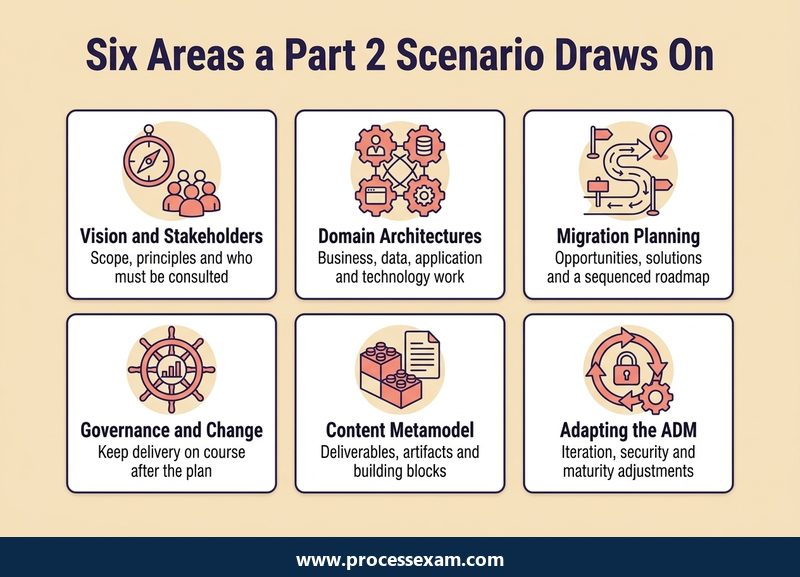
Vision and stakeholders
The Preliminary Phase and Phase A set the frame. Expect scenarios where an organisation has no agreed principles, an unclear scope or a sponsor who has not been consulted. You should know that the Architecture Vision produces a Statement of Architecture Work and that stakeholder management, including the stakeholder map and a communications plan, starts here and never stops. The business scenarios technique is a Level 2 topic too: it is the tool for discovering requirements from a business problem before any architecture is drawn.
Domain architectures
Phases B, C and D take the vision down into business, data, application and technology architectures. At Level 2 you are expected to reason about baseline and target architectures, gap analysis and which catalogs, matrices and diagrams suit a given stakeholder concern. A typical question gives you a team stuck between phases and asks which step is missing. Technology Architecture also brings in the Technical Reference Model, and the syllabus lists the Integrated Information Infrastructure Reference Model alongside it, both marked for Level 2 depth.
Migration planning
Phases E and F are where architecture meets money and sequence. Phase E identifies the work packages and transition architectures; Phase F finalises the implementation and migration plan and tests it against business value and risk. The migration planning techniques on the syllabus are favourite ground for ranking questions, because several answers are plausible and the best one reflects the order of work the framework recommends.
Governance and change
Phase G covers implementation governance: architecture contracts and compliance reviews that keep delivery projects aligned. Phase H covers architecture change management, where changes are classified and the Architecture Board or its equivalent decides whether a change can be handled within the existing framework or needs a new ADM cycle. The Level 2 topic of architecture governance in the Preliminary Phase belongs here too. Candidates who think of governance as paperwork lose points on scenarios that treat it as the control mechanism.
Content, repository and requirements
The Architecture Content Framework and the TOGAF Content Metamodel give names to deliverables, artifacts and building blocks. The Architecture Repository, which holds the metamodel, capability, landscape, standards, reference library, governance log and requirements repository, is where work products live. Requirements management sits at the centre of the ADM cycle and feeds every phase, so a scenario that mentions a changed requirement in mid-project is often really a question about how that process is meant to work.
Adapting the ADM
The last cluster is the one candidates meet least in practice. It covers iteration and levels, architecture partitioning, security, maturity models and the Architecture Skills Framework. Real organisations never run the ADM as a single clean pass, so these guidelines are the framework's answer to a team that asks whether it must complete a phase before starting the next. Expect a scenario in which a large programme is divided into several smaller iterations.
Does TOGAF 9 Part 2 still make sense beside the 10th Edition paper?
Yes, for now, and The Open Group has said so in writing. Its portfolio FAQ says it will continue to support the TOGAF 9 certification learning paths indefinitely, that TOGAF 9 certificates do not expire, and that TOGAF 9 certification is recognised as a prerequisite for newer learning paths. The datasheet, read in October 2026, still lists OG0-092 as the TOGAF 9 Part 2 exam alongside the TOGAF Standard, 10th Edition exams, and no withdrawal notice appeared on the pages read.
The two Part 2 papers are the same size in the ways that matter on the day. The comparison below puts the TOGAF 9 paper next to OGEA-102, the 10th Edition Part 2, using The Open Group's own figures.
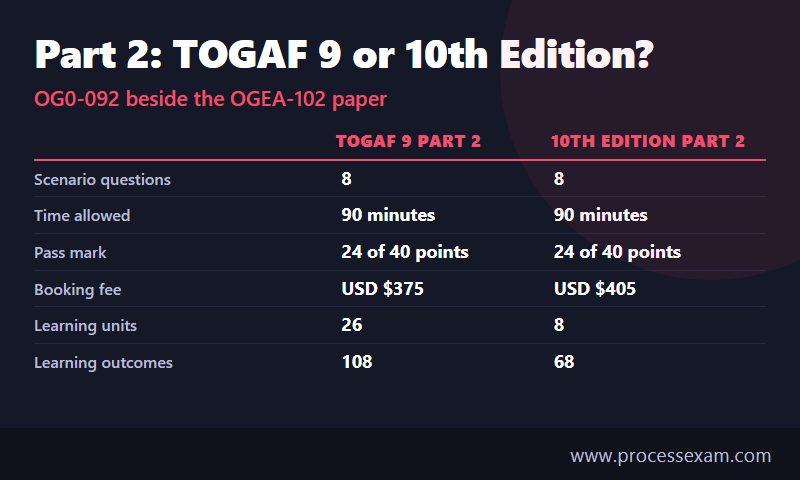
The difference is the syllabus. The portfolio FAQ states that TOGAF 9 Level 2 has 26 learning units and 108 learning outcomes, while the 10th Edition Practitioner level has 8 units and 68 outcomes, and it adds that the amount of learning content was chosen to meet each certification's goals. The newer paper focuses on practical exercises, so more material in the older syllabus does not mean more marks, but it does mean more topics you might meet.
How to choose
Choose OG0-092 if your employer, a job advert or a framework contract names TOGAF 9, if your study material is built on the 9.2 standard, or if you already hold Foundation and want the Level 2 credential without changing editions. Choose the 10th Edition path if you are starting fresh and want the current standard. The two are connected: the portfolio FAQ lists a bridge route in which a TOGAF 9 Certified holder adds the Practitioner certification by passing the Bridge exam. It also says no withdrawal date had been set for that bridge when written and that 18 months' notice will be given.
How should you spend the 90 minutes once the first scenario loads?
Ninety minutes divided by eight scenarios is eleven minutes and fifteen seconds each, with nothing left for review. A workable budget is nine or ten minutes per scenario, which leaves a reserve of ten to twenty minutes for the questions that fight back. Decide your budget before you start, then look at the clock after every second question, not after every question.
Use the standard as a reference, not as a reading list
The built-in copy is searchable, and that is its real value. The clean pattern is to decide first what you think the answer is, then open the reference to confirm one specific point: the name of a deliverable, the input to a phase, who owns an approval. A candidate who opens the standard to read up on a phase from scratch has already lost the time that the ranking needed. Practise searching with the keywords a scenario uses, such as the artifact name or the technique, not the question text.
Rank, then move on
Gradient scoring rewards a decision. Settle on a best and a runner-up, eliminate the option that breaks the method, and submit. If you cannot split two options after a minute of rereading, mark the question, take your best guess so it carries some points, and spend your reserve minutes at the end. An unanswered scenario can only score zero.
The scenarios are long. They add detail that has nothing to do with the answer, such as a regulator, a legacy platform or a reorganisation in progress. The closing question is the filter. Ask which phase, which deliverable or which role it is really about, then read the story again for only the facts that bear on that.
What does preparation look like once Part 1 is behind you?
Part 1 trains recall. Part 2 trains application, so a new plan is needed even if the vocabulary is fresh in your head. The sequence below fits candidates who already hold Foundation and can give an hour or so most days; stretch it if your schedule is lighter. It is a suggestion, not an Open Group requirement.
- First stretch: re-walk the ADM with outputs in mind. For every phase, list its inputs, steps and outputs from memory, then check the standard. Foundation asked what each phase is called; now ask what it produces and who signs it off.
- Second stretch: techniques and content. Work through the migration planning techniques, the stakeholder and requirements techniques, and the content metamodel. Build a one-page map of how deliverables flow from phase to phase.
- Third stretch: governance, repository and adaptation. Phases G and H, the Architecture Repository, iteration, partitioning, security and maturity. These produce the questions candidates call vague, so spend extra time here.
- Last stretch: timed scenarios. Do eight scenarios in 90 minutes, in one sitting, practising the search habit. After each, write why the runner-up beat the third choice. That sentence is the skill the exam scores.
For the timed stretch you need questions written in the exam's style. An OG0-092 practice exam gives you scenario items to rank against the same 5, 3, 1 and 0 logic, which is how you learn where your runner-up instinct drifts.
Alongside the practice, the TOGAF 9 Certified Study Guide named above is the reading companion most candidates pair with the standard. Accredited training courses are the other route, and the datasheet lists the exam as part of their fee. Whichever you choose, finish with the standard itself: you will be navigating it on exam day, and the layout you know is worth minutes.
A short self-check before booking
- Can you name, without notes, the main output of every ADM phase?
- Can you explain when a change in Phase H needs a new cycle and when it does not?
- Can you find a named deliverable in the built-in standard in under a minute?
- Have you finished a full set of eight scenarios inside 90 minutes?
What do you hold after a pass, and what if the points fall short?
A pass awards TOGAF 9 Certified. The Open Group states the credential does not expire and that the certification is widely required in the job market, a claim the organisation makes about its own programme. Treat it as a vendor statement. For your own career, the more reliable check is the job adverts in your market: if they name TOGAF 9, the credential is a match; if they name the 10th Edition, the Bridge exam is the short way to add it.
The credential is recognised through a digital badge, and the portfolio FAQ says your candidate ID is used to issue badges after you pass the applicable exam. Add it to your professional profile once it arrives.
If the result is a fail
The score report is your best study aid. Because points come in steps of 5, 3, 1 and 0, a result of 20 or 22 tells you that you were close on most questions and lost a few ranking decisions, so it is mostly a judgement problem, not a knowledge gap. Work out which topic clusters you were weakest in, redo the timed set, and wait out the one-month retake period The Open Group applies. Budget for a second booking fee.
For wider context on how the TOGAF 9 papers relate, The Open Group's examinations datasheet lists every paper, its question count and its time limit in one table, and the retail fee schedule is the document to check before you pay.
Frequently Asked Questions
How much does the TOGAF 9 Part 2 exam cost?
The Open Group's retail fee schedule, applicable from 1 February 2026, lists OG0-092 at a booking fee of USD $375 when you book directly with Pearson VUE, and USD $400 as a retail voucher fee. Taxes and exchange rates can change the amount you pay in some countries.
How many questions are on OG0-092 and how long is the exam?
OG0-092 has 8 scenario-based questions to be answered in 90 minutes. Each question is complex multiple choice and is marked on a gradient, so a single question can earn 5, 3, 1 or 0 points. The maximum score across the paper is 40 points.
What score do you need to pass OG0-092?
You need 60%, which The Open Group states as 24 or more points out of a maximum of 40. The best answer earns 5 points, the second-best 3, the third-best 1 and the distractor 0. Eight second-best answers add up to exactly 24, so consistent judgement can pass.
Is the TOGAF 9 Part 2 exam open book?
Yes, but only in a controlled way. An electronic copy of the TOGAF 9 Standard, in English, is built into the exam and opens from the Reference button. No hard-copy books may be used at test centres, so you cannot bring your own annotated copy into the room.
Do you need Part 1 before taking OG0-092?
The Open Group lists the prerequisite as TOGAF 9 Foundation, or a pass of the TOGAF 9 Part 1 exam on the same day at the same test centre. If you already hold Foundation you can book Part 2 on its own. Passing it awards TOGAF 9 Certified.
- Enterprise Architecture |
- Open Group TOGAF 9 Certified Test Questions |
- OG0-092 Question Bank |
- TOGAF 9 Part 2 |
- Open Group TOGAF 9 Certified Sample Questions |
- OG0-092 Exam Questions Download |
- OG0-092 Test Questions |
- TOGAF 9 Certified PDF |
- Open Group TOGAF 9 Certified Book |
- TOGAF 9 Certified Certification Cost |
- TOGAF 9 Certified Certification Requirements |
- TOGAF 9 Part 2 Certification |
- TOGAF 9 Part 2 Simulator |
- TOGAF 9 Part 2 Mock Exam |
- Open Group TOGAF 9 Part 2 Question Bank |
- Open Group TOGAF 9 Part 2 Book |
- Open Group TOGAF 9 Part 2 Study Guide |
- TOGAF 9 Part 2 Certification Cost |
- TOGAF 9 Part 2 Certification Requirements |
- Open Group TOGAF 9 Part 2 Exam Questions |
- Open Group TOGAF 9 Part 2 Sample Questions |
- TOGAF 9 Part 2 PDF


