
Things You Need to Know to Pass TOGAF Certification Exam
Updated on 22 September 2026. What’s new: rewritten for the TOGAF Standard, 10th Edition exams, where Part 1 (OGEA-101) needs 60%, or 24 of 40, and both parts are booked through Pearson VUE.
Passing TOGAF certification today means passing two papers built on the TOGAF Standard, 10th Edition. Part 1 (OGEA-101) gives you 40 closed-book questions in 60 minutes, and 24 correct answers pass. Part 2 (OGEA-102) gives you eight open-book scenarios in 90 minutes, each scored 5, 3, 1 or 0. Most people who fail already understand enterprise architecture; they lose marks by answering from their own habits instead of from the standard.

This page first appeared when the TOGAF 9 exams were current. It has been rewritten for the exams The Open Group runs now, which were checked against its datasheets in September 2026. What follows is a preparation plan rather than a sales pitch: what each paper measures, which parts of the standard to read and in what order, how scenario questions are scored and answered, how to run the clock on the day, and the errors that sink otherwise capable candidates.
If you are still deciding whether the credential suits your career, that is a separate question with its own answer. Here the assumption is simple: you have decided to sit the exams, and you want to pass them at the first attempt.
What do the two TOGAF papers actually test?
The two parts measure different abilities, and preparing for them the same way is the most common reason people stall. The Open Group describes the Foundation level as knowledge and comprehension: can you recognise the terms, name the phases and say what each one is for? The Practitioner level moves to application and analysis: given a messy organisation, can you choose the step a practitioner following the standard would take next?
Part 1 is therefore a vocabulary and structure test. Its 40 questions each carry a single point, the paper is closed book, and nothing in the question will define a term for you. A candidate who has read the standard once but never drilled the definitions tends to recognise every word and still pick the wrong option, because two answers often differ by one precise term.
Part 2 is a judgement test. Each of its eight questions opens with a scenario of several paragraphs about a fictional enterprise, then asks what the architect should do. All four answers sound plausible. One is the best fit with the standard, one is close, one is weaker and one is a distracter, and the marks follow that order. An electronic copy of the TOGAF Enterprise Architecture Body of Knowledge is built into the exam, but no printed books are allowed.
Here are the three exams on the current path side by side:
| Detail | Part 1 | Part 2 | Combined |
|---|---|---|---|
| Exam code | OGEA-101 | OGEA-102 | OGEA-103 |
| Certification earned | TOGAF Enterprise Architecture Foundation | TOGAF Enterprise Architecture Practitioner | TOGAF Enterprise Architecture Practitioner |
| Questions | 40 | 8 | 48 |
| Time | 60 minutes | 90 minutes | 150 minutes |
| Passing score | 60% | 60% | 60% |
| Exam fee | USD $405 | USD $405 | USD $610 |
| Reference material | Closed book | Open book, electronic copy only | Part 1 section closed, Part 2 section open |
The Open Group's TOGAF examinations summary sets out the scoring rules in full, including the 24-point threshold that applies in each part. The combined exam is marked as two sections, and each one has to reach that threshold on its own. A high Part 1 score cannot rescue a weak Part 2, and the reverse is also true.
There are no formal prerequisites for Part 1. Part 2 requires the Foundation certification, or a pass in Part 1 taken the same day at the same test centre. The combined exam has no prerequisite at all, which is why many self-studying candidates choose it.
Which TOGAF 10 topics does Part 1 cover, and how deep does it go?
The TOGAF Standard, 10th Edition is split into Fundamental Content and a library of Series Guides. The Fundamental Content runs to six documents. One introduces the core concepts, one sets out the Architecture Development Method (ADM), and the others deal with its techniques, with adapting it in practice, with the content it produces, and with building the capability and governance to run it. Part 1 draws almost entirely on that core, so the Series Guides can wait until you are working as an architect.
Our Part 1 syllabus page lists the learning units in exam order. Below is what each one asks of you and how deep to go.
Concepts and definitions
Start here, because every other unit assumes this language. You need to explain what an enterprise is in TOGAF terms, what enterprise architecture is for, and what an architecture framework does. Learn the four architecture domains (business, data, application and technology) and why the standard treats data and application together as information systems architecture.
The definitions unit is where Part 1 is won or lost. Expect questions that turn on the difference between a deliverable and an artifact, an architecture building block and a solution building block, a view and a viewpoint, a stakeholder and a concern. Write each pair on a card with a one-line example. If you cannot give the example, you do not yet know the term well enough for the exam.
The ADM cycle
Know the Preliminary Phase, Phases A to H, and Requirements Management at the centre of the cycle. For each phase, learn its objectives in your own words and the main outputs it produces. Phase A creates the Architecture Vision and the Statement of Architecture Work. Phases B, C and D develop the business, information systems and technology architectures. Phase E identifies opportunities and solutions, Phase F finalises the migration plan, Phase G governs implementation and Phase H manages change to the architecture once it is in place.
Part 1 rarely asks for a full list of inputs, but it often asks which phase an activity belongs to. A useful drill is to take ten activities from your own work, such as agreeing scope with a sponsor or assessing a vendor proposal, and place each one in the phase the standard would put it.
ADM techniques
This unit introduces the techniques the method relies on: architecture principles, stakeholder management, gap analysis, migration planning techniques, interoperability requirements, business transformation readiness assessment, risk management, architecture alternatives and trade-offs, business scenarios and capability-based planning. At Foundation level you must know what each technique is for and in which phase it earns its keep. You do not need to perform them in detail; that depth belongs to Part 2.
Applying the ADM
Here the standard explains how the ADM is adapted rather than followed rigidly. Learn the idea of iteration, the four iteration cycles (architecture context, architecture definition, transition planning and architecture governance), and the three levels of the architecture landscape: strategic, segment and capability. The 10th Edition also stresses using the ADM with agile delivery and in a digital enterprise, and the Foundation datasheet names both as competencies, so expect at least a question or two on them.
Governance and architecture content
Governance questions test whether you know who decides what: the role of the Architecture Board, what an architecture contract commits each party to, and why compliance reviews exist. Content questions test the vocabulary of outputs: catalogs, matrices and diagrams as the three kinds of artifact, the Enterprise Continuum as a way of classifying assets from generic to specific, and the Architecture Repository as the place those assets live.
Is TOGAF 9 study material still usable?
Partly. The ADM phases and most key terms carried over, so an old book will not mislead you on the core cycle. What changed is the structure of the standard, the emphasis on adapting the method, and the learning units behind the exam. A candidate who studies only from TOGAF 9 notes tends to miss questions about the modular structure and agile use. Use old material for revision if you have it, but read from the 10th Edition itself, which The Open Group sells and also offers under a 90-day evaluation licence for individuals.
How should you split your study time between Part 1 and Part 2?
How long it takes to get TOGAF certified depends mainly on whether you already work with architecture. Someone who reviews designs every week can often be ready for both parts in six weeks of evening study. A developer or analyst meeting the ADM for the first time should allow eight. Accredited training courses compress the reading into a few days, and The Open Group notes that every accredited course includes the exam voucher, but the practice work afterwards still takes time.
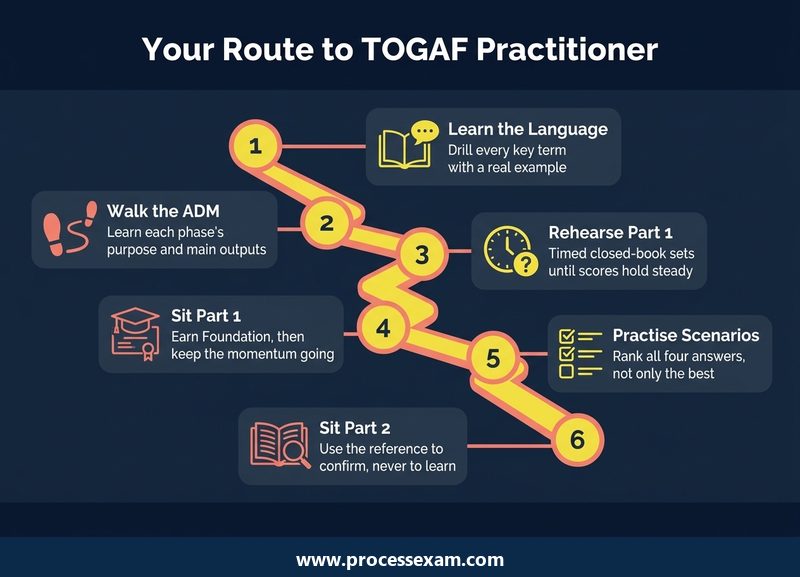
The plan below assumes self-study of around an hour a day and treats the two parts as one route with a checkpoint in the middle.
Days 1 to 10: learn the language before the method
Read the introduction and core concepts document first, then build your definition cards. Do not try to memorise the ADM yet. By the end of this stage you should be able to explain every key term aloud, with an example, without looking at the card.
Days 11 to 20: walk the ADM one phase at a time
Take one or two phases per session. For each, write the objectives, the headline outputs and one sentence on how it links to the phase before and after. Finish the stage by drawing the whole cycle from memory, including Requirements Management, and checking it against the standard.
Days 21 to 28: techniques, governance and a timed Part 1 rehearsal
Cover the techniques, applying the ADM, governance and content. Then sit a timed rehearsal of 40 questions in 60 minutes under exam rules: no notes and no pausing. A full-length OGEA-101 practice test on ProcessExam mirrors that format, which lets you see whether the clock or the content is your problem. Aim for a steady margin above 24 correct answers across several attempts before you book, not a single lucky score.
Days 29 to 45: scenario practice for Part 2
Once Part 1 is booked or behind you, change how you study. Read the stakeholder management, Phase A, architecture development, implementation, change management and requirements management material again, this time asking why each step exists and what goes wrong if it is skipped. Practise scenarios in sets of two, allowing about 22 minutes per pair, and after each one write down why the best answer beat the runner-up. Our walkthrough of each Part 2 learning unit covers those topics in more depth.
Days 46 to 56: open-book navigation drills
The reference built into Part 2 only helps if you can find things quickly. Practise with an electronic copy of the standard: given a technique name, how fast can you reach the paragraph that defines it? Candidates who have never searched the document under time pressure tend to spend five minutes looking up something they already half knew.
How do you answer a Part 2 scenario question?
Gradient scoring changes the tactics. Because the second-best answer earns 3 points out of 5, a candidate who reliably finds the two strongest answers but sometimes chooses the wrong one of the pair will usually pass. The job is less about finding a perfect answer and more about ranking four options by how faithfully they apply the standard.
A method that works for most candidates has five moves:
- Read the question at the end first. It tells you whether you are choosing the next step, the best technique or the right stakeholder approach, so you read the scenario with a purpose.
- Place the scenario in the ADM. Which phase is the organisation in, and has it finished the phases before it? Many scenarios describe a team that is skipping ahead.
- List the stakeholders and what worries each one. Scenarios often hide the deciding detail in a single sentence about a sponsor, a regulator or a resistant business unit.
- Test each answer against the standard, not your employer. Ask whether the answer follows the method fully, partly or not at all.
- Eliminate the distracter, then separate the top pair. The distracter usually breaks the method outright; the best answer is usually the one that deals with the stated concern while keeping the process intact.
Consider an illustrative case, not an exam item. A regional insurer has started Phase B work on a claims platform, but the sponsor has not yet approved the Architecture Vision and two business units disagree about scope. One option says to continue the business architecture and resolve scope later. Another says to return to Phase A, confirm scope and stakeholder concerns, and obtain approval of the Statement of Architecture Work. A third proposes an Architecture Board review to arbitrate between the units. A fourth says to begin a technology proof of concept to show progress. The fourth ignores the method and would score nothing. Returning to Phase A with stakeholder engagement follows the standard most closely, and the Board review is a reasonable but less direct runner-up.
Use the electronic reference sparingly. It is best for confirming the name or purpose of a technique you have narrowed down, not for reading a section for the first time. At roughly 11 minutes per scenario, one long search can cost you a whole question.
What is it like to sit both parts in one combined sitting?
The combined OGEA-103 exam runs the two parts back to back in 150 minutes: a 60-minute Part 1 section, then a 90-minute Part 2 section. There is no break between them, and once you submit the first section you cannot return to it. The reference material becomes available only when the second section starts.
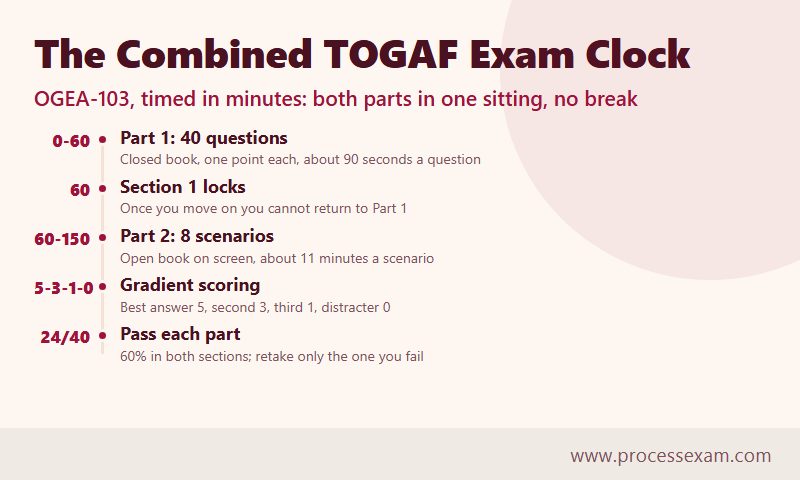
That structure suits some candidates and hurts others. It suits people who have studied both levels together and want the Practitioner certification in one booking. It hurts people who find the closed-book questions draining, because they arrive at the scenarios already tired, and those need the most concentration of the day.
If you fail one section of the combined exam, no certification is awarded, but you retake only the section you failed. That softens the risk. Still, candidates who are new to architecture often do better booking Part 1 on its own, taking a short pause to refocus, and then booking Part 2 once scenario practice is consistent. If you go this way, Part 2 can be sat on the same day as Part 1 at the same test centre, as long as you pass Part 1 first.
Whichever route you pick, finish Part 1 in good time. In the combined format any minutes left over in the first section are simply lost, because they do not carry into the second.
How should you pace yourself on exam day?
Part 1 allows about 90 seconds per question. Work through the paper once, answering everything you are sure of and flagging anything that needs thought. Every question is worth one point, so a hard definition deserves no more of your time than an easy one. On the second pass, go back to the flagged items, and never leave a question blank, because there is no penalty for a wrong answer.
Part 2 is slower but just as tight. With eight scenarios in 90 minutes, check the clock after every second question. If a scenario still makes no sense after two careful readings, eliminate what you can, take the stronger of the remaining options and move on. A 3-point answer on a hard scenario is far better than a blank on the last one because time ran out.
Some practical points about the day itself:
- You can test at a Pearson VUE centre or from home or the office through OnVUE online proctoring. For a remote sitting, run the system check days before, not minutes before.
- The Open Group notes that the time a provider quotes can include about 15 minutes for registration, a tutorial and a survey, on top of the exam time itself.
- If English is not your first language and you are taking an English-language exam, you may be given additional time. Ask about it when you book rather than on the day.
- At a test centre, the open-book material is provided electronically through a Reference button inside the exam; you cannot bring your own copy.
What do candidates get wrong in each paper?
The errors below come up again and again in candidate accounts and in training feedback. Each one is avoidable once you know to look for it.
Errors that cost points in Part 1
- Studying breadth without precision. Reading the whole standard twice feels productive, but Part 1 rewards exact definitions. Two options that differ by "artifact" and "deliverable" will catch anyone who learned the terms loosely.
- Mixing up the phases on either side of implementation. Phases E, F and G are the ones candidates confuse most often. Be clear which phase identifies work packages, which one agrees the migration plan and which one oversees delivery.
- Ignoring the units that feel dull. Governance and architecture content look like administration, yet they supply a steady share of questions.
- Relying on memory from TOGAF 9. The structure of the standard changed, and so did parts of the vocabulary around it.
Errors that cost points in Part 2
- Answering from experience. Your organisation may skip Phase A approvals and still deliver. The exam asks what the standard recommends, and it marks your answer against that alone.
- Hunting for a perfect answer. Candidates who keep rereading a scenario looking for certainty run out of time. Rank the options and commit.
- Overlooking the stakeholder sentence. The detail that separates the best answer from the second is often a single remark about who is worried and why.
- Treating open book as a safety net. The reference helps confirm; it does not teach. Candidates who planned to look things up in the exam are usually the ones who finish with scenarios unanswered.
Errors before you even book
- Booking the combined exam by default. It suits confident candidates. If scenario practice is still inconsistent, taking the parts separately lowers the pressure.
- Booking before the timed rehearsals are steady. One good score can be luck. Three consistent ones are evidence.
- Studying from unofficial summaries of the standard. Short notes are useful for revision, but the questions are written against the standard itself, so read the source.
What should you do after passing each part?
A pass in Part 1 gives you the TOGAF Enterprise Architecture Foundation certification and counts as the first half of the Practitioner route. Book Part 2 while the vocabulary is fresh; candidates who leave a long gap often find the scenarios harder because they have to relearn terms before they can use them.
Neither certification expires. The Open Group ties each certification to the edition of the standard you were examined on, so there is nothing to renew and no recertification cycle to track. You will appear in the directory of certified individuals and receive an Open Badge.
From there, the TOGAF certification portfolio offers several next steps. Foundation holders can move to the Practitioner level or take shorter certification credentials such as TOGAF Digital Specialist and TOGAF Agile Specialist. Practitioners who complete learning studies with an accredited training provider can add the Applied Practitioner badge. Role-based badges recognise complementary skills alongside either level.
The Open Group's Foundation datasheet summarises the competencies Part 1 is meant to prove. It is worth reading once before you start and once before you book, because it is the clearest short statement of what the examiners expect you to know.
Frequently Asked Questions
How long does it take to prepare for the TOGAF certification exam?
Most self-study candidates need three to four weeks for Part 1 and a further three to four weeks for Part 2, at about an hour a day. People who already review architecture designs at work can be quicker, while those meeting the Architecture Development Method for the first time should allow the full eight weeks.
What are the steps to get TOGAF certified?
Study the TOGAF Standard, 10th Edition, then pass Part 1 (OGEA-101) to earn Foundation and Part 2 (OGEA-102) to earn Practitioner. You can sit the parts separately or together as the combined OGEA-103 exam. Exams are booked through Pearson VUE, at a test centre or online.
Are there any prerequisites for the TOGAF exams?
Part 1 and the combined exam have no prerequisites, and prior architecture experience helps but is not required. Part 2 on its own needs the TOGAF Enterprise Architecture Foundation certification, or a pass in Part 1 taken earlier the same day at the same test centre.
Does TOGAF certification expire?
No. The Open Group awards TOGAF certification against a specific version of the body of knowledge, so it has no expiry date and no renewal fee or continuing-education requirement. Holders of older TOGAF 9 certifications keep them, and can move to the 10th Edition through the bridge route.
What happens if you fail one part of the combined TOGAF exam?
No certification is awarded, because both sections must reach the 60% pass mark. However, you only retake the section you failed. If you passed the Part 1 section but not Part 2, for example, you book Part 2 on its own rather than repeating the whole combined exam.
- Enterprise Architecture |
- Open Group TOGAF Enterprise Architecture Part 1 Test Questions |
- OGEA-101 Question Bank |
- TOGAF Enterprise Architecture Foundation Simulator |
- TOGAF Enterprise Architecture Foundation Mock Exam |
- Open Group TOGAF Enterprise Architecture Part 1 Book |
- TOGAF Enterprise Architecture Part 1 Certification Cost |
- Open Group TOGAF Enterprise Architecture Foundation Question Bank |
- Open Group TOGAF Enterprise Architecture Foundation Book |
- Open Group TOGAF Enterprise Architecture Foundation Study Guide |
- TOGAF Enterprise Architecture Foundation Certification |
- Open Group TOGAF Enterprise Architecture Part 1 Sample Questions |
- OGEA-101 Exam Questions Download |
- OGEA-101 Test Questions |
- TOGAF Enterprise Architecture Part 1 PDF |
- Open Group TOGAF Enterprise Architecture Foundation Exam Questions |
- Open Group TOGAF Enterprise Architecture Foundation Sample Questions |
- TOGAF Enterprise Architecture Foundation |
- TOGAF Enterprise Architecture Foundation PDF


