
SPS Exam Guide: Nexus Topics, Format and How to Pass
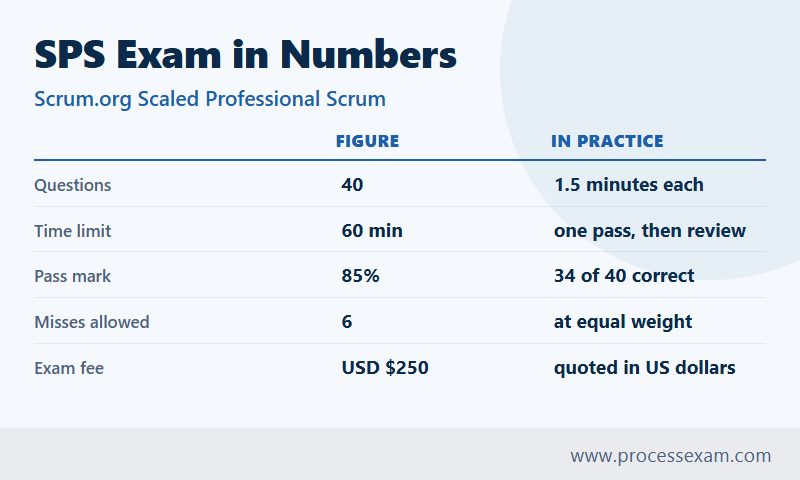
The SPS exam asks one question in many disguises: when several Scrum Teams build one product, what does Nexus add to Scrum, and why? You get 40 questions and 60 minutes, and you need 85% (34 correct answers) to pass. The questions come from the Nexus Guide and solid Scrum knowledge, so the fastest route is to learn the guide's few additions precisely rather than memorise scaling jargon.

What does the SPS test actually ask about the Nexus Framework?
The Scrum.org Scaled Professional Scrum (SPS) assessment checks whether you can explain how a group of Scrum Teams works from one Product Backlog to deliver one Integrated Increment. That is the whole territory. It is narrower than most people expect, because Nexus deliberately adds very little to Scrum. The guide describes itself as extending Scrum only where absolutely necessary to minimise and manage dependencies between multiple Scrum Teams.
In practice the questions fall into four families:
- Vocabulary and purpose. What is a Nexus, who owns the Product Backlog, what is the Integrated Increment, and what does each element exist to achieve.
- Accountabilities. Who belongs to the Nexus Integration Team, what it is responsible for, and what it is not.
- Events. How each Scrum event is extended, replaced or wrapped when many teams are involved, and who has to attend.
- Dependencies and scenarios. A short story about teams tripping over each other, and a question about which Nexus element is the right response.
Because the underlying material is one short document, the SPS test rewards precision. Two answers that look equally sensible in a real organisation are separated by a single word in the guide, such as who must do something and who merely may. The rest of this article follows the guide in the order the exam leans on it. If you sit the assessment without having read the Scrum Guide recently, refresh it first: the Nexus questions assume you can already answer the plain Scrum ones.
Which version is current?
The current edition is the Nexus Guide of January 2021, the third version of the guide, which Scrum.org publishes in its online Nexus Guide. It was checked against Scrum.org's own listing in September 2026 and no newer edition was found. This matters for study material: older books, slide decks and forum answers use pre-2021 wording (for example a Nexus Goal where the guide now says Nexus Sprint Goal), and the 2021 text drops much of the earlier prescriptive detail. Learn from the 2021 text and treat older wording with care.
What are the SPS exam facts, fee and pass mark in one place?
Scrum.org describes the assessment as intermediate in difficulty, made up of multiple-choice, multiple-answer and true/false questions. Taking the Scaled Professional Scrum course is recommended but not required, so you may attempt the assessment directly if you already work at scale. The figures below come from our exam records; confirm them on the Scrum.org assessment page before you pay.
| Exam detail | Scrum.org SPS |
|---|---|
| Full name | Scrum.org Certified Scaled Professional Scrum (SPS) |
| Exam code | SPS |
| Vendor | Scrum.org |
| Number of questions | 40 |
| Duration | 60 minutes |
| Passing score | 85% |
| Exam fee | USD $250 |
| Framework tested | Nexus, as written in the Nexus Guide (January 2021) |
What does 85% of 40 questions mean in practice?
Eighty-five percent of 40 questions is exactly 34, so you can afford six wrong answers and no more, assuming every question carries the same weight. That is stricter than it sounds, because multiple-answer questions usually need every correct option selected before they count. You cannot lean on partial knowledge. A candidate who is 90% sure of every answer will still miss around four questions on average, which leaves almost no margin for two or three genuine gaps.
The time limit is friendlier than the mark. Sixty minutes for 40 questions is a minute and a half each, and many Nexus questions are short. Most candidates who fail do so on knowledge, not on the clock.
Who is on the Nexus Integration Team, and why does the exam keep asking?
No topic produces more wrong answers than the Nexus Integration Team, because it is the one genuinely new accountability. Scrum has three (Developers, Product Owner, Scrum Master). Nexus adds a fourth grouping on top of them. The guide says this team is accountable for ensuring that a done Integrated Increment is produced at least once every Sprint.
Who belongs to it?
The team consists of three kinds of people:
- The Product Owner of the Nexus, who manages the single Product Backlog and is accountable for maximising the value of the work the teams integrate.
- A Scrum Master, accountable for making sure the Nexus framework is understood and enacted as the guide describes it. This person may also be the Scrum Master of one or more of the Scrum Teams.
- One or more Nexus Integration Team Members, often drawn from the Scrum Teams, who help teams adopt the tools and practices that make frequent integration possible.
The composition can change over time, because the members are the people with the skills and knowledge to resolve the issues the Nexus faces at that moment. An exam option that says the membership is permanent, or that it is a separate management layer, is wrong.
What is it responsible for, and what is it not?
The Nexus Integration Team provides a focal point for integration, including technical and non-technical constraints across teams. It coaches, consults and highlights cross-team dependencies. It does not assign work to the Scrum Teams, and it does not take over their self-management. The guide says it should use bottom-up intelligence from inside the Nexus to reach a resolution. When a scenario asks who fixes a recurring build conflict between two teams, the right answer involves the Nexus Integration Team helping the teams improve their practices, not directing them.
One rule catches many candidates: membership in the Nexus Integration Team takes precedence over membership of an individual Scrum Team. As long as the integration responsibility is satisfied, members can still work as members of their own teams. The preference exists so that problems affecting several teams get priority over problems affecting one.
How does each Scrum event change when many teams share one product?
Nexus does not replace the Scrum events. It adds to them, or in one case replaces a team-level event with a combined one. The guide says the duration of Nexus events follows the length of the corresponding events in the Scrum Guide, and that they are timeboxed in addition to their Scrum counterparts. It also accepts that at scale not everyone can attend everything, so Nexus events are attended by whichever members are needed to achieve the outcome.
| Scrum event | What Nexus does with it | Typical trap in a question |
|---|---|---|
| Product Backlog refinement | Adds Cross-Team Refinement, ongoing, to forecast which team takes which items and to expose dependencies | Suggesting refinement happens only once per Sprint, or only inside each team |
| Sprint Planning | Adds Nexus Sprint Planning, run by appropriate representatives and the Product Owner; each team still plans its own Sprint | Claiming that one plan replaces every team's Sprint Backlog |
| Daily Scrum | Adds a Nexus Daily Scrum to spot integration issues; team Daily Scrums then plan the day around them | Treating it as a status meeting for managers |
| Sprint Review | One Nexus Sprint Review of the Integrated Increment replaces the individual team reviews | Holding a separate review per team |
| Sprint Retrospective | A Nexus Sprint Retrospective for the whole Nexus, with team retrospectives feeding it | Forgetting that the Nexus retrospective concludes the Sprint |
What does Nexus Sprint Planning produce?
Expect at least one question on the outputs. The guide lists four: a Nexus Sprint Goal that aligns with the Product Goal, a Sprint Goal for each Scrum Team aligned with the Nexus Sprint Goal, a single Nexus Sprint Backlog that makes cross-team dependencies transparent, and a Sprint Backlog for each Scrum Team. The trap is remembering only one level. Nexus adds a layer of goals and backlog above the team ones. It does not delete the team ones.
What is different about the two Daily Scrums?
The Nexus Daily Scrum inspects the current state of the Integrated Increment and identifies integration issues and newly found cross-team dependencies. Each team's own Daily Scrum then complements it by planning the day, focused mainly on those integration issues. A common wrong option says the Nexus Daily Scrum replaces the team ones. It does not. The guide adds that the Nexus Daily Scrum is not the only moment a team may adjust its plan, and that cross-team conversation can happen throughout the day.
How do the Nexus artifacts and commitments fit together?
Nexus keeps Scrum's structure of an artifact with a commitment attached, and extends it. Learn the pairs as pairs, because exam options often mix them up:
- Product Backlog with the Product Goal. There is one Product Backlog for the whole Nexus. It must be understood at a level where dependencies can be detected and minimised. The Product Owner remains accountable for its content, availability and ordering.
- Nexus Sprint Backlog with the Nexus Sprint Goal. The Nexus Sprint Backlog is the composite of the Nexus Sprint Goal and the Product Backlog items from the teams' Sprint Backlogs, used to show dependencies and the flow of work. It is updated throughout the Sprint and needs enough detail for the Nexus Daily Scrum to inspect progress.
- Integrated Increment with the Definition of Done. The Integrated Increment is the current sum of all integrated work the Nexus has completed toward the Product Goal. It must meet the Definition of Done, and it is done only when integrated, valuable and usable.
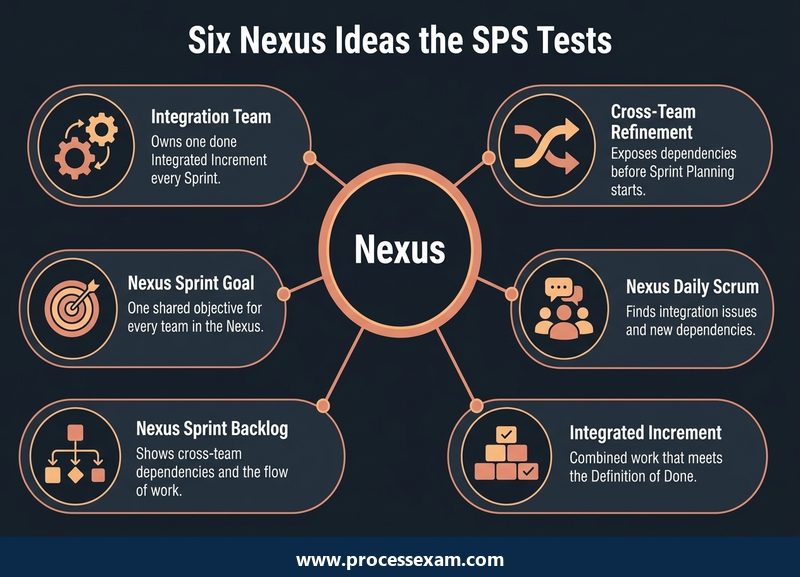
The Nexus Sprint Goal deserves a second look. The guide calls it a single objective for the Nexus and the sum of all the work and Sprint Goals of the teams. It exists to create coherence by encouraging teams to work together rather than on separate initiatives. If a scenario describes four teams each shipping a nice feature that nobody can combine, the missing element is a shared Nexus Sprint Goal and an integrated Increment.
Can the Integrated Increment be released before the Sprint ends?
Yes. The guide states that the Integrated Increment is inspected at the Nexus Sprint Review but may be delivered to stakeholders before the end of the Sprint. Candidates who assume the Sprint Review is the only release gate get this wrong. The requirement is that the increment meets the Definition of Done and is integrated across all teams, not that it waits for a meeting.
Which dependency problems does Nexus want teams to attack first?
The guide is explicit about where cross-team dependencies come from. It names two mismatches: the product structure (how independently the different concerns are separated in the product) and the communication structure (how people talk within and between teams, and how long feedback takes). Nexus provides opportunities to change the process, the product structure and the communication structure to reduce or remove those dependencies.
That gives you a reliable way to reason through scenario questions. If two teams keep editing the same component and blocking each other, ask whether the cause is product structure. If a decision sits for days waiting for a person in another team, ask whether it is communication structure. The best answer usually improves the underlying structure or makes the dependency visible in Cross-Team Refinement, rather than adding a coordination meeting on top.
Is more people ever the answer?
The guide says scaling the value delivered does not always require adding more people, and that reducing the number of people working on something can be an important practice. This is a favourite for tricky options. An answer that proposes adding a team to speed up a stalled product runs against the guide's reasoning about complexity, dependencies and the number of communication pathways.
How many teams is a Nexus?
The guide describes a Nexus as approximately three to nine Scrum Teams working on a single product with one Product Owner and one Product Backlog. The word "approximately" matters. Do not pick an option that treats three or nine as a hard limit enforced by the framework.
Which misreadings of the Nexus Guide cost the most marks?
These come up again and again in practice sets and in candidates' reports of what tripped them.
- Assuming Nexus changes Scrum's rules. The guide is emphatic that scaled Scrum is still Scrum and that Nexus does not leave out elements or negate the rules of Scrum. Any option that removes a Scrum accountability or event is wrong.
- Giving the Nexus Integration Team authority it does not have. It coaches, consults and highlights. It does not command teams.
- Mixing team-level and Nexus-level artifacts. Each team keeps its Sprint Backlog and Sprint Goal. The Nexus adds its own beside them.
- Believing the Nexus needs several Product Owners. There is a single Product Owner and a single Product Backlog.
- Reading a scenario as a tooling question. When the guide talks about integration it means both technical and non-technical constraints.
- Trusting old wording. Pre-2021 study notes can name elements differently. If a term looks unfamiliar, check the current guide before you memorise it.
Read each question for the word that decides it: replaces, adds, must, may, single, each. The guide is written carefully, and the exam follows its wording.
What study plan gets you to 85% in two to three weeks?
The guide is short, so the plan is less about volume and more about repetition and application. If you already run Scrum daily, two weeks is enough. If you are new to scaling, take three. The SPS topic outline lists the areas to tick off as you go.
| Days | Focus | Output |
|---|---|---|
| 1-2 | Re-read the Scrum Guide, then the whole Nexus Guide once, start to finish | A one-page sheet of new terms and who owns each |
| 3-5 | Accountabilities and the Nexus Integration Team | Your own answers to who belongs, what it does and what it must not do |
| 6-8 | Events: refinement, planning, Daily Scrum, review, retrospective | A table of Scrum event against Nexus counterpart, written from memory |
| 9-10 | Artifacts, commitments and the Integrated Increment | Three artifact-and-commitment pairs you can recite |
| 11-12 | Dependencies, product structure and communication structure | Two real dependencies from your work, classified |
| 13-14 | Timed sets and review | Two full 40-question runs in 60 minutes, every miss explained |
Scrum.org offers a free Nexus Open assessment that suits days 3 and 13: repeat it until you score close to full marks consistently and can explain each answer. Then move to harder mixed questions. A SPS practice exam is useful once the theory is in place, because it shows which of the four question families you still lose marks on, and a mock exam under a strict 60-minute timer builds the pace you need on the day. Do not measure yourself by a single run. Two consecutive timed scores above 90% on unseen questions is a sensible readiness signal, since the real pass mark leaves so little room.
How should you work through each practice set?
After every set, write down not just the questions you missed but the ones you guessed right. Group them by family (vocabulary, accountabilities, events, scenarios). If more than half your errors sit in one family, spend the next day on that section of the guide rather than doing more questions. Where possible, link each error to a sentence in the guide, so that the correction is a memory of text, not of an answer key.
How should you handle the 60 minutes and any retake?
Take one quick pass through all 40 questions, answering what you are sure about and flagging the rest. Most of the time you will spend belongs to the multiple-answer questions and the scenario stories. Budget roughly 30 minutes for the first pass, 20 for the flagged questions, and keep 10 to check that every multiple-answer question has all the options you intend selected.
When a scenario has two plausible answers, look for the one that keeps Scrum intact, keeps the single Product Backlog and Product Owner, and improves transparency or removes a dependency at its source. That test settles a surprising number of questions.
What happens if you do not pass?
Scrum.org has a retake arrangement for people who complete its Scaled Professional Scrum course: class participants who attempt the assessment within 14 days of receiving their free password and score below 85% are offered a second attempt at no additional cost. Outside that arrangement each attempt is paid, so treat the first sitting as the real one. Check the current terms on the Scrum.org assessment page before you book.
After the exam, keep using the guide. The SPS with Nexus certification confirms you can explain how several teams deliver one integrated product, and that explanation gets stronger every time you apply the Nexus events and artifacts to a real product with real dependencies.
Frequently Asked Questions
How many questions are on the SPS test?
The SPS test has 40 questions and a 60-minute time limit, which gives you about a minute and a half per question. Scrum.org describes the format as multiple choice, multiple answer and true/false, so read each stem carefully to see whether one option or several are required.
What score do you need to pass the SPS exam?
The passing score is 85%. On a 40-question paper that means 34 correct answers, so you can miss at most six if every question carries equal weight. Multiple-answer questions usually need every right option chosen, which makes precise knowledge of the Nexus Guide more valuable than broad familiarity.
What does SPS with Nexus mean?
SPS is Scaled Professional Scrum, the Scrum.org credential for scaling Scrum. Nexus is the framework it tests: a group of about three to nine Scrum Teams working from one Product Backlog to produce one Integrated Increment. The exam is based on the Nexus Guide plus your knowledge of Scrum itself.
How much does the SPS exam cost?
The SPS assessment fee is USD $250 in our exam records. Scrum.org gives participants of its Scaled Professional Scrum course a free password for the assessment, so course takers may not pay separately. Check the Scrum.org assessment page for the current fee and terms before you book your attempt.
Is a practice test worth using for SPS?
Yes, once you have read the Nexus Guide. Timed practice shows which question families cost you marks, trains your pace across 40 questions in 60 minutes, and exposes vague understanding of terms such as Integrated Increment. Review every wrong or guessed answer against the guide instead of memorising answers.
- Scrum |
- Scrum.org Scaled Professional Scrum Test Questions |
- SPS Question Bank |
- SPS with Nexus Simulator |
- SPS with Nexus Mock Exam |
- Scrum.org Scaled Professional Scrum Book |
- Scaled Professional Scrum Certification Cost |
- Scaled Professional Scrum Certification Requirements |
- Scrum.org SPS with Nexus Question Bank |
- Scrum.org SPS with Nexus Book |
- Scrum.org SPS with Nexus Study Guide |
- SPS with Nexus Certification |
- SPS with Nexus Certification Cost |
- SPS with Nexus Certification Requirements |
- Scrum.org Scaled Professional Scrum Sample Questions |
- SPS Exam Questions Download |
- SPS Test Questions |
- Scaled Professional Scrum PDF |
- Scrum.org SPS with Nexus Exam Questions |
- Scrum.org SPS with Nexus Sample Questions |
- SPS with Nexus |
- SPS with Nexus PDF


