
Six Sigma Black Belt or CQE - Which Quality Engineering Certification to Choose?
Take the ASQ Certified Six Sigma Black Belt if your working life is improvement projects: you lead a DMAIC team, you are judged on the result the project delivers, and you can produce signed affidavits for finished projects. Take the ASQ Certified Quality Engineer if you own the quality system itself, from design controls and inspection to sampling, statistics, audits and compliance, and you have the years of quality engineering work behind you. The rest of this article is the detail behind those two sentences.

Both credentials come from ASQ. Both exams are open book, both are scored out of 750, and both lapse unless you earn recertification units. After that the similarity runs out. The Black Belt exam is built around a method; the Quality Engineer exam is built around a discipline. Choosing between them is a question about the job you want to be doing in three years, not about which paper is harder to sit.
It is easy to see why the two end up in one search box. People look for a quality engineering certification and a Six Sigma Black Belt certification together because the two share a great deal of statistics and almost none of their purpose. What follows compares them on the things that genuinely differ: the body of knowledge, the eligibility bar, the roles each one fits, and what a hiring manager reads into the letters.
How do the CSSBB and CQE exams compare on cost, length and format?
Start with the part that can be measured. The figures below are the ones we hold for both ASQ exams.
| Exam detail | CSSBB | CQE |
|---|---|---|
| Certification | ASQ Certified Six Sigma Black Belt (CSSBB) | ASQ Certified Quality Engineer (CQE) |
| Vendor | ASQ | ASQ |
| Category | Six Sigma | Engineering |
| Number of questions | 165 | 175 |
| Duration (minutes) | Total appointment time - 270 Exam time - 258 |
Total appointment time - 330 Exam time - 318 |
| Exam fee (USD) | ASQ MEMBERS - $485 NON-MEMBERS - $585 RETAKES - $385 |
ASQ MEMBERS - $450 NON-MEMBERS - $550 RETAKES - $350 |
| Passing score | 550/750 | 550/750 |
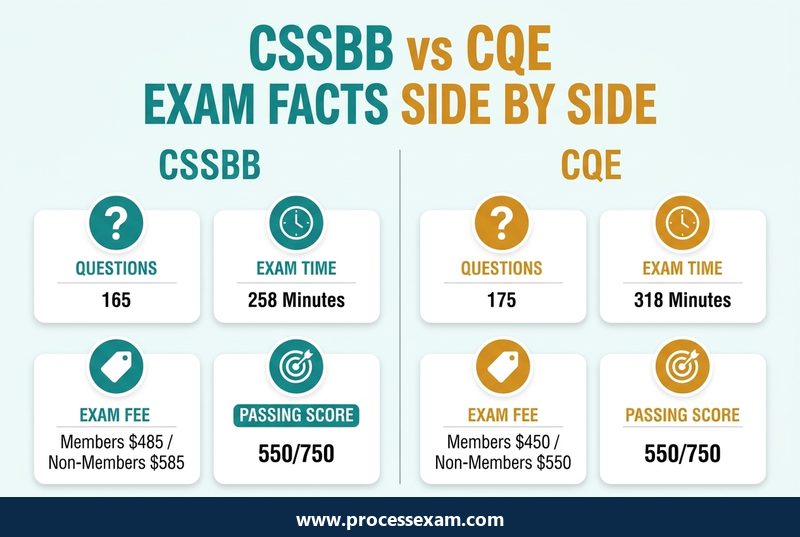
The money is close enough that it should not decide anything. A non-member pays $585 for the Black Belt exam and $550 for the Quality Engineer exam, a difference of $35. ASQ members save $100 on the initial exam fee for either one, which is why most candidates join before they apply rather than after. If a first attempt does not go your way, the retake rate is $385 for CSSBB and $350 for CQE.
The clock is a bigger difference than the price. The CQE sitting is the longer of the two by a full hour: exam time of 318 minutes against 258, inside a total appointment time of 330 minutes against 270. Ten extra questions do not explain that gap. The CQE paper carries more calculation-heavy items, and ASQ allows for the time they take.
Both exams are scored on the same scale, and 550 out of 750 is the bar for each. That number is a scaled score, not a percentage of questions answered correctly, so counting raw right answers on a practice run is the wrong way to judge readiness. ASQ also seeds unscored questions into both papers: of the 165 CSSBB questions, 150 are scored, and of the 175 CQE questions, 160 are scored. You cannot tell which is which, so every question deserves the same attention.
Two format details often surprise candidates. First, ASQ states that all of its examinations are open book and that each participant brings their own reference materials, which makes building and tabbing a reference library part of preparation rather than an optional extra. Second, language support differs: ASQ offers the computer-delivered CSSBB exam in English only, while the computer-delivered CQE exam is offered in English with bilingual English/German, English/Spanish and English/Mandarin forms available. If English is your second language, that alone may tilt the decision. Confirm the current details on ASQ's Six Sigma Black Belt certification page and ASQ's Quality Engineer certification page before you apply, because fees and testing windows change.
What is actually inside each body of knowledge?
This is where the two credentials stop looking like near neighbours. ASQ publishes a body of knowledge for each exam with the number of questions attached to every top-level area, so you can see exactly where the weight sits.
The Black Belt body of knowledge is organised around DMAIC
The CSSBB body of knowledge divides its 150 scored questions into nine areas:
- Organization-wide Planning and Deployment - 12 questions
- Organizational Process Management and Measures - 12 questions
- Team Management - 15 questions
- Define - 20 questions
- Measure - 25 questions
- Analyze - 22 questions
- Improve - 21 questions
- Control - 17 questions
- Design for Six Sigma (DFSS) Framework and Methodologies - 6 questions
Read that list as a project running from start to finish. The first three areas are about getting a programme off the ground: why an organisation deploys Six Sigma, how process performance is measured across the business, and how you build, launch and unstick a team. The five DMAIC areas then carry 105 of the 150 scored questions between them. Define covers voice of the customer, the business case and project charter, and project management tools such as Gantt charts, toll-gate reviews and the RACI model. Measure covers process flow metrics, data collection and measurement systems analysis. Analyze is regression, correlation, hypothesis testing and the errors people make with significance. Improve is design of experiments and lean methods such as waste elimination, cycle-time reduction and kaizen. Control is statistical process control, control chart selection and the control plan that keeps a gain from leaking away.
Notice what that list includes that a purely technical syllabus would not: team management, deployment, stakeholders and charters. Roughly a quarter of the exam is about leading the work rather than doing the mathematics.
The Quality Engineer body of knowledge is organised around the quality system
The CQE body of knowledge divides its 160 scored questions into seven areas:
- Management and Leadership - 17 questions
- The Quality System - 18 questions
- Product, Process, and Service Design - 21 questions
- Product and Process Control - 23 questions
- Continuous Improvement - 26 questions
- Quantitative Methods and Tools - 34 questions
- Risk Management - 21 questions
This list is not a project; it is the life of a product. Design comes first, with classification of quality characteristics, design validation such as installation, operational and process qualification, failure mode and effects analysis, and reliability and maintainability. Control follows, with control plans, critical control points, work instructions, sampling against the ANSI/ASQ Z1.4 and Z1.9 standards, sample integrity, and measurement and test equipment down to gage blocks, calipers and micrometers. Continuous Improvement is where Six Sigma itself appears, sitting alongside total quality management, kaizen, plan-do-check-act and lean tools such as 5S, value stream mapping and kanban.
The single heaviest area, Quantitative Methods and Tools, carries 34 questions on its own: data types, statistical inference, process capability indices, natural process limits against specification limits, defects per million opportunities, and designed experiments. Risk Management is a full area worth 21 questions, which has no separate counterpart on the Black Belt paper.
Where the two overlap, and where they do not
The shared ground is real. Statistics, process capability, control charts, design of experiments, lean tools and root cause analysis appear on both exams, and a strong Black Belt will recognise a good deal of the CQE quantitative area. That overlap is why so many people assume one credential replaces the other.
The unshared ground is what decides the choice. The Black Belt exam alone tests voice of the customer, project charters, toll-gate reviews, team dynamics, organisation-wide deployment and Design for Six Sigma. The Quality Engineer exam alone tests quality system elements and audits, design and reliability engineering, metrology and measurement systems, acceptance sampling standards, and a full area of risk management. One exam asks whether you can run a structured improvement project; the other asks whether you can engineer quality into a product and keep it there.
Which certification is harder to qualify for?
Difficulty on the day is subjective. The eligibility bar is not, and it is the part that stops most people. ASQ sets very different entry conditions for these two credentials.
What ASQ asks of a Black Belt candidate
For the CSSBB, ASQ requires three years of on-the-job experience in one or more areas of the CSSBB body of knowledge, plus one completed project with a signed affidavit, or two completed projects with signed affidavits instead. The work must have been done in a full-time, paid role. There is no education waiver on this exam: a degree does not shorten the three years, and it does not stand in for the projects.
The affidavit is the part candidates underestimate. It is a form that describes the project you ran and is signed by someone who can vouch for it, typically a champion, sponsor or manager. If your improvement work has been informal, undocumented, or shared so widely that nobody would call it yours, gathering that signature can take longer than studying for the exam. People who have moved employers since the project are often the worst affected, and it is worth starting the paperwork before you start the revision.
What ASQ asks of a Quality Engineer candidate
For the CQE, ASQ requires eight years of on-the-job experience in one or more areas of the CQE body of knowledge, of which three years must have been in a decision-making position, again in full-time, paid work. ASQ defines a decision-making position as having the authority to define, execute or control projects or processes and to be responsible for the outcome, which may or may not mean a management or supervisory title.
Unlike the Black Belt, the CQE recognises formal education. A diploma from a technical or trade school waives one year, an associate degree two years, a bachelor's degree four years, and a master's or doctorate five years. Only one waiver may be claimed. ASQ also counts experience already used to qualify for certification as a quality auditor, reliability engineer, supplier quality professional, software quality engineer or quality manager towards the quality engineer requirement.
What that means in practice
Run the arithmetic against your own history and the answer often appears by itself. A process engineer with a bachelor's degree and five years in the job needs four years for the CQE after the degree waiver, and must show that three of them involved real decision-making authority. The same person clears the CSSBB experience bar with two years to spare but has to produce completed projects with signatures.
So the two gates test different things. The Black Belt gate is evidence that you have delivered. The Quality Engineer gate is evidence that you have served the time in the discipline. Neither is easier in general; one of them is usually far easier for you. Whichever you choose, ASQ handles both through the same route, and you can apply for ASQ certification and check the testing windows on its certification pages, where the application deadline sits several weeks ahead of the window itself.
Which roles does each credential actually fit?
Job titles vary from company to company, but the shape of the work is consistent.
Where a Black Belt spends the week
A Black Belt works horizontally. The week is spent inside a chartered project: pulling data from a process that crosses three departments, sitting with the people who run it, testing whether the change made a measurable difference, and keeping a steering group informed. Black Belts commonly coach Green Belts, run tollgate reviews, and are held to a financial or operational benefit agreed at the charter stage. The credential fits continuous improvement leads, operational excellence managers, process improvement specialists, transformation consultants and production managers who are expected to remove waste and variation from someone else's process.
The clue is in the body of knowledge: if nobody expects you to hold a team together, present a business case or defend a savings number, the Black Belt is teaching you a skill you will not be asked to use.
Where a Quality Engineer spends the week
A Quality Engineer works vertically, through the product. The week might include reviewing a control plan before a new line starts, running a measurement systems study, approving a supplier's capability data, deciding whether a lot passes against a sampling plan, investigating a customer complaint back to its root cause, and preparing evidence for an audit. The credential fits quality engineers, quality assurance engineers, supplier quality engineers, design quality engineers, inspection and metrology leads, and anyone working to a formal quality management system in regulated manufacturing.
Here too the body of knowledge gives it away. Sampling standards, calibration, design validation and audit evidence are daily tools for a quality engineer and once-a-year curiosities for a project leader.
What do employers read into CSSBB and CQE?
Both credentials are awarded by ASQ and both are accredited by the ANSI National Accreditation Board under ISO 17024, so neither has to be explained or defended to a hiring manager who knows the field. What differs is the signal each one sends.
The Black Belt says you have finished improvement projects, because ASQ would not have let you sit the exam otherwise. That is exactly what an employer building a continuous improvement function wants to see, and it is why job adverts for operational excellence and process improvement roles so often name Black Belt certification as a requirement rather than a nice-to-have.
The Quality Engineer says you have depth. Eight years in the discipline, or four after a bachelor's degree with decision-making authority, plus a 160-question scored exam that reaches from design validation to acceptance sampling to risk. In medical devices, automotive, aerospace, pharmaceuticals and defence, where the quality system is audited by an outside body, "CQE preferred" is a common line in a job specification because it is a shortcut for the whole discipline.
There is a geographic wrinkle worth knowing. Six Sigma belts are recognised almost everywhere, partly because so many organisations run their own belt programmes. The CQE is less widely advertised outside the industries that depend on it, which sometimes leads candidates to undervalue it. Inside those industries the reverse is true: a hiring manager for a supplier quality role will recognise CQE immediately and may treat a belt from an unaccredited provider with more caution than an ASQ credential of either kind.
So, CSSBB or CQE - which should you choose?
Work through the two lists below. In most cases one of them will describe your work and the other will describe a job you are not applying for.
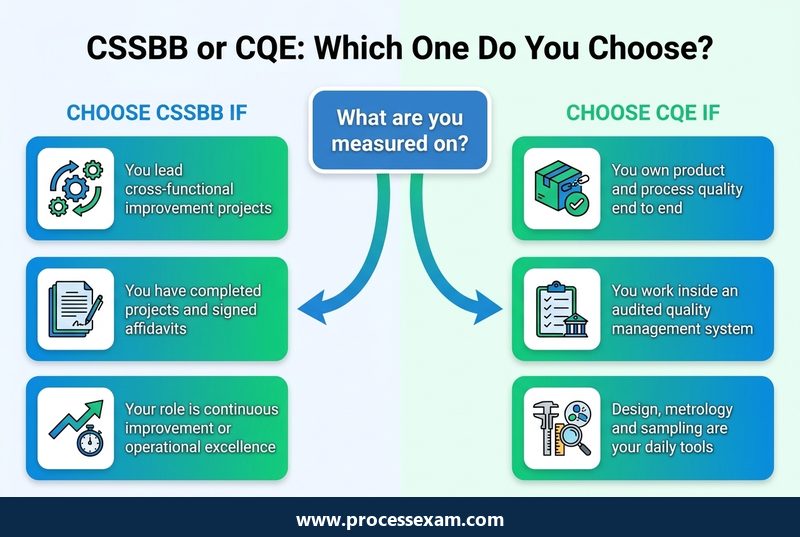
Choose the Six Sigma Black Belt if
- You lead or want to lead cross-functional improvement projects rather than own a product line.
- You already have completed projects and can get an affidavit signed for at least one of them.
- Your employer runs a belt programme, or your target roles are titled continuous improvement, operational excellence or process improvement.
- You are comfortable being measured on a savings or performance number agreed at the start of a project.
- Coaching other people through DMAIC appeals to you more than owning the inspection and control plan.
Choose the Quality Engineer if
- Your work sits inside a formal quality management system that is audited by an outside body.
- You are responsible for whether product conforms, not only for whether a project delivered.
- Design validation, reliability, metrology, acceptance sampling and process capability are part of your normal week.
- You have the years ASQ asks for, after any education waiver, with three of them in a decision-making role.
- You want one credential that covers the discipline end to end rather than one methodology in depth.
If both lists describe you
Some people genuinely straddle the two, usually quality engineers who have been handed improvement projects. If that is you, let the eligibility bar break the tie: sit whichever exam you already qualify for, and put the other on next year's plan. And before you commit to gathering affidavits, it is worth finding out how far your current knowledge actually carries you, so run a timed CSSBB practice exam and see which of the nine body-of-knowledge areas comes back weakest.
Can you hold both, and which should come first?
You can, and plenty of quality professionals do. The two credentials are complementary rather than competing: the Black Belt gives you the method for driving change, and the Quality Engineer gives you the engineering depth to know what should be changed and how to prove it stayed fixed. Together they cover both halves of a quality role that is expected to improve and to assure.
Order matters less than eligibility, but two rules of thumb help. If you work in a regulated manufacturer and your career runs through quality assurance, take the CQE first; it is the credential your job specifications will keep naming, and much of its quantitative area carries straight into Black Belt study afterwards. If you work in operations, services or a business that has just launched a Six Sigma programme, take the Black Belt first, while the projects that qualify you are fresh and the sponsors who would sign an affidavit still remember them.
One detail to plan around: ASQ's experience credit for the CQE applies to candidates already certified as a quality auditor, reliability engineer, supplier quality professional, software quality engineer or quality manager. A Black Belt is not on that list, so holding the CSSBB does not shorten the CQE experience requirement. If you are working towards both, the deciding factor is which exam you can sit now, not which one unlocks the other. If the Quality Engineer route is the one that fits, a timed CQE practice test is a quick way to see how much of that body of knowledge you already carry from day-to-day work.
How do you keep either credential once you have passed?
Neither certification is permanent, and this is a real cost that candidates rarely factor in. Both the CSSBB and the CQE run on a three-year recertification cycle, and ASQ asks for 18 recertification units within that period, or a retake of the exam instead. Recertification units come from the work you are already doing and the learning around it, so most people accumulate them without difficulty, provided they record them as they go rather than hunting for evidence in the final month.
The deadlines are firm. ASQ gives a 60-day grace period from your recertification date in which you can still recertify by journal. After that grace period ends, recertification is by exam. If you do not recertify by exam within one year of your recertification date, the certification expires. The current rules, unit categories and forms are set out on ASQ's recertification pages.
It is worth comparing this with the rest of the ASQ catalogue when you plan. Several ASQ certifications, including the Six Sigma Green Belt and Yellow Belt, are lifetime credentials with no recertification requirement at all. Both of the credentials in this comparison sit on the other side of that line, so whichever you choose, budget for keeping it as well as earning it.
Decide on the work, not on the letters. The exam you should sit is the one whose body of knowledge matches the problems on your desk, and whose eligibility rules you can satisfy this year rather than in four years' time.
Frequently Asked Questions
Is the CSSBB harder than the CQE?
Neither is harder in general. The CQE exam is longer, with 175 questions and an exam time of 318 minutes against 165 questions and 258 minutes for the CSSBB, and it covers a wider discipline. The CSSBB asks for completed projects with signed affidavits, which many candidates find the tougher hurdle.
Which exam costs more, the CSSBB or the CQE?
The Six Sigma Black Belt exam costs slightly more. ASQ lists the CSSBB at MEMBERS - $485, NON-MEMBERS - $585, RETAKES - $385, and the CQE at MEMBERS - $450, NON-MEMBERS - $550, RETAKES - $350. Membership saves $100 on the initial exam fee for either certification.
Do you need a Six Sigma Black Belt before taking the CQE?
No. The two credentials are independent, and ASQ does not require one before the other. Holding the CSSBB also does not shorten the CQE experience requirement, because the Black Belt is not among the ASQ certifications whose qualifying experience transfers to the quality engineer route.
Can you sit the CQE without eight years of experience?
Yes, if you hold a qualifying qualification. ASQ waives part of the eight years for education: one year for a technical or trade school diploma, two for an associate degree, four for a bachelor's degree and five for a master's or doctorate. Only one waiver may be claimed.
Which certification suits a regulated manufacturing job better?
The Certified Quality Engineer usually fits better. Its body of knowledge covers quality system elements, design validation, reliability, metrology and acceptance sampling to the ANSI/ASQ Z1.4 and Z1.9 standards, which are the daily tools in medical device, automotive, aerospace and pharmaceutical quality roles.
Do both the CSSBB and the CQE expire?
Yes. Both run on a three-year recertification cycle and require 18 recertification units in that period, or a retake of the exam. A 60-day grace period allows recertification by journal; after it, recertification is by exam, and the credential expires one year past the recertification date.
- Six Sigma |
- ASQ Six Sigma Black Belt Sample Questions |
- ASQ Six Sigma Black Belt Test Questions |
- CSSBB Question Bank |
- CSSBB Exam Questions Download |
- CSSBB Test Questions |
- Six Sigma Black Belt PDF |
- ASQ Quality Engineer Sample Questions |
- CQE Exam Questions Download |
- CQE Test Questions |
- Quality Engineer PDF |
- ASQ Six Sigma Black Belt Book |
- ASQ CSSBB BOK PDF |
- Six Sigma Black Belt Certification Cost |
- Six Sigma Black Belt Certification Requirements |
- ASQ Quality Engineer Book |
- ASQ CQE BOK PDF |
- Quality Engineer Certification Cost |
- Quality Engineer Certification Requirements |
- ASQ Quality Engineer Test Questions |
- CQE Question Bank |
- CQE Body of Knowledge (BOK) |
- CSSBB Body of Knowledge (BOK) |
- Engineering |
- CSSBB Handbook |
- CQE Handbook


